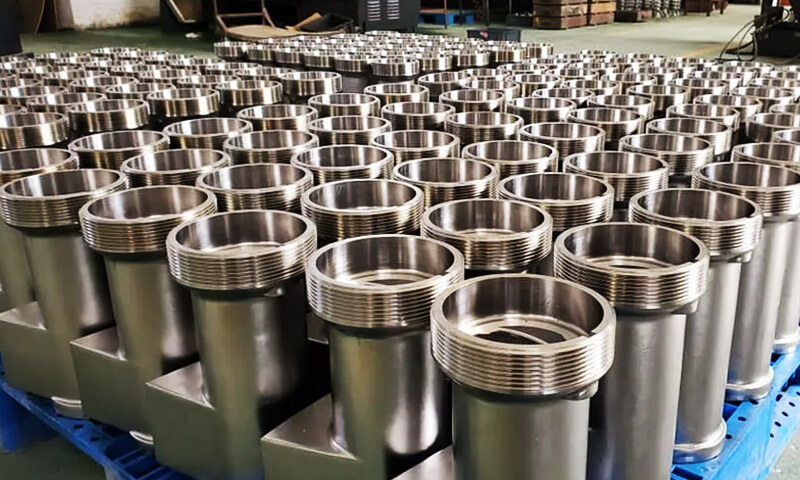

After 30-plus years on the machining floor — writing process sheets, adjusting setups at 2 a.m., and explaining to a young engineer why his carefully planned route produced a warped part — I can tell you this: machining process planning is not paperwork.
It is the systematic battle plan that decides whether a part comes in on tolerance, ตามงบประมาณ, and on time.
I have seen too many new process engineers walk into the office, pick a machine, jot down a few operations, and call it a process plan.
Six weeks later, they are wondering why first-piece rejection is 40%, why cycle time is double the estimate, and why the shop foreman hates them. เหตุผลง่ายๆ: they skipped the underlying logic.
At DEZE Tech, we have built precision machining programs for hundreds of customers across automotive, motorcycle, and industrial structural components.
This guide lays out the seven core design principles behind a solid machining process specification — from process unit definitions to tolerance chain calculation.
1. Understand the Basic Units of the Machining Process
Before developing a process route, it is important to distinguish the basic units of a machining process: การดำเนินการ, การตั้งค่า, ตำแหน่ง, ขั้นตอน, and pass. These terms are closely related, but they are not interchangeable.
หนึ่ง การดำเนินการ is generally defined by a continuous portion of the manufacturing process performed with the workpiece, worker, and workplace remaining essentially unchanged.
It is an important unit for production planning, process documentation, and cost calculation.
Within an operation, one or more setups อาจจำเป็น. A setup refers to the workpiece being clamped and positioned in a particular manner.
If the workpiece is repositioned or reclamped, a new setup is normally created.
Each additional setup introduces another opportunity for positioning error, so minimizing unnecessary setups is an important practical objective.
ก work position refers to different locations at which the workpiece is machined when the fixture or machine arrangement allows multiple positions without completely changing the setup.
ก machining step is a specific portion of an operation in which the machining surface, เครื่องมือตัด, and principal cutting conditions remain essentially unchanged.
When a large allowance must be removed in several cuts, each individual cutting pass is a pass.
This distinction matters because process planning is essentially the organization of these units into a controlled sequence.
A well-structured process route makes production instructions clearer, reduces unnecessary handling, and provides a better basis for calculating machining time and manufacturing cost.
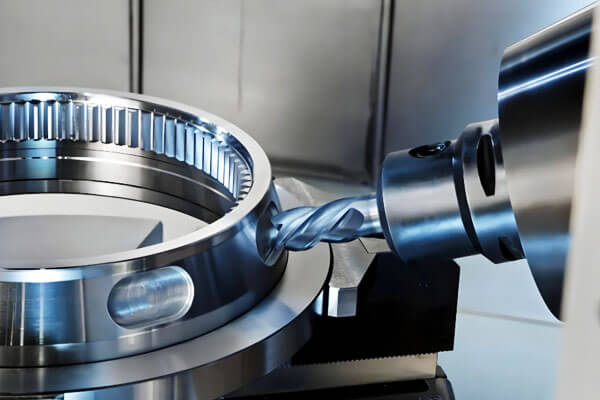
2. Match the Process Plan to the Production Volume
There is no universally optimal machining process. The right process depends heavily on production type and expected volume.
สำหรับ prototype, single-piece, และการผลิตปริมาณต่ำ, flexibility normally has greater value than maximum automation.
General-purpose CNC machines, standard cutting tools, adjustable fixtures, and flexible workholding are often more economical than expensive dedicated tooling.
The process may rely more heavily on probing, manual setup verification, and first-piece inspection.
สำหรับ medium-volume batch production, the balance changes.
CNC machining becomes increasingly attractive, while dedicated fixtures, modular tooling, preset tools, and standardized workholding can significantly reduce setup time. The objective is to achieve repeatability without sacrificing too much flexibility.
สำหรับ การผลิตปริมาณมาก, cycle time and process stability become dominant considerations.
Dedicated fixtures, multi-station equipment, high-productivity tooling, automated loading, and standardized cutting conditions can justify their initial investment because the tooling cost is distributed across a large number of parts.
| Production type | Typical process strategy | Main priority |
| ต้นแบบ / ปริมาณต่ำ | Flexible CNC, standard tooling, adjustable fixtures | ความยืดหยุ่น |
| ปริมาณปานกลาง | ซีเอ็นซี + dedicated or modular fixtures | สมดุล |
| High volume | Dedicated tooling, ระบบอัตโนมัติ, optimized cycles | Productivity and repeatability |
One of the most common planning mistakes is selecting equipment or tooling based purely on technical capability.
A process capable of producing the required tolerance is not necessarily an economically suitable process.
Production volume must be considered before deciding how much specialization and automation the process deserves.
3. Select the Correct Datum: The Foundation of Process Accuracy
If there is one part of machining process planning that deserves particular attention, มันคือ การเลือกข้อมูล.
A component may contain dozens of dimensions and geometric tolerances, but all of them ultimately depend on a controlled and repeatable reference system.
If the machining datum is poorly chosen, positioning errors can accumulate from one operation to the next, making it difficult to achieve the required final accuracy.
In practical machining, the objective is to establish a มั่นคง, ทำซ้ำได้, and functionally appropriate locating system as early as possible.
The selected datum should provide sufficient locating area, resist movement during cutting, and maintain a reliable relationship with the critical features shown on the drawing.
Primary, Secondary, and Tertiary Location
A typical workholding system controls the six degrees of freedom of a workpiece through a primary, รอง, and tertiary locating scheme.
ที่ primary datum generally restricts three degrees of freedom, ที่ secondary datum restricts two, และ tertiary datum restricts the remaining one.
The actual fixture arrangement depends on the part geometry and machining requirements, but the principle remains the same: locate the workpiece accurately without unnecessarily over-constraining it.
A stable fixture should prevent movement while allowing the workpiece to be clamped without introducing excessive deformation.
Use Design Datums Whenever Practical
When the design datum and machining datum can be made coincident, dimensional transfer errors can be reduced significantly.
This is especially important for features whose position directly affects assembly or functional performance, such as precision holes, ที่นั่งแบริ่ง, พื้นผิวการปิดผนึก, และอินเทอร์เฟซการติดตั้ง.
Using the same reference established by the engineering drawing also makes the relationship between machining and inspection clearer.
Where datum coincidence is not practical, the process engineer should account for the resulting datum conversion through appropriate dimensional-chain analysis.
Minimize Unnecessary Datum Changes
Every time a workpiece is repositioned, another source of positioning error is introduced.
Fixture accuracy, locating-surface condition, แรงหนีบ, operator handling, and accumulated tolerance can all affect the final result.
This does not mean every operation must use exactly the same datum or setup. Complex components often require multiple orientations to access different surfaces.
The practical objective is to avoid unnecessary datum changes and maintain a controlled relationship between successive datums.
In my experience, a good datum strategy often prevents problems before the CNC machine ever starts cutting.
Once the reference system is stable, subsequent decisions about fixtures, ลำดับการตัดเฉือน, allowances, and inspection become much easier to control.
4. Develop the Machining Route: Roughing First, Finishing Last
A machining process route should be developed as a logical sequence of operations, not simply as a list of dimensions or features taken from the engineering drawing.
The order in which material is removed, reference surfaces are established, heat treatment is performed, and critical features are finished has a direct influence on dimensional accuracy, การเสียรูป, คุณภาพพื้นผิว, และประสิทธิภาพการผลิต.
For a typical precision component, a practical route may follow:
Blank preparation → Rough machining → Stress relief or heat treatment → Semi-finishing → Finishing → Secondary operations → Surface treatment → Final inspection
The actual sequence must be adapted to the material, รูปทรงเรขาคณิต, ค่าเผื่อการตัดเฉือน, heat-treatment requirements, tolerance level, และปริมาณการผลิต.
การกลึงหยาบ: Remove Material Efficiently
The primary purpose of rough machining is to remove excess material efficiently while establishing stable reference surfaces for subsequent operations.
High material-removal rates are normally prioritized at this stage, while final surface finish and tight dimensional tolerances are not yet the main objectives.
อย่างไรก็ตาม, roughing should not be excessively aggressive. Large cutting forces can deform thin walls, introduce vibration, or release residual stresses within cast, ปลอม, or welded blanks.
ด้วยเหตุนี้, machining parameters should be selected according to the workpiece stiffness and material condition rather than simply maximizing cutting speed and feed rate.
For castings and forgings in particular, rough machining is also an important opportunity to establish accurate datums and expose potential material or internal defects before expensive finishing operations are performed.
Semi-Finishing: Establish a Stable Allowance
Semi-finishing bridges the gap between roughing and final machining.
ในขั้นตอนนี้, the component is brought much closer to its final geometry while maintaining a controlled and relatively uniform machining allowance for finishing.
This is especially important for complex components, thin-walled structures, and parts requiring substantial material removal.
Uneven allowance can produce inconsistent cutting forces during finishing and may contribute to dimensional variation or local deformation.
A well-planned semi-finishing operation therefore does more than remove a small amount of material—it creates a stable condition for the final machining stage.
จบ: Control the Final Accuracy
Finishing operations are responsible for achieving the specified final dimensions, ความคลาดเคลื่อนทางเรขาคณิต, ความขรุขระ, and functional features.
Critical bores, ที่นั่งแบริ่ง, พื้นผิวการปิดผนึก, รูที่แม่นยำ, and mating surfaces are normally completed during this stage.
ณ จุดนี้, the process becomes much more sensitive to tool wear, แรงตัด, การสั่นสะเทือน, การขยายตัวทางความร้อน, machine-tool accuracy, and workholding stability.
Cutting parameters should therefore be controlled more carefully than during roughing, and finishing tools should be kept in a predictable condition.
From a process-planning perspective, the basic rule is straightforward: rough first, stabilize the workpiece, then finish the critical features.
A logical machining route reduces unnecessary rework and gives each operation a clear purpose, making the final process easier to control for both quality and cost.
5. Determine the Correct Machining Allowance
Machining allowance is another area where inexperienced process planning can create unnecessary problems.
If the allowance is too large, more material must be removed, increasing cutting time, การสึกหรอของเครื่องมือ, การใช้พลังงาน, and machining cost.
Large stock can also increase cutting forces and contribute to workpiece deformation, particularly with thin-wall aluminum parts, ส่วนประกอบสแตนเลส, and other materials with relatively high distortion sensitivity.
If the allowance is too small, the finishing operation may not completely remove casting scale, forging skin, decarburized layers, ข้อบกพร่องที่พื้นผิว, or dimensional errors from the previous process.
The result can be insufficient surface quality or an unacceptable final dimension.
A practical allowance therefore has to account for the capability of the previous process, the required final tolerance, workholding error, การเสียรูป, and the behavior of the material during machining.
Three common approaches are used in manufacturing:
| วิธี | การใช้งานทั่วไป | ลักษณะเฉพาะ |
| Reference-table method | Routine production | Fast and based on established manufacturing data |
| Calculation method | มั่นคง, การผลิตปริมาณมาก | More systematic and considers process variation |
| Experience-based method | Prototypes and low-volume work | Flexible but dependent on process-engineering experience |
ตัวอย่างเช่น, a forged aluminum component may require different machining allowances from a sand-cast component even when the final dimensions are identical.
The quality and dimensional stability of the incoming blank determine how much stock must safely remain for machining.
The right allowance is therefore not the maximum possible allowance. It is the smallest practical allowance that reliably accommodates the upstream process and still provides enough material for achieving the final specification.
6. Use Dimensional Chain Analysis to Control Accumulated Error
Dimensional chain analysis is one of the fundamental technical skills in machining process planning.
It becomes particularly important when a finished dimension depends on several sequential machining dimensions.
The first step is to identify the closing dimension and the dimensions that contribute to it.
Once the dimensional relationship is established, the process engineer can determine how individual tolerances affect the final requirement.
Two basic approaches are commonly used.
ที่ worst-case method considers the maximum and minimum possible dimensions of each contributing element.
It is straightforward and conservative, making it suitable when the number of dimensions is relatively small or when guaranteed interchangeability is essential.
ที่ statistical or probability-based method considers the actual distribution of process dimensions.
Because it is unlikely that every contributing dimension will simultaneously reach its extreme limit, this approach can sometimes provide a more realistic tolerance allocation, particularly in stable high-volume production.
The important point is that tolerances should not automatically be distributed equally. Manufacturing difficulty varies considerably between features.
A simple milled surface may be capable of holding a tighter tolerance economically than a deep internal bore, thin-wall feature, or complex positional relationship.
Good tolerance allocation therefore considers both functional requirements and manufacturing capability.
The goal is to protect the critical dimensions while avoiding unnecessarily restrictive tolerances on features that do not require them.
7. Convert Process Dimensions and Check Economic Feasibility
A process plan is not complete simply because the operation sequence and tolerances have been calculated.
The final step is to verify that the specified process dimensions can actually be manufactured economically.
When the design datum and machining datum are different, process dimensions may need to be converted through dimensional-chain calculations.
Machining allowances must also be incorporated into intermediate dimensions so that each operation leaves the correct amount of stock for the following operation.
This is particularly important for multi-operation CNC machining.
If the intermediate dimension is incorrectly established, a theoretically correct final dimension may become impossible to achieve because too much or too little material remains for the finishing operation.
Economic evaluation should then be performed alongside technical verification.
Manufacturing cost generally includes variable costs such as material consumption, เวลาเครื่อง, เครื่องมือตัด, และแรงงาน, as well as fixed or semi-fixed costs associated with fixtures, เครื่องมือ, การเขียนโปรแกรม, และอุปกรณ์.
A dedicated fixture may reduce cycle time significantly, but if only a few dozen parts are required, its development cost may not be justified.
ในทางกลับกัน, for tens of thousands of parts, a relatively expensive fixture can quickly pay for itself through reduced setup time and improved repeatability.
This is where experienced process planning makes a difference: the technically most sophisticated process is not automatically the best process.
A good process is one that consistently achieves the required quality while using appropriate equipment, เครื่องมือ, เวลา, และค่าใช้จ่าย.
How DEZE Tech Approaches Machining Process Planning
ที่ เทคโนโลยีนี้, machining process planning is considered together with the part drawing, สภาพวัสดุ, blank manufacturing method, CNC equipment, เครื่องมือ, ข้อกำหนดการตรวจสอบ, และปริมาณการผลิต.
สำหรับส่วนประกอบที่มีความแม่นยำ, the process should be established before production rather than corrected after machining problems appear.
This means evaluating the critical datums, identifying high-risk dimensions, determining appropriate machining allowances, and selecting the most suitable sequence of roughing and finishing operations.
Where a component requires both forging or การคัดเลือกนักแสดง และ เครื่องจักรกลซีเอ็นซี, this integrated approach becomes even more important.
The condition of the incoming blank directly affects machining allowance, การทำงาน, การเลือกข้อมูล, อายุการใช้งานเครื่องมือ, and final dimensional stability.
The practical objective is simple: make each operation support the next one.
When the process is designed correctly from the beginning, machining becomes more predictable, inspection becomes easier, and the finished part is more consistent from the first piece to the production batch.
บทสรุป
After decades on the floor, the lesson is simple: a machining process specification is not a form to fill out.
It is a system-level plan that coordinates people, เครื่องจักร, เครื่องมือ, datums, allowances, and cost toward one goal — a part that meets drawing quality at the lowest sustainable cost.
Master the seven principles: know your process units, match production type, choose datums carefully, phase the route, set sensible allowances, calculate tolerance chains correctly, and always run the economic check.
Do that, and your process sheet will work on the shop floor, not just on paper.
At DEZE Tech, we bring this experience to every customer program — turning drawings into stable, ทำซ้ำได้, cost-effective machining processes.