
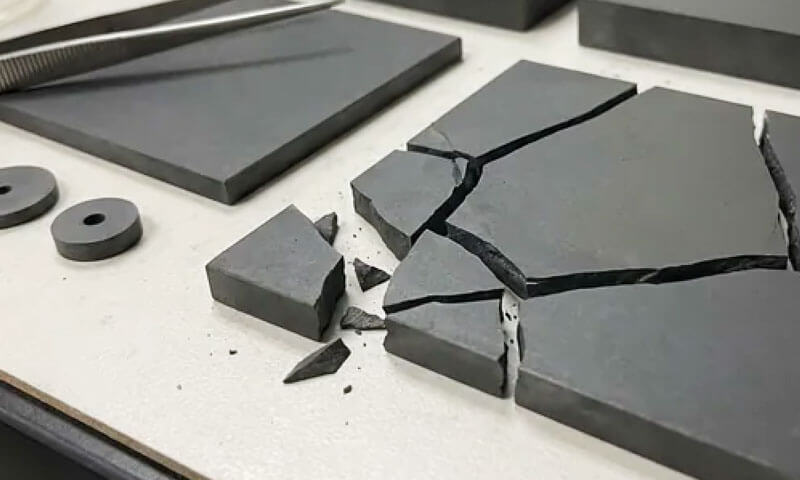
Materials used in engineering rarely fail simply because they are “strong” or “weak.”
Their actual behavior under load depends on a combination of strength, stiffness, ductility, toughness, fracture resistance, temperature, loading rate, microstructure, and defects.
Among these characteristics, brittleness is particularly important because it is associated with fracture occurring after relatively little permanent deformation.
A brittle material may withstand a considerable applied load and appear structurally sound until a critical condition is reached, after which cracking and fracture can occur rapidly.
This behavior is fundamentally different from that of a highly ductile material, which can undergo substantial plastic deformation before failure.
Brittleness is therefore not simply a synonym for weakness, hardness, or fragility.
1. What Is Brittleness?
Brittleness is a material characteristic describing the tendency to fracture with little or limited plastic deformation when subjected to mechanical stress.
Unlike a ductile material, which can undergo substantial permanent deformation before failure, a brittle material may reach fracture with relatively little visible change in shape.
From an engineering perspective, brittleness is best understood as a tendency for a material to accommodate applied stress through crack initiation and propagation rather than extensive plastic yielding.
Once a critical crack or defect becomes unstable, failure can occur rapidly.
Brittleness should not be confused with low strength or high hardness. A brittle material can have considerable tensile strength and hardness while still possessing poor resistance to crack propagation.
Its fracture behavior depends on factors such as microstructure, temperature, loading rate, defects, and stress concentration.

Key Characteristics of Brittle Materials
| Characteristic | Description |
| Limited plastic deformation | Relatively little permanent deformation occurs before fracture. |
| Sudden fracture | Failure can occur rapidly once a critical crack condition is reached. |
| Low deformation energy absorption | Compared with highly ductile materials, less energy is generally absorbed through plastic deformation before fracture. |
| High crack sensitivity | Cracks, pores, notches, scratches, and inclusions can strongly influence fracture behavior. |
Limited crack-tip plasticity |
Plastic deformation around a crack tip may be insufficient to effectively blunt the crack. |
| Fracture-dominated failure | Failure occurs primarily through crack initiation and propagation rather than extensive yielding. |
| Temperature sensitivity | Some materials become significantly more brittle as temperature decreases. |
| Loading-rate sensitivity | Certain materials exhibit increased brittle behavior under rapid or impact loading. |
2. How Does Brittleness Relate to the Stress–Strain Curve?
Brittleness is reflected primarily in the limited strain and energy absorption capacity of a material before fracture.
On a stress–strain curve, a brittle material typically shows a relatively short elastic region followed by fracture, with little or no plastic deformation.
Its fracture strain is therefore low compared with that of a ductile material. The area under the curve up to fracture represents the material’s toughness, so a small area generally indicates limited energy absorption.
By contrast, a ductile material develops a pronounced plastic region after yielding and can undergo substantial deformation before failure.
Thus, the stress–strain curve provides a useful visual distinction: brittle materials tend to fracture at low strain with little plastic deformation, whereas ductile materials sustain significant plastic strain before fracture.
Importantly, brittleness should not be judged from strength or stiffness alone; a material can have high strength or a high elastic modulus while still exhibiting brittle failure.
3. Brittle Fracture Mechanisms
Brittle fracture occurs when a crack propagates with little accompanying plastic deformation.
Cleavage Fracture
Cleavage fracture is a transgranular failure mechanism in which a crack propagates through grains along specific crystallographic planes.
It is favored when plastic deformation is strongly restricted, such as at low temperatures or under high constraint.
| Feature | Description |
| Mechanism | Atomic bonds separate along preferred crystallographic cleavage planes. |
| Fracture path | Generally transgranular, passing through individual grains. |
| Appearance | Relatively flat, faceted surface; characteristic river or chevron patterns may be observed. |
| Typical conditions | Low temperature, high loading rate, high stress concentration, or insufficient fracture toughness. |
| Examples | Glass, ceramics, and ferritic steels under conditions promoting ductile-to-brittle transition. |
Intergranular Fracture
Intergranular fracture occurs when cracking preferentially follows grain boundaries rather than cutting through the grains.
It generally indicates that the grain boundaries have become mechanically weaker than the grain interiors.
| Feature | Description |
| Mechanism | Separation occurs along weakened grain boundaries. |
| Fracture path | Follows the interfaces between adjacent grains. |
| Appearance | Faceted surface that can reveal the underlying grain structure. |
| Typical causes | Impurity segregation, precipitates, hydrogen, corrosion, or unfavorable heat treatment. |
| Examples | Certain hydrogen-embrittled steels and susceptible heat-treated alloys. |
Brittle Fracture in Polymers
Polymers exhibit different fracture mechanisms because their molecular structure and deformation behavior differ fundamentally from those of crystalline metals and ceramics.
Below a material-specific transition temperature, some polymers become glassy and lose much of their ability to undergo plastic deformation.
| Type / Mechanism | Description | Examples |
| Glassy brittle fracture | Crack growth occurs with little macroscopic plastic deformation when the polymer is below its effective ductile-to-brittle transition range. | Polystyrene, PMMA |
| Craze-assisted fracture | Localized fibrillar deformation, or crazing, develops ahead of a crack before final fracture. | Polystyrene, some acrylic and polycarbonate systems |
| Environmental embrittlement | Solvents, chemicals, aging, or other environmental factors reduce ductility and promote premature cracking. | Various thermoplastics and thermosetting polymers |
4. What Causes a Material to Become Brittle?
Brittleness is not determined by a single material property. It results from the interaction between chemical composition, microstructure, temperature, loading conditions, manufacturing history, and defects.
A material that behaves ductilely under one set of conditions may become significantly more brittle under another.
Temperature
Temperature is one of the most important factors affecting fracture behavior, particularly in many body-centered cubic (BCC) metals.
As temperature decreases, atomic mobility and dislocation movement become more difficult, reducing the material’s ability to accommodate plastic deformation.
Some steels therefore exhibit a ductile-to-brittle transition (DBT) over a specific temperature range.
This behavior is especially important for components exposed to cold environments, such as pipelines, pressure vessels, transportation equipment, and offshore structures.
Material selection must therefore consider not only room-temperature strength but also the required impact toughness at the minimum service temperature.
Chemical Composition and Alloying
Alloy chemistry can substantially alter the balance between strength, ductility, and fracture resistance.
Increasing carbon content, for example, can increase hardness and strength in steels but may reduce ductility and toughness if the microstructure becomes excessively hard or brittle.
Certain alloying elements can improve toughness or stabilize desirable phases, while impurities such as sulfur and phosphorus can promote embrittlement when present at inappropriate levels.
Hydrogen is another important concern because it can diffuse into susceptible metals and contribute to hydrogen embrittlement, particularly in high-strength steels.
Microstructure and Heat Treatment
The internal microstructure often determines how easily a crack can initiate and propagate.
Grain size, phase distribution, carbide morphology, precipitates, inclusions, and residual stresses all influence fracture behavior.
Heat treatment is therefore critical. Excessive hardening can produce high-strength but low-toughness microstructures, whereas properly controlled tempering can improve resistance to crack propagation.
In steels, for example, the difference between properly tempered martensite and excessively hard untempered martensite can be decisive for structural reliability.
Stress Concentration and Defects
Brittle fracture is highly sensitive to local stress concentrations. Sharp corners, notches, machining marks, pores, inclusions, shrinkage cavities, weld defects, and cracks can amplify the local stress far beyond the nominal applied stress.
The sharper the defect and the lower the material’s fracture toughness, the greater the risk of crack initiation.
This is why engineering designs often use generous fillet radii, controlled surface quality, and appropriate inspection methods to reduce potential fracture initiation sites.
Manufacturing and Service Conditions
Processing history can introduce factors that increase brittleness, including residual stress, improper heat treatment, segregation, excessive cold working, welding defects, and unfavorable phase transformations.
Environmental exposure may further contribute through mechanisms such as hydrogen embrittlement, corrosion-assisted cracking, or irradiation damage.
5. Which Materials Are Typically Brittle?
Brittleness is most commonly associated with materials that have limited plastic deformation and relatively low fracture strain.
However, brittleness is not an absolute classification: the same material may become more or less brittle depending on temperature, microstructure, loading rate, defects, and environmental conditions.
| Material Category | Typical Examples | Typical Brittle Behavior | Key Factors Affecting Brittleness |
| Glass and glass-ceramics | Soda-lime glass, borosilicate glass, fused silica | Very limited plastic deformation; cracks can propagate rapidly from surface flaws | Surface defects, thermal shock, flaw size, residual stress |
| Ceramics | Alumina, silicon carbide, porcelain, zirconia* | High hardness and compressive strength but generally low tensile ductility | Porosity, grain size, defects, temperature, processing quality |
| Gray cast iron | Flake-graphite cast iron | Relatively low tensile ductility; graphite flakes act as stress concentrators | Graphite morphology, matrix structure, defects, loading mode |
| White cast iron | High-chromium white iron | Very hard and highly wear-resistant but extremely limited ductility | Carbide content, carbide morphology, matrix structure |
Hardened high-carbon steel |
High-carbon tool steels, untempered martensitic steels | Can exhibit high strength and hardness with reduced fracture toughness | Carbon content, martensite condition, tempering, residual stress |
| Ferritic steels at low temperature | Low-carbon ferritic/BCC steels under DBT conditions | May transition from ductile to cleavage fracture | Temperature, grain size, loading rate, stress concentration |
| Concrete and cementitious materials | Concrete, mortar, cement-based composites | High compressive strength but low tensile strain capacity | Aggregate, porosity, microcracks, moisture, loading mode |
Thermosetting polymers |
Epoxy, phenolic resins, some cured resins | Rigid structure with limited plastic deformation; crack-sensitive | Crosslink density, temperature, fillers, defects, moisture |
| Glassy thermoplastics | PMMA, polystyrene | Can fracture with little plastic deformation, especially below transition temperatures | Temperature, molecular weight, notch sensitivity, strain rate |
| Ceramic-matrix composites | SiC/SiC, oxide/oxide systems | Matrix may be brittle, although reinforcement can improve damage tolerance | Fiber architecture, matrix cracking, interfaces, temperature |
| Semiconductors | Silicon, germanium, gallium arsenide | Limited room-temperature plasticity; susceptible to crack initiation | Crystal orientation, surface defects, temperature, residual stress |
6. What Is the Difference Between Brittleness and Ductility?
Brittleness and ductility describe how a material responds to stress before fracture.
A brittle material tends to fracture with little plastic deformation, while a ductile material can undergo substantial permanent deformation before failure.

These characteristics are closely related to the material’s ability to accommodate stress through plastic deformation.
| Property | Brittle Material | Ductile Material |
| Plastic deformation | Very limited | Significant |
| Fracture strain | Generally low | Generally high |
| Failure behavior | Sudden and often unstable | Usually preceded by substantial deformation |
| Energy absorption | Relatively low | Relatively high |
| Notch sensitivity | Usually high | Generally lower |
| Typical fracture mode | Cleavage or intergranular fracture | Ductile tearing and microvoid coalescence |
| Examples | Glass, ceramics, gray cast iron | Mild steel, copper, aluminum alloys |
7. Brittleness vs. Toughness: Why the Difference Matters
Toughness and brittleness are not the same property. Brittleness describes a material’s tendency to fracture with little plastic deformation, whereas toughness measures the amount of energy a material can absorb before fracture.
| Characteristic | Brittleness | Toughness |
| What it describes | Tendency to fracture with little plastic deformation | Ability to absorb energy before fracture |
| Primary concern | Deformation capacity before failure | Resistance to fracture under loading |
| Related measurements | Fracture strain, plastic strain | Impact toughness, fracture toughness, stress–strain energy |
| Effect of defects | Often highly sensitive to notches and cracks | Determines resistance to crack initiation and propagation |
| Engineering significance | Indicates potential for sudden failure | Indicates damage tolerance and energy absorption |
8. How Can Brittleness Be Reduced?
Brittleness can often be reduced by modifying the material composition, microstructure, processing conditions, component geometry, or service environment.
The appropriate approach depends strongly on the material system and the mechanism responsible for brittle behavior.
Optimize Heat Treatment
For steels and other heat-treatable alloys, controlled heat treatment is one of the most effective ways to balance strength and ductility.
For example, tempering hardened steel can reduce excessive hardness and residual stresses while improving toughness.
The objective is not necessarily to maximize ductility, but to establish an appropriate combination of strength, hardness, fracture toughness, and dimensional stability.
Refine and Control the Microstructure
Microstructural refinement can significantly improve resistance to brittle fracture in many metallic materials.
Fine, uniform grains can increase resistance to cleavage and reduce the distance over which an unstable crack can propagate.
Control of inclusions, precipitates, carbides, and segregation is equally important. Excessive or poorly distributed brittle phases can create preferential crack-initiation sites.
Modify Alloy Composition
Alloy design can be used to improve toughness while maintaining required mechanical properties.
Depending on the material system, appropriate alloying may stabilize desirable phases, refine grains, improve hardenability, or reduce susceptibility to environmental embrittlement.
For steels, controlling harmful impurities and minimizing conditions that promote hydrogen embrittlement, temper embrittlement, or grain-boundary weakening can be particularly important.
Reduce Stress Concentrations
Component geometry has a direct influence on brittle-fracture risk. Sharp corners, abrupt section changes, deep notches, and poorly designed holes can produce severe local stress concentrations.
Engineering measures such as larger fillet radii, smoother transitions, optimized hole geometry, and improved surface quality can lower peak local stresses and reduce the likelihood of crack initiation.
Control Manufacturing Defects
Porosity, inclusions, cracks, incomplete fusion, machining damage, and other manufacturing defects can become critical fracture origins.
Improving casting, forging, welding, heat treatment, and machining processes can therefore increase effective fracture resistance.
For safety-critical components, non-destructive testing (NDT)—such as ultrasonic, radiographic, magnetic-particle, or dye-penetrant inspection—can help identify defects before they become service failures.
Manage Temperature and Environment
If brittleness is associated with low temperature, increasing the operating temperature or selecting a material with better low-temperature toughness may prevent ductile-to-brittle transition.
Environmental controls are also important. Appropriate material selection, coatings, surface treatments, cathodic protection where applicable, and hydrogen-control measures can reduce environmentally assisted cracking.
9. Why Brittleness Matters in Engineering
Brittleness is an important engineering consideration because it directly influences failure mode, structural reliability, safety margins, and material selection.
A brittle component may sustain substantial loads while appearing undamaged and then fail rapidly once a critical crack or stress condition is reached.
This behavior is particularly concerning in structures where sudden fracture can lead to cascading damage or loss of containment.
Material Selection
Material selection should account for the complete service environment rather than relying solely on tensile strength or hardness.
For example, a high-strength steel may provide excellent load-bearing capacity but may be unsuitable for a low-temperature application if its fracture toughness becomes inadequate.
Structural and Component Design
Geometry strongly affects brittle-fracture risk. Sharp notches, abrupt section changes, holes, threads, and machining marks can concentrate stress and accelerate crack initiation.
Proper design therefore incorporates smooth transitions, suitable radii, controlled surface quality, and sufficient fracture resistance.
Manufacturing and Quality Control
Manufacturing defects can become critical fracture origins in brittle or fracture-sensitive materials.
Casting porosity, inclusions, welding discontinuities, heat-treatment defects, and surface cracks should be controlled through appropriate process parameters and inspection procedures.
For critical components, non-destructive testing (NDT) and fracture-mechanics-based acceptance criteria can provide an additional layer of protection against unexpected failure.
Safety and Failure Prediction
Ductile materials often provide visible deformation before failure, whereas brittle materials may provide little warning.
Consequently, designs involving brittle materials generally require greater attention to defect size, crack growth, operating temperature, loading conditions, and inspection intervals.
In applications such as pressure vessels, bridges, pipelines, aerospace structures, cutting tools, and ceramic components, understanding brittleness is essential for establishing appropriate safety factors and preventing catastrophic fracture.
10. What Is the Difference Between “Fragile” and “Brittle”?
The terms “fragile” and “brittle” are often used interchangeably in everyday language, but they have different meanings in engineering.
Brittle is a technical materials-science term describing a material’s tendency to fracture with limited plastic deformation.
Fragile, by contrast, is a broader descriptive term that usually means something is easily damaged, broken, or destroyed.
A fragile object may be vulnerable because of its geometry, thinness, surface condition, or construction—not necessarily because the material itself has intrinsically low ductility.
| Aspect | Brittle | Fragile |
| Meaning | Technical material behavior | General descriptive term |
| Primary characteristic | Limited plastic deformation before fracture | Easily damaged or broken |
| Engineering definition | Associated with fracture strain and deformation behavior | No single standardized mechanical definition |
| Failure behavior | Often sudden with limited warning | May fail through different mechanisms |
| Examples | Glass, ceramics, gray cast iron | A thin glass panel, delicate electronic assembly, thin-walled component |
| Can it describe a ductile material? | Generally not in the technical sense | Yes |
11. Conclusion
Brittleness is the tendency of a material to fracture with little or no significant plastic deformation.
It is fundamentally different from strength, hardness, and toughness, although these properties can interact strongly in determining real-world failure behavior.
From an engineering perspective, the key issue is not simply whether a material is labeled “brittle,” but how it will behave under its actual service conditions.
Appropriate material selection, microstructural control, heat treatment, geometric design, defect prevention, and inspection can substantially reduce the risk of unexpected fracture.
FAQs
What is brittleness in simple terms?
Brittleness is the tendency of a material to break rather than plastically deform when subjected to sufficient stress.
Brittle materials generally fracture suddenly and absorb relatively little energy before failure.
Is brittleness the same as low strength?
No. Strength and brittleness are different properties. A material can have very high strength or hardness but still fracture with little plastic deformation.
Can a metal become brittle?
Yes. Metals can become more brittle because of low temperature, excessive hardening, unfavorable heat treatment, hydrogen exposure, impurity segregation, radiation damage, or severe stress concentrations.
How is brittleness measured?
There is no single universal “brittleness value.”
Engineers commonly assess it using properties such as fracture strain, elongation, impact toughness, fracture toughness, and the ductile-to-brittle transition temperature, depending on the material and application.
Can brittle materials be made tougher?
In many cases, yes. Toughness can be improved through microstructural refinement, optimized heat treatment, alloy modification, controlled processing, reinforcement, and reduction of stress concentrations and defects.
Why does steel become brittle at low temperatures?
Steel becomes brittle at low temperatures due to the ductile‑to‑brittle transition.
Below the transition temperature, the material cannot accommodate stress through plastic deformation and fractures in a brittle manner.
What is the ductile‑to‑brittle transition temperature (DBTT)?
The DBTT is the temperature below which a material behaves in a brittle manner and above which it behaves in a ductile manner. It is a critical parameter for low‑temperature applications.

