
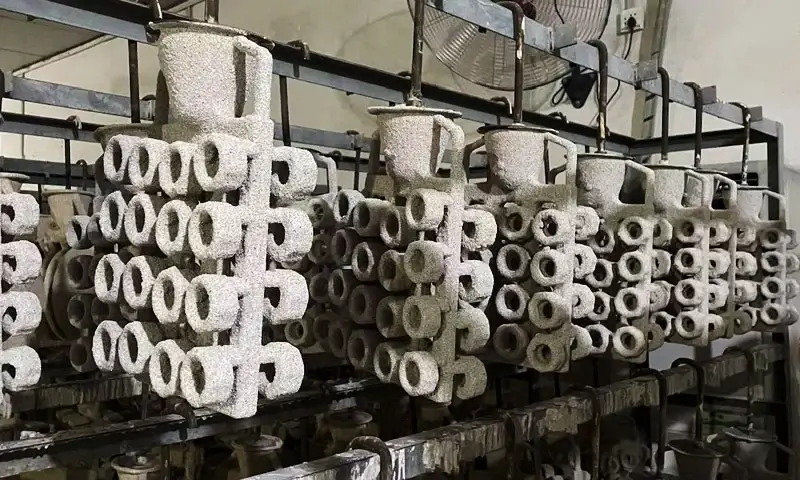
소개
A의 모든 속성 중에서 투자 주조 세라믹 쉘, 침투성 가장 많이 오해되는 것 중 하나예요.
많은 주조소에서, shell permeability is treated merely as a parameter that helps gases escape during pouring.
실제로는, 투과성에 영향을 미침 every major stage of the investment casting process, from steam dewaxing and shell firing to mold filling, 응고, 궁극적으로 주조 품질.
Poor permeability control can lead to shell cracking, 가스 다공성, 오도, 금속 침투, 모래 접착, 차원 불안정, 생산 수율 감소.
마찬가지로 문제는 다음과 같은 오해이다. 투자율이 높을수록 항상 좋습니다.
과도한 투과성은 쉘 강도를 약화시킵니다., 용융 금속 침투 촉진, 표면 결함을 증가시킵니다..
Modern investment casting therefore views shell permeability not as an isolated material property, but as a carefully engineered characteristic that balances gas transport, 구조적 완전성, 열 거동, 및 야금 성능.
This article examines shell permeability from multiple engineering perspectives, explaining how pore structure develops, how permeability affects every manufacturing stage, and how advanced foundries optimize permeability to achieve defect-free precision castings.
1. Scientific Definition and Quantitative Characterization of Shell Permeability
필수 물리적 정의
Shell permeability refers to the capacity of gas to penetrate and diffuse through porous ceramic shell walls under a certain pressure differential.
It is a comprehensive structural performance determined by the micro-pore characteristics inside the layered ceramic shell, rather than a simplistic binary qualitative judgment of “good” or “poor air permeability”.
Microscopically, 투자 주조 세라믹 쉘 are porous media formed by layered stacking of refractory aggregates bonded and cured by inorganic binders.
The internal pore system consists of three mutually coupled pore structures that jointly define the actual permeability level: interconnected macro primary pores formed by stacking gaps between refractory aggregate particles,
secondary micro-pores left by water volatilization during binder curing, and micro-crack pores naturally generated during shell coating, 건조, and high-temperature sintering.
The quantity, average size, spatial distribution, and connectivity of these three pore types collectively dominate gas migration efficiency inside the shell.

표준정량지수 및 시험방법
The universal industrial quantitative parameter for shell permeability is the permeability coefficient (케이) . Its standardized physical definition is:
The volume of gas with a viscosity of 1 Pa·s passing through a shell specimen with 1 cm thickness and 1 m² area within one hour under a fixed pressure differential of 10 아빠, with the unit of m²/(Pa·h) .
In on‑site industrial production, professional shell permeability testers are adopted for rapid quantitative detection.
The test principle is to deliver stable compressed air with fixed flow rate through a standard shell sample, convert the air flow resistance value into a standardized permeability coefficient, and realize batch data monitoring of shell air permeability.
Limitation of Traditional Single Index and Modern Three‑Dimensional Characterization System
The traditional single permeability coefficient has obvious technical limitations:
it only reflects the overall gas passing capacity of the shell but cannot distinguish the proportion and distribution of pores in different size ranges.
엔지니어링 실무에서, pores of different diameters exhibit completely differentiated functional mechanisms in different casting procedures:
| 기공 크기 카테고리 | 주요 기능 | Critical process stage |
| Macro connected pores (>10 μm) | Rapid escape of large‑volume gas | Molten metal pouring |
| 중간 모공 (1–10 µm) | Steam penetration and wax discharge | 탈 왁스 |
| Micro‑pores (<1 μm) | Residual gas volatilization and discharge | Shell sintering |
To eliminate evaluation deviations caused by single‑index detection, modern high‑precision investment casting has upgraded the permeability evaluation system to a three‑dimensional quantitative characterization system, 통합:
- 투과성 계수 (케이) – overall gas passing capacity.
- Pore size distribution – 매크로의 비율, 중간, and micro pores.
- 기공 연결율 – degree of interconnection between pore networks.
This multi‑dimensional system fully and accurately reflects the real gas permeability performance of ceramic shells and matches the process requirements of different production stages.
Inherent Permeability Differences of Different Binder Systems
The binder formula fundamentally determines the micro‑pore structure of ceramic shells, resulting in significant inherent permeability differences among mainstream industrial shell systems, with distinct application boundaries for casting products:
| 바인더 시스템 | 투과성 계수 (m²/(Pa·h)) | Pore structure characteristics | 적합한 주조 합금 |
| 물 유리 | 0.8 – 2.5 | Large‑diameter interconnected pores; high overall air permeability | 탄소강, 저합금강 (moderate surface quality) |
| 에틸실리케이트 | 0.5 – 1.8 | Medium pore size and connectivity; balanced universal performance | Medium‑precision alloy castings |
| 실리카졸 | 0.3 – 1.2 | 밀집한, uniform micro‑pore structure; 최소 매크로 모공 | High‑end stainless steel, 슈퍼 합금 (strict internal quality) |
주요 통찰력: Silica sol shells offer the most controllable and stable permeability, making them the exclusive choice for critical aerospace and medical components.
Water glass shells provide maximum gas discharge but at the cost of surface quality and structural integrity.
2. Influence of Shell Permeability Throughout the Investment Casting Process
A common misconception in investment casting is that shell permeability only influences the pouring stage.
실제로는, permeability affects every major manufacturing operation after shell building—including dewaxing, 발사, 붓는 것, 그리고 심지어 응고.
The role of permeability changes at each stage because the dominant transport mechanism evolves from steam diffusion, 가스 대피, 용융 금속 충전물에, and finally to thermal and pressure equilibration.
따라서, shell permeability should be regarded as a process-wide engineering parameter rather than an isolated shell characteristic.
Optimizing permeability requires balancing gas transport, 구조적 완전성, 금속 침투 저항, and dimensional stability throughout the entire casting cycle.
탈왁스 중 영향
Steam autoclave dewaxing is one of the most mechanically demanding stages for ceramic shells.
이 과정에서, high-pressure saturated steam must rapidly penetrate the porous shell to melt and remove the wax pattern before excessive thermal expansion occurs.
The efficiency of this heat transfer process is directly controlled by shell permeability.
낮은 투과성: 껍질 깨짐의 숨겨진 원인
통기성이 부족한 경우, 증기가 껍질에 천천히 침투합니다., creating a significant temperature gradient between the outer and inner shell layers.
결과적으로:
- the outer wax melts rapidly while the core remains solid;
- trapped solid wax expands as its temperature rises;
- internal pressure increases faster than the shell can accommodate.
If the generated pressure exceeds the shell’s ambient mechanical strength, cracking begins from the inner surface.
Industrial observations indicate that when the permeability of silica-sol shells falls below approximately 0.4 m²/(Pa·h), shell cracking during dewaxing may increase from normal levels of around 1% 에게 ~ 위에 18%.
더 중요한 것은, many of these cracks are microscopic and cannot be detected visually.
Although the shell may remain intact after dewaxing, these latent defects often propagate during firing or pouring, eventually causing metal leakage, 치수 왜곡, or catastrophic shell failure.
This explains why some casting defects that appear during pouring actually originate much earlier in the manufacturing process.
지나치게 높은 투과성: 다른 유형의 위험
Higher permeability does not necessarily improve dewaxing performance.
If the shell becomes excessively permeable:
- steam penetrates almost instantaneously;
- wax melts too rapidly;
- molten wax is expelled violently through the gating system.
빠른 왁스 배출은 안전상의 위험을 야기하는 동시에 페이스 코트의 국부적인 부식을 일으킬 수 있습니다..
흐르는 용융 왁스는 세라믹 표면의 일부를 씻어낼 수 있습니다., leaving cavities or damaged coating regions.
During subsequent pouring, these damaged areas are replicated as:
- surface protrusions,
- localized metal penetration,
- ceramic inclusions,
- dimensional inconsistencies.
그러므로, the objective during dewaxing is controlled steam penetration, not maximum permeability.
포탄 발사 중 영향
포탄 발사는 여러 가지 필수 기능을 동시에 수행합니다.:
- removing residual moisture;
- decomposing organic binder residues;
- eliminating remaining wax contamination;
- 세라믹 입자를 기계적으로 안정된 쉘로 소결.
All of these processes generate gases that must escape efficiently through the shell wall.
불충분한 투과성으로 인해 가스 제거가 제한됨
가열 중, 화학적으로 결합된 물, 잔류 유기물, and trace wax residues decompose into steam, 이산화탄소, 및 기타 휘발성 가스.
통기성이 너무 낮은 경우:
- gases accumulate inside closed pores;
- local pressure rises rapidly;
- pore expansion and internal delamination occur.
심한 경우에는, shell blistering or explosive cracking may occur inside the furnace.
Even when catastrophic failure does not occur, retained decomposition products can react with refractory materials at elevated temperatures, producing localized low-melting glassy phases.
These glassy reaction products later interact with molten metal during pouring, increasing the probability of:
- 화상 결함,
- 모래 접착,
- 표면 구멍,
- 산화물 내포물.
따라서, insufficient permeability not only affects shell integrity but also degrades casting surface metallurgy.
Excessively High Permeability Can Reduce High-Temperature Strength
Excessively open pore structures introduce another challenge.
Continuous airflow through highly permeable shells during firing accelerates oxidation of residual binder phases and may promote excessive ceramic dehydration or microstructural coarsening.
The resulting shell may exhibit:
- lower hot strength;
- reduced creep resistance;
- poorer thermal shock resistance.
따라서, although gas removal becomes easier, the shell becomes mechanically weaker during pouring, increasing susceptibility to:
- shell expansion,
- 치수 왜곡,
- mold bulging,
- localized deformation.
This illustrates that firing performance depends not simply on gas evacuation capability but on achieving an appropriate balance between permeability and ceramic densification.
용융 금속 충전 중 영향
The pouring stage represents the most widely recognized function of shell permeability.
As molten metal fills the cavity at high velocity, 대체된 공기와 분해 가스는 매우 짧은 시간 내에 다공성 세라믹 껍질을 통해 빠져나가야 합니다..
쉘은 분산 환기 시스템의 역할을 효과적으로 수행합니다..

낮은 투과성으로 인해 가스 포집이 발생함
When venting capacity is insufficient:
- cavity pressure rises rapidly;
- 전진하는 금속 전선 앞에 공기가 갇히게 됩니다.;
- gas bubbles are compressed into the liquid metal.
응고 후, these trapped gases form:
- 가스 다공성,
- 통풍구,
- 불완전한 충전,
- 콜드 셧,
- 오도.
These defects are particularly severe in:
- thin-wall castings,
- long flow paths,
- 복잡한 내부 채널,
- 터빈 블레이드,
- 항공우주 구조 부품.
Industrial experience shows that when shell permeability falls below approximately 0.5 m²/(Pa·h) 얇은 벽의 정밀 주조 생산 중,
the probability of incomplete filling can increase by 이상 20%, particularly near the final filling regions and sharp geometric transitions.
Excessively High Permeability Promotes Metal Penetration
Although higher permeability improves gas evacuation, it also increases interconnected pore volume inside the ceramic shell.
금속 정압 하에서, 용융된 금속이 이러한 열린 기공을 관통할 수 있습니다., 생산:
- 기계적 연소,
- 깊은 모래 접착,
- 거친 표면,
- 어려운 껍질 제거.
침투가 약을 초과하는 경우 0.5 mm, conventional blasting often cannot completely remove the adhered ceramic layer, 광범위한 연삭 또는 수리가 필요한 경우.
이 문제는 특히 다음과 같은 경우에 중요합니다.:
- 니켈 기반 슈퍼 합금,
- 코발트 합금,
- 고온 스테인리스강,
whose elevated pouring temperatures and lower viscosities significantly increase penetration capability.
따라서, shells intended for these alloys generally require tighter control of maximum permeability than shells used for lower-temperature alloys.
Influence During Solidification and Defect Formation
The influence of permeability does not end when mold filling is complete.
응고 중, dissolved gases continue evolving from the molten alloy while thermal contraction creates pressure gradients within the casting.
Appropriately engineered shell permeability helps maintain pressure equilibrium by allowing residual gases to escape gradually from the mold cavity.
Balanced permeability contributes to:
- 가스 다공성 감소,
- more stable feeding conditions,
- improved solidification uniformity,
- 낮은 잔류 응력,
- enhanced dimensional consistency.
거꾸로, shells with poorly optimized permeability may restrict late-stage gas release, increasing localized pressure and aggravating shrinkage-related defects in thermally isolated regions.
그러므로, permeability should be viewed as a parameter that influences the entire thermal and metallurgical evolution of the casting, rather than only the mold-filling stage.
3. How Shell Permeability Influences Casting Quality
Shell permeability directly affects multiple quality characteristics simultaneously.
Rather than influencing a single defect mechanism, it regulates gas transport, 압력 분포, 열전달, shell stability, 및 금속-금형 상호작용 캐스팅 사이클 내내.
이런 현상이 동시에 일어나기 때문에, permeability should be viewed as a system-level quality parameter rather than an isolated property.

Mold Filling Capability and Casting Integrity
One of the primary functions of shell permeability is to provide an efficient escape path for air and gaseous products displaced by advancing molten metal.
When molten metal enters the mold cavity at high speed, the trapped air must be evacuated almost instantaneously.
껍질이 이 가스를 충분히 빨리 배출할 수 없는 경우, the internal pressure rises and opposes metal flow, 효과적인 충전 압력 감소.
결과는 다음과 같습니다:
- 잘못된 실행 및 불완전한 충전
- Cold shuts between converging metal fronts
- Rounded edges instead of sharp corners
- Loss of fine details
- Poor replication of thin-wall features
These problems become increasingly severe in castings with:
- wall thicknesses below 2 mm;
- long metal flow paths;
- 복잡한 내부 통로;
- 격자 구조;
- turbine blades and medical implants.
Adequate shell permeability reduces cavity back pressure, allowing molten metal to maintain a continuous, stable filling front and accurately reproduce complex geometries.
Internal Porosity and Gas Defects
Gas-related defects are among the most common quality issues associated with poor shell permeability.
When gas generated during pouring cannot escape through the shell, it becomes entrapped within the molten metal.
As solidification progresses, the trapped gas forms spherical or irregular pores inside the casting.
Typical defects include:
- 가스 다공성
- 블로우홀
- 핀홀
- Subsurface gas cavities
Industrial production data indicate that inadequate shell venting is one of the major contributors to internal porosity in precision castings, particularly for large steel castings and thin-wall components with rapid filling rates.
거꾸로, a properly engineered shell provides continuous venting pathways that reduce internal gas pressure, minimize air entrapment, and significantly improve casting density.
항공우주용, 의료, and energy components, reducing internal porosity is particularly critical because fatigue cracks frequently initiate from internal pores subjected to cyclic loading.
Surface Finish and Metal Penetration
Shell permeability also governs the interaction between molten metal and the ceramic mold surface.
An excessively dense shell usually provides excellent resistance to metal penetration but may suffer from inadequate gas evacuation.
거꾸로, an overly porous shell allows molten metal to infiltrate interconnected surface pores under metallostatic pressure.
과도한 금속 침투로 인해:
- 기계적 모래 접착
- 번온 결함
- 거친 주조 표면
- 껍질 제거가 어렵다
- 세척 및 분쇄 비용 증가
For high-temperature alloys with strong penetration capability, the risk becomes particularly significant.
Molten metal may infiltrate several hundred micrometers into the shell surface, creating tenacious ceramic-metal bonding that cannot be completely removed by conventional blasting.
Maintaining moderate permeability while limiting large interconnected pores is therefore essential for achieving excellent surface quality.
Dimensional Accuracy and Shell Stability
Although permeability primarily controls gas transport, it also indirectly influences dimensional accuracy.
Poor permeability frequently leads to excessive internal gas pressure during pouring.
Elevated pressure imposes additional mechanical loading on the ceramic shell, increasing the likelihood of:
- 로컬 쉘 확장
- 곰팡이 뒤틀림
- 벽 변위
- Uneven dimensional variation
반면에, shells with excessively high permeability often possess lower ceramic density and reduced mechanical strength, making them more susceptible to deformation under the hydrostatic pressure of molten metal.
The most dimensionally stable castings are therefore produced using shells that achieve an optimal balance between:
- sufficient permeability for venting;
- adequate mechanical strength;
- high-temperature rigidity;
- resistance to creep deformation.
This balance becomes increasingly important for large structural castings where dimensional tolerances are tightly controlled.
Microstructure and Mechanical Properties
The influence of permeability extends beyond external quality to the internal metallurgical characteristics of the casting.
Gas evacuation efficiency affects the thermal environment surrounding the solidifying metal.
Stable pressure conditions promote more uniform heat extraction and reduce turbulence during mold filling, resulting in improved solidification behavior.
Optimized shell permeability contributes to:
- More uniform grain structures
- Reduced micro-porosity
- Improved feeding efficiency
- Lower residual stress
- Better mechanical consistency
대조적으로, castings containing gas defects or severe metal penetration often exhibit reduced tensile strength, 피로 저항성, and decreased fracture toughness due to stress concentration around internal discontinuities.
For safety-critical components—including aerospace hardware, 자동차 구조 부품, and medical implants—even minor improvements in shell permeability control can translate into significant gains in long-term service reliability.
Impact on Process Stability and Manufacturing Yield
Shell permeability influences not only individual casting quality but also overall production consistency.
When shell permeability fluctuates significantly between production batches, manufacturers often experience corresponding variations in:
- 충전 성능
- 표면 마무리
- 결함 분포
- 청소 효율성
- 폐기율
These inconsistencies complicate process optimization because pouring parameters that perform well for one shell batch may become unsuitable for another.
By establishing quantitative permeability specifications and maintaining tight process control, 파운드리는 달성할 수 있다:
- 더 높은 공정 반복성
- 결함 변동성 감소
- 향상된 치수 일관성
- 재작업 및 수리 감소
- Higher first-pass yield
- 제조 비용 절감
대량 생산을 위해, stable shell permeability is therefore an important contributor to overall process capability and quality assurance.
4. Industrial Synergistic Optimization Strategy for Shell Permeability Control
To solve the traditional trade‑off dilemma of permeability regulation and eliminate the three major industrial pain points, a full‑process balanced optimization system must be established based on the three‑dimensional permeability characterization system.
Standardize Quantitative Detection and Batch Monitoring
| 행동 | 구현 | 목표 |
| Adopt professional permeability testers | Replace empirical finger‑touch or visual judgment with instrumented measurement. | Eliminate subjective variation. |
| Establish batch threshold standards | Define acceptable K ranges for each binder system and alloy type. | Control permeability fluctuation within ±15%. |
| Implement statistical process control (SPC) | Monitor K values across batches; track trends. | Detect drift early; maintain process consistency. |
Optimize Pore Grading Structure
| 전략 | Technical approach | Effect on permeability |
| Adjust refractory powder gradation | Use bimodal or multimodal particle size distribution; reduce fine powder fraction to increase macro pores. | Raises K (more open structure). |
| Increase fine powder fraction | Increase sub‑micron powder content; improve packing density. | Lowers K (밀도가 높습니다). |
| Modify stucco mesh size | Use coarser stucco for higher permeability; finer stucco for lower permeability. | Targeted control of macro‑pore proportion. |
| Control slurry viscosity | Higher viscosity → thicker coating → lower permeability; lower viscosity → thinner coating → higher permeability. | Fine‑tuning of K within ±0.2 m²/(Pa·h). |
Achieve Multi‑Performance Collaborative Balance
| 성능 매개변수 | Optimization direction | Permeability interaction |
| Shell strength (MOR) | Improve binder toughness; increase refractory particle interlocking. | 강도가 적당히 증가하면 K가 감소하는 경우가 많습니다. (모공을 닫아줌으로써); 균형을 맞춰야 한다. |
| 열충격 저항 | 쉘 레이어 간의 열팽창 매칭 최적화. | K가 높으면 가스 방출이 향상되지만 열 충격 저항이 감소할 수 있습니다. (다공성은 구조를 약화시킨다). |
| 금속 침투 저항 | 표면 거대 기공 감소; 더 미세한 기본 코팅을 바르십시오.. | 낮은 K (더 미세한 모공) 침투 저항을 직접적으로 향상시킵니다.. |
| 가스 방전 용량 | 금속 침투를 위한 연속 채널을 생성하지 않고 상호 연결된 거대 기공을 유지합니다.. | 등급화된 기공 구조가 필요합니다.: 미세한 내부 표면 + 더 거친 백업 레이어. |
실제 구현: 최적의 쉘 디자인은 등급별 투과성 구조:
- 기본 코트: 미세분말, 고밀도, 낮은 투과성 (0.2–0.4m²/(Pa·h)) → 금속 침투 방지, 매끄러운 표면을 보장합니다.
- 백업 코트: 거친 분말, 더 높은 투과성 (1.0-2.0m²/(Pa·h)) → 가스 배출 채널 제공, 구조적 강도.
5. 결론
쉘 투과성은 환기 특성 그 이상입니다. 전체 매몰 주조 공정의 성공을 좌우하는 기본 엔지니어링 매개변수.
탈랍 시 증기 침투 및 소성 시 가스 배출부터 금형 충진까지, 응고, 및 결함 형성, 투과성은 생산의 거의 모든 단계에 영향을 미칩니다..
투과율이 극도로 낮거나 지나치게 높더라도 최적의 주조 품질을 제공할 수 없습니다..
불충분한 투과성은 가스 수송을 제한합니다., 껍질 균열 위험 증가, 다공성, 그리고 잘못 달리다, 과도한 투과성은 쉘을 약화시키고 용융 금속 침투를 촉진합니다., 표면 결함, 그리고 치수 불안정성.
그러므로 목표는 not maximum permeability, 정밀하게 설계된 투과성 합금 시스템과 일치하는 것, 주조 기하학, 쉘 구조, 그리고 프로세스 조건.
투자 주조가 항공우주 분야로 계속 발전함에 따라, 의료, 에너지, 및 기타 고성능 애플리케이션, permeability control is evolving from an empirical practice into a science-driven discipline.
최적화된 세라믹 소재를 접목하여, engineered pore structures, advanced characterization techniques, digital process monitoring, and intelligent manufacturing technologies, modern foundries can achieve higher casting quality, greater process consistency, and improved production efficiency.
Custom Investment Casting Services by DEZE
이것 제공 custom investment casting services for customers requiring precision-engineered metal components with demanding dimensional, 표면, and metallurgical requirements.
우리의 역량은 생산의 모든 단계를 포괄합니다., 포함 툴링 디자인, 왁스 패턴 제조, 세라믹 쉘 만들기, 정밀 주조, 열처리, CNC 가공, 표면 마무리, and comprehensive quality inspection.
Leveraging advanced shell-making technology and rigorous process control, 이것 optimizes critical shell properties—including permeability, 힘, 열 안정성, and interface performance—to ensure excellent mold filling, 우수한 표면 마감, 주조 결함 최소화, 뛰어난 치수 일관성.
프로토타입 제작 여부, 소량 특수 부품, 또는 대량 생산 구성 요소, we deliver reliable investment casting solutions in stainless steel, 탄소강, 합금강, 알류미늄, 구리 합금, 및 기타 엔지니어링 재료.
Our experienced engineering team works closely with customers to optimize casting design, 제조 가능성 향상, 생산 비용을 줄입니다, 그리고 일관된 달성, 모든 배치에서 고품질 결과.
자주 묻는 질문
What is shell permeability in investment casting?
Shell permeability is the ability of a ceramic shell to allow gases to pass through its porous structure under a pressure difference.
탈왁스 과정에서 중요한 역할을 합니다., 포탄 발사, 금형 충전, and solidification by enabling controlled gas evacuation while maintaining shell integrity.
Why isn’t higher shell permeability always better?
Excessively high permeability can reduce shell strength, increase molten metal penetration into the ceramic shell, promote mechanical sand adhesion, and negatively affect dimensional accuracy.
The optimal permeability depends on the alloy, 주조 기하학, 그리고 프로세스 조건.
How does low shell permeability affect casting quality?
낮은 투과성은 붓고 소성하는 동안 가스 누출을 제한합니다., 탈왁스 중 껍질 균열 가능성 증가, 가스 다공성, 통풍구, 불완전한 충전, and surface defects caused by trapped gases.
껍질 투과성에 가장 큰 영향을 미치는 요인은 무엇입니까??
가장 중요한 요소에는 내화성 입자 크기 분포가 포함됩니다., 바인더 시스템, slurry formulation, shell layer design, drying conditions, firing temperature, 쉘 두께, 결과적인 기공 크기 분포 및 연결성.
파운드리에서는 쉘 투과성을 어떻게 최적화할 수 있습니까??
파운드리에서는 엔지니어링된 내화물 그라데이션을 사용하여 투과성 제어를 개선할 수 있습니다., optimizing binder content, 건조 및 소성 과정을 신중하게 제어, monitoring slurry properties,
고급 테스트 방법으로 기공 구조 특성화, 일관된 쉘 품질을 보장하기 위해 디지털 프로세스 제어를 구현합니다..

