1. Executive summary
Stainless-steel coated-sand casting combines economical sand-based molding with engineered surface coatings to produce corrosion-resistant, mechanically robust castings.
The coating (a thin refractory layer applied to the sand mold or core) protects the sand from chemical attack by molten stainless steel, improves surface finish, controls metal-mold reactions, and reduces defects such as penetration, sand burn-on and hot tearing.
Proper selection of coating chemistry, particle size and process parameters is essential—stainless alloys are reactive and have high pouring temperatures, so shell integrity, permeability and thermal stability are critical.
When executed correctly, coated-sand casting yields high-value components for pumps, valves, petrochemical fittings, marine hardware, food-processing parts and many heavy industrial applications.
2. What is Stainless Steel Coated-Sand Casting?
Stainless steel coated sand casting is a sand-mold casting method in which the mold cavity surface is intentionally covered with a thin, engineered refractory coating (often called a facecoat, wash, or mold wash) before pouring molten stainless steel.
The coating is formulated from refractory powders (zircon, alumina, chromite, etc.) dispersed in a liquid carrier or binder and is applied to the mold or core surface as a thin film (typically tens to a few hundred micrometres).
Its purpose is to act as a chemically and thermally compatible interface between the reactive molten stainless steel and the bulk sand mold, thereby improving surface finish,
suppressing metal–sand reactions, controlling heat transfer at the metal–mold interface, and reducing defects such as penetration, sand burn-on and embedded sand inclusions.
Core concept
Coated-sand casting = conventional sand-mold casting + an engineered facecoat applied to the mold cavity surface.
The facecoat modifies the immediate mold–metal interaction while the underlying sand/stucco provides bulk support, permeability and thermal buffering.
The technique is specifically tailored to stainless and high-alloy steels, which are chemically aggressive, have high pouring temperatures, and are sensitive to surface contamination and inclusions.
Typical process flow
- Pattern & core preparation: make sand mold and any cores in the normal way (green sand, resin sand, or shell sand systems).
- Facecoat application: apply a refractory coating to the cavity surface by brushing, spraying or dipping. Target wet film thickness typically 0.05–0.25 mm depending on formulation and part needs.
- Stuccoing/backer build: if used, sprinkle stucco or apply additional backer coatings to build thickness and permeability.
- Drying / prebake / conditioning: allow the coating to dry and, where required, partially bake the mold to stabilize the face layer and remove volatiles.
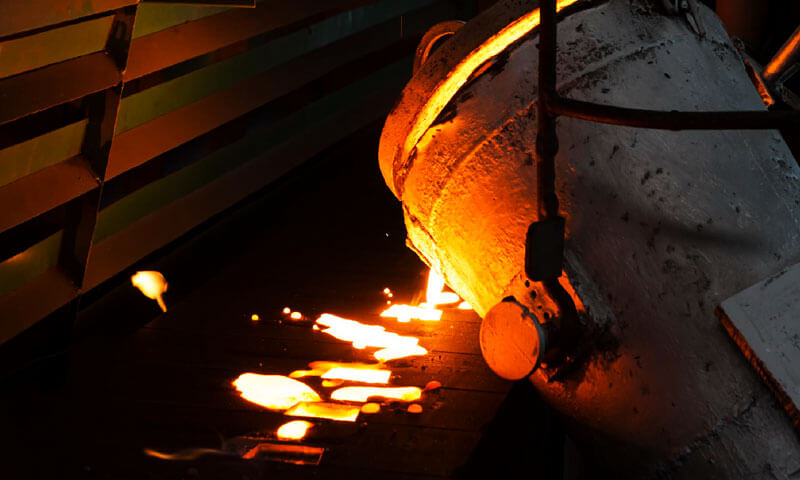
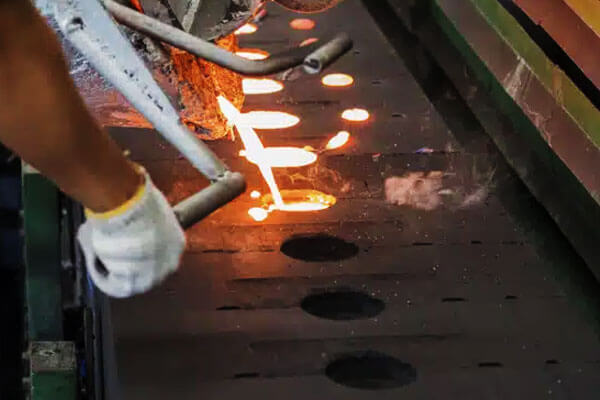
- Pouring: pour molten stainless steel at controlled superheat; the coating must resist chemical attack and thermal shock.
- Shakeout & cleaning: remove sand and coating residues; good coatings reduce bonded sand and simplify cleaning.
- Inspection / heat treatment: NDT and any required heat treatment or finishing.
Primary functions of the coating
- Chemical barrier: limits direct reaction between molten stainless steel and reactive silica/alumina in the sand; reduces formation of low-melting silicates and glassy reaction layers.
- Surface fidelity: with proper particle size and packing the coating replicates fine pattern detail and provides smoother as-cast surfaces.
- Thermal control: modifies local heat extraction and cooling rates, influencing microstructure and solidification shrinkage.
- Permeability control: a thin dense facecoat combined with coarser back layers maintains overall venting while preventing gas penetration at the surface.
- Dust and erosion protection: reduces mechanical erosion of sand during metal flow and minimizes embedded particles.
3. Key physical and metallurgical characteristics of stainless-steel castings from coated sand molds
High-temperature and reactivity aspects
- Austenitic stainless steels and many high-alloy grades have solidus–liquidus ranges rather than a single point.
Typical austenitic grades (e.g., 304/316 family) may begin to solidify around ~1370–1450 °C and finish melting around ~1500–1540 °C depending on composition and alloying; many martensitic or duplex stainless steels have somewhat different ranges.
Coating must withstand transient contact at these temperatures without forming low-melting reaction products. - Stainless melts contain surface oxides and active species (e.g., dissolved oxygen, sulfur, slag) that can chemically react with silica-based mold components; coatings that limit chemical exchange reduce penetration and sand sticking.
Thermal and mechanical consequences
- Heat flux control at the interface influences local solidification rate, microstructure (dendrite arm spacing), shrinkage pattern and porosity distribution.
- Shrinkage and solidification behavior of stainless castings are sensitive to section thickness;
typical linear solidification shrinkage for many stainless castings is in the range of ~1–2%, but precise values depend on alloy, casting geometry and cooling conditions. - Porosity and inclusion susceptibility is higher when coatings fail to prevent metal-sand interaction or when permeability/venting are inadequate.
Surface and metallurgical cleanliness
- Proper coatings reduce formation of hard, glassy reaction layers and reduce embedded sand inclusions, improving fatigue life, corrosion performance and surface machinability.
4. Mold and coating materials — selection principles and typical systems
Selection drivers: alloy chemistry and pouring temperature, desired surface finish, casting geometry and venting requirements, local available processing capabilities, cost.
Common coating families
- Zircon-based coatings (zircon flour + binder): chemically inert to stainless melts, deliver excellent surface finish—preferred for high-quality castings.
- Alumina (fused or calcined Al₂O₃) coatings: high refractoriness, good for abrasion resistance and high pouring temperatures.
- Chromite / spinel blends: sometimes used for high-temperature service; offer thermal shock resistance.
- Phosphate or silica washes (silica-sol based): lower cost, improved adhesion; silica-sol offers good bonding but must be formulated carefully to avoid reaction with steel—often combined with inert fillers (zircon/alumina).
- Colloidal silica and sodium-free sol systems: reduce ionic contamination, improve green strength; often used with zircon/alumina fillers to produce stable face coatings.
- Organically bound coatings (resin-based) are less common for stainless because of decomposition gases and potential carbon pickup.
Coating components and design
- Filler particle choice and PSD: controls fired density, permeability and surface replication. Fine fillers yield better finish but reduce permeability.
- Binders and additives: control adhesion, wetting and film formation. Use non-ionic wetting/dispersing agents to avoid sol destabilization.
- Application method: brushing, spraying, dipping, or slurry coating of mold surface; thickness control is essential.
5. Common defects and mitigation strategies
| Defect | Root causes (coating/mold related) | Mitigation |
| Sand burn-on / sand sticking | Reactive contact between molten metal and silica in mold, or excessive local superheat | Use inert facecoat (zircon/alumina), reduce pour superheat, improve roast to remove carbonaceous residues |
| Surface penetration / scab | Low coating density or reactive impurity phases in coating; high metal reactivity | Improve coating purity, tighter PSD, increase P/L for denser film, use zircon/alumina fillers |
| Pinholes and gas porosity | Poor venting/permeability, trapped binder gases | Improve vent paths with coarser backer, lower facecoat thickness, optimize dewax/bake profiles |
Hot tearing |
Restraint + progressive solidification + insufficient feeding | Modify gating, provide adequate feeders, control cooling gradients; adjust coating to alter heat extraction |
| Rough / grainy surface | Coarse facecoat filler, agglomerates in slurry, incomplete coverage | Use finer PSD, improve dispersion, monitor wet film thickness and apply uniform coat |
| Decarburization / surface chemistry changes | Excessive oxidation or carbon pickup during mold/bake | Control atmosphere during roast, avoid organic coatings that create carbon residues, use appropriate coating chemistry |
6. Surface finish, dimensional accuracy and machining allowances
- Coated-sand cast stainless parts often achieve good as-cast surface quality with Ra values that can be in the low micrometre range
when high-quality zircon facecoats and controlled process parameters are used — though exact values depend on casting geometry and coating. - Dimensional accuracy is governed by sand stability, thermal expansion, and solidification shrinkage.
Typical tolerances can range from standard sand-casting tolerances to tighter limits if shell and coating systems are optimized. - Machining allowances (stock removed) should be specified based on surface finish goals and expected sand adhesion; tighter control of coatings reduces the need for heavy stock removal.
7. Heat treatment, microstructure control and mechanical properties
- Solidification structure (grain size, dendritic arm spacing) is influenced by local cooling rate controlled by coating and mold thermal conductivity.
Finer microstructure improves toughness and fatigue properties. - Post-casting heat treatment (solution anneal, stress relief, aging) is commonly applied to stainless castings to homogenize chemistry, dissolve undesirable phases and restore corrosion resistance.
Specify heat-treatment schedules per alloy standard (e.g., solution anneal at ~1000–1100 °C and rapid quench for many austenitics). - Mechanical properties: as-cast stainless steels typically offer good tensile strength and corrosion performance that can be further improved by heat treatment and controlled solidification.
Coating failures and inclusions can drastically reduce fatigue life; therefore, high surface integrity is crucial for critical components.
8. Key Characteristics of Stainless-Steel Coated-Sand Casting
This section summarizes the defining strengths and the intrinsic limitations of coated-sand casting for stainless alloys.
Each point includes practical implications and—where relevant—ways to manage or mitigate downsides in production.
Core advantages
High dimensional accuracy and surface quality
When a properly formulated inert facecoat (zircon, alumina or engineered blends) is applied and controlled, the coating forms a dense, fine-grained interface that faithfully reproduces pattern detail and substantially reduces embedded sand and glassy reaction layers.
The result is improved as-cast surface finish (lower Ra), fewer surface inclusions and tighter local dimensional control compared with untreated sand molds.
For parts that require limited machining or cosmetic finishing, this can reduce post-processing time and cost.
Excellent high-temperature stability and anti-sand-sticking performance
Refractory facecoats selected for stainless steel applications are chosen for their thermochemical inertness toward molten stainless alloys.
High-purity zircon or fused alumina facecoats resist chemical penetration, glassy phase formation and softening at pour temperatures, thereby preventing “sand sticking” and scab defects.
This resistance preserves surface integrity and reduces scrap from adherent sand.
Good collapsibility and easy sand cleaning
Because coated-sand systems retain the bulk behavior of the underlying sand (especially when backers are coarser), shells can still exhibit good collapsibility after cooling—facilitating shakeout and sand reclamation.
Well-balanced facecoat/backer designs yield castings that are easier to clean and require less aggressive post-machining to remove bonded sand, lowering labor and abrasive cleaning costs.
High production efficiency and suitability for mass production
Coated-sand casting integrates into conventional sand foundry workflows with modest additional capital investment for mixers, sprayers or dipping rigs.
For medium-to-large components or higher production volumes, it provides a favourable cost-to-quality ratio compared with full investment/shell processes: cycle times are short, tooling costs are lower, and the process scales well for repeatable runs.
Process flexibility and material economy
A broad palette of coating chemistries and filler grades lets foundries tune coatings to particular alloys, geometries and surface requirements.
Because only a thin engineered coat is used, material cost is concentrated where it matters (the face), while the bulk sand can be economical stucco/backer material.
Inherent limitations
Limited to small-to-medium-sized castings (practical limits)
While coated-sand works well across many sizes, it is most competitive for small to medium components where facecoat control and oven/bake cycles are manageable.
Extremely large castings present challenges in achieving uniform coating thickness, consistent drying/roasting and adequate permeability across the volume;
in such cases alternative methods (large-scale shell systems, segmented castings or different processes) may be preferred.
Higher direct cost than basic green-sand casting
Adding engineered facecoats (zircon, alumina, silica-sol systems), ancillary binders and additional handling steps raises per-part material and process costs relative to raw green-sand casting.
The premium is justified when improved surface quality, reduced rework and corrosion resistance produce lower total lifecycle cost, but for low-value, noncritical parts the higher upfront cost may be prohibitive.
Susceptibility to gas-hole defects
Because the facecoat is intentionally denser than the backer, there is an intrinsic risk of trapping gases generated during dewaxing and binder pyrolysis.
If the facecoat is too thick, over-roasted, or the backer lacks sufficient permeability, gases can be trapped at the metal–mold interface, producing pinholes, blowholes or insufficient fill.
Mitigation requires careful balance of facecoat thickness, controlled dewax/roast schedules, and graded backer/stucco designs to provide vent paths.
Strict requirements on process parameters and material consistency
Coated-sand casting is less forgiving than ordinary sand casting: coating P/L ratio, slurry rheology, wet film thickness, drying profile, roast cycle, mold temperature, melt superheat and melt cleanliness all tightly influence outcomes.
Moreover, lot-to-lot variability in high-performance fillers (zircon, calcined kaolin, fused alumina) or binders can rapidly undermine casting quality.
This demands disciplined process control, incoming material QC (PSD, XRF, LOI), supplier qualification and operator training—investment that not all shops are prepared to make.
9. Industrial Applications of Stainless Steel Coated Sand Casting
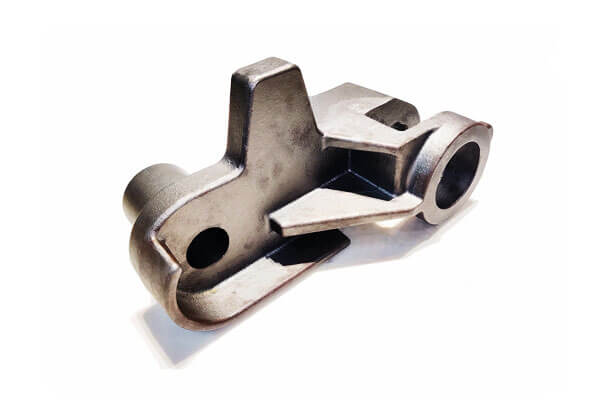
Coated-sand casting is widely used where stainless steel properties (corrosion resistance, hygienic surface, mechanical strength) are required, but the geometry, size or economic constraints make shell/investment casting impractical.
Pumps, valves and fluid-handling equipment
- Typical parts: volutes, impellers, valve bodies, valve seats, stems, pump casings.
- Why coated-sand: parts require corrosion resistance and reasonably good surface finish to minimise flow losses and improve sealing;
coated facecoats reduce sand inclusions and sand sticking in the flow paths. Large sizes and mid-volume runs favour coated sand economically.
Petrochemical and chemical process industry
- Typical parts: manifolds, fittings, valve bodies, heat exchanger housings.
- Why coated-sand: chemical plants need corrosion-resistant geometries often too large or costly for precision investment casting.
Zircon/alumina facecoats lower the risk of chemical penetration and extend service life in moderate chemical environments.
Marine and offshore hardware
- Typical parts: brackets, couplings, flange fittings, seawater pump components.
- Why coated-sand: seawater service demands stainless alloys; coated facecoats reduce embedded sand and give a surface less likely to corrode from pitting initiation sites.
For persistent seawater immersion duplex or higher alloy choices may be needed despite coating.
Food, beverage and pharmaceutical equipment
- Typical parts: hopper bodies, valve housings, mixing impellers.
- Why coated-sand: hygiene and cleanability require smooth surfaces and low inclusion content;
coated-sand enables cost-effective production of larger equipment components that meet surface cleanliness after finishing/polishing.
Power generation & thermal systems
- Typical parts: turbine brackets, exhaust manifolds, boiler components (when stainless is used).
- Why coated-sand: medium to large parts that see high temperatures or corrosive flue gases can be economically produced with robust coatings that resist molten metal interaction and improve as-cast surface condition.
Architectural and decorative stainless components
- Typical parts: railings, hardware, decorative castings.
- Why coated-sand: high surface quality and corrosion resistance combined with lower cost vs investment casting for large ornamentals.
Automotive and heavy machinery (selected)
- Typical parts: exhaust manifolds, brackets, housings for corrosive environments.
- Why coated-sand: when stainless is required for corrosion or heat resistance and part sizes are moderate to large, coated-sand provides a viable manufacturing route.
10. Conclusions
Stainless-steel coated-sand casting is a pragmatic hybrid that combines the economy and flexibility of sand casting with engineered surface coatings that protect against chemical attack and improve surface quality.
Success rests on a systems approach: proper coating chemistry and particle design, careful mold and sand engineering,
controlled thermal profiles during dewaxing/baking and pouring, and disciplined QC and supplier management.
When these elements are integrated, coated-sand cast stainless components deliver reliable performance in demanding industrial environments with attractive cost efficiency.
FAQs
Why use coated sand instead of investment/shell casting for stainless?
Coated-sand casting costs less and scales well for larger parts while coatings can achieve comparable surface quality for many applications.
Investment/shell casting yields superior surface and dimensional accuracy but at higher cost.
Which coating is best for stainless steel?
There is no single “best” coating; zircon-based coatings are often preferred for high quality because of chemical inertness.
Alumina blends and engineered silica-sol systems with inert fillers are also effective where matched to alloy and process.
How does coating affect corrosion resistance?
A good coating reduces embedded sand and reaction layers that act as initiation sites for corrosion and improves surface continuity, which enhances corrosion resistance of the final, cleaned, and finished part.
What is the most common failure mode linked to coatings?
Sand sticking and chemical penetration occur when coatings are contaminated, too thin, composed of reactive fillers, or when pouring superheat is excessive.
Do coatings change heat treatment needs?
Coatings affect local cooling rates and therefore as-cast microstructure.
Heat-treatment schedules for stainless alloys are generally governed by alloy chemistry and desired properties,
but process engineers should validate heat treatment on representative castings produced with the selected coating system.