
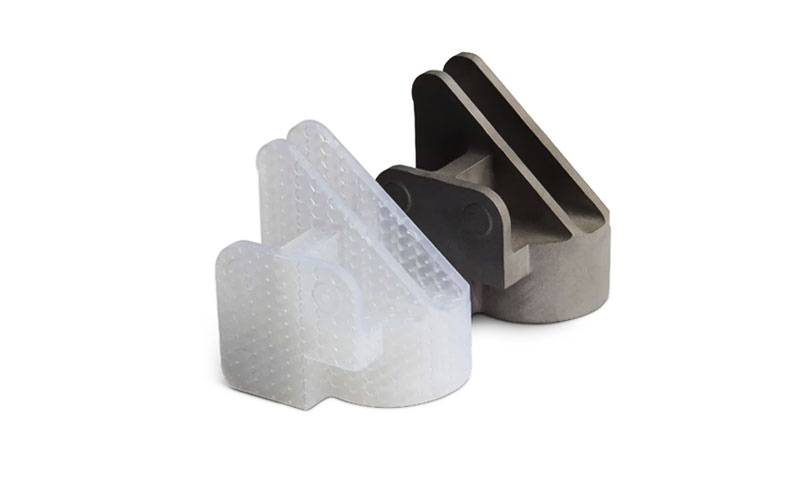
Prototype Investment Casting Metal Castings

Prototype Investment Casting Feasibility: Cost and Constraints

1. Overall Feasibility

Prototype investment casting is highly feasible when the goal is to validate a complex metal part quickly, before committing to hard tooling or high-volume production.

The investment casting industry has widely adopted hybrid strategies that use 3D-printed wax or plastic patterns,

specifically because they can reduce first-article lead time, lower cost for low-volume parts, and enable more geometric complexity than conventional tooling-driven routes.

그 말은, feasibility is not universal.

Prototype investment casting makes the most sense when the part’s geometry, target volume, and qualification burden justify a casting process rather than CNC machining, 적층 제조, or a simpler prototype route.

다시 말해서, it is often an excellent answer for complex near-net-shape metal prototypes, but not always the cheapest or fastest answer for every part.

This is an inference from the published lead-time, 비용, and process-control tradeoffs reported by investment-casting industry sources.

2. Cost Feasibility

Prototype Investment Casting

비용 측면에서, prototype investment casting is attractive because it can eliminate or reduce the need for hard tooling in early-stage development.

Industry conference material notes that printed wax/plastic patterns can significantly reduce first-article lead time and reduce cost for low-volume parts,

and that for some foundries the annual cost of printed patterns can even approach the cost of conventional hard tooling, which means the economic crossover depends heavily on volume and pattern strategy.

The cost picture becomes more favorable when the prototype is complex enough that machining would require many setups, or when the design includes internal passages or consolidated features that would otherwise need assembly.

Investment-casting literature explicitly highlights the value of complex internal geometries and reduced downstream machining as a major advantage of the process.

반면에, cost can rise quickly when the project demands very tight tolerances, unusually strict surface-finish requirements, extensive NDT, or elaborate certification.

Industry consensus notes that exceptionally close tolerances add to casting cost, that polished or special surface finishing adds cost and should only be specified when necessary, and that certification and test bars also add both direct and indirect expense.

3. Cycle Feasibility

Prototype investment casting is especially strong on cycle time when the traditional tooling path would be slow.

Without fixed tooling, the core die design and manufacturing cycle can be eliminated, and prototype ceramic cores can be produced on a relatively short schedule.

One cited example reached final dimensional and finishing standards and was ready for casting in 39 days from design conception; another required a 5-month total cycle from design to casting qualification.

The cycle advantage is most meaningful in early-stage development, where the main objective is to get a physically representative part into test as quickly as possible.

Industry sources also report that short-run investment casting using printed wax/plastic patterns has been widely adopted and that these approaches can deliver significant reductions in first-article casting lead time.

하지만, the cycle benefit is not automatic.

The same sources emphasize that successful development requires tight integration between the core, the casting design, 그리고 제조과정.

When that integration is weak, development can slow down rather than accelerate.

4. Technical Constraints and Practical Limits

The biggest limitations are geometric, quality-related, and specification-related.

Printed-pattern investment casting introduces some surface roughness and stair-stepping, and dimensional adjustments are often needed when moving from printed waxes to hard tooling.

Those are not fatal flaws, but they are real engineering constraints that affect prototype readiness.

Surface finish is another important constraint. Investment casting can produce good surfaces, but exact finish requirements must be managed carefully,

because special finishing operations add cost and because surface-finish expectations can become restrictive, especially when internal features are involved.

Industry consensus also notes that surface-finish standards and visual acceptance criteria can be particularly demanding, and that surface finish requirements may preclude additive-manufacturing-based approaches for some internal features.

Dimensional tolerance is feasible, but it is not unlimited.

Foundry guidance states that very close tolerances can be achieved only when truly necessary, and that they increase cost.

At the design level, investment-casting guidance also stresses controlling wall thickness, avoiding problematic undercuts and overhangs, and respecting the process’ fill and shell-removal constraints.

Inspection and qualification can also become a bottleneck.

Industry consensus highlights that test bars are expensive, that cert plans should be agreed in advance, and that traceability and certificate detail can materially affect both cost and lead time.

In prototype programs, this means the “prototype” may be delayed not by casting itself, but by the qualification package around it.

5. Design and Volume Dependence

Prototype investment casting is most feasible when the part has enough geometric complexity that casting creates genuine value.

That includes undercuts, 막힌 구멍, angular passages, and thin or consolidated shapes that are difficult or expensive to machine conventionally.

Investment-casting guidance explicitly notes that the process can handle many shapes that are impossible to machine or not accurate enough in sand casting.

It is less attractive when the prototype is a simple prismatic part, when tolerances are ultra-tight across all features, or when the part can be made faster and cheaper by CNC machining.

The literature on printed plastic patterns also shows that geometric constraints can reduce the practical lead-time gain in some cases, and that CNC machining of conventional patterns and core boxes can remain highly cost competitive.

6. Bottom-Line Feasibility

Prototype investment casting is highly feasible as a development tool, especially for complex metal parts that need a fast first article, realistic material behavior, and near-net-shape geometry.

It is most compelling when it helps collapse multiple machining and assembly steps into one cast component and when the prototype’s value lies in validating function, 맞다, 흐름, or structural behavior rather than perfect cosmetic finish.

The practical rule is simple: the more complex the geometry and the higher the value of early validation, the stronger the case for prototype investment casting.

The more the project is dominated by extreme finish requirements, very tight tolerances, or heavy certification burden, the more the cost and schedule advantages shrink.

That is the central feasibility divide.

맨 위로 스크롤