1. Introduction
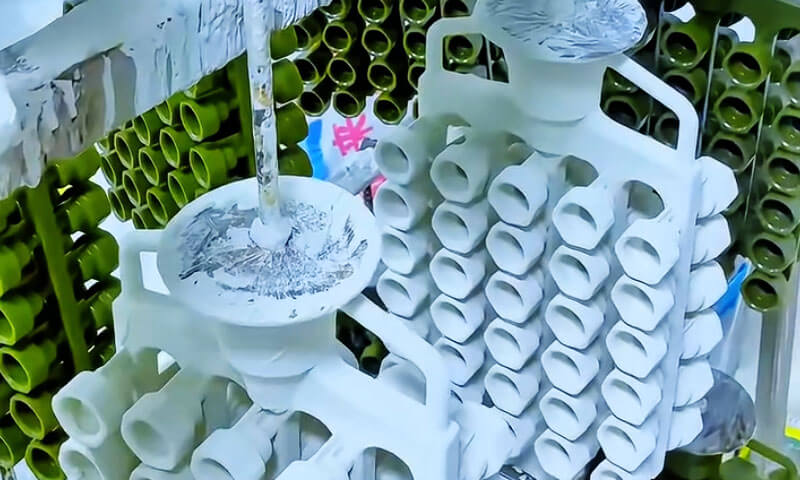
An investment-cast ductile-iron butterfly valve combines the mechanical advantages of nodular (ductile) iron with the geometric freedom and surface quality of precision (investment) casting.
The result is a compact valve body and disc with excellent dimensional accuracy, fine surface finish, and controlled microstructure—attributes that support tight-seat assemblies, complex internal passages and compact actuation packages.
This configuration is particularly attractive for small-to-medium valve sizes where intricate geometry, accurate seal interfaces and reduced finishing are priorities (e.g., HVAC, water distribution, HVAC, instrumentation and industrial fluid handling).
2. What is an investment casting ductile iron butterfly valve?
An investment casting ductile-iron butterfly valve is a quarter-turn flow control device in which the valve body and frequently the disc are produced by investment casting using a ductile (nodular) iron alloy.
Investment casting (also called precision or lost-wax casting) allows the production of near-net-shape parts with fine detail, thin walls and good as-cast surface quality.
After casting, critical surfaces (bore, seat faces, stem holes) are finish-machined, the trim is fitted (stem, bushings, seat material) and the assembled valve is tested (hydrostatic, seat leakage, torque and cycle tests) to the required standard.
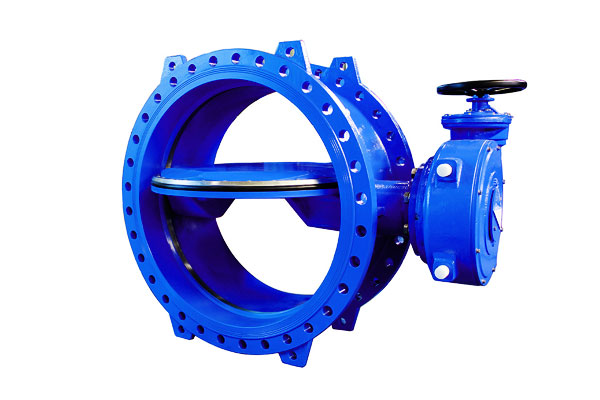
Investment casting offers:
- tighter dimensional tolerances and better roundness for bores;
- superior surface finish reducing seat leakage risk and machining needs;
- ability to cast thin sections, complex ribs, internal bosses and integral flow features.
This approach is most cost-effective for valves where per-part finishing must be minimized and where complex features (integral ribs, flow-control geometries, internal bosses) improve performance or mounting.
3. Material Selection: Ductile Iron Grades and Adaptability to Butterfly Valves
The performance of investment casting ductile iron butterfly valves is fundamentally determined by the selection of ductile iron grades.
Core Ductile Iron Grades and Performance Indicators
| Ductile iron grade | Corresponding standard | Representative mechanical properties | Typical butterfly valve service envelope |
| EN-GJS-400-15 (GGG40) | EN 1563 / ASTM A536 family (≈ 60-40-18) | Rm: ~370–430 MPa | Rp0.2: ~250–300 MPa | Elongation: ≥15% (typ. 15–20%) | Low to medium pressure service (commonly Class 150 / PN10–PN16), normal temperature (≈ −20 °C to +80 °C), non-corrosive or mildly corrosive media such as water, air and clean oils; widely used in municipal water, HVAC and general industrial pipelines |
| EN-GJS-500-7 (GGG50) | EN 1563 / higher-strength ductile iron family | Rm: ~450–550 MPa | Rp0.2: ~320–370 MPa | Elongation: ≥7% (typ. 7–12%) | Medium pressure service (up to Class 300 depending on design), moderate temperature (≈ −20 °C to +120 °C), mildly corrosive or higher-load industrial fluids; suitable for refinery auxiliary lines and chemical light-oil systems |
EN-GJS-600-3 (GGG60) |
EN 1563 / high-strength ductile iron family | Rm: ~550–700 MPa | Rp0.2: ~370–420 MPa | Elongation: ≥3% (typ. 3–6%) | High-pressure or high-load applications (commonly Class 600 by design validation), temperatures up to ≈150 °C; used where strength and wear resistance are prioritized over ductility |
| EN-GJS-350-22-LT | EN 1563 low-temperature grade / ASTM low-temperature iron intent | Rm: ~320–380 MPa | Rp0.2: ~180–230 MPa | Elongation: ≥22% | Low-temperature service (down to ≈ −40 °C), cryogenic or cold-climate media such as LNG service auxiliaries, refrigerants and cold-region municipal pipelines requiring high impact toughness |
4. Investment casting process as applied to valve bodies and discs
Why investment casting for valve components?
Investment casting (lost-wax / ceramic shell) yields high-fidelity geometry, thin section capability (2–4 mm practical minimum in many shops), and superior surface finish (typical Ra 3–6 µm on shell surface).
For valve bodies and discs, this means reduced machining, true concentric bores, and better seat geometry—critical for achieving low leakage and predictable torque.
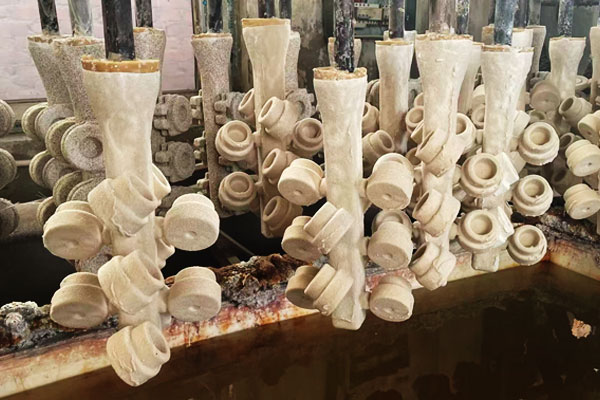
Critical process steps and controls
- Pattern and gating design: multi-part wax trees must be configured to ensure sound feeding, minimize directional solidification defects, and allow efficient shell removal.
- Shell build and dewaxing: shell thickness and drying control the thermal mass and influence solidification rate; ceramic shell bake schedules must avoid macrocracking.
- Melting and nodularization: the molten iron must be treated for spheroidization (magnesium/RE), with tight control of S and Mg levels and minimal hold time between nodulization and pour to preserve nodularity.
In investment casting the small batch/ladle approach makes timing and treatment particularly important. - Pouring and solidification: pouring temperature and mold preheat affect microstructure; appropriate gating/chill design is required to avoid hot spots and shrinkage porosity near sealing faces.
- Shell removal and cleaning: careful post-cast cleaning prevents surface damage to sealing faces; ceramic residue must be fully removed before machining/sealing.
- Heat treatment (optional): stress relief or anneal cycles reduce residual stresses and improve dimensional stability for precision bores.
- Machining and finishing: final bore reaming, seat machining, and stem slotting are performed to tight tolerances. Investment cast parts frequently reduce the volume of machining compared with sand cast equivalents.
- Inspection and NDT: metallography (nodularity), mechanical testing, and NDT (penetrant, radiography for critical seats) validate integrity.
Typical tolerances and finishes
- Dimensional tolerance: typical investment casting tolerances are ±0.1–0.5 mm depending on part size; bores often finish-machined to tighter limits.
- Surface finish: as-cast shell surface Ra ≈ 3–6 µm; machined sealing faces better (Ra ≤ 0.8–3.2 µm depending on seat design).
- Minimum wall: practical minimum wall thickness often 2–4 mm, but designers should consult foundry capabilities for structural sections.
5. Design and engineering considerations
Hydraulic and flow design
- Disc profile optimization: disc shape (concentric, offset, cam-type) controls flow coefficient (Cv), pressure drop and sealing behavior.
Investment casting enables complex cam/disc profiles to reduce torque and achieve better throttling characteristics. Use CFD to verify flow separation, cavitation risk and torque prediction through the operating range. - Seat geometry and sealing: ensure seat contact line geometry supports a predictable sealing zone under expected compression;
consider resilient seat compression, metal-to-metal seating, or double-offset designs for tight shutoff. Precision casting improves the repeatability of seat geometry.
Structural design and stiffness
- Ribs and bosses: investment casting allows thin ribs and optimized webbing to balance stiffness and weight while avoiding stress concentration.
Finite element analysis (FEA) should validate stress under maximum differential pressure and torque from actuation. - Bearing and stem support: design bearing journals and stem support to minimize eccentric loading and ensure even seat engagement; bearing surfaces often require insert bushes or hardened sleeves.
Manufacturability
- Draft and fillets: maintain adequate draft on features; avoid trapped cores and include sweep/undercut allowances where required.
- Gating location: choose gates to avoid feeding critical sealing surfaces; gating must be planned so that machining can remove gate scars from non-functional areas.
- Assembly and actuation: allow access for actuator mounting, position indicators and packing replacement.
If using geared actuators or electric actuators, ensure mounting pads conform to ISO or manufacturer standards.
Sealing performance and leakage class
- Specify leakage class per application (e.g., EN 12266, API, MSS standards). For potable water or tight shutoff, resilient seats or triple-offset designs provide lower leakage rates; investment casting can help achieve seat concentricity required for these classes.
6. Surface protection, sealing systems and trim materials
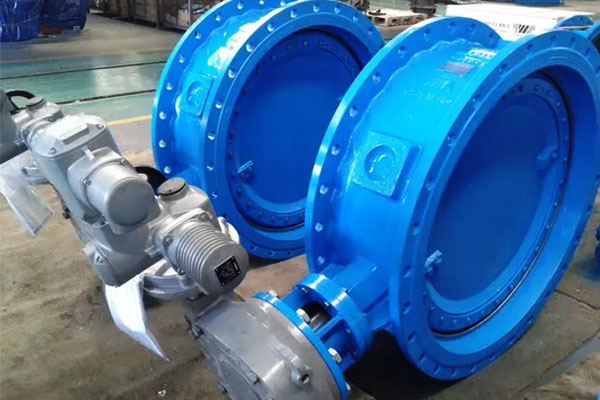
Corrosion protection and linings
- External coatings: epoxy painting, powder coating, or zinc systems for ambient corrosion protection.
- Internal linings: fusion-bonded epoxy (FBE) or cement mortar for potable water and aggressive fluids; rubber liners (EPDM/NBR) for abrasive slurry services where corrosion and abrasion control are required.
For chemicals, select lining compatible with media, temperature and pressure. - Metallic overlays: stainless or duplex sleeves in bore and seat areas for improved corrosion and wear resistance.
Seats and seals
- Elastomeric seats: EPDM for water and steam-free applications; NBR for hydrocarbons; EPDM/NR blends depending on compatibility.
- PTFE/TFM seats: for chemical compatibility and low friction; consider back-up rings when pressure differentials are high.
- Metal seats: used for high temperature or abrasive conditions; require very precise disc/seat geometry and often a hardened contact zone.
Trim material selection
- Stems: stainless steels (typ. 304/316) or duplex for increased strength and SCC resistance.
- Bearings/bushings: bronze, composite or PTFE-lined bearings for low friction and long life.
- Fasteners: corrosion-resistant fasteners matched to service and coating system.
7. Performance, service limits and failure modes
Typical performance and service limits
- Pressure classes: investment cast ductile iron bodies commonly used in PN10–PN16 / ANSI 150 class for small-to-medium sizes; higher classes possible with reinforced designs or liners but require separate qualification.
- Temperature limits: base ductile iron is mechanically stable up to roughly 200–250 °C; for sustained elevated temperatures consider cast stainless or alloy steels. Seat material and seals typically dictate working temperature envelope.
- Size range: investment casting is most economical and practical for small-to-medium valves—commonly up to several hundred millimetres bore depending on foundry capabilities (consult supplier for exact limits).
Common failure modes
- Corrosion and pitting: inadequate lining/coating or unsuitable material selection leads to wall loss and eventual leakage.
- Seat wear and extrusion: abrasive fluids wear resilient seats or cause extrusion under high differential pressure.
- Galling and stem wear: poor material pairing or inadequate lubrication in bearings leads to increased torque and seizure.
- Porosity/inclusion fatigue initiation: internal casting defects or non-metallic inclusions can act as crack initiation sites under cyclic loading.
- Cavitation and erosion of disc edges: high velocity or flashing conditions can erode discs and seats rapidly.
- Thermo-mechanical distortion: inadequate stress relief or thermal gradients during service cause distortion, impairing sealing.
Mitigation strategies
- Select appropriate linings and seat materials for media; specify NDT and acceptance limits for porosity;
use sacrificial wear liners for abrasive services; design for serviceability (replaceable seats/bushings); perform CFD to identify cavitation risk and design anti-cavitation trims where required.
8. Applications of ductile iron butterfly valve
Common markets and services where investment-cast ductile-iron butterfly valves are especially well suited:

- Municipal water distribution & treatment — resilient seats, epoxy linings, good cost/performance balance.
- HVAC and building services — tight shutoff, compact actuators and repeatable operation.
- Fire protection systems (where specified) — subject to local standards and coatings.
- Light industrial process lines — cooling water, non-aggressive chemicals, compressed air.
- Marine and offshore auxiliary systems (with appropriate coatings and trim selection).
9. Cost, lifecycle and sustainability considerations
Cost factors
- Unit cost for small-to-medium production runs may be higher per raw kilogram than sand casting but lower overall due to reduced machining and assembly.
- Tooling and pattern cost for investment casting is higher than for sand molds but favorable when tight tolerances or high surface quality reduce post-processing.
- Trim and coating selection materially impact the total system cost (PTFE seats and stainless stems add cost but extend life in aggressive fluids).
Lifecycle
- Properly coated and maintained ductile-iron butterfly valves can provide long service lives in potable water and HVAC systems.
Replacement costs are largely driven by maintenance intervals for seats and bearings rather than body failure.
Sustainability
- Recyclability: ductile iron is highly recyclable; scrap from production and end-of-life castings is readily reclaimed by ferrous recyclers.
- Energy & carbon: investment casting is energy-intensive in shell manufacture and melting, but reduced machining and material use in near-net shapes can offset part of the lifecycle footprint.
Lifecycle assessments should compare whole-system impacts (including coatings and service life) for a fair comparison.
10. Comparison with other casting processes
| Property / Criterion | Investment casting (lost-wax / ceramic shell) | Sand casting (green sand / resin sand) | Shell-mold casting (shell / shell-mould) |
| Dimensional tolerance (typ.) | ±0.1 – 0.5 mm (depends on size) | ±0.5 – 2.0 mm | ±0.2 – 1.0 mm |
| As-cast surface finish (Ra) | ≈ 3 – 6 μm | 6 – 25 μm | ≈ 3 – 8 μm |
| Minimum practical wall thickness | 2 – 4 mm | 6 – 8 mm (often thicker) | 4 – 6 mm |
| Typical part size range (economical) | Small → medium (e.g., DN15 → DN300 typical) | Small → very large (economical for large diameters) | Small → medium/large (larger than investment, smaller than biggest sand parts) |
| Tooling / pattern cost | High (wax patterns / dies) | Low (simple cope/drag moulds) | Medium (metal pattern, higher than sand) |
| Per-part casting cost (simple shape) | Relatively high | Low (most economical for simple shapes) | Medium |
Per-part cost (complex/precision shape) |
Competitive / often lower total cost (less machining) | Higher (requires significant machining) | Competitive (better finish than sand, lower than investment) |
| Geometric complexity / detail capability | Very high (thin walls, internal features) | Low → moderate | Moderate → high |
| Machining allowance / post-processing | Minimal (near-net shape) | Significant (more stock removal) | Moderate |
| Cycle time / lead time | Medium → long (pattern & shell cycles; batch processing) | Short → medium | Medium |
Production volume suited |
Low → medium → high (best where precision reduces downstream cost) | Low → very high (best for large volumes & large parts) | Medium → high (balanced option for mid volumes) |
| Feeding & shrinkage management | Requires careful riser/gating due to rigid shell; directional feeding critical | Easier to feed; sand yields more forgiving compensation | Better than sand for detail; still need good feeding design |
| Nodularization / metallurgical control (ductile iron) | Requires strict timing after Mg treatment; smaller batches easier to control | Good — established practice for large pours | Good — better than sand for thin features but must control timing |
Typical valve applications where preferred |
Precision small/medium valve bodies & discs, complex seat geometries, tight-tolerance bores | Large valve bodies, heavy industrial valves, simple geometries | Medium/large valves needing better finish/tolerance than sand (e.g., small→large series) |
| Primary advantages | Best detail, best surface finish, thin sections, lower final machining | Low tooling cost, best for very large/cheap parts, flexible | Good finish & tolerance with lower tooling cost than investment |
| Primary disadvantages | Higher tooling & process cost; limited very large parts; longer setup | Coarse finish, larger machining allowances, thicker sections required | Less geometric freedom than investment; tooling cost above sand |
11. Conclusions
Investment casting of ductile-iron butterfly valves merges precision geometry with robust cast metallurgy.
When specified and produced under tight process control — nodularity targets, metallographic checks, NDT, and defined finish requirements — these valves deliver excellent seat repeatability, reduced finishing cost, and reliable service in water, HVAC and many industrial services.
Careful selection of seat materials, linings and trim is required to match media and temperature.
For corrosive, very high temperature or very large-bore applications, alternative materials or casting routes should be evaluated.
FAQs
What sizes are practical for investment-cast ductile-iron butterfly valves?
Practically DN15 up to DN300 are the sweet spot for investment casting; larger diameters are possible but cost and tooling escalate — consult foundry capabilities.
How tight can the seat leakage be with investment casting?
With precision bores and quality resilient seats, valves can achieve industry-standard seat leakage classes used by purchasers; specify the desired leakage class and require verification testing during acceptance.
Is ductile iron corroded by potable water?
Untreated ductile iron will corrode. For potable water, internal fusion-bonded epoxy or cement mortar linings and corrosion-resistant trims are standard practice.
How does investment casting affect valve torque?
Investment casting improves disc bore concentricity and seat geometry, which typically lowers variation in operating torque and can result in lower average torque versus less accurate castings.
Actual torque depends mainly on disc profile, seat material and differential pressure.
How does investment casting compare cost-wise to sand casting?
Unit cast cost is higher for investment casting, but total part cost can be lower for complex parts due to reduced machining and assembly. For simple, large parts sand casting is usually less costly.