
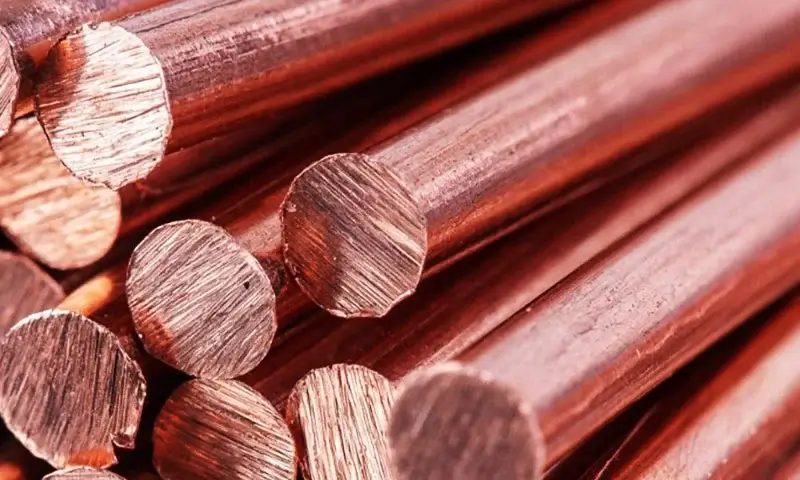
Copper is one of the most important engineering metals, and its density is one of the first properties engineers consult when evaluating it for design, manufacturing, and material substitution.
At room temperature, copper’s density is commonly given as about 8.94 to 8.96 g/cm³, which is equivalent to roughly 8,940 to 8,960 kg/m³.
In practical terms, that makes copper a relatively heavy metal: far denser than aluminum, somewhat denser than steel, and much heavier than most lightweight structural metals.
This density has direct consequences. It affects part weight, shipping cost, support structure design, inertia in moving systems, and the feasibility of replacing copper with another material.
At the same time, copper remains indispensable because its density comes with a package of valuable properties: excellent electrical conductivity, high thermal conductivity, good corrosion resistance, and reliable performance in demanding environments.
To understand copper properly, it is not enough to memorize a single number.
You also need to know what density means, why the value changes slightly with temperature and purity, how copper compares with related metals and alloys, and why engineers still choose copper even when its weight is a disadvantage.
1. What Does Density Mean?
Density describes how much mass is packed into a given volume. The basic relationship is simple:
Density = Mass ÷ Volume
If two objects have the same size but one is denser, the denser object will weigh more. That is why density matters so much in design and manufacturing.
It tells you how heavy a part will be before it is made, how much material a component will require, and how a material will behave when mass is important.

Density is usually expressed in one of these units:
- g/cm³
- kg/m³
- lb/in³
For metals, density is a fundamental property because it helps connect material choice to practical engineering outcomes.
A dense material may offer performance advantages, but it can also create challenges in weight-sensitive systems.
2. The Density of Pure Copper
For most engineering purposes, the density of copper at room temperature is treated as:
| Property | Typical value |
| Density of copper | 8.94–8.96 g/cm³ |
| Density of copper | 8,940–8,960 kg/m³ |
| Density of copper | 0.323–0.324 lb/in³ |
That small range is normal. Different references may use slightly different temperatures, measurement conventions, or rounding practices.
In real design work, these differences are not significant unless the application is highly sensitive to weight or volume.
3. Why Copper Feels So Heavy
Copper often surprises people because a small piece can feel much heavier than it looks. That sensation comes directly from its high density.
At room temperature, copper has a density of about 8.94–8.96 g/cm³

The explanation is straightforward: copper atoms are tightly packed and relatively massive compared with many other common engineering metals.
Because density equals mass divided by volume, a material with more mass in the same space will always feel heavier.
Copper belongs in that category, which is why even compact parts can have a substantial weight.
That matters in real applications. A copper bus bar, connector, tube, or heat-exchange element can deliver excellent performance, but it will also add more mass than a comparable aluminum part.
In systems where every kilogram counts, density becomes a design constraint rather than a background fact.
4. Copper Density Versus Copper Alloys
Below is an expanded comparison with more common copper and copper-alloy UNS grades.
The density values are shown in kg/m³, lb/in³, and g/cm³ for convenient engineering reference; the kg/m³ figures are rounded conversions of the published room-temperature density data.
| Material | UNS Number | Typical Density (g/cm³) | Typical Density (kg/m³) | Typical Density (lb/in³) | Typical Notes |
| Oxygen-Free Electronic Copper | C10100 | 8.94 | 8,940 | 0.323 | Very high-purity copper with density essentially at the standard copper range. |
| Phosphorus-Deoxidized Copper | C12200 | 8.94 | 8,940 | 0.323 | Copper with very similar density to pure copper, commonly used in tube and plumbing applications. |
| Cartridge Brass | C26000 | 8.53 | 8,530 | 0.308 | Lighter than pure copper; a common general-purpose brass. |
| Yellow Brass | C27000 | 8.47 | 8,480 | 0.306 | Slightly lighter than C26000, still in the brass family. |
Muntz Metal / Brass Family |
C28000 | 8.39 | 8,390 | 0.303 | A lower-density brass grade relative to pure copper. |
| Phosphor Bronze | C51000 | 8.86 | 8,860 | 0.320 | Close to copper in density, with stronger spring and wear behavior. |
| Phosphor Bronze | C52100 | 8.80 | 8,800 | 0.318 | Slightly lighter than pure copper, widely used for wear and fatigue resistance. |
| Leaded Phosphor Bronze | C54400 | 8.86 | 8,860 | 0.320 | Density remains close to copper; used where machinability and bearing performance matter. |
Copper-Nickel Alloy |
C70600 | 8.94 | 8,940 | 0.323 | Density close to copper; valued for corrosion resistance, especially in marine service. |
| Bearing Bronze | C93200 | 8.91 | 8,910 | 0.322 | Very close to copper in density; common in bearings and bushings. |
| Aluminum Bronze | C95200 | 7.64 | 7,640 | 0.276 | Much lighter than pure copper, with strong wear and corrosion performance. |
| Aluminum Bronze | C95400 | 7.45 | 7,450 | 0.269 | A widely used cast aluminum bronze with high strength and good corrosion resistance. |
Nickel Aluminum Bronze |
C95500 | 7.53 | 7,530 | 0.272 | Similar to other aluminum bronzes, with excellent marine performance. |
| Manganese Bronze | C86300 | 7.83 | 7,830 | 0.283 | Significantly lighter than pure copper, but still strong for heavy-duty parts. |
| Aluminum Bronze | C60600 | 8.17 | 8,170 | 0.295 | Lighter than copper, with a lower density than most brass and bronze grades. |
| Tin Bronze | C81500 | 8.82 | 8,820 | 0.319 | Close to copper in density, while offering a bronze-type property balance. |
5. Why copper density matters in real engineering work
Copper’s density influences design decisions in several ways.

Mass estimation
Engineers use density to calculate part weight from geometry.
If a copper part has a known volume, density lets designers estimate mass early in the design process and compare it against alternative materials.
That makes density a core parameter in mechanical and manufacturing calculations.
Material substitution
When a design needs lower weight, engineers often compare copper with aluminum or lighter alloys.
Because copper is more than three times as dense as aluminum, substitution can dramatically reduce mass.
NIST’s reference values make that contrast clear: 8.96 g/mL for copper versus 2.70 g/mL for aluminum.
Thermal and electrical hardware
Copper is widely used in electrical systems because it combines excellent conductivity with a compact form factor.
Its density does not make it lighter, but it does help explain why copper parts are so effective when space is limited and high conductivity is required.
Britannica identifies copper as an unusually good conductor of electricity and heat, which is part of the reason engineers continue to accept its weight penalty in many applications.
Shipping and logistics
In manufacturing, density affects freight cost, handling, and storage planning. A copper product may look small, but its weight can be significant relative to its size.
That is especially relevant for cables, bars, tubes, and machined components sold by length or volume.
6. What Influences the Density of Copper?
Copper density is not perfectly fixed under every condition. Several factors affect the exact value.
Temperature
As copper gets warmer, it expands slightly. Volume increases, while mass stays the same, so density decreases.
NIST lists copper’s linear thermal expansion coefficient at 16.66 × 10⁻⁶/K at 295 K, which shows that copper does expand measurably with temperature.
Copper Development Association tables also show temperature-dependent physical values for copper, reinforcing the fact that density should always be interpreted with a temperature reference.
Purity
Pure copper and copper with impurities do not always have exactly the same density. Even small differences in composition can slightly shift the mass-to-volume relationship.
That is why datasheets often specify “high-purity copper,” “electrolytic copper,” or another defined grade rather than assuming every copper product is identical.
Processing and structure
In dense wrought copper, the measured density should stay close to the reference value. However, porosity, voids, or manufacturing defects can reduce the effective bulk density of a finished piece.
In other words, a real component can be slightly less dense than ideal copper if it contains internal discontinuities.
That matters especially in cast or powder-processed parts. This point follows directly from how density is measured in real materials: volume that contains voids contributes less mass than fully dense metal.
Alloying
Once copper is alloyed with other elements, the density changes. Brass, bronze, and specialized copper alloys may be lighter or heavier than pure copper depending on their composition.
7. Standardized Methods for Measuring Copper Density
Accurate density measurement of copper and copper alloys follows international industrial and scientific standards, ensuring consistency and credibility:
- Archimedes’ Principle (ASTM B311): The most common method for solid copper components—measuring mass in air and buoyant mass in distilled water to calculate volume and density.
Used for bars, sheets, machined parts, and castings. - Pycnometer Method: For copper powder, granules, or porous samples, measuring volume via liquid displacement in a calibrated pycnometer.
- Gas Pycnometry: High-precision scientific measurement for ultra-pure copper samples, using helium gas to determine true volume with ±0.001 g/cm³ accuracy.
- Bulk Density Testing: For porous copper or powder metallurgy parts, measuring overall mass and geometric volume to calculate apparent bulk density.
All industrial measurements are standardized to 20°C to eliminate temperature-induced errors.
8. Where Copper Density Matters Most
Copper’s density plays a practical role across many industries.

Electrical engineering
Copper is widely used in wires, bus bars, connectors, motors, and switchgear. Its conductivity makes it valuable, while its density affects enclosure design and structural support.
Thermal systems
Heat exchangers, radiators, and cooling components often rely on copper because it transfers heat efficiently. Density matters because these systems must balance thermal performance with mass.
Mechanical manufacturing
Machined copper parts, fittings, and tubing require accurate density data for costing, handling, and assembly planning.
Transportation and aerospace
Weight-sensitive industries often treat copper carefully because it can raise the total mass of a system quickly. Engineers may choose lighter materials where conductivity requirements allow.
Power and energy systems
Copper remains essential in transformers, generators, and electrical infrastructure because performance is often more important than weight alone.
9. Common Misconceptions About Copper Density
“Copper density is exactly one fixed number.”
Not quite. The value changes slightly with temperature, purity, and measurement method.
“All copper-based materials have the same density.”
False. Brass, bronze, and specialized copper alloys can differ significantly.
“Density tells you everything about a material.”
It does not. Density is important, but conductivity, strength, corrosion resistance, fatigue behavior, and cost are also critical.
“A denser material is always better.”
Not necessarily. In lightweight systems, high density can be a disadvantage even when the material performs well in other respects.
10. Why Engineers Still Use Copper Despite Its Density
Copper is dense, but it remains one of the most valuable metals in engineering. The reason is balance.
Engineers often accept the weight penalty because copper offers a rare combination of properties:
- excellent electrical conductivity
- excellent thermal conductivity
- good corrosion resistance
- proven durability
- strong industrial availability
- straightforward joining and fabrication in many applications
In short, copper is not chosen because it is light. It is chosen because it performs exceptionally well when conductivity and reliability matter more than mass.
11. Comparative Density: Copper vs. Common Metals
| Metal | Typical Density (g/cm³) | Typical Density (kg/m³) | Typical Density (lb/in³) | Relative to Copper | Notes |
| Copper | 8.96 | 8,960 | 0.324 | Baseline | Dense, highly conductive, and widely used in electrical and thermal applications. |
| Aluminum | 2.70 | 2,700 | 0.098 | Much lighter | A common lightweight substitute when mass reduction is a priority. |
| Magnesium | 1.74 | 1,740 | 0.063 | Much lighter | One of the lightest structural metals in common use. |
| Steel (carbon steel) | 7.85 | 7,850 | 0.284 | Slightly lighter | Close to copper in absolute feel, but still noticeably less dense. |
Stainless Steel 304 |
8.00 | 8,000 | 0.289 | Slightly lighter | Often used where corrosion resistance is needed with moderate density. |
| Iron | 7.87 | 7,870 | 0.284 | Slightly lighter | The base metal for steel, with density just below copper. |
| Titanium | 4.51 | 4,510 | 0.163 | Much lighter | Strong-to-weight efficient, especially in aerospace and medical uses. |
| Nickel | 8.90 | 8,900 | 0.322 | Slightly lighter | Close to copper in density, often used in high-performance alloys. |
Zinc |
7.14 | 7,140 | 0.258 | Lighter | Common in galvanizing and die-casting alloys. |
| Lead | 11.34 | 11,340 | 0.410 | Much heavier | Denser than copper, but far less useful structurally. |
| Silver | 10.49 | 10,490 | 0.379 | Heavier | Denser than copper and far more expensive, though highly conductive. |
| Gold | 19.30 | 19,300 | 0.698 | Much heavier | Extremely dense and used mainly where cost and chemical stability justify it. |
12. Conclusion
The density of copper is usually taken as about 8.94–8.96 g/cm³ at room temperature. That value places copper among the denser common engineering metals, well above aluminum and slightly above stainless steel.
From an engineering standpoint, copper’s density matters because it influences mass, logistics, substitution choices, and structural design.
Yet density alone never tells the whole story. Copper remains essential because it pairs that relatively high density with outstanding electrical and thermal conductivity, strong corrosion resistance, and mature industrial supply chains.

