
1. Introduction
Tube connectors — couplers, elbows, manifolds, flanged tube ends and multi-port distribution blocks — are critical components in fluid and structural systems.
When service demands corrosion resistance, strength and complex internal geometry, casting stainless steel is a proven route: it produces near-net-shape parts with integrated bosses, ribs and internal passages that minimize welding, assembly steps and leak risk.
2. What is a Casting Stainless Steel Tube Connector?
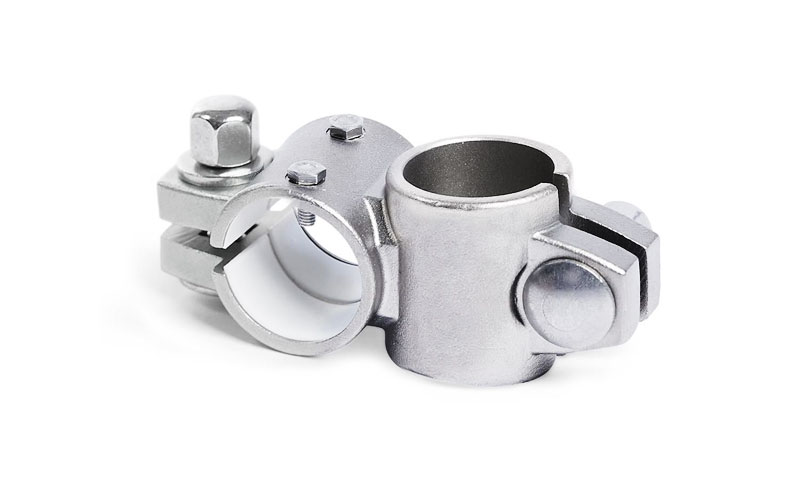
A casting stainless steel tube connector is a component produced by pouring molten stainless alloy into a mold to form a part whose function is to join, transition, terminate or distribute tubes, pipes or hoses.
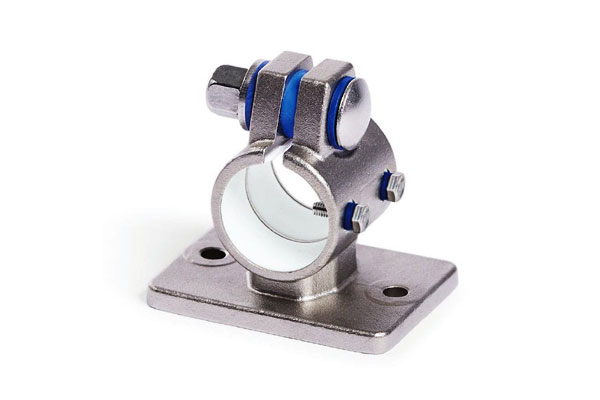
Typical connectors include threaded couplings, slip-fit flanges, elbows with integrated ports, multi-port manifolds and sanitary fittings.
Casting permits integration of mounting bosses, internal passages, ribs and custom geometries not practical or economical as fabricated assemblies.

Typical functions & application space for tube connectors
- Fluid couplings and adapters for water, process fluids, steam and chemical services.
- Distribution manifolds for instrumentation, gas, hydraulic or coolant distribution.
- Sanitary tube connectors in food, beverage and pharmaceutical systems (when electropolished / passivated).
- Architectural and structural tube joints (railings, balustrades, lighting).
- High-temperature or corrosive process connectors (selected stainless grades or higher-alloy castings).
3. Why Choose Casting Stainless Steel — Material Advantages & Limits
Advantages
- Near-net shape: complex features (cores, internal passages, bosses) cast in one piece—reduces welding and assembly cost.
- Corrosion resistance: stainless alloys form a chromium-rich passive film; cast 300-series equivalents (cast 304/CF8, cast 316/CF8M) provide excellent general corrosion resistance.
- Mechanical performance: cast stainless has good toughness and ductility (typical as-cast UTS ≥ 485 MPa, elongation 25–35%) for many connector duties.
- Durability: good fatigue and impact performance when porosity and defects are controlled.
- Recyclability: stainless scrap is well recycled—casting can be an environmentally efficient route when designed for reuse and material recovery.
Limits and tradeoffs
- Porosity and inclusions risk: if melt cleanliness, degassing or feeding is poor, internal defects can reduce pressure integrity and fatigue life.
- Localized corrosion risk in chlorides: cast 304 equivalents lack Mo; for chloride-rich service (seawater, brines) upgrade to Mo-bearing cast 316 (CF8M) or duplex structures.
- Higher initial tooling and pattern costs for precision casting methods (investment/shell) compared with simple machined fittings; justified only by volume or performance.
- Welding & sensitization: higher carbon cast grades can sensitize in the 450–850 °C range—use low-C variants (cast 304L/CF3) or controlled welding practice if extensive welding is required.
4. Material Selection — Stainless Grades and Tradeoffs
| Grade (Cast) | Typical Composition Highlights | Key Properties | Corrosion Resistance (Practical) | Typical Connector Applications |
| CF8 (cast 304 equivalent) | Cr 17–21%, Ni 8–12%, C ≤0.08% | Good ductility and toughness; typical UTS ~485 MPa or higher | Good general corrosion resistance in water, air, food-grade media; limited pitting resistance in chlorides | General-purpose tube connectors, manifolds, pump/valve housings in non-chloride environments |
| CF3 (cast 304L equivalent) | Same Cr/Ni balance as CF8 but C ≤0.03% | Similar strength and toughness; improved post-weld microstructural stability | Same general corrosion resistance as CF8; improved resistance to sensitization-related corrosion | Sanitary connectors, welded manifolds, low-temperature piping requiring extra weld reliability |
| CF8M (cast 316 equivalent) | Cr 16–18%, Ni 9–12%, Mo 2–3%, C ≤0.08% | Comparable strength; improved resistance to aggressive media; good toughness | Significantly better pitting/crevice resistance; preferred for chloride-containing fluids | Marine connectors, chemical process fittings, seawater manifolds, chlorinated liquid transfer |
CF3M (cast 316L equivalent) |
Same as CF8M but C ≤0.03% | Same mechanical profile with excellent stability in heat-affected zones | Excellent in chloride-containing environments, especially where welding occurs | Critical welded tube connectors, food/pharma fluid systems, brine transfer assemblies |
| Cast Duplex (e.g., CD3MN / CD4MCuN) | High Cr (≈22–25%), moderate Ni, balanced ferrite–austenite microstructure | High strength (yield ~450–550 MPa), low thermal expansion, good toughness | Very high pitting/crevice and SCC resistance, outperforming 316 in many chloride cases | High-pressure manifolds, seawater/RO plants, offshore tube connectors |
| Ni-base Cast Alloys (e.g., Hastelloy, Inconel types) | Ni typically >50%, Cr/Mo additions as needed | Exceptional high-temperature and corrosion performance | Outstanding resistance in strong acids, halides and reducing environments | Extreme chemical-duty connectors, high-temperature process connections |
5. Casting Processes Suitable for Stainless Steel Tube Connectors
The choice of casting process for stainless steel tube connectors depends on part size, geometry complexity, tolerance requirements, surface finish, and production volume.

| Casting Process | Dimensional Tolerance (per 100 mm) | Surface Roughness (Ra, μm) | Ideal Part Size / Complexity | Notes |
| Investment Casting (Lost Wax) | ±0.1–0.3 mm | 1.6–3.2 | Small to medium parts (≤50 kg), high-precision fittings | Excellent surface finish and detail; ideal for sanitary connectors and intricate internal passages; higher tooling cost; moderate volumes |
| Sand Casting | ±0.5–1.0 mm | 6.3–12.5 | Large parts (≥50 kg), complex geometries | Flexible, low tooling cost; allows large connectors with internal cores; rougher surface, requires more machining |
| Lost Foam Casting | ±0.3–0.5 mm | 3.2–6.3 | Medium parts, complex internal cavities | Foam pattern vaporizes during pour, enabling complex geometries without cores; moderate surface finish; suitable for medium volume production |
| Shell Mold Casting | ±0.2–0.4 mm | 2.5–5.0 | Medium to large connectors, moderately complex shapes | Thin ceramic shell provides better surface finish and dimensional accuracy than sand; ideal for parts needing tighter tolerances and improved aesthetics |
Practical Considerations
- Surface Finish: Investment and shell mold casting provide superior Ra values, reducing post-machining requirements for sealing faces and O-ring seats.
- Dimensional Accuracy: Lost foam and shell mold casting are more precise than traditional sand casting, reducing machining allowances.
- Production Volume: Sand casting is economical for prototypes and low-volume connectors; investment casting and shell molds are more cost-effective at moderate volumes; lost foam is flexible for medium-to-high volumes.
- Internal Passages: Lost foam and investment casting are preferred for connectors with intricate internal fluid channels, as they reduce the need for multiple cores and assembly steps.
- Material Considerations: Stainless steels, particularly CF8/CF8M grades, require controlled melt temperature and solidification to avoid porosity; finer mold types (investment, shell) assist in producing sound internal structure.
6. Surface finishing, passivation and corrosion control
Surface finish and post-casting treatment directly affect corrosion performance, hygiene and sealing.

Typical finishes & targets
- As-cast (sand): Ra 6–25 µm — machine sealing faces and critical surfaces.
- Investment / shell: Ra 0.8–3.2 µm — often suitable for sanitary uses after passivation.
- Electropolish: reduces Ra, removes embedded contaminants, improves cleanability — target Ra ≤ 0.4–0.8 µm for sanitary connectors.
Passivation & pickling
- Purpose: restore and thicken the chromium oxide passive film after machining/welding.
Standards such as ASTM A967 (guidelines) are often used as the basis for procedures (e.g., nitric / citric passivation). Require certificates showing procedure and results.
Sealing porous castings
- Vacuum impregnation with epoxy or polymer sealants can close minor through-porosity—commonly used for low-pressure fluid connectors when small porosity risks exist.
Coatings & platings
- Tin or nickel plating for improved solderability or sacrificial surface; clear lacquers for decorative items. For potable water, ensure coatings are certified safe.
7. Sealing, joining and assembly methods for cast connectors

Machined threads & inserts
- Machine threads for pressure joints; for thin bosses prefer pressed steel inserts or helicoils to avoid wear. Use O-rings or gasket surfaces where appropriate.
Compression / ferrule fittings
- Cast connectors often include machined seats for ferrules — widely used in instrumentation and hydraulic connectors for robust, leak-tight joints.
Flanges & bolted connections
- Machine flange faces and bolt patterns to standard tolerances; specify face flatness and Ra (e.g., Ra ≤ 0.8 µm) based on gasket type.
Welding & brazing
- Use qualified WPS/PQR and appropriate filler (ER308/308L for CF8; ER316/316L for CF8M).
Beware sensitization in higher-C grades; if welding is heavy, choose low-C cast grades (CF3 / CF3M) or plan for solution anneal if practical.
Thread sealing & gasket strategies
- For metal-to-metal seals, machined seat surfaces and precise clamping matter.
For threaded connections, use PTFE, anaerobic sealants or O-rings; design O-ring grooves per standard sizes.
8. Foundry practice that matters (melt, cleanliness, ferrite control)
Production quality hinges on foundry controls:
Melt & pouring parameters
- Solidus / liquidus: cast 304-type alloys solidify roughly 1370–1450 °C; pouring practical windows often ~1420–1520 °C depending on alloy and section. Specify pour temperature bands for critical parts.
Cleanliness & filtration
- Ceramic in-line filtration reduces non-metallic inclusions. Degassing and controlled ladle transfer minimize blowholes. For pressure parts, require filtration and low-gas practice.
Delta-ferrite control
- Retained delta-ferrite (~a few %; Ferrite Number FN ≈ 3–12) helps prevent hot tearing in cast austenitics.
Specify target FN when needed and require Feritscope readings or metallographic evidence.
Feeding & gating / directional solidification
- Good gating, chills and risers force directional solidification and reduce shrinkage porosity. Use thermal simulation for complex connectors to optimize feeder placement.
Post-casting heat treatment
- Stress relief: moderate temps (e.g., 600–750 °C) for residual stress.
- Solution anneal: ~1,040–1,120 °C + rapid quench to dissolve carbides and restore corrosion resistance—expensive and can distort large castings; use only when necessary.
9. Manufacturing economics, lead time & scale decisions
Cost drivers
- Tooling & pattern cost: high for investment/pattern tooling; justified for larger production runs.
- Process choice: sand/shell for low volumes; investment or permanent mold for higher finish/tight tolerance; vacuum/low-pressure increases cost but reduces rework.
- Secondary operations: machining (sealing faces, threads), passivation, inspection & NDT add to part cost.
- Yield/scrap: gating/runner losses and rejects (porosity, NDT failures) directly affect per-part cost.
Lead times
- Prototype patterns, cores and validation cycles typically drive initial lead time (weeks to months). Production lead time shortens after tooling is validated.
Volume economics
- For > a few thousand units/year, investment in tooling for shell or permanent mold may be justified.
For low volumes, sand casting with modest machining allowances is often most economical.
10. Casting Stainless Steel Tube Connector — Vs. Alternatives
| Material / Method | Advantages | Limitations / Considerations | Typical Applications |
| Casting Stainless Steel | Near-net shape, corrosion-resistant (CF8/CF8M), integrated features (bosses, ribs, internal passages), suitable for medium-to-large complex connectors | Higher tooling cost for investment/shell; porosity risk if melt control is poor; heavier than aluminum/brass | Industrial valves, manifolds, hydraulic / sanitary connectors, marine fittings |
| Forged Stainless Steel | Excellent mechanical strength and toughness; low porosity; good fatigue performance | Requires secondary machining for complex internal passages; higher material & labor cost; limited geometric complexity | High-pressure fittings, critical pressure vessels, flanges, pipe adapters |
| Cast Aluminum | Lightweight, good corrosion resistance in mild environments, low cost, easy machining | Lower strength and hardness than stainless; limited high-temperature capability; poor resistance to chlorides and aggressive chemicals | Low-pressure fluid connectors, HVAC fittings, lightweight piping systems |
| Brass / Bronze Castings | Excellent machinability, good corrosion resistance in potable water and mild chemical service, antimicrobial properties | Susceptible to dezincification in aggressive chloride or acidic media; lower strength than stainless; limited temperature capability | Plumbing, potable water fittings, decorative connectors, instrumentation fittings |
| Forged / Machined Steel | High strength and wear resistance; excellent pressure and fatigue performance | Requires coatings or plating to prevent rust; heavier than stainless or aluminum; machining cost for complex geometry | High-pressure hydraulic connectors, industrial piping where corrosion is controlled or coating applied |
11. DEZE offers Custom Casting Stainless Steel Tube Connector
DEZE provides end-to-end solutions for custom casting stainless steel tube connectors, offering expert support from design-for-casting (DFM) reviews and alloy selection to prototype production, precision tooling, controlled melt and pour processes, low-porosity casting methods,
machining of critical sealing faces, passivation or electropolishing, and rigorous inspection including dimensional checks, NDT, and pressure testing—ensuring high-quality, reliable connectors tailored to each client’s service requirements.
12. Conclusion
Casting stainless-steel tube connectors offers economical, functionally integrated parts when the design, material, foundry practice and inspection are correctly matched to the service conditions.
Success depends on choosing the right alloy (CF8/CF8M/CF3 variants or duplex), designing for uniform sections and sound feeding, specifying foundry controls (melt cleanliness, ferrite targets, filtration), and enforcing appropriate QA (CMTR, NDT, pressure testing, passivation).
For chloride or highly aggressive services upgrade to Mo-bearing or duplex grades; for welded, highly sensitization-sensitive assemblies choose low-carbon cast grades or plan for solution anneal.
FAQs
Can I cast a tube connector in CF8 for seawater service?
Not recommended for continuous seawater immersion. Prefer CF8M (316 equivalent) or bronze/Cu-Ni alloys, or duplex stainless, depending on chloride concentration and temperature.
Are cast stainless connectors leak-tight without machining?
Some low-pressure applications can use as-cast sealing surfaces, but for pressure-tight seals you should machine sealing faces and/or use O-rings/gaskets. Vacuum impregnation can seal minor porosity.
What NDT is essential for pressure-rated cast connectors?
At minimum: 100% visual and dye-penetrant on sealing/weld faces; radiography or CT sampling per risk; hydrostatic test at 1.5× design pressure.
Add ultrasonic thickness and pressure-decay or helium leak tests for critical services.
Does casting method affect corrosion performance?
Yes. Melt cleanliness and porosity control (vacuum/degassing/filtration) directly affect susceptibility to localized attack and fatigue crack initiation.
Choose casting process and post-processing based on required integrity.

