1. Introduction
Strainer valves are simple in principle but critical in practice: they keep debris out of pumps, control valves, heat-exchangers and instrumentation.
Custom casting the valve body and bonnet in stainless steel allows OEMs to integrate unusual porting, large cleanout access and robust flanges while achieving corrosion resistance in aggressive media (seawater, process fluids, brine).
This article explains how to design, specify and qualify custom cast stainless-steel strainer valves so they perform reliably across industrial, marine and process environments.
2. What is a Cast Stainless Steel Strainer Valve?
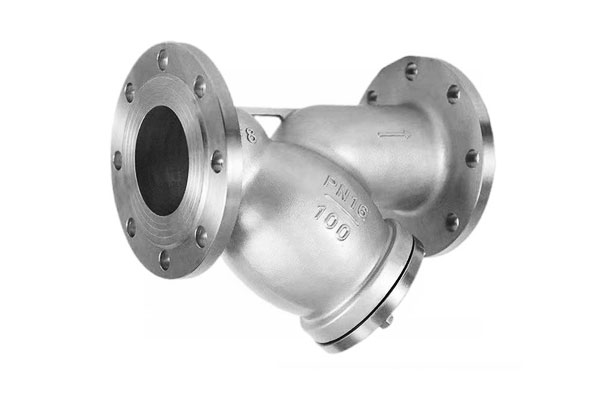
A cast stainless steel strainer valve is a pipeline device whose primary function is to remove solid particles from a flowing fluid while also providing pressure-containing connections and, where required, isolation or blow-down capability.
Unlike fabricated or welded bodies, the pressure-retaining parts of a cast strainer — body, bonnet/cover and sometimes the basket chamber or internal bossing — are produced as a single or small number of castings, typically in stainless grades chosen for corrosion resistance (for example CF3M/CF8M or duplex alloys).
Core definition and role
- Definition: a pipeline component consisting of a pressure-rated cast body that houses a removable filtration element (basket, screen or mesh) and provides ports for inlet, outlet, drain/blowdown and access for cleaning.
- Primary role: protect downstream equipment (pumps, valves, heat exchangers, instruments) from damage or clogging by removing debris, weld scale, corrosion products and foreign particles.
- Secondary roles: provide a convenient access point for inspection/cleaning and, in some designs, allow blowdown or duplex operation to keep systems online.
Common Strainer Types (by geometry & operation)
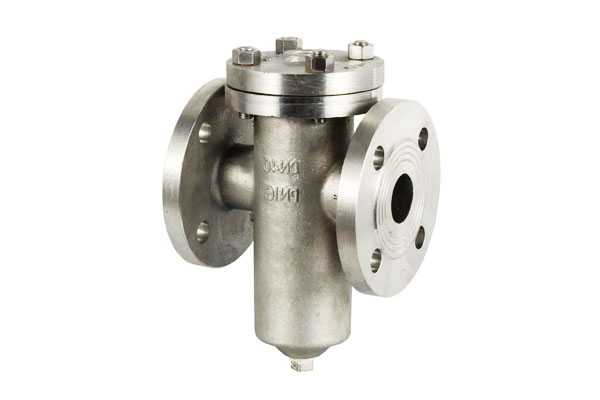
- Basket (inline) strainer: axial flow through a cylindrical or tapered basket; large open area and low pressure drop — preferred for high particulate loads or where long cleaning intervals are required.
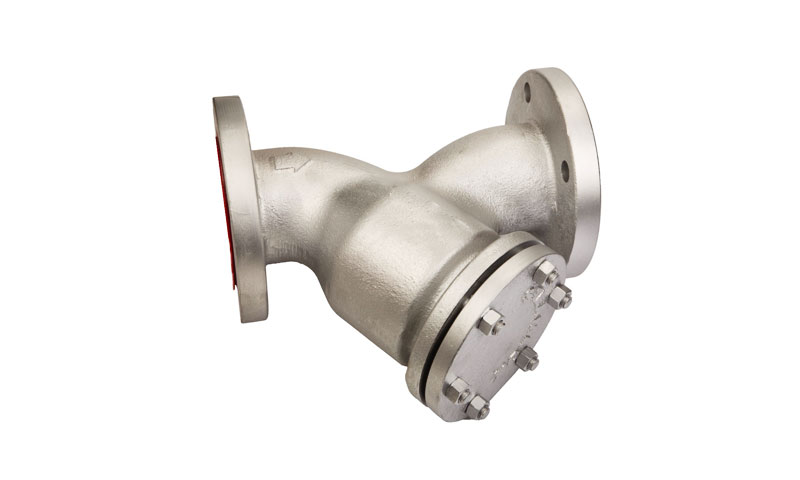
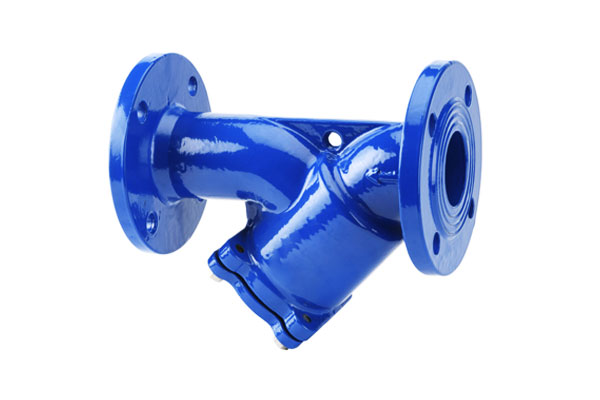
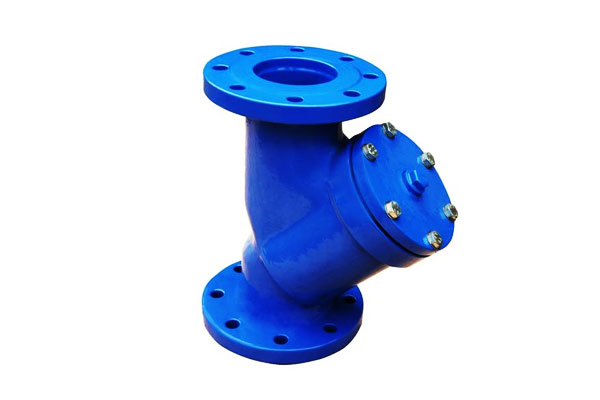
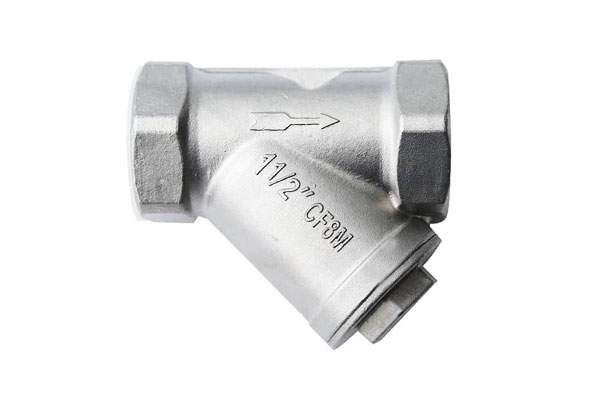
- Y-type strainer: compact body with an angled pocket; good for high-velocity lines and moderate debris loads; pocket may be horizontal or vertical.
- T-type / Duplex (parallel) strainer: two parallel chambers with valving to permit online cleaning (one chamber in service while the other is cleaned). Ideal for critical continuous systems.
- Blow-down / self-cleaning strainer: includes a blow-down or purge valve to flush accumulated solids without removing the basket. Useful for large pipelines and abrasive loads.
- Integral strainer-valve assemblies: cast bodies that incorporate isolation or control valves in the same casting for compact systems.
Key Components
- Cast body & bonnet/cover: pressure vessel and access for element removal; flanged or threaded ends per spec.
- Removable element (basket/screen): the filter media — perforated plate, woven/knit wire mesh, sintered metal; chosen by particle size and flow/erosion considerations.
- Seat & sealing surfaces: machined sealing faces between bonnet and body, and any flanged surfaces — critical for leak tightness.
- Blowdown/drain port & valve: for purging solids or draining the chamber.
- Gasket & fasteners: gasket type (metal, elastomer, spiral wound) selected by pressure/temperature/chemistry; bolting sized to flange class.
3. Why Choose Custom Cast Valve Bodies?
Custom cast stainless steel valve bodies are chosen when the application requirements or system layout make standard fabricated parts inadequate.
Geometry freedom & integration
- Castings can incorporate large baskets, complex internal flow paths, integral drains/manways, multiple ports and bosses in a single piece — reducing part count, welds and potential leak paths.
- Allows compact or unusual port layouts (offset flanges, angled inlets, internal baffles) that would be expensive or impossible with fabrication.
Hydraulic & functional optimization
- Large open-area baskets and optimized internal passages lower pressure drop (Δp) and increase time between cleanings.
- Internal features (sight ports, instrumentation taps, blow-down channels) can be placed exactly where needed without extra assemblies.
Corrosion & material performance
- Casting allows use of corrosion-resistant stainless grades (CF8M/CF3M, duplex) or Ni-base alloys where chemical resistance and pressure capability are required.
- Fewer welded joints mean fewer metallurgical discontinuities and fewer locations susceptible to weld-related corrosion when produced correctly.
Structural strength & pressure rating
- Properly designed cast sections meet ANSI/ASME pressure classes (150 → 1500+) while supporting larger internal cavities than welded fabrications of equivalent rating.
Reduced assembly and field work
- One-piece bodies eliminate multiple flanged joints and welds, simplifying installation and reducing assembly leakage risk and field labor.
Cost and lead-time at the right scale
- For medium → high volumes or when complex geometry reduces downstream machining/welding, custom cast parts can be more economic than welded fabrications once tooling is amortized.
4. Materials & Alloy selection
Selecting alloy is driven by fluid chemistry, temperature, and pressure.
Common cast stainless candidates
- CF8 / CF8M (cast 304 / 316 equivalents): general-purpose. CF8M (Mo) offers better chloride resistance. Use CF8M for seawater and many chemical services.
- CF3M (cast 316L-like, low C): preferred where welding and low sensitization are required.
- Duplex stainless (e.g., cast 2205/LDX analogues): when higher strength and superior chloride/SCC resistance are needed.
Duplex offers higher yield/UTS and less wall thickness for the same pressure class but requires experienced foundries. - Nickel-base alloys (Inconel, Hastelloy): for highly aggressive chemistries or high temperatures — costly and often overkill for general strainer service.
Practical data points (engineering ranges)
- Density: stainless ~ ~7.9 g·cm⁻³.
- Typical service temp ranges: many stainless grades reliably operate from cryogenic service up to several hundred °C; duplex and Ni-base alloys extend high-T capability.
- Pressure capability: cast stainless valve bodies are produced for ANSI classes from 150 → 1500 (and higher); actual capability depends on design and thickness.
5. Stainless Steel Strainer Valves — Casting Processes
Selecting the correct casting route for stainless-steel strainer valves is a core decision: the valve body must be pressure-tight, corrosion-resistant and frequently contains complex internal cavities to house baskets, blow-down ports and manways.
Quick decision matrix — process vs. priority
| Priority / Requirement | Investment Casting | Shell Mold | Resin / Green Sand | Lost-Foam | Centrifugal / Gravity | VIM / Vacuum Pouring (process addition) |
| Complex internal geometry | Excellent | Good | Limited | Good | Limited | Applies to any (improves quality) |
| Surface finish & dimensional accuracy | Excellent (Ra 1.6–3.2 µm) | Very good (Ra 2.5–6.3 µm) | Moderate (Ra 6–25 µm) | Good (depends on pattern) | Poor → moderate | Improves surface/interior if used |
| Pressure-critical integrity (low porosity) | Good (with VIM/degass) | Good (with controls) | Lower unless strict controls | Moderate | Moderate → good (for axisymmetric) | Greatly improves integrity (VIM/VAC) |
| Typical part size | small → medium | small → large | medium → very large | small → medium | cylindrical/large | N/A (process enhancement) |
| Unit cost (low→high volume) | Higher (tooling) | Moderate | Low tooling cost | Moderate | Low tooling | Adds cost but essential for critical parts |
Investment (Lost-Wax) Casting
When to use: small → medium bodies with complex internal flow, fine external detail, thin walls or precision flanges where high surface finish helps reduce machining.
Good for precision baskets, internal bosses and manways.
Key parameters
- Melt / pour temp (stainless): typically 1 450–1 550 °C (confirm to alloy).
- Shell preheat:400–800 °C depending on investment chemistry.
- Investments: phosphate/zircon/alumina reinforced investments for austenitic stainless to resist metal-investment reaction.
Advantages
- Excellent dimensional accuracy and surface finish.
- Can reproduce fine internal features with ceramic cores.
Risks & mitigations
- Metal-investment reaction: apply zircon/alumina washes or barrier coatings; control pour temperature.
- Gas porosity: degas melt (argon), apply vacuum pouring if possible, and use ceramic filtration.
- Core integrity: use high-quality ceramic cores and robust chaplets.
Post-cast needs
- Shot-blast, trim, machining of sealing faces, passivation/pickling.
Shell Mold Casting
When to use: medium complexity bodies where better accuracy than sand is required but investment costs are excessive. Good for medium runs and moderate internal features using cores.
Key parameters
- Mold temp: 200–350 °C preheat typical; depends on binder.
- Binders: phenolic-urethane or resin shell systems tuned for stainless pour temps.
Advantages
- Good dimensional control at lower cost than investment.
- Faster than investment for medium volumes.
Risks & mitigations
- Core shifting: robust core prints and chaplets.
- Surface reaction: use barrier washes for high pour temps.
Resin / Green Sand Casting (Shell & Resin Sand)
When to use: large bodies, low-to-medium complexity, low cost volumes or very large baskets where detail & finish are secondary. Common for large process valves.
Key parameters
- Mold preheat: generally lower; control moisture carefully.
- Binders & coatings: use refractory washes for stainless.
Advantages
- Low tooling cost for large parts. Flexible for late design changes.
Risks & mitigations
- Surface finish roughness and higher porosity — require heavier machining at sealing faces; specify NDT for pressure zones.
- Moisture in cores → gas porosity — control drying & core baking.
Lost-Foam Casting
When to use: complex internal geometries without cores; useful for medium complexity and moderate volumes where tooling costs must be controlled.
Key parameters
- Pattern integrity & coating determine surface finish and gas evolution.
- Pour temp control to avoid excessive foaming/reaction.
Advantages
- Eliminates cores for many complex internal passages.
- Good geometric freedom.
Risks & mitigations
- Foam decomposition gas → robust shell permeability and venting required.
- Dimensional accuracy depends on pattern and coating control.
Centrifugal & Gravity Casting
When to use: axisymmetric components (sleeves, cylindrical housings), or large simple bodies. Centrifugal casting gives dense, low-porosity wall sections.
Advantages
- Excellent density and low porosity in radial direction.
- Good for pipe-like strainers, cylindrical housings.
Limitations
- Not suitable for multi-port or highly complex shapes.
6. Strainer element design: basket, Y-type, mesh & cleanability
Element design defines performance and maintenance intervals.
Element types
- Perforated baskets / cylinders: robust, low clogging tendency; used for coarse straining.
- Woven wire mesh: fine filtration down to tens of microns — used for instrument protection.
- Sintered metal elements: higher precision and strength for high-T/higher-pressure services.
- Multi-stage elements: coarse outer + fine inner to extend life and ease cleaning.
Key parameters
- Open area (OA): target OA as multiple of nominal pipe area — more OA = lower Δp.
- Porosity / mesh rating: choose by particle size distribution (PSD) of incoming fluid; typical industrial ranges from ~50 μm (fine) to >2 mm (coarse).
- Element backwash / blowdown: consider duplex or blowdown arrangements for continuous service.
- Access & cleaning: baskets should be removable through a bolted bonnet or quick-release cover; provide lifting features and gasket seating.
7. Joining, machining, sealing & surface finishing
Post-casting work produces functional sealing surfaces and connections.
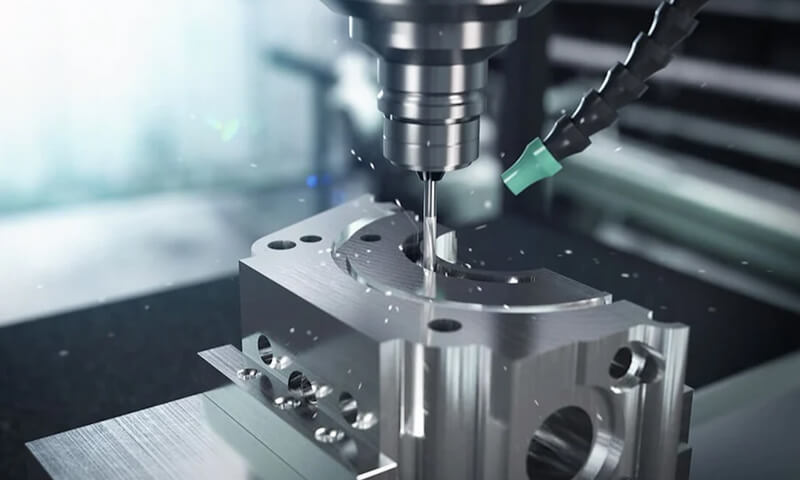
CNC Machining
- Machine flange faces, element seats, bolt bosses and bearing surfaces to final tolerances. Use fixtures/CMM to ensure concentricity for pipe connections.
Sealing
- Flanged ends to standards (ANSI/ASME or EN) or custom flanges; ensure finish and flatness meet gasket selection.
- Bonnet cover seals: use spiral wound, ring joint or elastomer joints as appropriate for temperature/pressure. For high temp or aggressive chemicals use metal-to-metal or graphite seals.
Welding & joins
- If components (nozzles, drains) are welded on, specify low-carbon cast grade (CF3M) or post-weld solution anneal if corrosion resistance is critical.
Surface finishing
- Pickling & passivation (nitric or citric) to remove free iron and restore passive layer.
- Electropolish for sanitary or high-corrosion environments.
- Coatings (epoxy, e-coat, polymer linings) where additional corrosion protection is needed.
8. Common defects, root causes & troubleshooting
Typical problems and practical remedies:
- Porosity in sealing areas → root causes: trapped gases, poor degassing, inadequate risers. Remedy: degas melts, use ceramic filtration, redesign riser/feed, vacuum melting.
- Shrink cavities near nozzle → cause: improper gating/insufficient feed. Remedy: add riser/chill, change gating.
- Inclusions / slag → cause: dirty charge or poor skimming. Remedy: improve charge control, filtration.
- Core shift → cause: weak core supports/handling. Remedy: stronger core support, chaplet redesign.
- Gasket failures → cause: uneven flange faces, poor finish. Remedy: machine flange faces, improve finish/flatness.
9. Applications of Cast Stainless Steel Strainer Valves
Cast stainless steel strainer valves are widely used in fluid handling systems where both contaminant removal and corrosion resistance are critical.
Because custom casting allows optimized flow paths, high-pressure cavities, and durable mesh/basket interfaces, these valves are preferred in industries with harsh media, sanitary requirements, or demanding reliability expectations.
Chemical Processing & Petrochemical Plants
- Filtration of process chemicals, solvents, monomers, acids, and caustics.
- Protecting pumps, compressors, flow meters, and control valves from particulate contamination.
- CF8M/CF3M cast strainers favored where chloride-bearing fluids demand superior pitting resistance.
Oil & Gas (Upstream, Midstream, Downstream)
- Sand, scale, and debris removal in crude oil, produced water, and gas pipelines.
- Strainers used upstream of separators, manifolds, and LACT units.
- High-pressure cast stainless bodies withstand severe pressure cycles and corrosion from sour or saline fluids.
Water Treatment, Desalination & Municipal Utilities
- Intake screening and particulate filtration in seawater, brackish water, and treated wastewater.
- Stainless grades provide long service life vs. carbon steel in high-salinity or chlorinated environments.
- Custom casting allows large-diameter Y-type and basket strainers for high-volume flows.
Food, Beverage & Pharmaceutical Industries
- Removal of particles in ingredient lines, CIP systems, and purified water loops.
- Cast stainless ensures hygienic surfaces, low porosity, and suitability for passivation and electropolishing.
- Common in dairy, brewing, fermentation, and pharmaceutical production where contamination control is strict.
Power Generation (Steam, Cooling, Turbine Systems)
- Protecting boiler feed pumps, condensate systems, and turbine cooling circuits.
- Used for filtering particulates in high-temperature water, condensate, or auxiliary fuel systems.
- Stainless cast bodies maintain mechanical integrity under thermal cycling.
Marine & Offshore Platforms
- Filtration of seawater for cooling, ballast, and fire suppression systems.
- High corrosion resistance to chlorides, biofouling, and marine atmospheres.
- Custom-cast housings allow compact designs ideal for limited space aboard vessels or rigs.
HVAC, District Heating & Industrial Utilities
- Removal of rust, scale, sediment, and welding debris from chilled/heating water systems.
- Stainless castings preferred in facilities where glycol mixtures or mildly corrosive fluids are present.
Pulp & Paper Processing
- Filtering fibrous materials and particulates in process water and alkalized bleaching fluids.
- Stainless alloys resist corrosion from chemicals such as sodium hypochlorite and chlorine dioxide.
Mining, Mineral Processing & Slurry Lines
- Strainers installed upstream of pumps handling abrasive slurries or corrosive mine waters.
- Cast stainless improves wear and corrosion performance compared to ductile iron.
Pharmaceuticals, Biotech & High-Purity Chemical Distribution
- Protecting precision dosing pumps, chromatography systems, and ultra-clean fluid circuits.
- CF3M/low-carbon castings avoid sensitization and particle shedding.
Automotive, Industrial Equipment & Manufacturing Plants
- Inline filtration for lubricants, coolants, hydraulic oils, and process chemicals.
- Cast stainless strainers are used in areas where cleanliness and long life reduce downtime.
10. Conclusion
Custom cast stainless steel strainer valves are a powerful solution when systems demand large-capacity filtration, unusual geometry or corrosion resistance.
The technology delivers excellent operational performance when alloy selection, foundry controls, element design and QA/testing are all tightly specified and enforced.
For safety- and service-critical installations, insist on rigorous melt control, NDT of sealing areas, hydrostatic testing and a prepared spare/maintenance plan.
FAQs
CF8M or CF3M — which for seawater?
CF8M (316 equivalent) is suitable for many seawater uses; CF3M (low C) is preferred if heavy welding is expected. For prolonged warm seawater and high chloride concentration, consider duplex.
How do I size a basket for low Δp?
Increase open area (OA) relative to pipe area; aim for OA several times the pipe cross-section and verify Cv vs Δp curves in the spec stage.
Is CT better than X-ray for inspecting castings?
CT gives 3-D porosity mapping and is superior for complex cavities; X-ray is faster and cheaper for many acceptance workflows.
Typical mesh range for industrial strainers?
Industrial practice ranges widely — coarse (mm-scale holes) for bulk debris to fine (tens–hundreds of microns) for instrument protection. Choose based on particle size distribution (PSD).