1. Executive summary
Investment casting, often referred to as the lost-wax process, relies heavily on the structural and chemical integrity of the ceramic shell.
As the mold that dictates the final geometry and surface quality of the cast component, any defect within the shell propagates directly to the metal part.
This article provides an in-depth analysis of the most prevalent shell-related defects, examining their root causes from material science, process control, and environmental perspectives.
By understanding the mechanisms of cracking, delamination, bulging, and inclusions, manufacturers can implement robust preventive strategies to enhance yield and part performance.
2. Why shell quality matters
The ceramic shell is the single most important passive element between your pattern and the finished metal.
Problems that originate in the shell almost always propagate into the casting or into downstream operations (machining, testing, assembly), and they do so in ways that are disproportionately expensive.
Functional impacts — how poor shell quality degrades casting performance
Surface integrity and finish
- The face coat determines as-cast surface roughness, detail reproduction (text, filigree) and the need for polishing.
Defects such as pinholes, stucco lumps or contamination become visible blemishes or require additional finishing. - Consequence: extra machining, hand-polishing, replating or rejection.
Dimensional accuracy and feature fidelity
- Uneven layer thickness, delamination, bulging or shrinkage during drying change local geometry and effective pattern shrinkage allowances. Thin spots cause underbuild; overthick zones change critical fits.
- Consequence: rework for fit-up, scrappage of parts that cannot be machined to tolerance, and failures in assembly.
Metallurgical defects and porosity
- Non-uniform permeability, blocked vents, trapped gases in the shell or organic residues in face coats increase the likelihood of gas porosity, pinholes and cold shuts in the casting.
- Consequence: reduced mechanical properties, lower fatigue life, leaks in pressure parts, and increased NDT requirements.
Chemical reactions and washout
- Incompatible face coats or residual contaminants allow reactive alloys (aluminum bronzes, nickel-aluminum bronzes) to attack the shell—producing washout, surface reaction layers and inclusions.
- Consequence: surface-conditioned metal requiring extra machining or outright rejection for critical service parts.
Structural failure of the shell
- Delamination, poor bonding or insufficient backing thickness can lead to crack propagation or shell collapse during dewax, handling or pouring.
- Consequence: catastrophic scrap, safety hazards from hot metal spills, unplanned downtime.
Internal geometry and core support
- Insufficient core prints, core movement or poor adhesion between core and shell cause dimensional errors in internal passages (flow loss in impellers, leakage in valves).
- Consequence: reruns, complex repairs, or complete part rejection.
Operational impacts — process, throughput and time-to-market
First-pass yield and throughput
- Shell defects are discovered before or after pour. Either way they reduce first-pass yield and force rework loops (re-coating, re-dipping) or scrap; both reduce effective throughput and increase lead time.
Inspection load and downstream bottlenecks
- Poor shell quality increases NDT and manual inspection workload (visual, dye-penetrant, radiography), delaying release to melting/pouring and tying up fixtures and personnel.
Increased variability and production instability
- Variable shell properties (thickness, permeability) reduce process capability — more trial pours, more sampling and slower ramp-up for new jobs.
Safety and regulatory delays
- Shell failure incidents (washout, collapse) create safety investigations, stoppages and potential regulatory reporting (if molten metal is spilled). These stoppages magnify cost beyond the part value.
3. In-depth analysis of defects
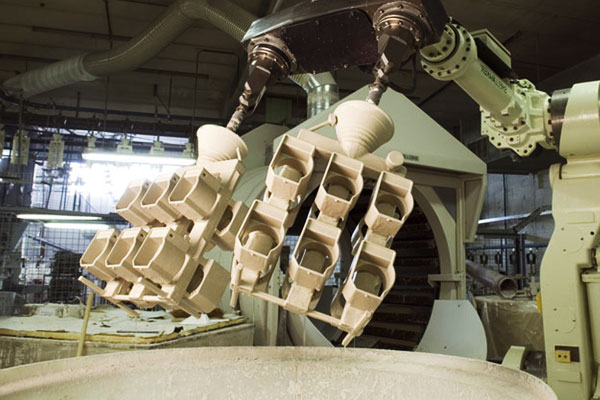
Surface pinholes / pin-porosity (small round surface pits)
Appearance / detection: many small, round pits on the face coat visible after drying or after first blast; show up as pinholes in the final casting.
Root causes: gas release (residual organics in wax/resin), entrapped air during dipping, excessive viscosity or poor wetting, trapped bubbles in slurry, microbial gas from contaminated slurry.
Immediate corrective actions: brush and re-dip the local area; allow extra drain time and gentle vibration to release bubbles. Replace top slurry skim to remove trapped foam.
Prevention / long term: control slurry viscosity and degassing; maintain slurry hygiene (biocide, filtered surface); match pattern and slurry temperatures; ensure adequate mixing and avoid over-aeration.
Cracking / crazing of face coat
Appearance / detection: network of hairline cracks or open fissures in the face coat after drying; may worsen during handling.
Root causes: too rapid drying, high drying temperature or local drafts, overly thick face coat, incompatible thermal expansion between layers, poor binder cure.
Immediate corrective actions: slow down drying (lower temperature / increase humidity), remove or repair cracked areas and recoat.
Prevention / long term: control drying profile (temperature, humidity, airflow), avoid excessive single-coat thickness, ensure proper binder mix and cure schedule, maintain even staging of parts in drying room.
Shell delamination / flaking (layers separating)
Appearance / detection: face coat or transition layer peels away from backing layers; shell layers separate during handling.
Root causes: poor interlayer adhesion (inadequate wetting or bonding), contaminated surface (oils, release agents), incorrect slurry formulation or under-mixing, insufficient tack of transition layer.
Immediate corrective actions: discard badly delaminated shells; for marginal cases, recoat with a compatible transition slurry and re-stucco.
Prevention / long term: ensure correct slurry chemistry and wetting agent levels, strict cleaning of molds, implement layer bonding checks, add slight wetting agent to transition/backing slurries if approved.
Bulging / blistering (local out-of-plane deformation)
Appearance / detection: local convex bulges, bubbles, or blisters on shell surface after drying or during burnout.
Root causes: trapped moisture or volatile gases in the interior layers, rapid external drying sealing volatiles inside, non-uniform drying, air pockets beneath stucco.
Immediate corrective actions: gently open/rework blister, dry slowly from inside out if possible; remove and recoat if structural integrity compromised.
Prevention / long term: staged drying (slow ramp for face coat), ensure permeability between layers, proper drain/vent paths in geometry, maintain slurry permeability specs.
Stucco / sand inclusion and agglomeration (embedded sand lumps)
Appearance / detection: localized lumps or “sand clumps” in face coat; visible rough spots and weak pockets; sand grain clusters after shotblast.
Root causes: poorly sieved stucco, sand with slurry beads or hardened agglomerates, insufficient pre-screening, contaminated sand buckets.
Immediate corrective actions: sift stucco and remove clumps; brush off affected areas and re-stucco with clean material.
Prevention / long term: implement sieve checks, daily sand bucket inspection, maintain dry storage for stucco, reject lots with high agglomeration.
Thin spots / uncoated areas (local lack of coverage)
Appearance / detection: visibly thinner film or bare substrate in depressions, grooves or shadowed areas after dipping; premature metal bloom or washout in casting.
Root causes: improper dipping angle/speed, poor drain control, surface tension/wetting problems (wrong wetting agent level), geometric traps (acute corners).
Immediate corrective actions: hand-brush slurry into the area or apply a local re-dip; for many parts, perform a second face dip in problematic zones.
Prevention / long term: train operators on dipped entry angle and drain timing; ensure wetting agent and temperature parity; design tooling to reduce inaccessible cavities.
Sand bridging / hole plugging (bridged cavities and blocked passages)
Appearance / detection: small holes, thin slots or blind cavities where sand grains build an arch/bridge preventing slurry penetration — seen as hollow cavities or blocked vents.
Root causes: large stucco grain size, overly dry sand causing bridging, poor vibration/settling control during stucco application.
Immediate corrective actions: open bridges with a brush or probe before drying; thin coat or re-stucco with finer grit for the area.
Prevention / long term: select correct stucco gradation for fine features; pre-wet and agitate stucco; use controlled vibration/air-blow to encourage penetration.
“Mouse tail” / thin trailing edges (fragile thin projections)
Appearance / detection: extremely thin, fragile trailing edges or fillets that deform, crack, or break on handling or during pour.
Root causes: insufficient deposition at thin edges (poor flow or drain), over-rapid drying causing contraction, geometry that traps slurry return.
Immediate corrective actions: reinforce the area by local hand-coating or adding support wax/brace before shelling (if caught early).
Prevention / long term: design for manufacturability (avoid extremely thin trailing geometry), use second face dip in fine features, train to pay special attention to edge wetting and drainage.
Washout / chemical reaction of face coat (particularly with reactive alloys)
Appearance / detection: rough, pitted, chemically attacked face coat zones after pouring or during preheat; face coat erosion where metal contact occurs.
Root causes: incompatibility between alloy and silica-rich face coat (e.g., aluminum bronzes), excessive metal superheat, wrong face-coat chemistry or contaminants.
Immediate corrective actions: for high-risk alloys, use zircon/alumina face coats or barrier washes; avoid re-using incompatible slurry batches.
Prevention / long term: specify face coat for alloy family, control pouring temperature, verify refractory chemistry and contamination levels.
Contamination streaks / foreign-body inclusion (oils, fibers, dust)
Appearance / detection: streaks, dark lines, or foreign fragments embedded in face coat; may cause local weak spots or visual blemishes in castings.
Root causes: dirty wash tubs, lint or fibers from rags, airborne dust or oil carryover from handling, dirty mixing equipment.
Immediate corrective actions: remove affected shells or carefully remove contamination and recoat; clean tools and rework work area.
Prevention / long term: enforce clean-room discipline for shell room, cover slurry tanks, use lint-free wipes, regular housekeeping and tool cleaning schedules.
Layer thickness inconsistency (variable shell strength)
Appearance / detection: measured wet film thickness or cured layer thickness is inconsistent across parts or within a part causing weak or brittle zones.
Root causes: slurry viscosity drift, operator technique variation, inconsistent plunge/drain timing, slurry temperature differences.
Immediate corrective actions: re-dip areas that are too thin; scrap shells with critical under-thickness. Re-balance slurry or remix batch.
Prevention / long term: daily QC checks (viscosity, specific gravity), fixed drain times in SOP, operator training and standardized tooling jigs.
Appearance / detection: dusty, chalky skin on dried face coat; poor adhesion and low strength.
Root causes: under-cured binder, contamination of binders, incorrect binder/solids ratio, low bake/insufficient dwell.
Immediate corrective actions: test adhesion; recoat with a proper slurry; review last batch record for improper weighment.
Prevention / long term: strict weighing discipline, validated binder storage, regular binder quality checks and mixing procedures.
Core movement / core shift (for shells with cores)
Appearance / detection: internal geometry mismatch, core offset, visible thinness or misaligned internal passages.
Root causes: poor core support (no core prints), insufficient core prints, weak core bake/drying, core loosened during shell build or handling.
Immediate corrective actions: where possible rebuild core supports or scrap and re-core; stop line until core fixture issues corrected.
Prevention / long term: robust core prints, support fixtures, adhesive or mechanical support design, pre-flight checks before shelling.
Microbial foaming / slime in slurry
Appearance / detection: foamy surface, sudden increase in gas or pinholes, visible biofilm or odor in slurry.
Root causes: use of non-sterile water, long retention time of slurry, warm temperatures promoting bacterial growth.
Immediate corrective actions: remove and replace surface skim, add approved biocide, discard heavily contaminated batches.
Prevention / long term: use potable or treated water, maintain biocide schedule, temperature control and regular slurry turnover.
Excessive shrinkage / warpage of shell (after drying)
Appearance / detection: warped shell geometry, misfit to pattern or tree, dimensional drift.
Root causes: uneven drying rates, extreme thermal gradients, excessive stresses from thick non-uniform builds.
Immediate corrective actions: slow the drying cycle, re-equalize temperature, use fixturing to hold critical geometry during cure.
Prevention / long term: optimized layer schedule, controlled drying ramp, symmetrical build plans and jigs to restrain geometry.
4. Detection, measurement and inspection methods
Visual inspection: first line — look for pinholes, lumps, delamination, streaks. Use good lighting and magnification for face coats.
Tactile inspection: glove-hand feel for soft spots, flaking, and unevenness.
Wet film / cured thickness: gauge wet film thickness during process; measure cured layer with calipers or ultrasonic coating gauges where applicable.
Slurry tests: viscosity (rotational viscometer or Ford cup), specific gravity, pH, temperature; log values.
Stucco QC: sieve retention tests (e.g., % retained on 63 µm and 150 µm sieves), moisture content testing.
Environmental monitoring: continuous logging of room temperature, RH and airflow; alarm at deviation thresholds.
NDT of shells (advanced): X-ray CT for core movement or internal voids in complex cores (used selectively for high-value components).
5. Conclusion
Shell quality is not a cosmetic concern — it is a primary driver of product performance, operational throughput and profitability.
Investing a modest amount in measurement, discipline and environmental controls typically yields outsized reductions in scrap, rework and customer risk.
Quantify the current scrap and rework costs in your operation, and you will often find the investment case for shell-control measures is immediate and financially compelling.
FAQs
Which defects have the biggest impact on final casting quality?
Pinholes, washout (chemical attack), delamination and core shift — these often produce visible or functional casting failures.
How often should slurry be replaced?
Replace based on process metrics (viscosity drift, contamination). For many shops daily top-up and weekly partial exchange is common; heavy usage may require more frequent refresh.
Can design changes eliminate some defects?
Yes. Avoid extremely thin trailing edges, add access/venting for trapped volumes, and design core prints for robust support.
Is automation worth it for dipping & stuccoing?
For medium-to-high volumes, automation improves repeatability and reduces operator variability. Evaluate ROI by comparing defect reduction vs. automation cost.
What’s the first thing to check when a new defect appears?
Batch traceability: slurry batch, stucco lot, operator on duty, and drying room log for the affected shells. These usually reveal immediate clues.