1. Introduction
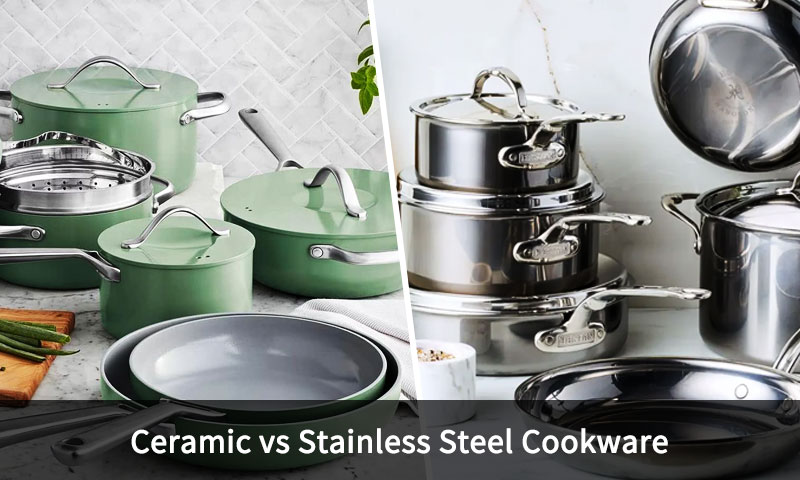
Cookware material is a core determinant of cooking efficiency, food safety, and culinary experience. When selecting cookware, the trade-offs come down to how you cook and what you value.
- Stainless-steel (especially multi-ply constructions with an aluminum or copper core) excels at high-heat cooking, searing, deglazing and long life; it is robust, fully recyclable and broadly inert.
- Ceramic is an umbrella term that includes true ceramic ovenware (porcelain/stoneware), ceramic-coated metal nonstick pans, and fully ceramic frying surfaces. Ceramic coatings deliver good nonstick performance initially and are perceived as chemically inert, but they wear faster than quality stainless and have lower thermal responsiveness and durability.
This article compares both from metallurgical, thermal, practical, safety and lifecycle perspectives so you can match cookware choice to technique, budget and sustainability goals.
2. What we mean by “ceramic” and “stainless steel”
To compare ceramic and stainless-steel cookware sensibly we must be precise about the materials and product families that the market labels “ceramic” and “stainless steel.”
“Ceramic” — three distinct product families
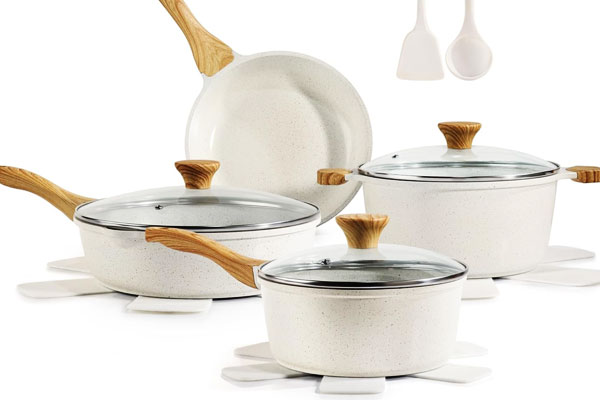
The word ceramic is used in three different senses in cookware contexts. Each has different material chemistry, manufacturing routes, thermal behavior and durability.
Solid ceramic ovenware (porcelain, stoneware, earthenware)
- What it is: dense, vitrified clay bodies (porcelain/stoneware) fired at high temperature and usually glazed.
- Manufacture: shaped (pressing, slip casting), high-temperature firing (typically 1 000–1 300 °C) to vitrify the body, then glaze application and a second firing.
- Material character: brittle, high thermal mass, chemically inert once glazed, good long-term color stability.
- Typical uses: baking dishes, casseroles, oven roasts and tableware. Excellent for even, retained heat in the oven; poor for rapid stovetop searing.
- Care notes: thermal shock sensitivity (avoid rapid temperature swings), glaze integrity is key (lead/cadmium risk only for poorly manufactured older/cheap ware).
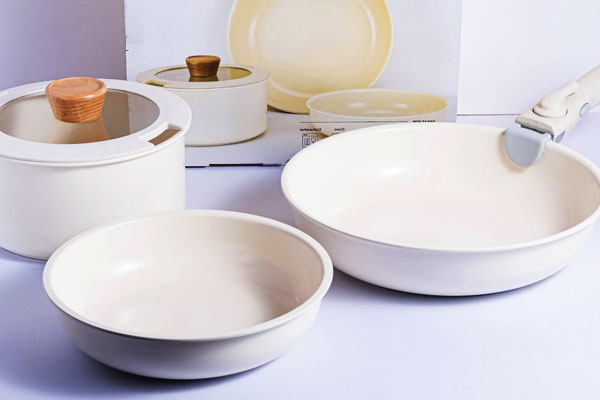
Ceramic-coated metal cookware (the large consumer nonstick category marketed as “ceramic”)
- What it is: a metal substrate (usually aluminum) with a thin inorganic/oxide-based coating applied by spray/dip or sol-gel processes and cured to form a hard silica/oxide layer. Often sold as “PTFE-free nonstick.”
- Manufacture: substrate preparation → coating application (sol-gel/spray) → curing (low- to medium-temperature bake). Some products use multiple layers (primer + ceramic layer + topcoat).
- Material character: coating thickness is thin (microns), so bulk heat conduction is governed by the metal core (typically aluminum). The coating gives initial nonstick behavior but is mechanically and thermally fragile relative to metal surfaces.
- Typical uses: low-fat frying (eggs, pancakes), delicate foods; lightweight cookware.
- Care notes: avoid metal utensils and abrasive cleaners; coating life depends on use temperature and handling — performance commonly degrades over months to a few years.
Technical / monolithic ceramics (alumina, silicon carbide, glass-ceramics)
- What it is: engineered high-performance ceramics used in specialty cookware or technical applications (rare for consumer cookware). Examples include alumina or silicon-carbide products that can be used for specific high-temperature applications.
- Material character: very hard, excellent wear and temperature resistance, brittle and expensive.
- Typical uses: niche cookware, industrial applications; not common for everyday pans.
Key takeaways about “ceramic” in cookware
- If you say “ceramic pan” most consumers mean ceramic-coated metal (nonstick) or stoneware/porcelain bakeware.
- The functional differences are large: a ceramic coating’s lifetime and performance depend on coating chemistry, layer thickness and mechanical abrasion resistance; a solid ceramic’s performance is dominated by thermal mass and glaze quality.
“Stainless Steel” — material family and cookware constructions
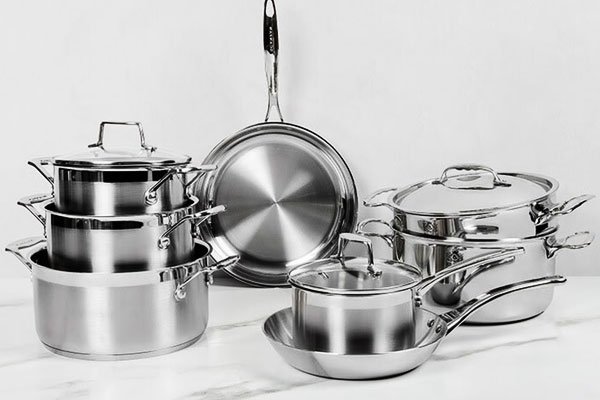
Stainless steel in cookware refers to stainless-steel alloys (principally austenitic grades) and to specific construction methods used to compensate for stainless steel’s comparatively low thermal conductivity.
Alloy chemistry (what stainless means)
- Common consumer grades:
-
- 18/8 or 18/10 stainless — shorthand for ~18% chromium and ~8–10% nickel (austenitic 300-series, e.g., type 304 family). Chromium provides corrosion resistance via a thin passive oxide film; nickel stabilizes the austenitic phase and improves toughness and formability.
- 316/CF8M — similar but with added molybdenum (≈2–3%) for improved pitting resistance in chloride-bearing environments (used in higher-end cookware and professional kitchens).
- Material behavior: stainless develops a passive Cr₂O₃ film that makes it nonreactive with most foods; in rare cases acidic foods can promote trace metal leaching in certain alloys (an allergy concern for some individuals).
Cookware constructions (how stainless is used to get good heat performance)
- Single-ply stainless: thin sheet stainless with no conductive core. Durable but poor heat distribution and slow to respond. Found in inexpensive stockpots and basic pans.
- Bonded / clad (multi-ply) constructions: layers of stainless bonded to a high-conductivity core (aluminum, copper, or both). Common formats:
-
- Tri-ply (clad): stainless exterior + aluminum core + stainless interior. Balances durability and heat conduction.
- 5-ply / 7-ply: alternating stainless and metal layers (often added copper layers) for even better conduction and thermal control.
- Full-clad vs. disc-bottom: full-clad sandwiches the core across base and walls; disc-bottom uses a conductive disc bonded into the base only (cheaper, less even heating).
- How these perform: clad stainless combines the inert cooking surface and mechanical durability of stainless with the rapid, even heating of aluminum or copper cores.
Manufacturing and finish
- Surface finish: interior surface finishes range from mirror-polish to brushed; finish affects release behavior and cleanability. Some users “season” stainless to improve release characteristics for certain foods.
- Welding and fabrication: high quality cookware uses vacuum brazing or roll bonding to achieve a metallurgical bond between layers; poor bonding leads to delamination and hot-spots.
Key takeaways about “stainless steel” in cookware
- “Stainless” refers to an alloy family; its cooking performance hinges on construction (single-ply vs. clad) more than the stainless chemistry alone.
- For searing, fond formation and deglazing, multi-ply stainless with an aluminum or copper core is the proven professional choice.
3. Core Technical Performance Comparison
Thermal conductivity, heat distribution and responsiveness
Thermal conduction controls how quickly and evenly a pan heats and how well you can control temperature.
Representative thermal conductivities (approximate ranges at room temperature):
- Aluminum (substrate often under ceramic): ~200 W·m⁻¹·K⁻¹
- Copper (core in premium stainless): ~380–400 W·m⁻¹·K⁻¹
- Stainless steel (304/316): ~14–16 W·m⁻¹·K⁻¹
- Ceramic (solid stoneware/glass-type): ~1–3 W·m⁻¹·K⁻¹ (low)
- Ceramic coating (thin oxide layer): effectively low thermal mass; the coating itself is thin so bulk conduction is dominated by the metal substrate.
Implications
- A tri-ply stainless pan (stainless exterior/interior with aluminum or copper core) combines rapid, even heating with a durable stainless cooking surface. That is why stainless multi-ply is the professional choice for searing and controlled browning.
- Ceramic-coated pans usually have an aluminum core — heating is rapid because of aluminum, but the ceramic coating alters surface energy and heat transfer at the contact layer. The coating can make browning and fond formation less efficient than on stainless.
- Solid ceramic (baking dishes) heats slowly, stores heat well (high thermal mass) and is excellent for stable oven temperatures but poor for fast temperature changes.
Surface behavior — nonstick, browning and fond
- Stainless steel: less inherently nonstick. Proteins stick unless you control pan temperature and oil. Excellent for Maillard browning and creating fond for deglazing and pan sauces. Not recommended for sticky low-fat cooking without oil.
- Ceramic-coated nonstick: initially excellent for low-fat, delicate foods (eggs, pancakes). Over time the coating thins and nonstick performance degrades. Typically not ideal for searing at very high temperatures because the coating reduces surface browning and can be damaged by extreme heat.
- Solid ceramic: nonstick only if glazed specifically for that; otherwise moderate. Excellent for baked goods.
Heat limits and durability
- Stainless steel: safe at very high temperatures (well above typical stovetop/oven ranges). You can use stainless for oven finishing, searing under broilers, and even dehydrating. It resists abrasion and metal utensils.
- Ceramic coatings: manufacturer temperature limits vary but commonly recommended maximums are 260–400 °C (500–750 °F); many producers advise avoiding dry-heating above oil smoke points. The nonstick coating is the wear-limited element — abrasive scrubbing, metal utensils and high heat accelerate failure.
- Solid ceramic: high glass-transition and firing temperatures make the material thermally stable in ovens, but thermal shock (rapid large temperature change) can crack ware.
4. Food safety and chemical reactivity
Chemical inertness and leaching
- Stainless steel (18/10): forms a passive chromium oxide film that renders the surface highly inert. At typical cooking conditions stainless will not react with most foods. Acidic foods (tomato, lemon) can leach trace amounts of nickel or chromium in some circumstances — levels are low and generally not a health concern for the general population, but people with nickel allergy may notice issues.
- Ceramic coatings and solid glazes: properly formulated, fired and certified glazes are chemically inert. Risks occur with poorly manufactured low-quality glazes (legacy issues: lead, cadmium in glazes) — modern products intended for cookware are regulated and should be certified lead-/cadmium-free. Ceramic coatings on pans are usually inorganic oxide sol-gels and inert when intact.
Decomposition and thermal hazards
- PTFE (Teflon)-based nonsticks decompose above ~260–300 °C and can generate fumes hazardous to birds and cause polymer fume fever in humans in extreme conditions. Ceramic-coated pans are marketed as PTFE-free and avoid PTFE decomposition issues — but the coating may still degrade at high temperature and release particulates or volatile organics depending on binder chemistry. Choose reputable brands with independent testing.
Cross-contamination and hygiene
- Stainless surfaces are non-porous and can be scrubbed aggressively; high durability aids hygiene.
- Ceramic coatings are smooth initially and resist staining, but once scratched or crazed they become harder to sanitize fully and are more prone to accelerated wear.
5. Use, maintenance and lifetime cost
Cleaning and care
- Stainless steel: dishwasher-safe in most cases (but detergents and high heat can cause discoloration). For stuck foods use deglazing or soaking; Bar Keepers Friend or citric acid removes stains. Can tolerate metal utensils.
- Ceramic-coated pans: handwashing recommended to preserve coating; abrasive pads shorten life. Use silicone, wood or nylon utensils to avoid scratching.
- Solid ceramic bakeware: generally dishwasher-safe; avoid thermal shock.
Expected lifetime
- High-quality stainless (tri-ply): lifetime measured in decades with normal use.
- Ceramic-coated nonstick: practical nonstick life often 1–5 years depending on frequency of use, heat level and care. Once coating fails, re-coating is not usually practical — pan is effectively end-of-life for nonstick use.
- Solid ceramic: long life but susceptible to chipping; glaze crazing is cosmetic unless cracked.
Cost and total cost of ownership
- Upfront cost: stainless multi-ply tends to be mid-to-high; ceramic-coated pans are often mid-priced (entry level to premium). Solid ceramics vary by manufacture.
- Total cost: because stainless is longer lived, lifecycle cost per year is often lower despite higher initial outlay. Ceramic nonstick can be cheaper initially but replacement frequency increases lifetime cost.
6. Environmental and end-of-life considerations
- Stainless steel: highly recyclable, well-established scrap markets. Long lifetime reduces embodied energy per service year.
- Ceramic-coated cookware: substrate often aluminum (recyclable), but separating thin coatings is impractical; many ceramic pans are not accepted in metal recycling streams and may go to landfill. Glazed ceramic ware is not readily recyclable.
- Manufacturing footprint: firing ceramics requires high energy; aluminum and steel production are energy-intensive too, but stainless recycling rates mitigate impact.
If sustainability is a major goal, prioritize durability + recyclability — stainless typically scores better.
7. Quick comparison table: ceramic vs stainless steel cookware
| Attribute | Ceramic-coated aluminium | Solid ceramic (stoneware / porcelain) | Stainless steel — single-ply | Stainless steel — multi-ply (clad) |
| Thermal responsiveness | Very high (aluminium substrate) | Low (high thermal mass) | Low–moderate (poor conductor) | High (aluminium/copper core gives rapid, even heating) |
| Heat distribution / evenness | Good across base; thinner walls can create hot spots | Moderate; slow to heat but evens out once hot | Poor unless thick or with disc base | Excellent (full-clad best; disc-bottom less even) |
| Browning / searing / fond formation | Fair — limited fond; not ideal for high-heat searing | Poor (not for stovetop searing) | Good with correct technique; excellent surface for fond | Excellent — professional performance for searing and deglazing |
| Nonstick performance (initial) | High (when coating intact) | Variable (glaze-dependent) | Low (unless seasoned) | Low (interior stainless; not nonstick) |
Durability (surface life) |
Moderate — coating wears/scratches over time (1–5 years typical) | High for glaze integrity; brittle if chipped | Very high — resists abrasion and high heat | Very high — combines durability with heat control |
| Tolerance to metal utensils & abrasive cleaning | Low — avoid metal utensils and abrasives | Moderate — glaze resists wear but can chip | High — metal utensils and abrasive cleaners acceptable | High — metal utensils acceptable; care still advised for polished finishes |
| Maximum safe stovetop temperature | Moderate — manufacturer limits (avoid sustained dry high heat) | High (oven use); avoid direct high flame for thin pieces | Very high — safe for searing and oven use | Very high — safe for searing, broiler and oven finishing |
| Thermal shock sensitivity | Low (metal substrate) | High — risk of cracking with rapid temperature change | Low | Low |
| Cleaning & maintenance | Handwash preferred to preserve coating; gentle detergents | Dishwasher OK (glazed); avoid thermal shock | Dishwasher OK; stains removable with cleaners | Dishwasher OK; retain finish with proper detergents |
Recyclability / end-of-life |
Substrate recyclable, coating complicates recycling | Poor — limited recycling options | Excellent — highly recyclable stainless scrap market | Excellent — recyclable; multi-material may need separation in processing |
| Typical upfront cost | Low–mid | Mid | Low–mid | Mid–high (premium cookware) |
| Typical useful life (practical) | 1–5 years (coating life dependent) | Many years if not chipped | Decades with normal use | Decades; best lifetime value for heavy use |
| Best use cases | Low-fat frying, eggs, pancakes, delicate foods | Baking, roasting, oven-to-table serving | Searing, deglazing, sauces, general multipurpose | Professional cooking, searing, pan sauces, single-pan meals |
| Primary risk / failure mode | Coating abrasion / thermal degradation | Chipping / thermal shock | Food sticking if used incorrectly; discoloration | Delamination (poor manufacturing) or warped if poor quality |
8. Conclusion
There is no universal “best” cookware — the right choice depends on cooking technique and priorities. If you want versatility, longevity and professional performance, invest in quality multi-ply stainless-steel.
If delicate, low-fat items dominate your cooking and you accept replacing pans periodically, ceramic-coated nonstick is convenient and effective. For oven/bake applications and attractive table presentation, choose solid ceramic.
A practical kitchen often includes both: stainless for searing and sauce work; a ceramic nonstick for eggs and pancakes; ceramic bakeware for oven use.
FAQs
Are ceramic nonstick pans safer than PTFE (Teflon)?
Ceramic-coated pans are PTFE-free and avoid PTFE-decomposition fumes.
However, the ceramic coating can degrade mechanically and thermally; choosing reputable brands and following temperature guidelines minimizes risk.
Can I sear steak in a ceramic-coated pan?
You can, but browning and fond formation are better on stainless. High heat may damage coating—use a heavy aluminum or stainless pan for searing.
Is stainless steel nonstick if I preheat and oil?
With correct technique (preheat to the right temperature, add oil and let it shimmer), many foods release from stainless reliably. It takes practice.
How do I know a ceramic pan is high quality?
Look for reputable manufacturers, clear temperature limits, independent testing, and warranties. Avoid cheap imports without certification — low-quality glazes or coatings are the main risk.
What utensils should I use?
Stainless: metal utensils OK. Ceramic-coated: use wood, silicone or nylon to protect the coating. Stoneware: use utensils that won’t chip the glaze.