1. Executive summary
Bronze investment casting (lost-wax casting of copper-based alloys) is a precision manufacturing route for producing complex near-net-shape components with excellent surface quality, fine detail, and a wide range of mechanical properties.
It is widely used for valves, pump components, marine hardware, bearings, art/sculpture and other applications where geometry and surface integrity reduce downstream machining and assembly.
Typical design and process tradeoffs include alloy selection (tin, phosphor, aluminum, silicon bronzes), shell/investment selection, controlled burnout and melt cleanliness.
When engineered with proper gating, melting practice and QA (including NDT or HIP where necessary), investment casting delivers parts with predictable tolerances, good repeatability and competitive life-cycle cost for medium to high value parts.
2. What is Bronze Investment Casting?
Bronze investment casting — commonly called lost-wax casting when applied to copper-based alloys — is a precision ceramic-mold casting process in which a disposable pattern (traditionally wax, increasingly printed polymers or waxes) defines the final metal geometry.
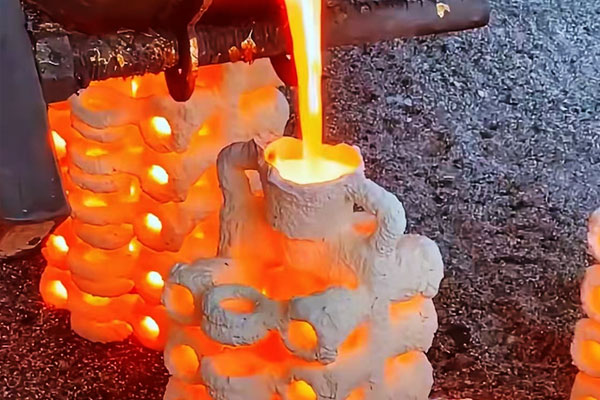
The pattern is coated with successive ceramic (investment) layers to form a rigid, thermally stable mold; the pattern material is removed by dewaxing and thermal burnout, leaving a cavity that is filled with molten bronze.
After solidification the ceramic shell is removed and the cast parts are cleaned and finished.
Why “bronze” matters — metallurgy and chemistry considerations.
“Bronze” is not a single composition but a family of copper-based alloys (e.g., tin bronzes, phosphor bronzes, silicon bronzes, aluminum bronzes).
These alloys differ in melting range, fluidity, tendency to form oxides, and chemical reactivity with investment materials:
- Melting/solidification window. Most tin/silicon bronzes have liquidus/solidus in the ≈ 850–1,050 °C band; aluminum bronzes typically melt and solidify at higher temperatures (≈ 1,020–1,080 °C).
The alloy’s melting range directly controls required pouring superheat and influences shell materials. - Reactivity with investments. Aluminum-rich bronzes can chemically attack silica face coats at elevated superheat, causing surface washout and inclusions.
Face-coat chemistry (zircon/alumina additions or barrier washes) and limiting superheat are routine mitigations. - Shrinkage & thermal conductivity. Copper alloys typically exhibit linear solidification shrinkage in the order of ~1.0–2.5% (alloy and casting size dependent).
High thermal conductivity of copper changes cooling gradients and gating strategy relative to ferrous castings; gating must promote directional feeding to avoid shrinkage porosity.
Key benefits that define the process value for bronze parts.
- High geometric fidelity. Fine external detail, thin ribs and small features are achievable with minimal tooling cost compared with die casting.
- Near-net shape. Minimizes machining and material removal, often reducing total part cost for complex components.
- Good surface finish. Typical as-cast finishes fall in Ra ≈ 1.6–6.3 μm; finer finishes are obtainable with special face coats and polishing.
- Material flexibility. Wide range of bronze chemistries can be cast, from ductile tin bronzes to high-strength aluminum bronzes for seawater service.
- Internal complexity. Ceramic cores enable internal passages and undercuts that would be difficult with other casting methods.
3. Bronze alloys used in investment casting — common grades
Values are industry-typical ranges; always confirm final numbers with your foundry and the specific alloy datasheet.
| Common name / trade | UNS / CDA | Primary alloying (typical wt%) | Liquidus (°C) | Typical UTS (MPa) | Typical applications |
| Tin bronze (general) | — / ASTM B584 families (e.g., C90300) | Cu–Sn (5–12% Sn typical) | ~900–1,050 | ~250–350 | Bearings, bushings, pump parts, decorative hardware |
| Leaded bearing bronze | UNS C93200 | Pb 6–8%, Sn ~6–8% | ~900–1,050 | ~250–400 | Bearings, bushings, wear parts, machinable components |
| Phosphor bronze | UNS C51000 | Sn ~4–10%, P 0.01–0.35% | ~950–1,020 | ~300–700 | Springs, electrical contacts, bushings, wear parts |
Silicon bronze |
UNS C63000 (Cu–Si types) | Si 1–4% (±Mn) | ~930–1,050 | ~200–450 | Architectural hardware, marine fittings, weldable castings |
| Nickel-aluminum bronze | UNS C63000 | Al 8–11%, Ni 3–6%, Fe 1–4% | ~1,010–1,070 | ~450–750 | High-load bushings, marine hardware, gears, impellers |
| Aluminum bronze (casting grades) | UNS C95200 / C95400 | Al ~8–12%, Fe 2–4%, Ni minor | ~1,040–1,080 | ~400–700+ | Pump impellers, seawater valves, heavy wear components |
| Red / architectural bronze (semi-red brasses) | UNS C84400 | Cu with Zn and small additions | ~843–1,004 (range) | ~200–350 | Ornamental hardware, plumbing fixtures, decorative castings |
4. Core Process of Bronze Investment Casting
The investment casting process for bronze shares the basic framework of traditional investment casting (wax pattern, shell making, dewaxing, pouring, cooling, shell removal, post-processing)
but requires targeted optimization to accommodate bronze’s unique material properties (moderate melting point, good fluidity, specific shrinkage characteristics).

4.1 Pattern production
- Wax injection tooling: efficient for medium-to-high volumes; produces consistent weights and surface finish.
Typical dimensional stability ±0.05 mm for small features, dependent on tooling quality. - 3D printed patterns: SLA/PolyJet/DLP or lost-wax 3D printing enable rapid iteration and economical low-volume production.
Consider resin ash content and burnout residues—select low-ash, investment-compatible resins or printed wax where possible.
4.2 Tree assembly and gating
- Gating philosophy: place gates to feed hot spots and promote directional solidification. Use short, smooth gates to reduce turbulence; incorporate filters if needed.
For bronze, avoid overly small gates that freeze prematurely relative to sections being fed. - Riser strategy: risers sized and located to supply liquid metal during shrinkage; simulation tools (solidification and thermal analysis) significantly reduce trial iterations.
4.3 Shell building (investment)
- Typical shell makeup: multiple slurry/stucco cycles—fine silica or zircon face coat (for surface finish), followed by coarser structural coats.
For reactive alloys, a zircon or alumina-rich face coat minimizes chemical attack. - Permeability and strength: shells must be permeable enough to vent gases during pour but sufficiently strong to resist thermal shock.
Shell thickness is scaled with part size; typical total shell thickness ranges from 6–25 mm for small to moderate parts.
4.4 Dewaxing and burnout
- Dewaxing methods: steam autoclave (fast, clean) or oven dewaxing. Steam is preferred for minimal residue; autoclave parameters are set to avoid shell cracking.
- Burnout schedule example (indicative): hold at 200–300 °C to remove volatiles, ramp to 700–900 °C with soak (2–8 hours) to ensure complete removal of carbonaceous residues and to thermally stabilize the shell.
Exact profile depends on investment chemistry, pattern material and shell thickness.
4.5 Melting and metal treatment
- Melting equipment: induction furnaces are standard for control and cleanliness. Crucible choice must be compatible with alloy (e.g., high-alumina crucibles for aluminum bronzes).
- Melt cleanliness: fluxing, skimming of dross, porous ceramic filters and degassing (argon or nitrogen sparging as appropriate) minimize inclusions and gas porosity.
- Pour temperature: practical superheat window commonly 30–150 °C above liquidus; keep superheat as low as process permits to limit shell reaction and gas pickup. Record melt chemistry and temperature for traceability.
4.6 Pouring, solidification and shakeout
- Pouring mode: gravity pouring for most parts; vacuum or pressure assist for very thin sections or to minimize turbulence. Controlled pour rate reduces oxide entrapment.
- Cooling strategy: allow directional solidification toward risers; controlled cool down reduces residual stresses.
Shakeout follows once the casting has sufficient strength; mechanical or thermal methods remove shell.
4.7 Cleaning and finishing
- Shell removal: mechanical (knockout, shot blast) followed by chemical cleaning if needed.
- Gate removal & machining: gates and runners are cut; critical features finish-machined as specified. Heat treatment (stress relief or solution/age procedures for certain aluminum bronzes) may follow.
5. Post-Processing: Enhancing Performance and Surface Quality
Post-cast operations tune properties, heal defects and reach functional specifications.
- Heat treatment: selected alloys (notably aluminum bronzes) respond to solution heat treating and aging to increase strength and hardness.
Typical aluminum bronze solution treatment ≈ 800–950 °C with controlled quench and aging cycles—consult specific alloy datasheet. - Hot Isostatic Pressing (HIP): reduces internal porosity and increases fatigue life; effective for critical rotating or pressure-retaining parts.
HIP cycles depend on alloy but commonly use pressures of 100–200 MPa at elevated temperatures. - Impregnation: resin impregnation for leak-tightness on parts with minor porosity (e.g., pump casings) is cost-effective when HIP is uneconomic.
- Surface finishing: shot-peening can improve fatigue resistance; polishing and plating/patination for corrosion resistance or aesthetics.
Surface coatings (e.g., lacquer, conversion coatings) may be applied for long-term appearance preservation. - Precision machining: tolerances tightened on critical features (bores, threads) with standard machining practices; design should indicate net versus machined critical dimensions.
6. Key Performance Characteristics of Bronze Investment Castings

Dimensional Accuracy and Surface Quality
- Typical small-feature tolerances: ±0.1–0.5 mm depending on feature size and criticality.
For linear scaling, ±0.08–0.13 mm per 25 mm (approx. ±0.003–0.005 in/in) is commonly specified for design guidance, but supplier capability tables should be used for final sign-off. - Surface finish: as-cast Ra commonly 1.6–6.3 μm; fine face coats and polishing enable much lower Ra values at additional cost.
Fine ornamental detail (lettering, filigree) is achievable to sub-millimetre resolution when pattern and shell are controlled.
Mechanical Properties
Investment-cast bronze exhibits consistent and predictable mechanical properties due to controlled solidification and uniform microstructure.
- Strength and toughness balance: Depending on alloy type (tin bronze, aluminum bronze, silicon bronze), investment castings can achieve good tensile strength while maintaining sufficient ductility for impact and cyclic loading.
- Isotropic behavior: Unlike wrought or directionally solidified processes, properties are relatively uniform in all directions, reducing design uncertainty.
- Good wear resistance: Many bronze alloys naturally resist galling and adhesive wear, making them suitable for bearings, bushings, and sliding components.
The combination of strength, ductility, and wear resistance supports reliable long-term service in demanding mechanical environments.
Corrosion Resistance
Bronze alloys are inherently resistant to a wide range of corrosive environments, and investment casting preserves this advantage without introducing process-related defects.
- Excellent resistance to atmospheric and freshwater corrosion, making bronze castings suitable for outdoor and architectural applications.
- Superior performance in marine environments: Aluminum bronze and tin bronze investment castings show strong resistance to seawater, biofouling, and stress corrosion.
- Chemical stability: Many bronze grades resist corrosion from mild acids, alkalis, and industrial fluids, extending component service life.
This corrosion resistance reduces maintenance requirements and lowers total lifecycle cost, especially in marine, chemical, and fluid-handling industries.
Castability and Process Flexibility
- Castability: Bronze has excellent castability – good fluidity (enabling complete filling of complex cavities), low shrinkage rate (0.8–1.2% for tin bronze, 1.0–1.4% for aluminum bronze), and minimal susceptibility to hot cracking.
- Process Flexibility: Bronze investment casting can accommodate a wide range of component sizes (from a few grams to hundreds of kilograms) and geometries (complex internal cavities, thin walls, fine details).
It is suitable for both low-volume (artistic castings, custom parts) and high-volume (mechanical components) production.
7. Common Defects in Bronze Investment Casting: Causes and Solutions
| Defect | Typical appearance / how detected | Common causes | Corrective actions & preventive measures |
| Porosity — gas (pinholes, dispersed porosity) | Small round holes visible on surface or internal by radiography; reduced density on micrograph | Inadequate burnout (organics), dissolved gas in melt, moisture in shell, turbulent pouring | Degas melt (argon/N₂), filter melt, optimize burnout (longer soak, higher temp), dry shells, reduce turbulence (gentle gating), consider vacuum/pressure fill; for critical parts use HIP or impregnation. |
| Porosity — shrinkage (cavities, internal voids) | Localized voids in thick sections, visible on X-ray; often connected to hot spots | Inadequate feeding/riser design, abrupt section changes, poor directional solidification | Redesign gating/riser to feed hot spots, add chills or insulating sleeves, smooth section transitions (fillets), use simulation to validate; increase riser capacity. |
| Inclusions / dross | Dark non-metallic spots on surface or internal inclusions on X-ray/microscopy | Poor melt cleanliness, slag entrainment, incompatible crucible/refractory | Improve fluxing and skimming, use ceramic filters, select compatible crucible/refractory, control pouring technique (clean ladle practices). |
Misrun / Cold shut |
Incomplete fill, visible seams or cold laps, short shots | Insufficient superheat, low mold temp, poor gating, long thin flow path | Increase pouring temperature within safe limit, preheat shell, enlarge/shorten gates, redesign runner layout to maintain head and flow. |
| Washout / shell reaction | Surface pitting, rough patches, chemical attack on face coat (often on Al-bronze) | Chemical reaction between alloy and silica face coat; excessive superheat | Use zircon/alumina face coats or barrier wash, lower superheat, shorten metal-to-shell contact time, choose compatible investment chemistry. |
| Hot tears / hot cracking | Irregular cracks in high-stressed or restrained areas, often near fillets | Constrained contraction, high thermal gradients, abrupt section changes | Redesign to reduce restraint (fillets, radius), improve gating to promote directional solidification, modify mold rigidity, control cooling rate. |
Surface roughness / crazing / pitting |
Rough as-cast surface, micro-pitting after cleaning | Incorrect slurry rheology, coarse stucco, poor drying/cure of shell | Adjust slurry viscosity and binder, use finer face stucco, ensure controlled drying and binder cure, improve slurry mixing consistency. |
| Oxide film / scum on surface | Black/gray film or scum, often at weld lines or seams | Oxidation of molten metal, turbulent flow folding oxide into liquid | Reduce turbulence, use filtration, control pouring speed, reduce exposure to air, use proper melt fluxes and skimming. |
| Core defects (shift, blowholes, gas porosity) | Misaligned internal passages, localized porosity near core surfaces | Poor core support/prints, core gas generation, inadequate venting | Add core supports/prints, improve core drying and cure, provide vents or permeability paths, use low-ash binders, inspect core fit before shelling. |
Dimensional distortion / warpage |
Out-of-tolerance dimensions, bent thin sections | Uneven cooling, thermal shock during dewax/burnout, residual stresses | Improve uniform heating/cooling, adjust burnout ramp, apply stress-relief heat treatment, modify gating to allow controlled contraction. |
| Blisters / blowholes | Raised bubbles under surface or subsurface pockets | Trapped gases (moisture, residual wax), poor shell venting | Ensure complete dewax and burnout, dry shells thoroughly, increase shell permeability/venting paths, control pouring to avoid gas entrapment. |
| Segregation / interdendritic porosity | Chemical segregation zones, brittle intermetallics, localized weak regions | Slow or non-uniform solidification, wide freezing range alloys | Tighten melt chemistry control, adjust pour rate and gating to control solidification, consider modified alloy or heat treatment to homogenize. |
Excessive flash / poor gate removal |
Large amounts of remaining gate material, difficult trimming | Oversized gating, poor gate placement, weak trimming process | Optimize gate size/location for automated trimming, add forged-in shear grooves, use jigs/fixtures for consistent cutting. |
| Surface contamination (stains, burn marks) | Discoloration, staining, or residues after cleaning | Incomplete removal of investment, chemical residues, overheating | Improve cleaning procedures (chemical and mechanical), control burnout peak temp, use proper pickling/neutralizing baths. |
8. Industrial Applications of Bronze Investment Casting
Bronze investment casting is widely adopted across industrial sectors where complex geometry, corrosion resistance, and reliable mechanical performance are required simultaneously.
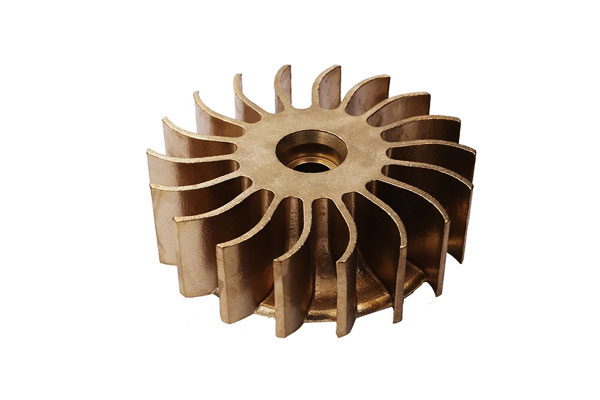
Marine and offshore industry
The marine environment places severe demands on metallic components due to continuous exposure to seawater, chlorides, high flow velocities, and cyclic mechanical loading.
Bronze investment casting is extensively used for pump impellers, propeller components, seawater valves, shaft sleeves, and bearing housings.
Aluminum bronzes and nickel-aluminum bronzes are preferred because of their excellent resistance to seawater corrosion, cavitation, and erosion.
Investment casting allows complex impeller blade geometries and smooth hydraulic surfaces to be produced as a single piece, reducing welding, improving balance, and extending service life.
For rotating marine components, investment casting also enables precise dimensional control that supports dynamic balancing and fatigue performance.
Fluid handling, pumps, and valves
In industrial pump and valve systems, performance depends heavily on dimensional accuracy, surface quality of wetted passages, and leak tightness.
Bronze investment casting is commonly used for valve bodies, impellers, trim components, throttling elements, and nozzles.
The process produces smooth internal flow paths that reduce turbulence, pressure loss, and erosion.
Aluminum bronzes are often selected for high-velocity or abrasive media, while tin and silicon bronzes are suitable for less aggressive fluids.
Investment casting minimizes internal machining and enables integrated features such as flanges, bosses, and flow guides, which lowers total manufacturing cost and improves reliability.
Oil, gas, and chemical processing
Bronze investment castings are used in oil, gas, and chemical applications for metering components, customized fittings, corrosion-resistant bushings, and valve internals.
These applications require consistent metallurgy, traceable quality, and resistance to corrosive or brine-based environments.
Nickel-aluminum bronzes and selected phosphor bronzes are commonly used where strength, corrosion resistance, and dimensional stability are critical.
Investment casting allows precise sealing geometries and complex internal channels while maintaining strict quality control through non-destructive testing and material certification.
Energy and power generation
In power generation systems—such as hydroelectric, thermal, and industrial power equipment—bronze investment castings are used for bearing housings, wear rings, guide vanes, and rotating or sliding components.
These parts must operate under cyclic loads, elevated temperatures, and long service intervals.
Phosphor bronzes are often selected for bearing and wear applications due to their fatigue resistance and tribological performance, while aluminum bronzes are used for high-load or corrosion-exposed components.
Investment casting supports tight clearances and complex shapes that improve efficiency and reduce maintenance requirements.
Aerospace and defense (specialized applications)
Although used selectively, bronze investment casting plays an important role in aerospace and defense systems for bushings, bearings, wear components, and electrical contact elements. In these applications, reliability and repeatability are paramount.
Investment casting allows precise control of geometry and metallurgy, often combined with advanced post-processing such as heat treatment, hot isostatic pressing, and full non-destructive inspection.
Phosphor bronzes are commonly used for spring and contact applications, while high-strength aluminum bronzes are selected for structural or load-bearing wear components.
Automotive and transportation
In automotive and transportation sectors, bronze investment castings are applied primarily in specialized or high-performance components such as bushings, valve train elements, wear pads, and decorative hardware.
In heritage or premium vehicles, bronze is also used for aesthetic components where appearance and durability are equally important.
Leaded bronzes are frequently selected for bushings due to their excellent machinability and anti-friction behavior, while tin and silicon bronzes provide a balance of strength, corrosion resistance, and surface finish.
Investment casting enables near-net-shape production, reducing machining time and material waste.
Industrial machinery and equipment
General industrial machinery relies on bronze investment castings for bearings, thrust washers, valve components, small gear elements, and sliding or oscillating parts.
These components often experience repeated motion, boundary lubrication, and moderate mechanical loads.
Phosphor and tin bronzes are commonly chosen for their wear resistance and fatigue performance.
Investment casting allows consistent production of intricate shapes, integrated lubrication features, and precise mating surfaces, improving machine reliability and service life.
Architectural hardware and building applications
Bronze investment casting is widely used in architectural hardware, including door handles, hinges, locks, railing components, and decorative fittings.
In this sector, surface finish, dimensional consistency, and long-term corrosion resistance in urban or coastal environments are key requirements.
Silicon bronzes, tin bronzes, and architectural red bronzes are preferred for their attractive appearance and patina behavior.
Investment casting enables fine surface detail and repeatability across production batches, which is essential for large building projects and restoration work.
Art, sculpture, and cultural restoration
One of the oldest applications of bronze casting remains highly relevant today. Investment casting is extensively used for sculptures, artistic installations, replicas, and historical restoration.
The process excels at reproducing fine textures, undercuts, and complex organic forms.
Tin and silicon bronzes are typically used due to their fluidity, workability, and compatibility with patination processes.
Modern investment casting techniques allow artists and conservators to achieve exceptional fidelity while maintaining structural integrity.
Electrical and electronic components
In electrical and electronic applications, bronze investment castings are used for connectors, terminal blocks, spring contacts, and specialized conductive components.
Phosphor bronzes are particularly valued for their combination of electrical conductivity, spring properties, and corrosion resistance.
Investment casting enables precise geometry for contact pressure and alignment, which is critical for long-term electrical performance and reliability.
9. Comparative Analysis: Bronze Investment Casting vs. Other Bronze Casting Processes
| Comparison Aspect | Bronze Investment Casting (Lost Wax) | Sand Casting (Bronze) | Centrifugal Casting (Bronze) | Die Casting (Bronze / Copper Alloys) | Continuous Casting (Bronze) |
| Dimensional Accuracy | Very high (near-net shape, ±0.1–0.3%) | Moderate to low (large machining allowance) | High in diameter, limited in length features | Very high, but geometry limited | High for constant cross-sections |
| Surface Finish (Ra) | Excellent (Ra 3.2–6.3 μm) | Rough (Ra 12.5–25 μm) | Good to very good | Excellent (Ra <3.2 μm) | Good |
| Geometric Complexity | Excellent (thin walls, undercuts, fine details) | Moderate | Limited to axisymmetric parts | Limited by die design | Very limited (simple profiles) |
| Wall Thickness Capability | Thin sections possible (≈2–3 mm) | Thick sections preferred (>5–6 mm) | Medium to thick walls | Thin sections possible | Thick, uniform sections |
| Internal Soundness | High, uniform microstructure | Risk of shrinkage and porosity | Excellent (dense structure) | Very high, but alloy options limited | Very high |
| Mechanical Properties | Consistent, isotropic | Variable, section-dependent | Superior in hoop direction | Very high due to rapid solidification | Consistent |
Tooling Cost |
Medium (wax tooling + shell system) | Low | Medium | Very high (steel dies) | Very high |
| Unit Cost (Low Volume) | Economical | Lowest | High | Not economical | Not economical |
| Unit Cost (High Volume) | Competitive | Competitive | High | Lowest at very high volumes | Competitive |
| Lead Time | Medium | Short | Medium to long | Long (die manufacture) | Long |
| Machining Requirement | Minimal | High | Medium | Minimal | Medium |
| Alloy Flexibility | Very high (tin bronze, aluminum bronze, silicon bronze, etc.) | Very high | Moderate | Limited (casting-fluidity dependent) | Moderate |
Typical Part Size |
Small to medium (grams to ~50 kg) | Small to very large | Medium to large cylinders | Small to medium | Long products (bars, tubes) |
| Typical Applications | Valves, pump parts, marine hardware, art castings, precision components | Bushings, housings, structural parts | Bushings, sleeves, bearings | Electrical components, fittings | Bars, rods, tubes for machining |
| Overall Process Positioning | Best balance of precision, flexibility, and quality | Cost-driven, low precision | Performance-driven for rotational parts | Volume-driven, design-limited | Semi-finished product production |
Key Takeaways from the Comparison:
- Bronze Investment Casting is the best choice for applications requiring complexity, precision, and superior surface finish (e.g., art, aerospace, medical), regardless of production volume.
It is the only process capable of casting thin walls (≤0.3 mm) and fine details (≤0.2 mm). - Bronze Sand Casting is preferred for large, simple components (e.g., heavy machinery parts) where precision and surface finish are not critical, due to its low cost and ability to handle large sizes.
- Bronze Die Casting is ideal for high-volume production of small, simple-to-medium complexity components (e.g., electrical connectors) due to its low unit cost at high volumes, but high initial tooling cost limits its use for low-volume production.
- Bronze Centrifugal Casting is specialized for cylindrical components (e.g., pipes, bearings) where uniform wall thickness is critical, but it cannot cast complex or asymmetric shapes.
10. Conclusions
Bronze investment casting remains a premier method where part complexity, surface integrity and tailored metallurgy converge.
Its strengths derive from controlled patterning (including modern additive techniques), engineered ceramic investments, disciplined burnout, clean melting practices and intelligent gating that together deliver predictable part quality.
Engineers should engage foundries early to align alloy selection, shrink allowances, shell composition and finishing strategy with functional requirements.
For high-integrity applications, combine process controls (degassing, melt filtration), post-processing (HIP, heat treatment) and rigorous inspection to meet service life expectations.
FAQs
What minimum wall thickness can I realistically design for?
Design guidance: 1.0–2.5 mm practical range depending on alloy and geometry. For critical thin sections, validate with sample castings and consider vacuum/pressure assist.
What shrinkage factor should I apply when dimensioning patterns?
Typical linear shrinkage: 1.0–2.5%. Use supplier-specific values established from cast trials for accurate tooling.
Which bronze family is best for seawater service?
Aluminum bronzes are commonly chosen for seawater exposure due to superior corrosion resistance and anti-fouling behavior, often in the UNS C95400 family or equivalents.
Validate alloy selection against exact seawater chemistry and mechanical loading.
How do I reduce porosity in castings?
Combine adequate burnout (eliminate organics), melt degassing and filtration, smooth non-turbulent gating, and consider vacuum/pressure fill or HIP for critical parts. Maintain dry, well-cured shells.
Is 3D printing compatible with investment casting?
Yes—wax and resin patterns produced by SLA/DLP/PolyJet or direct-wax printers allow rapid iteration and low-volume production.
Ensure the printed material is investment-compatible (low ash, predictable burnout) or use printed sacrificial wax where appropriate.