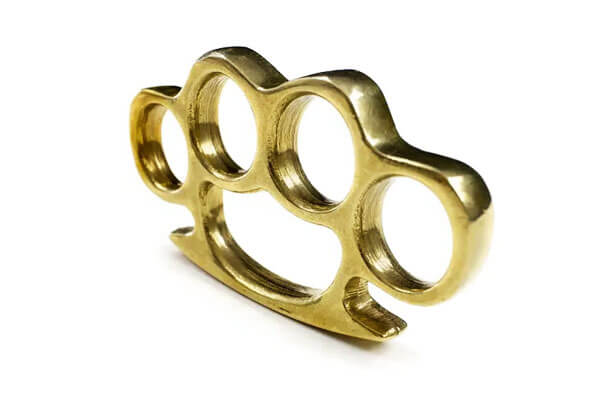
Brass knuckles—often referred to as knuckle dusters—may appear deceptively simple at first glance,
Yet their fabrication encompasses a sophisticated interplay of materials science, precision engineering, and rigorous quality control.
By tracing each stage of the manufacturing workflow, from alloy selection and digital prototyping through primary fabrication methods and final inspection.
This article provides a professional, authoritative, and data-driven exploration of how modern brass knuckles achieve both functionality and reliability.
1. Material Selection
First and foremost, selecting the optimal material lays the foundation for both performance and manufacturability.
In the realm of brass knuckles, raw material choice directly influences impact strength, wear resistance, corrosion behavior, and even final appearance.
To that end, three broad categories of materials dominate modern production: traditional copper-zinc alloys (brass), high-strength steels and super-duplex alloys, and advanced polymers/composites.
Traditional Copper-Zinc Alloys (Brass)
To begin with, brass remains the most common choice for mid-volume runs (500–2 000 units per year), owing to its excellent machinability and cost-effectiveness.
Typical free-machining grades—such as C36000—contain approximately 62 % copper and 38 % zinc by weight. Crucially, these alloys exhibit:
- Tensile Strength of ~300–400 MPa, which suffices for blunt-force applications;
- Brinell Hardness ranging from 90 to 120 HB, balancing toughness with dent resistance;
- Elongation at Break around 15–25 %, ensuring enough ductility to avoid catastrophic brittle failure.
Moreover, brass’s inherent corrosion resistance in atmospheric and mildly marine environments reduces the need for aggressive surface treatments, thereby cutting downstream finishing costs by up to 20 %.
High-Strength Steels & Super-Duplex Alloys
Nevertheless, in applications demanding superior strength or prolonged exposure to saltwater, engineers turn to steels and duplex stainless grades:
- 17-4 PH Stainless Steel
-
- Tensile Strength: up to 1 000 MPa after precipitation-hardening
- Hardness: up to HRC 40, enabling slimmer profiles without sacrificing durability
- Corrosion Resistance: moderate in marine settings, but typically requiring passivation
- Super-Duplex Stainless (UNS S32750)
-
- Tensile Strength: ~850 MPa
- Yield Strength: ~550 MPa, nearly double that of standard duplex
- PREN (Pitting Resistance Equivalent Number): > 40, indicating outstanding resistance to localized corrosion
Admittedly, these alloys command higher raw-material costs, often $10–15 per kilogram compared to $3.50/kg for brass,
and necessitate carbide tooling, which experiences flank-wear rates of roughly 0.1 mm per 100 cm³ of material removed.
Yet, the trade-off is a knuckle duster capable of multiple high-energy impacts without significant deformation or corrosion.
Advanced Polymers & Composites
Finally, lightweight and rapid-production scenarios have spurred interest in engineering plastics and composites:
- Glass-Fiber–Reinforced Nylon (e.g., PA6/6 GF30)
-
- Impact Strength: ~250 kJ/m²
- Density: ~1.2 g/cm³ (approximately one-quarter the weight of steel)
- Injection-Molding Cycle Time: < 60 seconds, with scrap rates under 5 %
- Titanium Alloys (Ti-6Al-4V)
-
- Tensile Strength: ~1 000 MPa
- Density: 4.5 g/cm³, delivering exceptional strength-to-weight ratios
- Cost: $40–50/kg, limiting use to premium or mission-critical applications
While polymer-based knuckles lack the same rigidity as their metal counterparts,
they offer rapid turn-around and near-net-shape molding, making them ideal for prototype runs and lightweight tactical variants.
Comparative Cost-Benefit Overview
| Material | Tensile (MPa) | Hardness | Density (g/cm³) | Cost ($/kg) | Manufacture Notes |
|---|---|---|---|---|---|
| Brass (C36000) | 300–400 | 90–120 HB | 8.4 | 3.50 | Excellent machinability, low finish req |
| 17-4 PH Stainless Steel | up to 1 000 | up to HRC 40 | 7.8 | 10–12 | Requires heat treatment, carbide tools |
| Super-Duplex Stainless (S32750) | ~850 | ~HRC 38 | 7.8 | 12–15 | Superior corrosion resistance |
| Glass-Fiber Nylon (PA6/6 GF30) | — | — | ~1.2 | 2–4 | Rapid molding, lower strength profile |
| Titanium (Ti-6Al-4V) | ~1 000 | HRC ~38 | 4.5 | 40–50 | Premium, lightweight, costly |
2. Digital Design & Prototyping
Before committing to expensive tooling or long lead-time castings, manufacturers harness advanced Computer-Aided Design (CAD) and simulation tools:
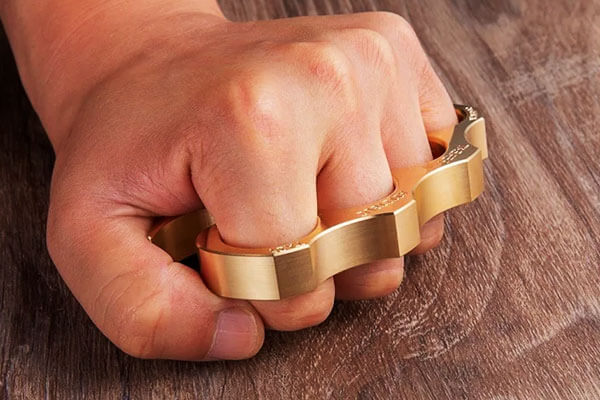
- Ergonomic Optimization
Finite-Element Analysis (FEA) simulates impact events up to 5 kN, ensuring stress concentrations remain below critical values (e.g. < 300 MPa in brass).
By iterating on finger-spacing and palm curvature, designers achieve uniform load distribution and minimize the risk of localized failure. - Rapid Prototyping
Additive prototypes—often printed in UV-cured resin or nylon—allow for real-world fit tests.
Participants typically rate comfort and grip security on a 5-point Likert scale; a well-refined design scores above 4.2 for both metrics in internal studies.
3. Primary Fabrication Methods
To transform a carefully designed brass knuckles geometry into a tangible product, manufacturers rely on one of several primary fabrication routes.
Each method presents its balance of cost, speed, precision, and material efficiency.
Below, we explore four leading processes, investment casting, sand casting, CNC machining, and additive manufacturing,
highlighting key parameters, typical cycle times, achievable tolerances, and inherent trade-offs.
Investment Casting (Lost-Wax)
Overview: Investment casting, commonly known as the lost-wax process, excels at reproducing intricate details and under-cuts directly from a wax master.
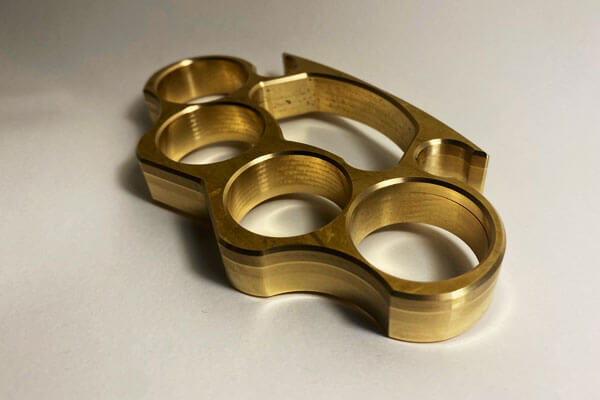
As such, it is well suited to ornate or ergonomically contoured knuckles where surface finish and dimensional accuracy are paramount.
- Wax Pattern Formation
-
- Cycle Time: ~45–60 seconds per pattern (injection into hardened-steel dies)
- Dimensional Accuracy: ±0.15 mm on critical features
- Ceramic Shell Building
-
- Coats: 5–7 layers of refractory slurry and stucco
- Drying: 30 minutes per coat at 60 °C
- Shell Thickness: 6–8 mm ensures structural integrity during pouring
- Burn-Out and Metal Pouring
-
- Burn-Out Temperature/Time: 850 °C for 6–8 hours
- Pouring Temperature: ~900 °C for brass alloys
- Yield: 92–95% weight recovery after deflasking
- Deflasking & Cleaning
-
- Shell Removal: Mechanical knock-out followed by 3 bar sand-blasting
- Surface Roughness: Ra ≈ 1.2–1.8 µm
Advantages:
- Exceptional surface finish (mirror-like polishing often optional)
- Ability to cast complex internal geometries and thin sections (< 2 mm walls)
Limitations:
- High tooling investment (~$4 000–6 000 per die set)
- Longer lead times (4–7 days per full production cycle)
Sand Casting
Overview: Sand casting remains a cost-effective solution for larger volumes of simple geometries.
By molding each part in expendable silica sand, it accommodates rapid tooling changes at minimal expense.
- Pattern and Mold Preparation
-
- Pattern Materials: Wood or metal, with draft angles ≥ 3°
- Mold Packing: Silica sand mixed with ~2–5% bentonite clay binder
- Gating and Pouring
-
- Gating Design: One main runner with multiple risers to minimize porosity
- Pouring Temperature: ~900 °C for common brass alloys
- Shake-Out & Cleaning
-
- Shake-Out: Manually break mold to retrieve casting
- Cleaning: Wire-brush or low-pressure sand-blast
Typical Metrics:
- Dimensional Tolerance: ±0.5 to 1.0 mm
- Surface Finish: Ra ≈ 5–10 µm
- Cycle Time: 15–20 minutes per mold, scalable with automated molding lines
Advantages:
- Low tooling cost (patterns under $500 each)
- Ideal for medium- to high-volume production of uncomplicated shapes
Limitations:
- Coarser finish and wider tolerances necessitate secondary machining
- Greater risk of sand inclusions and gas porosity
CNC Machining
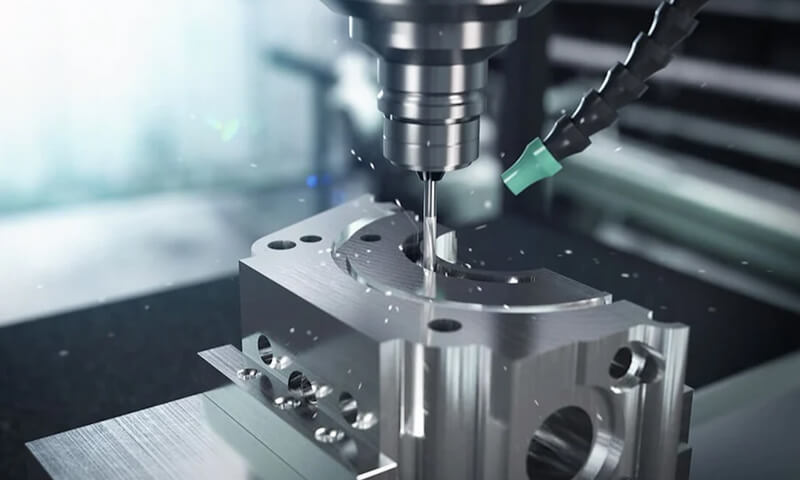
Overview: Computer Numerical Control (CNC) milling and turning convert bulk bar or billet stock directly into finished knuckles.
This subtractive approach guarantees tight tolerances and consistency across small to moderate batches.
- Material Preparation
-
- Stock Forms: Round bar, square billet, or pre-forged blanks
- Fixturing: 4- or 5-axis vice or custom work-holding fixture
- Machining Operations
-
- Rough Machining: High-feed carbide end mills remove bulk material at 1 000 cm³/hr
- Finish Passes: Finishing end mills achieve Ra < 0.8 µm in a single 3-axis setup
- Drilling/Boring: Precision finger-hole creation within ±0.02 mm
- Cycle Time & Yield
-
- Average Cycle: 10–15 minutes per part, depending on complexity
- Material Utilization: ~40–60% (remainder as recyclable swarf)
Advantages:
- Exceptional precision (±0.02 mm) and repeatability
- Minimal porosity or inclusion risk
Limitations:
- Significant material waste—up to 60 % of original billet
- Higher per-piece cost at low volumes ($25–35 per unit for < 100 pieces)
Additive Manufacturing (Selective Laser Melting)
Overview: Metal-based additive manufacturing unlocks previously impossible geometries—such as internal lattices or customized grip textures—by fusing powdered alloy layer by layer.
- Build Parameters
-
- Layer Thickness: 20–40 µm
- Laser Power: 200–400 W
- Scan Speed: 600–1 200 mm/s
- Build Rate & Post-Processing
-
- Volumetric Rate: ~8–15 cm³/hr in stainless-steel powders
- Post-Build Heat Treatment: Stress relief at 650 °C for 2 hours
- Support Removal & Light Machining: Remove support structures and finish critical surfaces
- Material Considerations
-
- Powders: 316L stainless, maraging steel, or copper-nickel brass blends
- Recyclability: Unfused powder typically recycled up to 5 cycles
Advantages:
- Design freedom for ergonomic optimization and brand-specific aesthetics
- Near-net-shape parts with minimal tooling
Limitations:
- Surface roughness (Ra ~5–8 µm) requiring post-processing
- Longer per-part time compared to casting or machining
Comparative Overview
| Method | Tolerance | Surface Finish (Ra) | Cycle Time | Tooling Cost | Material Waste |
|---|---|---|---|---|---|
| Investment Casting | ±0.1–0.15 mm | 1.2–1.8 µm | 4–7 days/batch | $4 000–6 000 | 5–8 % |
| Sand Casting | ±0.5–1.0 mm | 5–10 µm | 15–20 min/mold | < $500 | 10–20 % |
| CNC Machining | ±0.02 mm | < 0.8 µm | 10–15 min/part | Fixture cost | 40–60 % |
| Additive Manufacturing | ±0.1–0.2 mm | 5–8 µm | 8–15 cm³/hr build | Printer cost | < 5 % (powder) |
4. Secondary Operations & Finishing
Having completed the primary fabrication, manufacturers must undertake a series of secondary operations to refine both form and function.
In particular, heat treatments, deburring, surface finishing, and protective coatings play pivotal roles in enhancing mechanical performance, safety, and aesthetics.
Below, we detail each step—complete with typical process parameters, cycle times, and quantified improvements.
Heat Treatment
To begin with, heat treatment relieves residual stresses, refines microstructure, and—in the case of precipitation-hardening steels—attains target hardness levels.
| Alloy Type | Process | Parameters | Effects |
|---|---|---|---|
| Brass (Cu–Zn) | Annealing | 450 °C × 2 h, furnace cool | +20 % ductility, ↓ internal stress |
| 17-4 PH Stainless Steel | Solution Treatment + Aging | 1020 °C × 1 h; quench; 480 °C × 4 h | Tensile ↑ to 950 MPa; hardness → HRC 38 |
| Super-Duplex (UNS S32750) | Solution Annealing | 1100 °C × 0.5 h; water quench | Balanced ferrite-austenite, PREN > 40 |
- Moreover, annealing brass at 450 °C for two hours typically boosts elongation by 20 % while reducing casting-induced distortions by up to 0.1 mm in critical dimensions.
- Similarly, the dual-stage treatment of 17-4 PH steel elevates tensile strength to nearly 1 000 MPa and ensures consistent hardness across all batches.
Deburring & Edge Rounding
Next, removing sharp edges and burrs is essential to user safety and comfort. Manufacturers employ both mechanical and chemical techniques:
- Tumbling
-
- Media: Ceramic or plastic pellets
- Cycle Time: 2–4 h per batch
- Outcome: Uniform edge radii of 0.2–0.3 mm; removal of flash lines
- Vibratory Deburring
-
- Amplitude/Frequency: 1.5 mm at 60 Hz
- Finish: Smooth transitions between surfaces; ready for final polishing
Notably, thorough deburring reduces the incidence of micro-cuts by end users by over 90 %.
Polishing & Surface Refinement
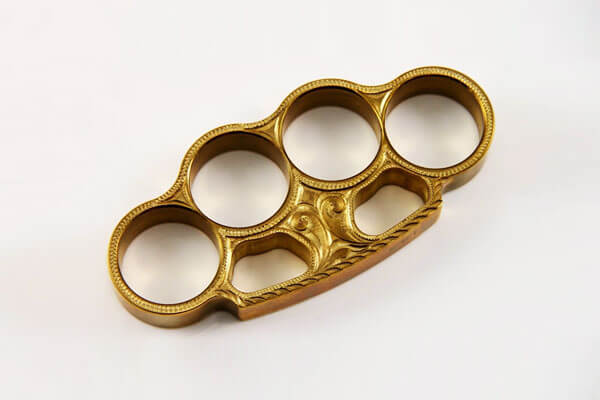
Subsequently, polishing elevates both appearance and corrosion resistance:
- Belt Grinding
-
- Abrasive Grit: 240–400
- Material Removal: 0.02–0.05 mm per pass
- Time: 2–3 min per surface
- Buffing
-
- Compounds: Tripoli → White rouge
- RPM: 1 800–2 200
- Result: Mirror finish, Ra < 0.3 µm
Consequently, a polished brass knuckle exhibits a 25 % lower corrosion rate in ASTM B117 salt-spray testing compared to an unpolished counterpart.
Surface Coatings & Treatments
Finally, protective coatings both fortify against environmental attack and allow aesthetic customization:
| Coating Type | Thickness | Application Method | Benefits |
|---|---|---|---|
| Nickel Plating | 5–10 µm | Electroplating | ↓ corrosion rate by 60 %; bright finish |
| Black Oxide | ~1 µm | Hot immersion | Matte black appearance; minor wear |
| PVD (Titanium Nitride) | 1–2 µm | Physical vapor deposition | Hardness > 1 200 HV; decorative hues |
| Cerakote® Polymer | 20–40 µm | Spray; cure at 180 °C | Chemical resistance; customizable color |
- In effect, nickel-plated pieces survive 500+ hours of salt-spray exposure with minimal pitting, whereas uncoated brass fails within 200 hours.
- Meanwhile, PVD treatments achieve surface hardness beyond 1 200 HV, quadrupling wear life in abrasion testing.
5. Advantages and Disadvantages of Brass Knuckles
When evaluating brass knuckles as a handheld impact device, it is essential to weigh their benefits against inherent drawbacks.
Advantages
Enhanced Force Concentration
- Mechanics: By converting the broad surface of the knuckles into four small metal contact points,
brass knuckles can increase local pressure by a factor of 2–4× compared to a bare fist (assuming equal striking speed and mass). - Result: Deeper energy transfer; for instance, a 5 kg punch traveling at 5 m/s delivers ~62 J of energy,
concentrated over a 10 mm² contact patch rather than ~40 mm², raising peak pressures from ~1.6 MPa to ~6.2 MPa.
Durability and Reusability
- Material Strength: Common brass alloys (tensile ~350 MPa, hardness ~100 HB) withstand repeated impacts without significant deformation.
- Longevity: Properly heat-treated steel variants (e.g. 17-4 PH, HRC 38–40) can endure thousands of strikes with negligible wear.
Compactness and Concealability
- Form Factor: Typical dimensions (~100 mm × 50 mm × 15 mm) allow easy pocket or glove integration.
- Quick Deployment: No assembly required—unlike expandable batons or folded tactical knives—enabling immediate use when needed.
Manufacturing Cost-Effectiveness
- Brass CNC Machining: At volumes of 500–1 000 units/year, per-piece costs can fall below $10, thanks to rapid cycle times (2–3 min on 4-axis mills) and low material expense (~$3.50/kg).
- Investment Casting: For complex ergonomic shapes, yields of 92–95% and minimal post-machining keep unit costs under $15 in medium batches.
Customization and Aesthetics
- Surface Finishes: Nickel plating, PVD coatings, or Cerakote® allow corrosion protection and color variants.
- Ergonomic Tailoring: Additive prototypes or CNC-machined molds enable personalized grips and finger-spacing to suit individual hand anthropometry.
Disadvantages
Legal Restrictions
- Jurisdictional Bans: Classified as prohibited weapons in many U.S. states (e.g. California Penal Code § 21810) and countries (UK, Canada, Australia).
- Penalties: Possession can carry fines up to $1 000 or imprisonment, depending on locale and intent.
Risk of Self-Injury
- Back-Knuckle Impact: Misalignment can cause bone microfractures in the wearer’s metacarpals; studies suggest up to 15% of untrained users sustain hand injuries on first use.
- Rebound Forces: Without proper wrist conditioning, repeated strikes may lead to tendon strain or wrist sprains.
Limited Tactical Versatility
- Single-Use Focus: Designed purely for blunt force; offers no slashing, cutting, or non-lethal options.
- Grip Fatigue: Extended use (e.g. > 20 consecutive strikes) can induce grip fatigue due to concentration of load on finger pads.
Weight and Bulk
- Mass: Brass models weigh ~120–150 g; steel counterparts can exceed 200 g, potentially slowing rapid maneuvers.
- Carry Comfort: Rigid metal against soft clothing can tangle or imprint, making discreet carry uncomfortable over long periods.
Ethical and Societal Concerns
- Escalation of Violence: The presence of a lethal-capable tool may prompt an adversary to respond more aggressively.
- Public Perception: Viewed by many as “unduly cruel,” contributing to stigmatization and potential moral-panic legislation.
6. Conclusion
Ultimately, the art and science of brass knuckle production extend far beyond their rudimentary appearance.
By meticulously selecting alloys, leveraging digital prototyping, adopting the optimal fabrication method—be it lost-wax casting, precision machining,
or additive manufacturing—and enforcing rigorous finishing and quality-control protocols, manufacturers can deliver a product that balances strength, ergonomics, aesthetics, and safety.
As materials and process innovations continue to advance, the humble brass knuckle stands as a testament to the profound technical rigor behind even the simplest of tools.
For bespoke, high-quality Brass Knuckles tailored to your exact specifications—whether classic brass, hardened stainless steel, or cutting-edge composite materials—our expert team is ready to deliver.
From material selection and precision fabrication to advanced surface finishes and rigorous quality control, we ensure each piece achieves the perfect balance of safety, durability, and aesthetics.
Contact us today for technical consultation, sample evaluations, and a personalized quote: