Introduction
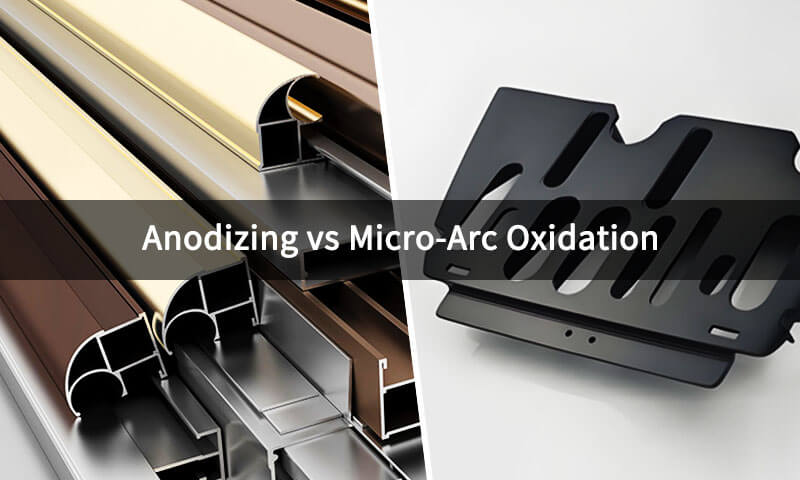
Anodizing vs micro-arc oxidation are both electrochemically driven surface treatments, but they serve different engineering purposes and produce very different coating architectures.
In common industrial usage, anodizing is most associated with aluminum, where it is used to form a controlled oxide layer that can improve corrosion resistance and provide an excellent base for further finishing.
Micro-arc oxidation, also called plasma electrolytic oxidation (PEO), is a more energetic process used to generate oxide-ceramic coatings on light alloys such as aluminum, titanium, magnesium, and zirconium.
The practical question is therefore not which process is “better” in the abstract, but which process better matches the part’s function.
1. What is Anodizing?
Classical anodizing forms anodic alumina on aluminum by anodic polarization in a suitable electrolyte.
The resulting film may be barrier-type or porous-type depending on the electrolyte and process conditions.
In near-neutral electrolytes, barrier films tend to be compact and relatively uniform; in acid electrolytes, porous anodic films are commonly produced, with cylindrical pores separated from the metal by a thin barrier layer.
This structural tunability is one of anodizing’s greatest strengths.

From a corrosion-engineering perspective, porous anodic films are often not the final answer by themselves: sealing is commonly used to close or partially close pores and improve corrosion resistance by blocking corrosive media from reaching the substrate.
That is why anodizing is frequently treated as a system rather than a single step, especially in industrial manufacturing and other demanding applications.
2. What is Micro-Arc Oxidation?
Micro-arc oxidation/PEO is best understood as an anodic process that intentionally moves beyond ordinary anodizing into dielectric breakdown and plasma-assisted growth.
Under high voltage, micro-discharges form at the metal–oxide–electrolyte interface; these discharges locally melt, oxidize, and rapidly solidify the surface layer, creating a ceramic coating in situ.
The process is therefore not merely “thicker anodizing”; it is a distinct growth regime with its own discharge physics and layer evolution.

The formation process usually proceeds in stages. The early stage resembles conventional anodizing, but once the oxide reaches breakdown conditions, micro-arcs appear and the coating begins to develop through plasma events.
As the layer thickens, the discharges become less frequent but more intense, and the coating evolves into a layered structure with distinct dense and more friable regions.
This discharge-driven growth explains why MAO coatings are often rougher, thicker, and more ceramic-like than conventional anodic films.
3. Structure: Porous Oxide Film versus Ceramic Composite Layer
Anodizing: a Controlled Oxide Architecture
Anodizing typically produces an oxide layer with a barrier-plus-porous structure, especially on aluminum.
The outer porous region provides pathways for sealing, dyeing, and surface modification, while the inner barrier layer contributes to corrosion protection and electrical insulation.
This architecture is highly controllable and is one of the main reasons anodizing remains so widely used in industrial finishing.
Micro-Arc Oxidation: a Plasma-Formed Ceramic Layer
Micro-arc oxidation, by contrast, forms a ceramic-like composite coating through plasma-assisted discharges.
The coating generally contains dense oxide regions, discharge channels, and locally re-solidified material, resulting in a more complex and more rugged structure than conventional anodic films.
Instead of emphasizing pore engineering for sealing or coloring, MAO emphasizes the formation of a hard, functional ceramic surface.
4. Performance Comparison: Anodizing vs Micro-Arc Oxidation
Corrosion Resistance
Both processes can provide excellent corrosion protection, but they do so in different ways.
Anodizing depends heavily on film quality, pore sealing, and process consistency. When properly sealed, anodic coatings can perform very well in moderate environments.
Micro-arc oxidation coatings also offer strong corrosion resistance, particularly when the coating is dense and well controlled, although their performance may be influenced by microcracks, porosity, and discharge-induced defects.
Wear Resistance and Hardness
In general, anodizing improves surface durability, and hard anodizing is specifically used where abrasion resistance matters.
However, Micro-arc oxidation usually delivers a more ceramic-like surface and therefore tends to offer stronger wear performance under demanding mechanical conditions.
This makes MAO especially attractive for components exposed to friction, impact, or repeated sliding contact.
Surface Functionality
Anodizing is especially effective when the goal is to combine corrosion resistance with aesthetic value, paint adhesion, or electrical insulation.
Micro-arc oxidation is more often selected when the surface must perform as a functional engineering layer rather than a decorative finish.
Its value lies in the combination of hardness, stability, and resistance to harsh service environments.
Adhesion and load-bearing behavior.
Both technologies produce oxide layers that are integral with the substrate rather than externally sprayed films, so adhesion is generally a strength of each.
Micro-arc oxidation’s plasma-assisted growth can create highly adherent ceramic coatings, while anodizing’s advantage is that it can be tightly controlled and integrated with sealing or primer systems.
Insulation and functional surface behavior.
Anodizing has long been used for dielectric applications and as a base for organic coatings.
Micro-arc oxidation coatings can also provide electrical insulation, but they are more often selected when the design priority shifts toward wear, thermal stability, or a ceramic-like surface rather than precision porous morphology.
Fatigue and Structural Reliability
A thicker and harder coating is not automatically a better coating. For load-bearing parts, surface defects, residual stress, and coating brittleness may affect fatigue behavior.
Anodizing, especially when thin and well controlled, is often gentler on dimensional tolerance and structural performance.
Micro-arc oxidation can be highly effective, but its adoption requires careful attention to the interaction between coating integrity and mechanical reliability.
5. Process, Scalability, and Environmental Considerations
Process Characteristics
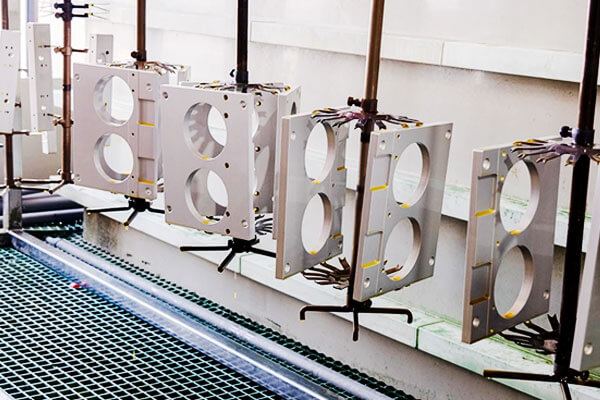
Anodizing is a mature electrochemical process with well-established industrial control methods.
Its operating window is relatively familiar, and the technology has been refined over decades for large-scale manufacturing.
Micro-arc oxidation is also electrochemical in origin, but it operates in a much more energetic regime, where micro-discharges play a central role in coating formation. This makes the process more complex to control.
Scalability
Anodizing scales well for high-volume production, especially in industries where repeatability and appearance are important.
It is suitable for many common aluminum components and integrates smoothly with sealing, dyeing, and painting operations.
Micro-arc oxidation is scalable as well, but its process complexity can make industrial implementation more demanding.
It is often adopted where performance requirements justify the higher technical threshold.
Environmental Considerations
Both technologies can be developed in environmentally responsible directions, but they differ in process burden and downstream treatment needs.
Anodizing is mature enough that many industrial systems already have established wastewater treatment and recovery practices.
Micro-arc oxidation may reduce dependence on some traditional surface-protection approaches, but it also requires careful management of electrolytes, energy input, and process byproducts.
In both cases, environmental performance depends strongly on process design and plant-level control.
6. Cost and Surface-Engineering Implications
Cost Considerations
From a cost perspective, anodizing is generally the more economical and accessible option.
Its industrial maturity, broad supplier base, and process familiarity help keep implementation costs relatively manageable.
Micro-arc oxidation is usually more expensive because of its higher energy demand, more complex equipment requirements, and tighter process control needs.
That said, higher initial cost does not necessarily mean lower value; in severe-service applications, Micro-arc oxidation may deliver better lifecycle performance.
Surface-Engineering Implications
The choice between anodizing and Micro-arc oxidation is ultimately a surface-engineering decision, not just a coating decision.
Anodizing is best viewed as a controlled oxide-platform technology: it creates a stable surface that can be sealed, dyed, painted, or further functionalized.
Micro-arc oxidation is better understood as a functional ceramic-surface technology: it creates a harder, more durable, and more application-specific surface for demanding service conditions.
7. Technical Comparison: Anodizing vs Micro-Arc Oxidation
| Aspect | Anodizing | MAO (Micro-arc oxidation / PEO) |
| Process nature | An electrochemical oxidation process that grows an oxide layer directly on the metal surface under controlled anodic polarization. | A plasma-assisted electrochemical oxidation process in which micro-discharges drive rapid oxide formation and surface ceramicization. |
| Typical substrates | Most commonly applied to aluminum and aluminum alloys; widely standardized for aluminum oxide coatings. | Commonly used on aluminum, titanium, magnesium, zirconium, and other light alloys. |
| Coating character | Typically forms a barrier-plus-porous oxide structure, especially on aluminum. | Produces an oxide–ceramic composite coating generated through oxidation, local melting, and electrolyte interaction. |
Primary performance focus |
Corrosion resistance, decorative appearance, paint adhesion, electrical insulation, and, in hard-anodized variants, improved wear resistance. | High wear resistance, corrosion resistance, thermal stability, and broader functional ceramic performance. |
| Surface appearance | Usually more uniform, smooth, and visually refined, making it well suited to architectural and decorative applications. | Generally more textured and ceramic-like, with a process signature that reflects discharge-driven coating growth. |
| Wear performance | Conventional anodizing mainly improves corrosion behavior; hard anodizing is specifically used where abrasion resistance is required. | Often delivers stronger wear performance than conventional anodizing because of its harder, ceramic-like oxide structure. |
Corrosion behavior |
Excellent when properly sealed; performance depends strongly on pore sealing, process quality, and alloy condition. | Also strong in corrosive environments, particularly when coating density and discharge control are well managed. |
| Application emphasis | Decorative parts, corrosion protection, paint-preparation surfaces, and precision aluminum components requiring controlled oxide films. | High-wear, high-corrosion, thermal-management, biomedical, and other functional light-alloy surfaces. |
| Process maturity | Highly mature, widely industrialized, and well established across many sectors. | More specialized and technically demanding, with growing adoption in advanced functional applications. |
| Typical design logic | Preferred when appearance, dimensional control, and process stability are key priorities. | Preferred when a harder, more ceramic-like surface is needed and roughness or higher process intensity is acceptable. |
8. Selection Criteria by Application
When Anodizing Is the Better Choice
Anodizing is usually the preferred option when the component is made of aluminum and the primary requirements are corrosion resistance,
a clean and uniform surface, sealing compatibility, paint adhesion, or moderate wear improvement through hard anodizing.
It is especially well suited to architectural elements, consumer products, precision housings, and aluminum parts that require a stable, well-controlled oxide layer without entering the realm of ceramic-like coatings.
When Micro-Arc Oxidation Is the Better Choice
Micro-arc oxidation is generally more appropriate when the substrate is a light alloy such as aluminum, titanium, or magnesium, and the part must withstand more severe wear, corrosion, or thermal loading.
MAO becomes particularly attractive when the coating itself is expected to serve as a functional engineering layer rather than a conventional protective finish.
In practical terms, it is often chosen when the surface must do more than protect the substrate — it must actively contribute to the component’s service performance.
The Core Engineering Distinction
A useful way to distinguish the two processes is to think of anodizing as a solution for refined surface protection,
while Micro-arc oxidation is better viewed as a route to functional ceramic performance.
Anodizing is typically the more elegant answer when the goal is controlled oxide growth and surface quality.
Micro-arc oxidation is typically the stronger answer when the design calls for a harder, more robust, and more application-driven surface.
That difference defines the central engineering divide between the two technologies.
9. Conclusion
Anodizing and micro-arc oxidation are not competitors in a simple sense; they solve related but different engineering problems.
Anodizing excels at controllable oxide engineering, especially porous or barrier alumina with strong system-level corrosion protection after sealing.
Micro-arc oxidation, by contrast, is a plasma-assisted route to ceramic-like coatings that can deliver much higher wear resistance and often superior durability under severe mechanical service.
The best choice depends less on which process is “better” in the abstract and more on whether the component needs a refined anodic film or a robust ceramic surface.