
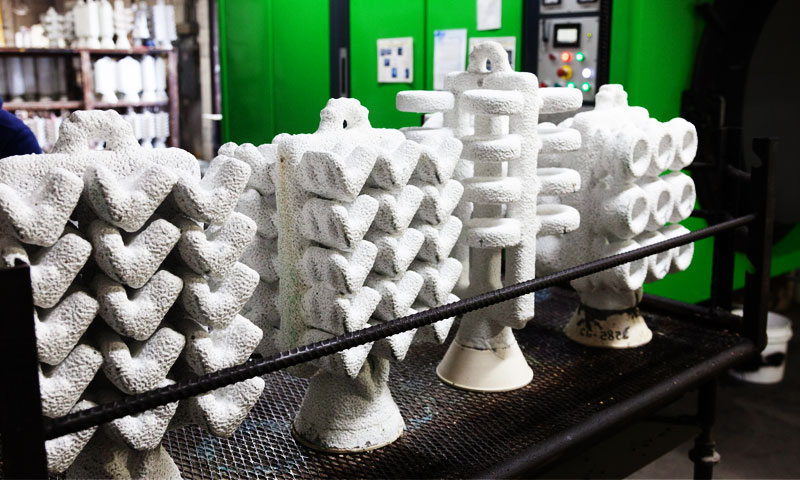
Shell manufacturing is a core step in stainless steel precision casting (investment casting), directly determining dimensional accuracy, surface quality, and structural integrity of the final component.
Unlike conventional sand casting, stainless steel precision castings demand extremely tight tolerances, stable mold geometry at elevated temperatures, and consistent shell strength during metal pouring and solidification.
Among all influencing factors—such as alloy shrinkage, solidification behavior, and thermal deformation—the ceramic shell system plays a decisive role.
This article provides a comprehensive and technically grounded analysis of how shells for stainless steel precision castings are manufactured, with a particular focus on the three dominant industrial routes: water glass shells, silica sol shells, and hybrid shell systems.
1. Role of the Ceramic Shell in Precision Casting
In stainless steel precision casting, the ceramic shell serves as both a mold and a structural support system, determining the final casting’s dimensional accuracy, surface quality, and structural integrity.
Its role can be analyzed from several technical perspectives:
Dimensional Reproduction
The shell must accurately replicate the geometry of the wax pattern, including fine details such as fillets, holes, threads, and thin walls.
Any shrinkage or deformation in the shell directly translates into dimensional errors in the final casting.
Thermal Stability
Stainless steel pours at high temperatures (≈1550–1650°C). The shell must maintain mechanical strength and rigidity during heating and metal filling. Insufficient thermal resistance can lead to warping, cracking, or collapse of the mold.
Controlled Heat Transfer
The shell acts as a thermal barrier, controlling the cooling rate of the metal.
Proper heat transfer ensures uniform solidification, reduces internal stresses, and minimizes defects like porosity or hot tearing.
Gas Permeability
During pouring, trapped gases must escape through the shell to prevent gas porosity.
Well-engineered shells balance density and permeability to allow gas venting without compromising mold strength.
Defect Mitigation
The ceramic shell prevents common casting defects by:
- Reducing the formation of sand inclusions
- Minimizing oxidation at the metal–mold interface
- Limiting surface roughness and shrinkage irregularities
2. Three Main Shell-Making Processes for Stainless Steel Precision Castings
Based on the type of binder used, shell-making processes for stainless steel precision castings are classified into three categories, each with distinct technical characteristics, quality performance, and cost advantages.
2.1 Water Glass Shell-Making Process
The water glass process is the most widely used shell-making technology in stainless steel precision casting, characterized by low cost and simple operation.
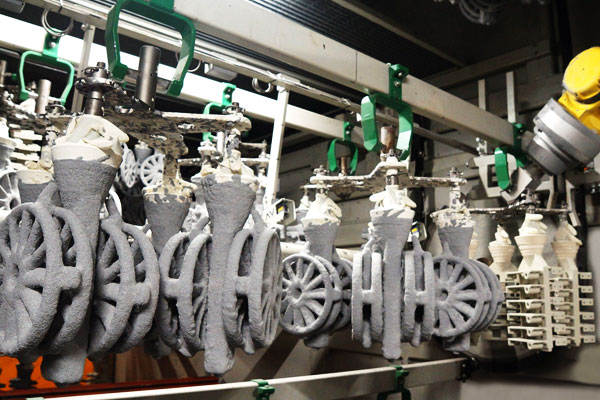
Core Principles:
Sodium silicate (water glass) serves as the binder, mixed with refractory sand (silica sand, zircon sand) to form a coating.
Ammonium chloride (NH₄Cl) or ammonium sulfate is used as the hardener; the hardener reacts with water glass to generate silicic acid gel, which solidifies and bonds the refractory sand to form the shell.
Process Characteristics:
The shell is formed by 3–5 layers of coating and sanding, with a total thickness of 5–8 mm.
After coating each layer, the shell is immersed in hardener for 1–2 minutes, then air-dried for 2–4 hours at room temperature.
Performance & Quality Pros and Cons
Advantages: Low raw material cost (water glass is 1/3 the price of silica sol); simple process, no need for special drying equipment;
high production efficiency, suitable for mass production of medium-precision castings.
Limitations: Compared with silica sol shells, water glass shells retain residual sodium silicate, resulting in lower high-temperature strength (≤15 MPa at 1000℃ vs. silica sol’s ≥25 MPa) and poor deformation resistance.
Castings produced have rough surfaces (Ra 12.5–25 μm), with common defects like sand inclusions and shrinkage porosity; dimensional accuracy is relatively low (tolerance ±0.15–0.3 mm).
Applicable Scenarios:
General stainless steel precision castings with low requirements for surface finish and accuracy, such as ordinary machinery parts, hardware accessories, and low-pressure pipeline components.
Most small and medium-sized foundries prioritize this process for cost control.
2.2 Silica Sol Shell-Making Process
The silica sol process is a high-end shell-making technology tailored for high-quality stainless steel precision castings, renowned for its excellent dimensional accuracy and surface quality.

Core Principles:
Colloidal silica (silica sol, particle size 10–20 nm) acts as the binder, with refractory sand (high-purity zircon sand, fused silica sand) as the aggregate.
Unlike water glass, silica sol does not require chemical hardeners; it hardens via dehydration and condensation in a constant temperature and humidity environment.
Process Characteristics:
The shell requires 5–7 layers of coating and sanding, total thickness 7–10 mm. Each layer needs to be dried in a constant temperature (20–25℃) and constant humidity (40–60%) chamber for 8–12 hours.
The drying process is critical: slow, uniform drying ensures the shell forms a dense, uniform structure without cracks.
Performance & Quality Pros and Cons
Advantages: The silica sol shell has high purity (no residual alkaline substances) and excellent high-temperature performance:
high-temperature strength ≥25 MPa at 1000℃, good thermal shock resistance, and minimal linear change (≤0.15%) during heating and cooling.
Castings have high dimensional accuracy (tolerance ±0.05–0.1 mm) and smooth surfaces (Ra 3.2–6.3 μm),
with almost no sand inclusion defects; internal structure is dense, meeting the requirements of high-end applications.
Limitations: High cost—silica sol binder is 3× more expensive than water glass; the constant temperature and humidity drying chamber increases equipment investment;
long drying time (total drying time 48–72 hours) reduces production efficiency, pushing up overall manufacturing costs.
Applicable Scenarios:
High-end stainless steel precision castings with strict requirements for accuracy, surface finish, and internal quality,
such as aerospace components, medical instruments, automotive engine parts, and marine precision valves.
It is the preferred process for manufacturers pursuing high product grades.
2.3 Silica Sol Composite Shell-Making Process
The silica sol composite process integrates the advantages of water glass and silica sol processes, striking a balance between quality and cost,
and has become the mainstream choice for batch production of medium-to-high-end stainless steel precision castings.
Core Principles:
It adopts a “hybrid binder” design: the inner 2–3 layers (contacting the wax pattern) use silica sol as the binder to ensure surface smoothness and dimensional accuracy;
the outer 2–3 layers use water glass as the binder to enhance shell strength and reduce costs.
The inner layers are dried in a constant temperature and humidity environment, while the outer layers use chemical hardeners for rapid curing.
Process Characteristics:
Combines the high-quality inner layer of silica sol process and the low-cost outer layer of water glass process;
total shell thickness 6–9 mm, total production cycle 24–36 hours—faster than pure silica sol process and more precise than pure water glass process.
Performance & Quality Pros and Cons
Advantages: Quality stability is better than water glass process but slightly inferior to pure silica sol process; castings have surface finish Ra 6.3–12.5 μm and dimensional accuracy ±0.1–0.2 mm, meeting the requirements of most medium-to-high-end mechanical products.
Production cost is 40–50% lower than pure silica sol process, with higher efficiency than water glass process for high-quality castings.
Limitations: Process control is more complex than single-process shell making; the interface between silica sol inner layer and water glass outer layer requires strict parameter matching to avoid delamination;
it cannot reach the precision level of pure silica sol process.
Applicable Scenarios:
Batch production of medium-to-high-end stainless steel mechanical products, such as hydraulic components, precision gears, pump impellers, and construction machinery parts.
It is the optimal choice for manufacturers pursuing both quality and cost-effectiveness.
3. Critical Control Points for High-Quality Stainless Steel Casting Shells
Regardless of the shell-making process adopted, several key control points must be strictly followed to ensure shell quality and casting performance:
- Binder Concentration Control: For water glass, modulus 2.8–3.2 and density 1.26–1.30 g/cm³ are optimal;
for silica sol, solid content 30–32% and pH 9–10 ensure coating stability and bonding strength. - Refractory Sand Matching: Inner layers use fine-grained sand (100–200 mesh) for smoothness; outer layers use coarse-grained sand (40–80 mesh) for strength.
High-purity zircon sand is preferred for stainless steel castings to avoid chemical reaction with molten steel. - Drying & Hardening Parameters: For water glass shells, hardener concentration 20–25% ensures uniform curing;
for silica sol shells, constant temperature 22±2℃ and humidity 50±5% prevent cracking and delamination. - Shell Layer Design: The number of layers and thickness are determined by casting size: small castings (≤50 mm) need 3–4 layers,
medium castings (50–200 mm) 5–6 layers, large castings (>200 mm) 7–8 layers to withstand molten steel impact. - De-waxing & Roasting Control: After shell making, de-waxing at 100–120℃ removes wax patterns completely;
roasting at 900–1050℃ for 2–4 hours eliminates residual organic matter, improves shell strength, and reduces gas defects in castings.
4. Comparative Evaluation of Shell Systems
| Feature / Property | Water Glass (Sodium Silicate) | Silica Sol | Hybrid (Water Glass + Silica Sol) |
| Binder / Hardening Method | Hardening with ammonium chloride or CO₂ | Colloidal silica + acid catalyst, dried in controlled temperature/humidity | Combination of both methods |
| Dimensional Accuracy | Medium | High | Medium-High |
| Surface Finish | Medium to Low | High | Medium-High |
| Thermal & Mechanical Strength | Moderate | High | Moderate-High |
| Cost | Low | High | Medium |
| Typical Applications | General machinery, low-precision castings | High-precision components, aerospace, valves, pumps | Mass-produced mechanical components with improved quality |
Key Advantages |
Low cost, simple process | Excellent dimensional control, superior surface finish, low defect rate | Better stability than water glass, lower cost than pure silica sol |
| Key Limitations | Lower strength at high temperature, prone to deformation, rougher surface, more defects | Higher cost, longer processing time, requires strict environmental control | Surface finish and precision not as high as pure silica sol, process control still needed |
5. Conclusion
Shell manufacturing is a decisive technology in stainless steel precision casting, directly influencing accuracy, surface integrity, and defect formation.
While water glass, silica sol, and composite shell systems each have inherent advantages and limitations, no single process is universally optimal.
Modern precision casting increasingly favors process optimization and hybrid shell strategies, balancing performance and cost while ensuring stable quality.
Through proper shell system selection and rigorous process control, manufacturers can consistently produce high-quality stainless steel precision castings that meet demanding industrial standards.

