1. Introduction — why alloy choice is the first, and most consequential, decision
The aluminum alloy you specify for a die-cast component establishes the physical and economic foundation for the entire program. Alloy chemistry dictates:
- Castability (fluidity, hot-tearing sensitivity, feedability),
- Solidification behavior (freezing range and shrinkage characteristics),
- As-cast and heat-treated mechanical performance (strength, ductility, fatigue),
- Corrosion resistance and surface finishing compatibility,
- Machinability and wear on cutting tools, and
- Die life and maintenance needs (soldering, erosion).
A poorly matched alloy choice either forces expensive compensations in tooling and process control or results in scrap and field failures.
Conversely, the right alloy for the part geometry, loading environment and post-process plan minimizes cost, risk and time-to-capability.
2. Aluminum-Alloy Selection Criteria — What to Evaluate (and Why)
Selecting an aluminum alloy for a die-cast component is a structured decision process. The goal is to match service and functional requirements with manufacturability, cost and reliability.
Functional mechanical requirements
Why: The alloy must provide the necessary strength, stiffness, ductility and fatigue life for the part’s load cases. A mismatch forces over-design or leads to field failures.
How to quantify: specify required UTS, yield strength, elongation, fatigue life (S–N or fatigue limit), fracture toughness if applicable.
Implication: If significant post-casting heat treatment is planned to achieve strength, select a heat-treatable Al-Si-Mg class (e.g., A356/A357).
For as-cast service with moderate loads, general die-casting alloys (e.g., A380 family) may suffice.
Geometry and castability (feature requirements)
Why: Thin walls, long thin ribs, deep bosses, and fine apertures impose strict fillability and hot-tearing requirements. Some alloys fill complex cavities more readily.
How to quantify: minimum wall thickness, maximum unsupported rib length, feature density, volume/section variation and required surface detail.
Implication: For very thin walls or intricate features choose high-fluidity, high-Si die alloys;
for heavy sections choose alloys whose feeding and freezing behaviour supports large mass sections without internal shrinkage.
Solidification behaviour, shrinkage & feeding
Why: Shrinkage determines die compensation, feeding strategy and the need for holding pressure or vacuum. Uncontrolled shrinkage causes cavities and dimensional drift.
How to quantify: linear shrinkage range (typical Al die alloys ~1.2–1.8% in production), freezing range (liquidus→solidus), tendency to microporosity.
Implication: Narrow freezing range and predictable shrinkage simplify gating and reduce hot spots; alloys with wide mushy zones require more aggressive feeding and longer hold times.
Heat-treatment response
Why: If you plan to heat-treat (T6/T61/T651) to achieve target strength or aging behaviour, alloy chemistry must support it. Heat treatment also affects dimensional stability.
How to quantify: hardness/strength gain after standard solution + ageing schedules; sensitivity to over-aging; dimensional change during heat treatment.
Implication: Al-Si-Mg alloys (A356/A357) are suitable for T-tempers; general-purpose alloys are often used as-cast or with minimal ageing.
Surface finish, coating and appearance
Why: The alloy and its microstructure affect achievable surface finish, anodizing behavior, paint adhesion and plating. Surface quality affects shelling and downstream finishing cost.
How to quantify: required Ra, acceptable surface defect classes, coating compatibility and post-process tolerance.
Implication: Some alloys require pre-treatment or special chemistries to anodize or plate cleanly; high-Si alloys can be more abrasive in machining and may affect final finish.
Corrosion resistance and environment
Why: Service environment (marine, industrial chemicals, high humidity, galvanic contact) drives alloy choice or the need for protective systems.
How to quantify: required corrosion allowance, expected lifetime, presence of chloride or sulfur species, operating temperature.
Implication: Choose alloys with lower Cu and controlled impurity levels when corrosion resistance is critical; plan coatings or sacrificial protections if unavoidable.
Machinability and secondary processing
Why: Many die-cast parts require bores, threads or critical surfaces to be machined. Alloy abrasivity and chip behaviour affect cycle time and tooling cost.
How to quantify: expected material removal volume, surface finish targets after machining, tool life metrics.
Implication: General die-casting alloys often give predictable machining; high-Si or high-hardness alloys increase tool wear and machining cost.
Thermal and dimensional stability (service and process)
Why: Parts that operate across temperature ranges or require tight dimensional tolerances must have predictable thermal expansion and minimal creep/aging.
How to quantify: coefficient of thermal expansion (typical Al alloys ≈ 23–25 ×10⁻⁶/°C), dimensional drift after heat cycles, creep under sustained loads/temperature.
Implication: Large thermal excursions or tight datums may require material and design choices that minimize thermal distortion or allow post-machining for critical features.
Die-side considerations: tool wear, soldering and die life
Why: Alloy chemistry affects die wear (abrasiveness), soldering propensity and die thermal loading; these impact tooling cost and production uptime.
How to quantify: die rework interval estimates, wear rates in trial runs, soldering occurrence under specific die temperatures.
Implication: High-Si alloys typically increase abrasive wear; choose alloys and die coatings (nitriding, PVD) and run maintenance schedules to control TCO.
Castability metrics and defect sensitivity
Why: Some alloys are more tolerant of entrained oxides, bifilms or hydrogen; others are more sensitive, increasing scrap risk.
How to quantify: susceptibility to cold-shut, hot-tearing index, sensitivity to hydrogen (porosity tendency).
Implication: For parts with little tolerance for porosity or inclusions, choose alloys and foundry practices (degassing, filtration) that minimize defects.
Supply chain, cost and sustainability
Why: Material price, availability, and recyclability influence unit cost and program risk. Sustainability requirements (recycled content, life-cycle analysis) are increasingly important.
How to quantify: unit cost per kg, availability lead times, recycled content percentage, embodied energy targets.
Implication: Balance material performance with predictable supply and acceptable lifecycle/environmental metrics.
3. Common Aluminum Die Casting Alloy Families — Characteristics and Use Cases
This section summarizes the practical characteristics, typical processing behaviour, strengths and limitations of the alloy families most commonly specified for high-pressure die casting.
A380 family — the general-purpose HPDC alloy (balanced performance)
What it is (chemistry & intent).
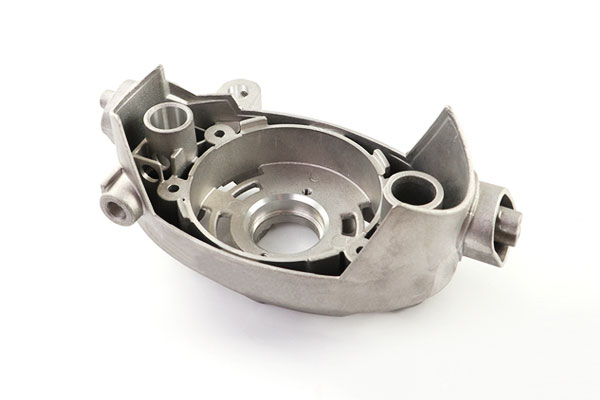
A380 (an Al–Si–Cu family alloy optimized for HPDC) is formulated to deliver a broad balance of fluidity, pressure-tightness, reasonable strength and good machinability.
Its silicon level is moderate and copper provides strength without excessive loss of corrosion resistance.
Key practical properties.
- Good fluidity and resistance to hot-tearing; predictable shrinkage and filling behaviour in standard die designs.
- Moderate as-cast strength and ductility suitable for many structural and housing applications.
- Acceptable surface finish for most paint and plating processes; machines predictably with conventional tooling.
Manufacturing considerations.
- Robust across a wide process window — forgiving to small variations in melt temperature and die thermal balance.
- Tooling life is moderate; die maintenance and standard coatings (nitriding, PVD where used) keep soldering and wear under control.
- Typically used as-cast, though limited age/thermal treatments may be applied for stress relief.
When to choose A380 aluminum alloy.
Default choice for high-volume components where a good balance of castability, dimensional stability, machinability and cost is required (e.g., housings, connectors, general automotive castings).
ADC12 / A383 family — high-silicon die alloys for thin walls and fine detail
What it is (chemistry & intent).
ADC12 (also referenced in some specifications as A383/AC-series equivalents) is a die-casting alloy with relatively high silicon (typically ~9.5–11.5% Si) and appreciable copper — its formulation maximizes melt fluidity and feedability.
Key practical properties.
- Exceptional fluidity and crisp feature reproduction — fills thin walls, narrow ribs and intricate vents with lower risk of cold-shut.
- Good dimensional stability and feedability in complex cavity geometries.
- Slightly higher tool abrasion and potential for increased die wear versus lower-Si alloys; machinability is typically still acceptable but tool life can be shorter.
Manufacturing considerations.
- Very effective for extremely thin or detailed enclosures and fine-feature consumer or telecom parts.
- Requires disciplined die maintenance (to manage abrasion) and attention to gating/venting to prevent oxide entrapment.
When to choose ADC12 / A383 aluminum alloy.
Select for thin-walled, high-detail parts produced at volume where fillability and as-cast feature fidelity are the dominant drivers.
A356 / A357 family — heat-treatable Al-Si-Mg alloys for strength and fatigue resistance
What it is (chemistry & intent).
A356 and A357 are Al–Si–Mg alloys engineered to accept solution treatment and artificial aging (T-tempers), producing significantly higher strength and improved fatigue life compared with typical as-cast die alloys.
A357 is characterized by slightly higher Mg (and in some formulations a controlled Be addition) to enhance age-hardening response.
Key practical properties.
- Strong response to T6/T61 heat treatments — substantial increases in tensile strength and fatigue performance are achievable.
- Good combination of ductility and tensile strength after appropriate heat cycles; microstructure control (SDAS, eutectic morphology) is important for property consistency.
- As-cast ductility is generally lower than some general die alloys but heat treatment closes the gap for structural applications.
Manufacturing considerations.
- Requires stricter melt cleanliness (degassing, filtration) and porosity control to exploit heat-treat potential without fatigue-critical defects.
- Heat-treatment introduces process steps and potential dimensional movement — tool compensation and machining plans must account for this.
- Often used in gravity/permanent-mold casting but also employed in HPDC when higher strength is required and the foundry can control porosity/thermal cycles.
When to choose A356 / A357 aluminum alloy.
When final part demands higher static strength, fatigue life or post-cast heat treatment — e.g., structural housings, some EV motor components, and parts where post-machining to tight bores follows heat treatment.
B390 and high-Si / hypereutectic grades — wear and thermal-stability specialists
What it is (chemistry & intent).
B390 and similar hypereutectic, very-high-Si alloys are designed to provide high hardness, low thermal expansion and excellent wear resistance.
They are hypereutectic (Si above eutectic), which delivers a hard silicon phase in the microstructure.
Key practical properties.
- Very high surface hardness and excellent seizure/wear resistance; low thermal expansion compared with standard Al-Si casting alloys.
- Lower ductility — these alloys are not suitable where impact toughness is a primary requirement.
- Often produce superior sliding wear and pin/bore life in bearing or piston-like applications.
Manufacturing considerations.
- More abrasive to tooling — tool materials, coatings and maintenance cadence need to be adjusted.
- Require tight melt and fill control to avoid casting defects associated with hypereutectic segregation.
When to choose B390 / hypereutectic alloys.
Use when wear resistance, low thermal expansion or high hardness are critical (e.g., high-wear sleeves, piston skirts, bearing surfaces or components subject to sliding contact).
A413, A413-type and other specialty alloys — tailored property packages
What it is (chemistry & intent).
A413 aluminum alloy and allied specialty cast alloys are formulated to provide combinations of higher strength, pressure tightness, thermal conductivity or specific corrosion/wear performance that standard families do not cover.
Key practical properties.
- Good castability with property sets tuned for engine components, pressure-tight housings or heat-transfer applications.
- Alloy additions and balance are selected to achieve specific trade-offs between mechanical behaviour and processability.
Manufacturing considerations.
- Often used where function drives material choice (e.g., engine internals, transmission housings) and where the foundry and downstream processes are set up for the specific alloy.
- Qualification and supplier control are essential because behaviour can be more alloy-sensitive.
When to choose specialty alloys.
Select when a part’s functional demands (thermal, pressure, wear) cannot be met by general or heat-treatable families and the program can justify qualification and tool-up for the special chemistry.
4. Process and tooling interactions — why alloy choice cannot be isolated
Alloy selection is not a stand-alone decision.
The alloy’s metallurgy determines how the melt flows, solidifies and responds to pressure and temperature — and those behaviours are shaped further by die geometry, cooling architecture, machine dynamics and the chosen process window.
In practice, the material, the tool and the process form a single coupled system.
Neglect any link and predictable production performance — dimensional control, defect rates, mechanical properties and die life — will suffer.

Solidification behaviour → gating, feeding and shrinkage compensation
Mechanism. Different alloys have different liquidus/solidus ranges and interdendritic feeding characteristics.
Alloys with wide mushy zones and higher overall shrinkage require more aggressive feeding (larger gates, risers or longer pack times); narrow-range alloys feed more readily.
Consequences. If the die and gating are designed for one alloy but another alloy is used, hot spots may form, internal shrinkage cavities appear, and dimensional compensation will be wrong.
This is particularly acute in mixed-section parts where thick bosses and thin walls coexist.
Mitigation.
- Use filling/solidification simulation to derive local shrinkage compensation and gate sizing for the target alloy.
- Design feeders or add local chills/inserts where simulation predicts hot spots.
- Validate with pilot castings and cross-section metallography to confirm feeding effectiveness.
Thermal management of the die → cycle time, microstructure and distortion
Mechanism. Alloy thermal conductivity, specific heat and latent heat influence in-die cooling rates.
Die cooling channel layout, flow rate and temperature determine local cooling gradients; these gradients drive residual stress and distortion as the part solidifies and cools to room temperature.
Consequences. A die cooled for a low-Si general alloy may produce unacceptable warpage when used with a heat-treatable Al-Si-Mg alloy,
because the latter’s microstructure and solidification path create different shrinkage and stress profiles.
Uneven die temperature accelerates die wear and produces shot-to-shot dimensional variability.
Mitigation.
- Match cooling architecture to the alloy’s thermal behaviour: tighter channel spacing or conformal cooling for alloys that form hot spots.
- Instrument the die with multiple thermocouples and use PID control to hold die running temperature within a narrow band (often ±5 °C for precision work).
- Use thermal-distortion simulation (transfer casting thermal history into FEA) to predict and compensate for expected warpage.
Injection dynamics and oxide/entrapment sensitivity
Mechanism. Melt fluidity and surface tension vary with alloy composition and temperature.
Fill velocity and turbulence levels interact with alloy rheology to determine oxide film entrainment, air entrapment and the likelihood of cold shuts.
Consequences. High-fluidity alloys may tolerate faster fills but can entrain oxides unless gate design and venting are correct.
Conversely, poorer-flowing alloys require higher superheat and pressure to fill thin features, increasing thermal load on the die and risk of die soldering.
Mitigation.
- Specify alloy-specific shot profiles (multi-stage speeds) and validate the switchover point empirically or by cavity pressure feedback.
- Design gates and vents to promote laminar flow and safe escape paths for air.
- Keep melt temperature and transfer practices disciplined to avoid excessive oxidation.
Heat treatment compatibility → dimensional change and process sequencing
Mechanism. Heat-treatable alloys (Al-Si-Mg families) can achieve high strength after solutionizing and aging but will experience microstructural evolution and dimensional shifts during heat treatment.
The extent of change depends on chemistry, casting porosity and initial microstructure.
Consequences. If heat treatment is part of the design, tooling compensation and process timing must anticipate final dimensions after T-temper.
Components that require tight bores or positional accuracy often need machining after heat treatment, adding cost and process steps.
Mitigation.
- Define the full thermomechanical sequence up front (cast → solutionize → quench → age → machine) and include dimensional targets after heat treatment in the specification.
- Where possible, machine critical datums after heat treatment, or design bosses/inserts that can be finished to spec.
- Validate dimensional shifts through representative heat-treat trials on pilot castings.
Die life, wear and maintenance — economic feedback to alloy choice
Mechanism. Alloy chemistry affects die wear (abrasiveness), soldering tendency and thermal fatigue.
High-Si or hypereutectic alloys are more abrasive; certain alloys promote soldering under inappropriate die temperatures.
Consequences. Choosing an alloy that accelerates tool wear without adjusting die material/coating and maintenance cadence increases tooling cost and unplanned downtime, shifting the total cost of ownership.
Mitigation.
- Include die material selection and surface treatments (e.g., nitriding, PVD coatings) in alloy decisions.
- Plan a shot-count-based preventive maintenance schedule aligned to expected wear rates for the chosen alloy.
- Account for die rework and insert replacement in the economic model for alloy selection.
Process-control instrumentation — enabling alloy/process coupling
Mechanism. Alloy-sensitive behaviours (shrinkage, pressure response, thermal gradients) are observable through in-die sensors (cavity pressure transducers, thermocouples) and process logs (melt temp, shot curves).
Consequences. Without real-time data, operators cannot detect the subtle but repeatable shifts that indicate a mismatch between alloy and tooling or drift in melt condition.
Mitigation.
- Implement cavity pressure control and use pressure-based switchover rather than fixed position/time.
- Monitor melt hydrogen (DI), melt temp, die temps and shot traces; establish SPC limits and alarms tied to CTQs.
- Use logged data to refine shot profiles and maintenance schedules for the specific alloy.
Validation: the pilot loop that closes the design cycle
The only reliable way to confirm alloy/tool/process interactions is a structured pilot program: tryout shots in the actual die, metallography to inspect feeding and porosity, mechanical testing (as-cast and post-treat), dimensional surveys and tool-wear assessment.
Use iterative correction (local cavity compensation, gating changes, cooling revisions) guided by measured evidence rather than assumptions.
5. Alloy-Selection Strategy for Typical Application Scenarios
Choosing the “right” alloy is an exercise in mapping functional demands and production reality to a small set of candidate chemistries, then validating the choice with targeted trials.
Guiding principles (how to apply the strategy)
- Start from function: list the single most important requirement (strength, thin-wall fill, wear, corrosion, finish). Use that as the primary filter.
- Assess geometry: quantify minimum wall thickness, maximum boss mass and feature density—these control castability priorities.
- Decide heat-treat plan early: if T-tempers are needed, eliminate non-heat-treatable alloys.
- Consider life-cycle cost: include die wear, tooling frequency, secondary machining and finishing in total cost of ownership (TCO).
- Shortlist 2–3 alloys: don’t finalize on one alloy before pilot trials—different dies and processes expose different sensitivities.
- Validate with pilots: perform die-tryout, metallography, mechanical tests and capability studies on representative parts.
- Lock process and alloy together: treat alloy, die design, cooling and shot profile as a coupled system; freeze all after successful validation.
Scenario matrix — recommended alloy families, process notes and validation steps
| Application scenario | Primary drivers (ranked) | Preferred alloy family (shortlist) | Tooling/process implications | Key validation checks |
| High-volume thin-walled enclosure (consumer / telecom) | 1. Fillability / thin-wall 2. Surface finish 3. Low cost | ADC12 / high-Si die alloys | Frequent die maintenance (abrasion); precise gating & venting; tight melt temp control | Pilot fill trials for minimum wall, surface roughness check (Ra), die wear trial |
| General structural housing (automotive non-critical) | 1. Balanced castability 2. Machinability 3. Cost | A380 family | Forgiving process window; standard die materials; normal maintenance cadence | Dimensional capability (Cp/Cpk), machining test, corrosion spot tests |
Fatigue-critical structural part (EV motor housing, suspension bracket) |
1. Fatigue strength 2. Heat-treat response 3. Porosity control | A356 / A357 (heat-treatable Al-Si-Mg) | Vacuum/degassing, filtration, controlled cooling, plan heat-treat & post-machine datums | Porosity CT/sectioning, tensile & fatigue tests (as-cast & T-treat), dimensional shift after heat treat |
| High-wear contact surfaces (bearing sleeves, pistons) | 1. Hardness/wear resistance 2. Dimensional stability 3. Thermal behavior | B390 / hypereutectic high-Si alloys or surface-treated standard alloys | Abrasive tooling wear; consider inserts or hardened sleeves; high-quality melt handling | Wear testing, hardness mapping, tool wear rate measurement |
Aesthetic consumer parts (visible housings) |
1. Surface finish & paintability 2. Thinness 3. Cost | A380 or ADC12 depending on thin-wall needs | Polished cavity finish, strict cleanliness, controlled de-gas & filtration | Surface profilometry (Ra), paint adhesion test, cosmetic defect rate |
| Corrosion-sensitive exterior parts (marine / outdoors) | 1. Corrosion resistance 2. Coating compatibility 3. Mechanical need | Low-Cu variants of A380 or coated/treated alloys; evaluate coatings | Emphasize low-impurity melts; pre-treatment for anodize/plating; seal design | Salt-spray or cyclic corrosion tests, coating adhesion, galvanic pair checks |
High-temperature transient parts (near engines, short exposure) |
1. Dimensional/thermal stability 2. Short-term strength 3. Oxidation behavior | Specialty alloys selected for thermal stability (evaluate case-by-case) | Thermal fatigue of die; stricter metallurgical control | Thermal cycling tests, dimensional drift after exposure |
| Small, complex precision parts (medical, aerospace small fittings) | 1. Dimensional tolerance 2. Surface fidelity 3. Traceability | Investment-grade die alloys: A380 / ADC12 variants or alternative casting routes; sometimes grav./perm-mold preferred | Tight process control, full traceability, refined tooling & inspection | 100% CMM inspection, surface and internal defect scanning, full material traceability |
6. Practical examples and trade-off analyses
EV motor housing
- Constraints: thin ribs for heat dissipation, precise bore geometry for bearings, fatigue life under thermal cycling.
- Choice path: A356/A357 with controlled melt treatment, vacuum degassing and ceramic filtration;
apply heat-treatment to critical bearing bores; machine and hone bores after T6 where required; ensure die cooling and feeding tailored to thick boss regions.
Thin-wall consumer electronics enclosure
- Constraints: very thin walls, intricate vents, high production volume, good surface finish.
- Choice path: ADC12 (or regional equivalent) to maximize fluidity; use hardened inserts where mating features need tight tolerances; plan for aggressive die maintenance to manage tool wear.
7. Common Misunderstandings and Optimization Strategies in Alloy Selection
In actual production, many enterprises have misunderstandings in aluminum die casting alloy selection, which leads to product defects, increased costs and reduced efficiency.
The following will sort out common misunderstandings and put forward corresponding optimization strategies.
Common Selection Misunderstandings
Blindly pursuing high strength:
Some designers believe that the higher the strength of the alloy, the better, and blindly select high-strength alloys such as A383 and A357 for general structural parts.
This not only increases the raw material and heat treatment costs, but also increases the difficulty of the die casting process (such as increased hot cracking tendency), reducing the production efficiency.
Ignoring process adaptability:
Only focusing on the performance of the alloy, ignoring its adaptability to the die casting process.
For example, selecting Al-Mg alloys with poor fluidity for complex thin-walled parts leads to short shot and other defects, and the qualification rate is less than 70%.
Neglecting the impact of service environment:
Selecting ordinary alloys such as ADC12 for parts working in corrosive environments leads to rapid corrosion and failure of the product, and the service life is less than the design requirement.
Only considering raw material cost:
Blindly selecting low-cost alloys such as ADC12, ignoring the subsequent processing cost and defect loss cost.
For example, the surface quality of ADC12 is poor, and the post-processing cost (such as polishing) is high, which ultimately increases the total cost.
Optimization Strategies
Establish a performance-cost balance thinking:
According to the functional requirements of the product, select the alloy with the lowest cost that meets the performance requirements.
For general structural parts, select ordinary Al-Si alloys; for high-performance parts, select heat-treatable alloys, and avoid over-design.
Combine process capabilities to select alloys:
For enterprises with backward process control capabilities, select alloys with good process adaptability (such as A380, ADC12);
for enterprises with advanced process capabilities, select alloys with better performance (such as A356, A383) according to product requirements.
Comprehensively consider the service environment:
Conduct a detailed analysis of the product’s service environment, and select alloys with corresponding corrosion resistance, high-temperature stability and low-temperature toughness.
For parts with moderate corrosion resistance requirements, ordinary alloys can be selected and then surface treated to reduce costs.
Strengthen communication between design and production departments:
The design department should communicate with the production department in advance to understand the process capabilities of the enterprise,
and select alloys that are compatible with the enterprise’s die casting equipment, mold technology and process level to avoid design and production disconnection.
8. Conclusion
Alloy selection for aluminum die casting is a multi-axis engineering decision that must be made deliberately and collaboratively.
The best practice is to capture functional requirements early, use selection heuristics to identify 2–3 candidate alloys, and then validate those choices with targeted metallurgy, pilot die trials and capability studies.
Balancing castability, mechanical needs, post-processing demands and total cost of ownership will produce the best long-term outcome: a part that meets performance targets, can be manufactured repeatably and does so at acceptable cost.