Introduction
Among all the properties of an investment casting ceramic shell, permeability is one of the most misunderstood.
In many foundries, shell permeability is treated merely as a parameter that helps gases escape during pouring.
In reality, permeability influences every major stage of the investment casting process, from steam dewaxing and shell firing to mold filling, solidification, and ultimately casting quality.
Poor permeability control can lead to shell cracking, gas porosity, misruns, metal penetration, sand adhesion, dimensional instability, and reduced production yield.
Equally problematic is the misconception that higher permeability is always better.
Excessive permeability weakens shell strength, promotes molten metal penetration, and increases surface defects.
Modern investment casting therefore views shell permeability not as an isolated material property, but as a carefully engineered characteristic that balances gas transport, structural integrity, thermal behavior, and metallurgical performance.
This article examines shell permeability from multiple engineering perspectives, explaining how pore structure develops, how permeability affects every manufacturing stage, and how advanced foundries optimize permeability to achieve defect-free precision castings.
1. Scientific Definition and Quantitative Characterization of Shell Permeability
Essential Physical Definition
Shell permeability refers to the capacity of gas to penetrate and diffuse through porous ceramic shell walls under a certain pressure differential.
It is a comprehensive structural performance determined by the micro-pore characteristics inside the layered ceramic shell, rather than a simplistic binary qualitative judgment of “good” or “poor air permeability”.
Microscopically, investment casting ceramic shells are porous media formed by layered stacking of refractory aggregates bonded and cured by inorganic binders.
The internal pore system consists of three mutually coupled pore structures that jointly define the actual permeability level: interconnected macro primary pores formed by stacking gaps between refractory aggregate particles,
secondary micro-pores left by water volatilization during binder curing, and micro-crack pores naturally generated during shell coating, drying, and high-temperature sintering.
The quantity, average size, spatial distribution, and connectivity of these three pore types collectively dominate gas migration efficiency inside the shell.

Standard Quantitative Index and Testing Method
The universal industrial quantitative parameter for shell permeability is the permeability coefficient (K) . Its standardized physical definition is:
The volume of gas with a viscosity of 1 Pa·s passing through a shell specimen with 1 cm thickness and 1 m² area within one hour under a fixed pressure differential of 10 Pa, with the unit of m²/(Pa·h) .
In on‑site industrial production, professional shell permeability testers are adopted for rapid quantitative detection.
The test principle is to deliver stable compressed air with fixed flow rate through a standard shell sample, convert the air flow resistance value into a standardized permeability coefficient, and realize batch data monitoring of shell air permeability.
Limitation of Traditional Single Index and Modern Three‑Dimensional Characterization System
The traditional single permeability coefficient has obvious technical limitations:
it only reflects the overall gas passing capacity of the shell but cannot distinguish the proportion and distribution of pores in different size ranges.
In engineering practice, pores of different diameters exhibit completely differentiated functional mechanisms in different casting procedures:
| Pore size category | Dominant function | Critical process stage |
| Macro connected pores (>10 µm) | Rapid escape of large‑volume gas | Molten metal pouring |
| Medium pores (1–10 µm) | Steam penetration and wax discharge | Dewaxing |
| Micro‑pores (<1 µm) | Residual gas volatilization and discharge | Shell sintering |
To eliminate evaluation deviations caused by single‑index detection, modern high‑precision investment casting has upgraded the permeability evaluation system to a three‑dimensional quantitative characterization system, integrating:
- Permeability coefficient (K) – overall gas passing capacity.
- Pore size distribution – proportion of macro, medium, and micro pores.
- Pore connectivity rate – degree of interconnection between pore networks.
This multi‑dimensional system fully and accurately reflects the real gas permeability performance of ceramic shells and matches the process requirements of different production stages.
Inherent Permeability Differences of Different Binder Systems
The binder formula fundamentally determines the micro‑pore structure of ceramic shells, resulting in significant inherent permeability differences among mainstream industrial shell systems, with distinct application boundaries for casting products:
| Binder system | Permeability coefficient (m²/(Pa·h)) | Pore structure characteristics | Suitable casting alloys |
| Water glass | 0.8 – 2.5 | Large‑diameter interconnected pores; high overall air permeability | Carbon steel, low‑alloy steel (moderate surface quality) |
| Ethyl silicate | 0.5 – 1.8 | Medium pore size and connectivity; balanced universal performance | Medium‑precision alloy castings |
| Silica sol | 0.3 – 1.2 | Dense, uniform micro‑pore structure; minimal macro pores | High‑end stainless steel, superalloys (strict internal quality) |
Key insight: Silica sol shells offer the most controllable and stable permeability, making them the exclusive choice for critical aerospace and medical components.
Water glass shells provide maximum gas discharge but at the cost of surface quality and structural integrity.
2. Influence of Shell Permeability Throughout the Investment Casting Process
A common misconception in investment casting is that shell permeability only influences the pouring stage.
In reality, permeability affects every major manufacturing operation after shell building—including dewaxing, firing, pouring, and even solidification.
The role of permeability changes at each stage because the dominant transport mechanism evolves from steam diffusion, to gas evacuation, to molten metal filling, and finally to thermal and pressure equilibration.
Consequently, shell permeability should be regarded as a process-wide engineering parameter rather than an isolated shell characteristic.
Optimizing permeability requires balancing gas transport, structural integrity, metal penetration resistance, and dimensional stability throughout the entire casting cycle.
Influence During Dewaxing
Steam autoclave dewaxing is one of the most mechanically demanding stages for ceramic shells.
During this process, high-pressure saturated steam must rapidly penetrate the porous shell to melt and remove the wax pattern before excessive thermal expansion occurs.
The efficiency of this heat transfer process is directly controlled by shell permeability.
Low Permeability: Hidden Source of Shell Cracking
When permeability is insufficient, steam penetrates the shell slowly, creating a significant temperature gradient between the outer and inner shell layers.
As a result:
- the outer wax melts rapidly while the core remains solid;
- trapped solid wax expands as its temperature rises;
- internal pressure increases faster than the shell can accommodate.
If the generated pressure exceeds the shell’s ambient mechanical strength, cracking begins from the inner surface.
Industrial observations indicate that when the permeability of silica-sol shells falls below approximately 0.4 m²/(Pa·h), shell cracking during dewaxing may increase from normal levels of around 1% to over 18%.
More importantly, many of these cracks are microscopic and cannot be detected visually.
Although the shell may remain intact after dewaxing, these latent defects often propagate during firing or pouring, eventually causing metal leakage, dimensional distortion, or catastrophic shell failure.
This explains why some casting defects that appear during pouring actually originate much earlier in the manufacturing process.
Excessively High Permeability: A Different Type of Risk
Higher permeability does not necessarily improve dewaxing performance.
If the shell becomes excessively permeable:
- steam penetrates almost instantaneously;
- wax melts too rapidly;
- molten wax is expelled violently through the gating system.
Rapid wax discharge can generate safety hazards while simultaneously producing localized erosion of the face coat.
The flowing molten wax may wash away portions of the ceramic surface, leaving cavities or damaged coating regions.
During subsequent pouring, these damaged areas are replicated as:
- surface protrusions,
- localized metal penetration,
- ceramic inclusions,
- dimensional inconsistencies.
Therefore, the objective during dewaxing is controlled steam penetration, not maximum permeability.
Influence During Shell Firing
Shell firing performs several essential functions simultaneously:
- removing residual moisture;
- decomposing organic binder residues;
- eliminating remaining wax contamination;
- sintering ceramic particles into a mechanically stable shell.
All of these processes generate gases that must escape efficiently through the shell wall.
Insufficient Permeability Restricts Gas Removal
During heating, chemically bound water, residual organics, and trace wax residues decompose into steam, carbon dioxide, and other volatile gases.
If permeability is too low:
- gases accumulate inside closed pores;
- local pressure rises rapidly;
- pore expansion and internal delamination occur.
In severe cases, shell blistering or explosive cracking may occur inside the furnace.
Even when catastrophic failure does not occur, retained decomposition products can react with refractory materials at elevated temperatures, producing localized low-melting glassy phases.
These glassy reaction products later interact with molten metal during pouring, increasing the probability of:
- burn-on defects,
- sand adhesion,
- surface pitting,
- oxide inclusions.
Thus, insufficient permeability not only affects shell integrity but also degrades casting surface metallurgy.
Excessively High Permeability Can Reduce High-Temperature Strength
Excessively open pore structures introduce another challenge.
Continuous airflow through highly permeable shells during firing accelerates oxidation of residual binder phases and may promote excessive ceramic dehydration or microstructural coarsening.
The resulting shell may exhibit:
- lower hot strength;
- reduced creep resistance;
- poorer thermal shock resistance.
Consequently, although gas removal becomes easier, the shell becomes mechanically weaker during pouring, increasing susceptibility to:
- shell expansion,
- dimensional distortion,
- mold bulging,
- localized deformation.
This illustrates that firing performance depends not simply on gas evacuation capability but on achieving an appropriate balance between permeability and ceramic densification.
Influence During Molten Metal Filling
The pouring stage represents the most widely recognized function of shell permeability.
As molten metal fills the cavity at high velocity, the displaced air and decomposition gases must escape through the porous ceramic shell within a very short period.
The shell effectively acts as a distributed venting system.

Low Permeability Causes Gas Entrapment
When venting capacity is insufficient:
- cavity pressure rises rapidly;
- air becomes trapped ahead of the advancing metal front;
- gas bubbles are compressed into the liquid metal.
After solidification, these trapped gases form:
- gas porosity,
- blowholes,
- incomplete filling,
- cold shuts,
- misruns.
These defects are particularly severe in:
- thin-wall castings,
- long flow paths,
- complex internal channels,
- turbine blades,
- aerospace structural components.
Industrial experience shows that when shell permeability falls below approximately 0.5 m²/(Pa·h) during production of thin-wall precision castings,
the probability of incomplete filling can increase by more than 20%, particularly near the final filling regions and sharp geometric transitions.
Excessively High Permeability Promotes Metal Penetration
Although higher permeability improves gas evacuation, it also increases interconnected pore volume inside the ceramic shell.
Under metallostatic pressure, molten metal may penetrate these open pores, producing:
- mechanical burn-on,
- deep sand adhesion,
- rough surfaces,
- difficult shell removal.
When penetration exceeds approximately 0.5 mm, conventional blasting often cannot completely remove the adhered ceramic layer, requiring extensive grinding or repair.
This problem becomes especially critical for:
- nickel-based superalloys,
- cobalt alloys,
- high-temperature stainless steels,
whose elevated pouring temperatures and lower viscosities significantly increase penetration capability.
Consequently, shells intended for these alloys generally require tighter control of maximum permeability than shells used for lower-temperature alloys.
Influence During Solidification and Defect Formation
The influence of permeability does not end when mold filling is complete.
During solidification, dissolved gases continue evolving from the molten alloy while thermal contraction creates pressure gradients within the casting.
Appropriately engineered shell permeability helps maintain pressure equilibrium by allowing residual gases to escape gradually from the mold cavity.
Balanced permeability contributes to:
- reduced gas porosity,
- more stable feeding conditions,
- improved solidification uniformity,
- lower residual stress,
- enhanced dimensional consistency.
Conversely, shells with poorly optimized permeability may restrict late-stage gas release, increasing localized pressure and aggravating shrinkage-related defects in thermally isolated regions.
Therefore, permeability should be viewed as a parameter that influences the entire thermal and metallurgical evolution of the casting, rather than only the mold-filling stage.
3. How Shell Permeability Influences Casting Quality
Shell permeability directly affects multiple quality characteristics simultaneously.
Rather than influencing a single defect mechanism, it regulates gas transport, pressure distribution, heat transfer, shell stability, and metal–mold interaction throughout the casting cycle.
Because these phenomena occur concurrently, permeability should be viewed as a system-level quality parameter rather than an isolated property.

Mold Filling Capability and Casting Integrity
One of the primary functions of shell permeability is to provide an efficient escape path for air and gaseous products displaced by advancing molten metal.
When molten metal enters the mold cavity at high speed, the trapped air must be evacuated almost instantaneously.
If the shell cannot vent this gas quickly enough, the internal pressure rises and opposes metal flow, reducing the effective filling pressure.
The consequences include:
- Misruns and incomplete filling
- Cold shuts between converging metal fronts
- Rounded edges instead of sharp corners
- Loss of fine details
- Poor replication of thin-wall features
These problems become increasingly severe in castings with:
- wall thicknesses below 2 mm;
- long metal flow paths;
- intricate internal passages;
- lattice structures;
- turbine blades and medical implants.
Adequate shell permeability reduces cavity back pressure, allowing molten metal to maintain a continuous, stable filling front and accurately reproduce complex geometries.
Internal Porosity and Gas Defects
Gas-related defects are among the most common quality issues associated with poor shell permeability.
When gas generated during pouring cannot escape through the shell, it becomes entrapped within the molten metal.
As solidification progresses, the trapped gas forms spherical or irregular pores inside the casting.
Typical defects include:
- Gas porosity
- Blowholes
- Pinholes
- Subsurface gas cavities
Industrial production data indicate that inadequate shell venting is one of the major contributors to internal porosity in precision castings, particularly for large steel castings and thin-wall components with rapid filling rates.
Conversely, a properly engineered shell provides continuous venting pathways that reduce internal gas pressure, minimize air entrapment, and significantly improve casting density.
For aerospace, medical, and energy components, reducing internal porosity is particularly critical because fatigue cracks frequently initiate from internal pores subjected to cyclic loading.
Surface Finish and Metal Penetration
Shell permeability also governs the interaction between molten metal and the ceramic mold surface.
An excessively dense shell usually provides excellent resistance to metal penetration but may suffer from inadequate gas evacuation.
Conversely, an overly porous shell allows molten metal to infiltrate interconnected surface pores under metallostatic pressure.
Excessive metal penetration can produce:
- Mechanical sand adhesion
- Burn-on defects
- Rough casting surfaces
- Difficult shell removal
- Increased cleaning and grinding costs
For high-temperature alloys with strong penetration capability, the risk becomes particularly significant.
Molten metal may infiltrate several hundred micrometers into the shell surface, creating tenacious ceramic-metal bonding that cannot be completely removed by conventional blasting.
Maintaining moderate permeability while limiting large interconnected pores is therefore essential for achieving excellent surface quality.
Dimensional Accuracy and Shell Stability
Although permeability primarily controls gas transport, it also indirectly influences dimensional accuracy.
Poor permeability frequently leads to excessive internal gas pressure during pouring.
Elevated pressure imposes additional mechanical loading on the ceramic shell, increasing the likelihood of:
- Local shell expansion
- Mold distortion
- Wall displacement
- Uneven dimensional variation
On the other hand, shells with excessively high permeability often possess lower ceramic density and reduced mechanical strength, making them more susceptible to deformation under the hydrostatic pressure of molten metal.
The most dimensionally stable castings are therefore produced using shells that achieve an optimal balance between:
- sufficient permeability for venting;
- adequate mechanical strength;
- high-temperature rigidity;
- resistance to creep deformation.
This balance becomes increasingly important for large structural castings where dimensional tolerances are tightly controlled.
Microstructure and Mechanical Properties
The influence of permeability extends beyond external quality to the internal metallurgical characteristics of the casting.
Gas evacuation efficiency affects the thermal environment surrounding the solidifying metal.
Stable pressure conditions promote more uniform heat extraction and reduce turbulence during mold filling, resulting in improved solidification behavior.
Optimized shell permeability contributes to:
- More uniform grain structures
- Reduced micro-porosity
- Improved feeding efficiency
- Lower residual stress
- Better mechanical consistency
By contrast, castings containing gas defects or severe metal penetration often exhibit reduced tensile strength, lower fatigue resistance, and decreased fracture toughness due to stress concentration around internal discontinuities.
For safety-critical components—including aerospace hardware, automotive structural parts, and medical implants—even minor improvements in shell permeability control can translate into significant gains in long-term service reliability.
Impact on Process Stability and Manufacturing Yield
Shell permeability influences not only individual casting quality but also overall production consistency.
When shell permeability fluctuates significantly between production batches, manufacturers often experience corresponding variations in:
- Filling performance
- Surface finish
- Defect distribution
- Cleaning efficiency
- Scrap rate
These inconsistencies complicate process optimization because pouring parameters that perform well for one shell batch may become unsuitable for another.
By establishing quantitative permeability specifications and maintaining tight process control, foundries can achieve:
- Higher process repeatability
- Lower defect variability
- Improved dimensional consistency
- Reduced rework and repair
- Higher first-pass yield
- Lower manufacturing costs
For high-volume production, stable shell permeability is therefore an important contributor to overall process capability and quality assurance.
4. Industrial Synergistic Optimization Strategy for Shell Permeability Control
To solve the traditional trade‑off dilemma of permeability regulation and eliminate the three major industrial pain points, a full‑process balanced optimization system must be established based on the three‑dimensional permeability characterization system.
Standardize Quantitative Detection and Batch Monitoring
| Action | Implementation | Target |
| Adopt professional permeability testers | Replace empirical finger‑touch or visual judgment with instrumented measurement. | Eliminate subjective variation. |
| Establish batch threshold standards | Define acceptable K ranges for each binder system and alloy type. | Control permeability fluctuation within ±15%. |
| Implement statistical process control (SPC) | Monitor K values across batches; track trends. | Detect drift early; maintain process consistency. |
Optimize Pore Grading Structure
| Strategy | Technical approach | Effect on permeability |
| Adjust refractory powder gradation | Use bimodal or multimodal particle size distribution; reduce fine powder fraction to increase macro pores. | Raises K (more open structure). |
| Increase fine powder fraction | Increase sub‑micron powder content; improve packing density. | Lowers K (denser structure). |
| Modify stucco mesh size | Use coarser stucco for higher permeability; finer stucco for lower permeability. | Targeted control of macro‑pore proportion. |
| Control slurry viscosity | Higher viscosity → thicker coating → lower permeability; lower viscosity → thinner coating → higher permeability. | Fine‑tuning of K within ±0.2 m²/(Pa·h). |
Achieve Multi‑Performance Collaborative Balance
| Performance parameter | Optimization direction | Permeability interaction |
| Shell strength (MOR) | Improve binder toughness; increase refractory particle interlocking. | Moderate increase in strength often reduces K (by closing pores); must balance. |
| Thermal shock resistance | Optimize thermal expansion matching between shell layers. | High K improves gas release but can reduce thermal shock resistance (porosity weakens structure). |
| Metal penetration resistance | Reduce surface macro‑pores; apply finer primary coats. | Lower K (finer pores) directly improves penetration resistance. |
| Gas discharge capacity | Maintain interconnected macro‑pores without creating continuous channels for metal penetration. | Requires graded pore structure: fine inner surface + coarser back‑up layers. |
Practical implementation: The optimal shell design is a graded permeability structure:
- Primary coat: Fine powder, high density, low permeability (0.2–0.4 m²/(Pa·h)) → prevents metal penetration, ensures smooth surface.
- Back‑up coats: Coarser powder, higher permeability (1.0–2.0 m²/(Pa·h)) → provides gas discharge channels, structural strength.
5. Conclusion
Shell permeability is far more than a venting characteristic—it is a fundamental engineering parameter that governs the success of the entire investment casting process.
From steam penetration during dewaxing and gas evacuation during firing to mold filling, solidification, and defect formation, permeability influences nearly every stage of production.
Neither extremely low nor excessively high permeability can deliver optimal casting quality.
Insufficient permeability restricts gas transport, increasing the risk of shell cracking, porosity, and misruns, while excessive permeability weakens the shell and promotes molten metal penetration, surface defects, and dimensional instability.
The goal is therefore not maximum permeability, but precisely engineered permeability that matches the alloy system, casting geometry, shell structure, and process conditions.
As investment casting continues to advance toward aerospace, medical, energy, and other high-performance applications, permeability control is evolving from an empirical practice into a science-driven discipline.
By integrating optimized ceramic materials, engineered pore structures, advanced characterization techniques, digital process monitoring, and intelligent manufacturing technologies, modern foundries can achieve higher casting quality, greater process consistency, and improved production efficiency.
Custom Investment Casting Services by DEZE
DEZE provides custom investment casting services for customers requiring precision-engineered metal components with demanding dimensional, surface, and metallurgical requirements.
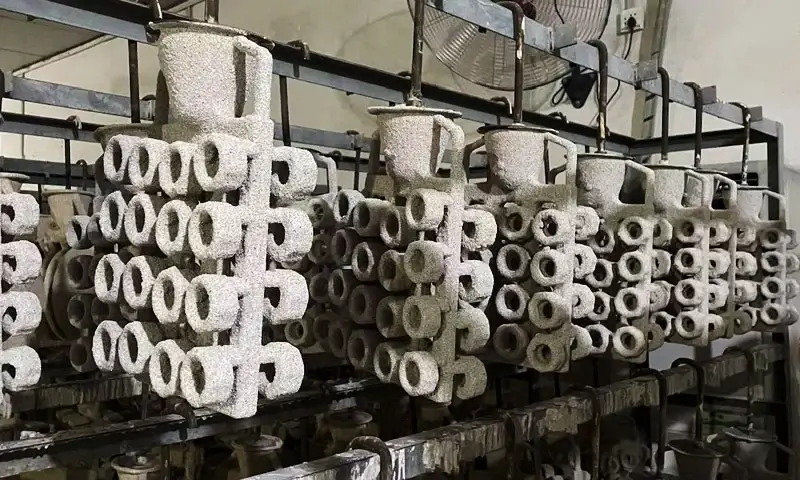
Our capabilities cover every stage of production, including tooling design, wax pattern manufacturing, ceramic shell making, precision casting, heat treatment, CNC machining, surface finishing, and comprehensive quality inspection.
Leveraging advanced shell-making technology and rigorous process control, DEZE optimizes critical shell properties—including permeability, strength, thermal stability, and interface performance—to ensure excellent mold filling, superior surface finish, minimal casting defects, and outstanding dimensional consistency.
Whether producing prototypes, low-volume specialty parts, or high-volume production components, we deliver reliable investment casting solutions in stainless steel, carbon steel, alloy steel, aluminum, copper alloys, and other engineered materials.
Our experienced engineering team works closely with customers to optimize casting design, improve manufacturability, reduce production costs, and achieve consistent, high-quality results across every batch.
FAQs
What is shell permeability in investment casting?
Shell permeability is the ability of a ceramic shell to allow gases to pass through its porous structure under a pressure difference.
It plays a critical role during dewaxing, shell firing, mold filling, and solidification by enabling controlled gas evacuation while maintaining shell integrity.
Why isn’t higher shell permeability always better?
Excessively high permeability can reduce shell strength, increase molten metal penetration into the ceramic shell, promote mechanical sand adhesion, and negatively affect dimensional accuracy.
The optimal permeability depends on the alloy, casting geometry, and process conditions.
How does low shell permeability affect casting quality?
Low permeability restricts gas escape during pouring and firing, increasing the likelihood of shell cracking during dewaxing, gas porosity, blowholes, incomplete filling, and surface defects caused by trapped gases.
Which factors most influence shell permeability?
The most significant factors include refractory particle size distribution, binder system, slurry formulation, shell layer design, drying conditions, firing temperature, shell thickness, and the resulting pore size distribution and connectivity.
How can foundries optimize shell permeability?
Foundries can improve permeability control by using engineered refractory gradations, optimizing binder content, carefully controlling drying and firing processes, monitoring slurry properties,
characterizing pore structures with advanced testing methods, and implementing digital process control to ensure consistent shell quality.