Introduktion
Gjutning, som en av de tidigaste bemästrade metallvarma bearbetningsprocesserna för människor, ståtar med en historia på ca 6,000 år.
Kina gick in i storhetstid av bronsgjutningar mellan 1700 BC och 1000 B.C, med att gjuthantverket nått en ganska avancerad nivå.
Som en kärnprocess i modern tillverkning, gjutning möjliggör bildning av komplexformade metallkomponenter som är svåra att tillverka via smide eller bearbetning, och det används allmänt inom flyg- och rymdindustrin, bil-, maskiner, och precisionsinstrumentindustrier.
Valet av gjutningsmetoder avgör direkt gjutkvaliteten, produktionseffektivitet, och tillverkningskostnader.
1. Gjutning (Konventionell sandgjutning)
Kärndefinition & Processprincip
Grön sandgjutning är den mest traditionella och mest använda gjutmetoden globalt.
Dess kärnråvaror är gjutersand (övervägande kiseldioxidsand; speciell sand som zirkonsand och korundsand används när kiseldioxidsand inte uppfyller höga temperaturkrav) och sandbindemedel (lera är det vanligaste; torr olja, vattenlösligt silikat, fosfat, och syntetiska hartser är alternativa alternativ).
De externa sandformarna klassificeras i tre typer baserat på bindemedel och hållfasthetsbildande mekanismer: grön lersandform, torr lersandmögel, och kemiskt bunden sandmögel.
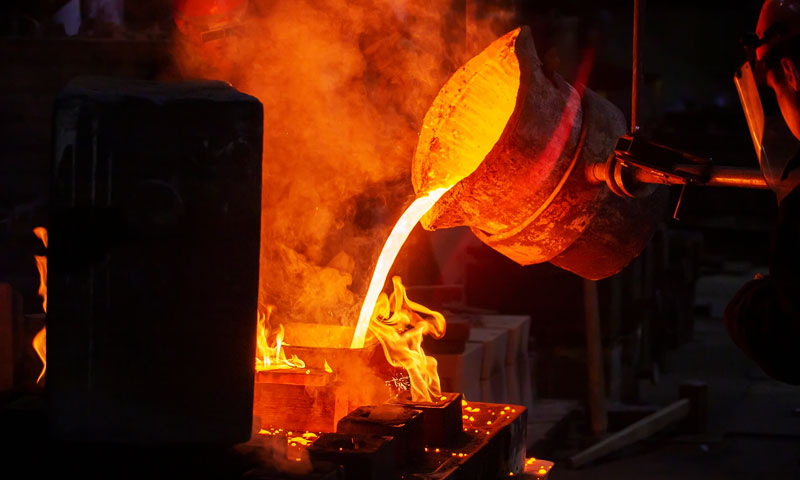
Smält metall hälls i sandformen, som stelnar till gjutgods, och formen är skadad efter en enda upphällning och kan inte återanvändas.

Fördelar
- Kostnadseffektiva råvaror: Lera är rik på resurser och till låga priser; över 90% av använd grön lersand kan återvinnas och återanvändas efter sandbehandling, minska materialavfallet.
- Hög processflexibilitet: Kort formtillverkningscykel och hög effektivitet; blandad formsand har lång livslängd; den är anpassningsbar till små, stor, enkel, och komplexa gjutningar, såväl som i ett stycke, liten sats, och massproduktionsscenarier.
- Låg utrustningströskel: Kräver ingen avancerad specialutrustning, lämplig för små och medelstora gjuterier.
Nackdelar & Begränsningar
- Låg produktionseffektivitet: Varje sandform kan endast användas en gång och måste formas om för efterföljande gjutningar, vilket leder till låg kontinuerlig produktionseffektivitet.
- Dålig måttnoggrannhet: Sandformens styvhet är låg, vilket resulterar i gjutning av dimensionella toleransgrader av CT10–CT13, som inte kan uppfylla höga precisionskrav.
- Hög defektrisk: Gjutgods är utsatta för typiska defekter som sandtvätt, sandinneslutning, gasporositet, och krympningporositet på grund av sandformens lösa struktur.
- Sämre ytkvalitet: Gjutytan är relativt grov, kräver ytterligare bearbetning för att förbättra finishen.
2. Investeringsgjutning (Gjutning)
Kärndefinition & Processprincip
Investeringsgjutning, allmänt känd som förlorad vaxgjutning, har ett sofistikerat processflöde:
tillverka vaxmönster med smältbara material, bestryka flera lager av eldfast material på mönsterytan för att bilda ett keramiskt skal, smält och ta bort vaxmönstret för att få en form utan skiljeytor, och utför högtemperaturrostning innan du häller smält metall.
Den är tillämpbar på ett brett utbud av legeringar, inklusive kolstål, legeringsstål, värmebeständig legering, rostfritt stål, kopparlegering, aluminiumlegering, titanlegering, och duktilt järn, speciellt för material som är svåra att bearbeta genom smidning eller skärning.

Fördelar
- Utmärkt dimensionell noggrannhet: Gjuttolerans betyg når CT4–CT6, mycket högre än grönsandgjutning (CT10 - CT13) och jämförbar med pressgjutning (CT5–CT7), minimera eftergjutningsbearbetning.
- Högt materialutnyttjande: Minskar bearbetningsvolymen av formade och passande ytor avsevärt, sparar bearbetningstid och skärverktygsförbrukning, med materialutnyttjandegrad som överstiger 90%.
- Stark formanpassningsförmåga: Kan gjuta extremt komplexa komponenter, tunnväggiga delar (minsta väggtjocklek 0,5 mm), och gjutgods i mikrostorlek (minsta vikt 1g);
den stöder även integrerad gjutning av monterade delar, förenkla efterföljande monteringsprocesser. - Bred legeringskompatibilitet: Lämplig för nästan alla metallmaterial, inklusive högtemperaturlegeringar, magnesiumlegeringar, titanlegeringar, och ädelmetaller som är svåra att bearbeta med andra metoder.
- Flexibel produktionsskala: Anpassar sig till massproduktion, produktion i små partier, och även anpassning i ett stycke, med stark skalbarhet.
Nackdelar & Begränsningar
- Komplext processflöde: Den har den mest intrikata processen bland alla gjutningsmetoder, involverar framställning av vaxmönster, skalbeläggning, dewaxing, rostning, och hälla, kräver strikt processkontroll.
- Begränsad gjutstorlek: Ej lämplig för stora gjutgods; den maximala vikten för konventionella investeringsgjutgods ligger i allmänhet inom 50 kg, eftersom stora skal är benägna att spricka under rostning och upphällning.
- Långsam nedkylningshastighet: Det keramiska skalet har låg värmeledningsförmåga, leder till långsam stelning av smält metall, vilket kan orsaka grova kornstrukturer i vissa legeringar.
- Hög tillverkningskostnad: Kostnaden för vaxmönster, eldfasta material, och processkontrollen är relativt hög; det är ekonomiskt lönsamt endast i kombination med minskad bearbetning och materialbesparing.
3. Gjutning
Kärndefinition & Processprincip
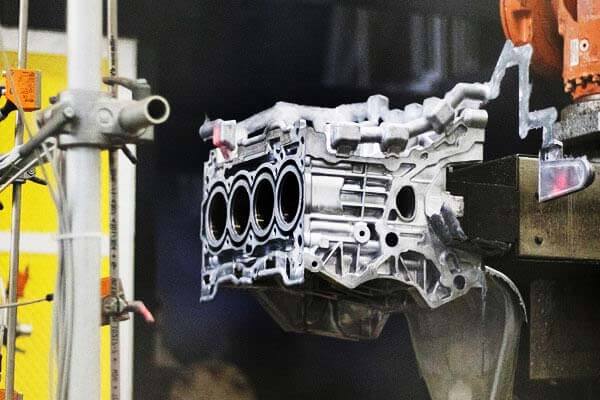
Gjutning är en högtrycksgjutningsmetod som involverar insprutning av smält metall i en precisionsmetallformhålighet med hög hastighet (10–50m/s) under högt tryck (20–150 MPa), och stelna metallen under tryck för att bilda gjutgods.
Den har två grundläggande processer: varmkammare gjutning (smält metall strömmar automatiskt in i tryckkammaren) och kallkammarpressgjutning (smält metall hälls manuellt eller automatiskt i tryckkammaren).
Formen är gjord av höghållfast formstål, säkerställer upprepad användning.
Fördelar
- Överlägsen produktkvalitet: Gjutdimensionell noggrannhet når grad 6–7 (jämnt betyg 4 för precisionsprodukter) med ytjämnhet Ra 5–8μm;
hållfastheten och hårdheten är 25–30 % högre än grönsandgjutgods på grund av tryckstelning, även om förlängningen minskar med ca 70%. - Ultrahög produktionseffektivitet: En horisontell kallkammarpressgjutmaskin kan utföra 600–700 cykler per 8 timme,
medan en liten varmkammarpressgjutmaskin kan uppnå 3 000–7 000 cykler, långt över andra gjutningsmetoder. - Lång formlivslängd: Formar för pressgjutning av zinklegeringar kan hålla hundratusentals eller till och med miljontals gånger, minska de långsiktiga produktionskostnaderna.
- Enkel automatisering: Processen är mycket kompatibel med mekanisering och automatisering, minska arbetskostnaderna och förbättra produktionsstabiliteten.
- Utmärkta ekonomiska fördelar: Gjutgods kräver minimal eller ingen bearbetning, förbättra metallanvändningen och minska investeringarna i bearbetningsutrustning;
kombinerad pressgjutning av metall och icke-metallmaterial sparar monteringstid och råmaterial.
Nackdelar & Begränsningar
- Hög defektrisk för gasporositet: Höghastighetsfyllning leder till instabilt flöde av smält metall,
lätt fånga in gas för att bilda inre porositet, vilket gör att gjutgods inte kan genomgå värmebehandling (värmebehandling orsakar gasexpansion och sprickbildning). - Dålig anpassningsförmåga till komplexa inre konkava delar: Det är svårt att ta bort inre konkava komplexa strukturer, begränsa utformningen av gjutformer.
- Kort formlivslängd för legeringar med hög smältpunkt: För legeringar med hög smältpunkt som kopparlegeringar och järnmetaller, mögeln är utsatt för termisk trötthet och slitage, avsevärt minska livslängden.
- Ej lämplig för produktion i små serier: Formtillverkningskostnaden är hög, och den höga effektiviteten hos pressgjutningsmaskiner gör produktion av små partier ekonomiskt olönsam.
4. Permanent mögelgjutning (Hård formgjutning)
Kärndefinition & Processprincip
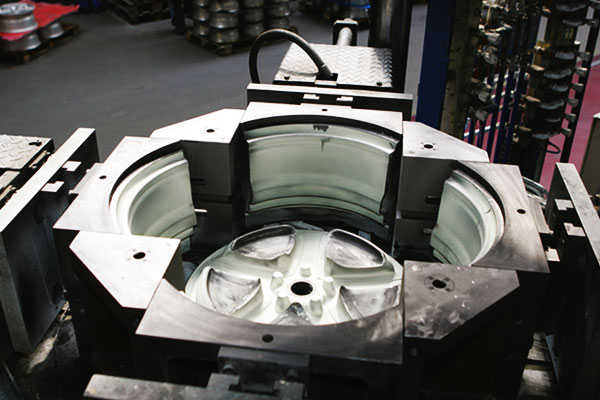
Permanent mögelgjutning, kallas även hårdformgjutning, innebär att smält metall hälls i en metallform för att bilda gjutgods.
Formen är gjord av gjutjärn eller gjutstål och kan återanvändas hundratals till tusentals gånger, därav namnet "permanent mögel".
Den inre kaviteten hos gjutgods kan använda metallkärnor eller sandkärnor, och formstrukturerna är uppdelade i horisontell avskiljning, vertikal avskiljning, och kompositavskiljning för att anpassa sig till olika gjutformer:
vertikal avskiljning underlättar grindning och urtagning av formen, horisontell avskiljning är för tunnväggiga hjulformade delar, och kompositavskiljning är för komplexa komponenter.
Fördelar
- Utmärkt mögelåteranvändbarhet: "En form för flera gjutningar" eliminerar behovet av upprepad formtillverkning, sparar formmaterial och tid, och förbättra produktionseffektiviteten.
- Hög gjutningsprestanda: Metallformen har stark kylkapacitet, leder till tät gjutstruktur och överlägsna mekaniska egenskaper jämfört med sandgjutgods.
- Bra måttnoggrannhet och ytkvalitet: Gjuttoleransgraderna når IT12–IT14, ytjämnhet Ra ≤6,3μm, minska arbetsbelastningen efter bearbetning.
- Förbättrade arbetsförhållanden: Den använder lite eller ingen sand, undvika dammföroreningar och optimera arbetsmiljön för arbetare.
Nackdelar & Begränsningar
- Hög formkostnad och lång tillverkningscykel: Metallformen kräver höghållfasta material och precisionsbearbetning,
med hög förhandsinvestering och lång ledtid, olämplig för enstycks- och småsatsproduktion. - Begränsade tillämpliga legeringar och gjutstorlekar: Främst lämplig för massproduktion av gjutgods av icke-järnlegering (aluminiumkolvar, cylinderblock, cylinderhuvuden, bussningar av kopparlegering, etc.) för bilar, flygplan, och förbränningsmotorer;
för gjutgods av järnlegeringar, den är endast tillämpbar på små och medelstora delar med enkla former. - Strikta processkrav: Formen behöver förvärmas och temperaturkontrolleras för att undvika kallstängningar och mögelsprickor; det är benäget att bli termisk trötthet efter långvarig användning, påverkar gjutkvaliteten.
5. Lågtrycksgjutning
Kärndefinition & Processprincip
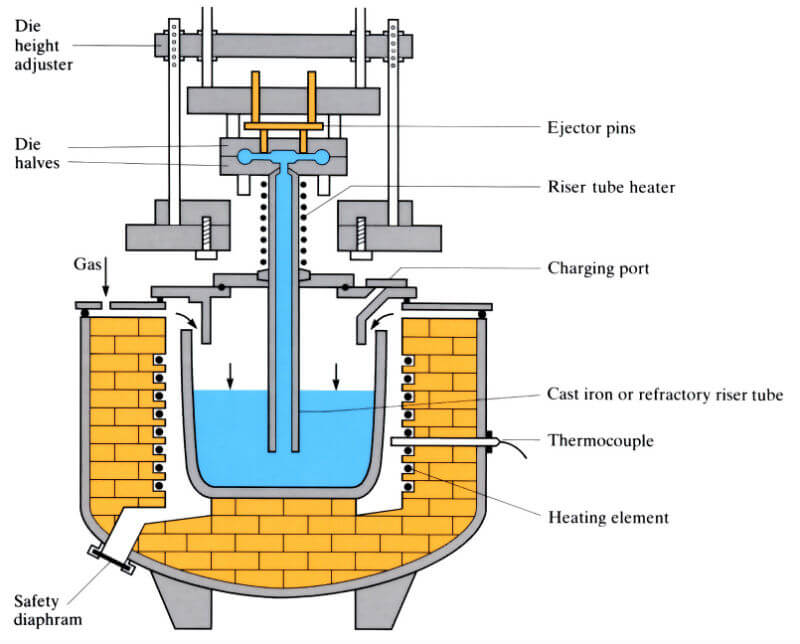
Lågtrycksgjutning är en gjutmetod som fyller formen och stelnar smält metall under lågt tryck (0.02-0,06 MPa).
Kärnprocessen inkluderar: hälla smält metall i en isolerad degel, tätning av degeln, anslutning av stigröret till formen, införa torr komprimerad luft i degeln för att driva smält metall uppåt genom stigarröret för att fylla formhålan,
stelna metallen under konstant tryck, släpper trycket för att låta kvarvarande smält metall flöda tillbaka till degeln, och slutligen öppna formen för att ta ut gjutgodset.
Fördelar
- Flexibel processkontroll: Den smälta metallens stighastighet och stelningstrycket är justerbara, lämplig för olika formar (metallformar, sandformar) och legeringar, samt gjutgods av olika storlekar.
- Stabil fyllning och låg defektfrekvens: Bottom-up fyllning säkerställer smidigt flöde av smält metall utan stänk, undvika gasinneslutning och erosion av mögelväggar och kärnor;
gjutningsdefekter såsom gasporositet och slagginslutning reduceras avsevärt, med kvalifikationsgrad över 95%. - Högkvalitativa gjutgods: Tryckstelning realiserar riktad stelning från utsidan till insidan, resulterar i tät gjutstruktur,
tydliga konturer, släta ytor, och utmärkta mekaniska egenskaper, speciellt lämplig för stora tunnväggiga delar. - Högt materialutnyttjande: Inget matningssteg krävs, med materialutnyttjandegrad som når 90–98 %, minskar metallavfall.
- Vänlig arbetsmiljö: Låg arbetsintensitet, enkel utrustning, och enkelt förverkligande av mekanisering och automatisering, överensstämmer med moderna produktionskrav.
Nackdelar & Begränsningar
- Kort livslängd för stigröret: Stigröret är i direkt kontakt med högtemperatursmält metall under lång tid, benägen för oxidation och slitage, kräver regelbundet byte.
- Föroreningsrisk för smält metall: Under värmekonservering, smält metall oxideras lätt och blandas med slagg, kräver strikt kontroll av värmekonserveringsmiljön och rening av smält metall.
- Begränsat tillämpningsområde: Används huvudsakligen för gjutning av högkvalitativa aluminium- och magnesiumlegeringar, såsom cylinderblock, cylinderhuvuden, vevhus, och höghastighetskolvar av aluminium för förbränningsmotorer; det används sällan för järnlegeringar på grund av höga temperaturkrav.
6. Centrifugalgjutning
Kärndefinition & Processprincip
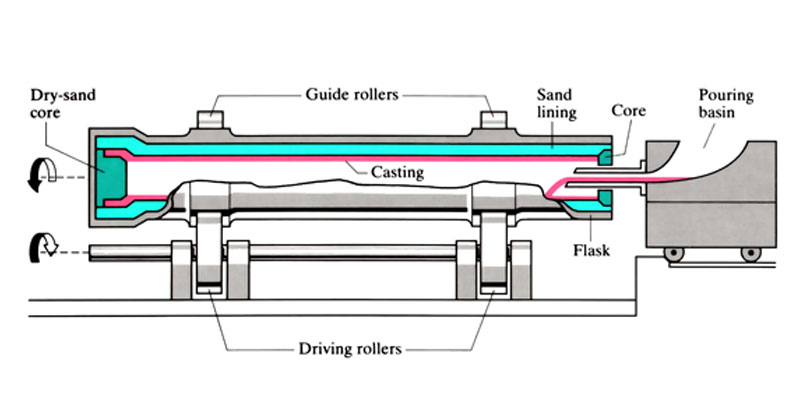
Centrifugalgjutning innebär att smält metall hälls i en roterande form, där metallen fyller formen och stelnar under centrifugalkraft.
Enligt orienteringen av formens roterande axel, den är indelad i tre typer: horisontell centrifugalgjutning (axel horisontell eller <4° till horisontellt, lämplig för långa cylindriska delar),
vertikal centrifugalgjutning (axel vertikal, lämplig för korta cylindriska eller ringformade delar), och centrifugalgjutning med lutande axel (används sällan på grund av komplex drift).
Centrifugalkraften driver riktningsrörelsen hos smält metall, optimera gjutningsstrukturen.
Fördelar
- Förenklad formstruktur: För ihåliga roterande delar, ingen kärna, grindsystem, eller stigare behövs, förenkla formkonstruktionen och minska tillverkningskostnaderna.
- Högkvalitativa gjutgods: Centrifugalkraften separerar lågdensitetsgaser och slagg till den inre ytan,
och främjar riktad stelning från utsidan till insidan, resulterar i tät gjutstruktur, få defekter, och utmärkta mekaniska egenskaper. - Kostnadsbesparande för bimetalldetaljer: Lättgjuta bimetallkomponenter som bussningar och lager (TILL EXEMPEL., stålhylsor med tunt kopparfoder), spara dyra icke-järnmetaller samtidigt som prestanda säkerställs.
- Stark fyllningskapacitet: Centrifugalkraften ökar flytbarheten hos smält metall, lämplig för gjutning av tunnväggiga delar och legeringar med dålig flytbarhet.
- Minskat materialspill: Eliminerar grindsystem och stigare, ytterligare förbättra materialutnyttjandet.
Nackdelar & Begränsningar
- Dålig inre ytkvalitet: Den inre fria ytan på gjutgods är grov, med stora dimensionsfel och dålig enhetlighet, som kräver efterföljande bearbetning för att uppfylla dimensionskrav.
- Olämplig för vissa legeringar: Ej tillämpligt på legeringar med kraftig densitetssegregering (TILL EXEMPEL., bly brons), eftersom centrifugalkraften kommer att förvärra segregationen;
inte heller lämplig för aluminium- och magnesiumlegeringar på grund av deras låga densitet och dåliga centrifugalseparationseffekt. - Begränsade gjutningsformer: Endast lämplig för roterande symmetriska delar (cylindrar, ringar, ärm); kan inte gjuta komplexa delar med oregelbundna konturer.
- Höga utrustningskrav: Kräver specialiserade centrifugalgjutmaskiner med stabil rotationshastighetskontroll, ökade investeringar i utrustning.
7. Jämförelsetabell över vanliga gjutningsmetoder
| Gjutmetod | Fördelar | Begränsningar | Typiska applikationer |
| Sandgjutning | Låg kostnad, flexibel för små/stora delar, enkla och komplexa former, återvinningsbar sand | Engångsformar → låg effektivitet, lägre dimensionsnoggrannhet, ytfel | Motorblock, pumphus, stora konstruktionsdelar |
| Investering (Förlorad wax) Gjutning | Högprecision (CT4–6), Utmärkt ytfinish, komplexa former, tunna väggar, bred materialkompatibilitet | Hög kostnad, komplex process, inte lämplig för mycket stora delar | Flyg-, medicinsk implantat, precision till bildelar |
| Gjutning | Högdimensionell noggrannhet (CT6–7), Utmärkt ytfinish, tunnväggiga delar, hög produktionseffektivitet, automationsvänlig | Hög verktygskostnad, Begränsad till lågsmältande legeringar, porositetsrisk, inte idealisk för små partier | Motordelar till fordon, inhus, konsumentelektronik |
Permanent mögel (Metallform) Gjutning |
Återanvändbara formar minskar kostnaderna, tät mikrostruktur, högstyrka, Bra ytfinish | Hög mögelkostnad, strikt processkontroll, begränsad till medel komplexitet, huvudsakligen icke-järnlegeringar | Aluminium kolvar, cylinderhuvuden, bilhus |
| Lågtrycksgjutning | Smidig fyllning, minimal porositet, högkvalitativ tät struktur, högt metallutnyttjande (90–98%), lämplig för tunnväggiga delar | Begränsad livslängd för stigrör/rör, oxidationsrisk, främst för icke-järnlegeringar | Motorblock i aluminium, cylinderhuvuden, kolvar, magnesium delar |
| Centrifugalgjutning | Tät struktur, riktningsstelning, eliminerar kärnor, möjliggör bimetallgjutningar, minskad grind | Inre fri yta grov, dimensionell noggrannhet begränsad, olämpliga för segregationsbenägna legeringar, begränsad till cylindriska/rotationsgeometrier | Rör, bussningar, skål, cylinderfoder |
8. Slutsats
Varje gjutmetod erbjuder unika fördelar och begränsningar som gör den lämplig för specifika applikationer.
Sandgjutning är fortfarande den mest mångsidiga och ekonomiska metoden för stora, komplex gjutning, medan investeringsgjutning ger exceptionell precision för högvärdiga komponenter.
Pressgjutning utmärker sig i högvolymproduktion av tunnväggiga detaljer, och permanent formgjutning ger jämn kvalitet för icke-järnproduktion i medelvolym.
Lågtrycksgjutning är idealisk för högintegritetskomponenter av aluminium och magnesium, och centrifugalgjutning är oöverträffad för ihåliga symmetriska delar.
Valet av en lämplig gjutmetod beror på faktorer inklusive detaljens geometri, önskad dimensionsnoggrannhet, ytfin, materialtyp, produktionsvolym, och kostnadsöverväganden.
Modern tillverkning kombinerar i allt högre grad dessa tekniker för att utnyttja deras kompletterande fördelar, driver innovation inom komplex komponentproduktion inom flyg- och rymdindustrin, bil-, och industrisektorer.