1. Introduction — Why corrosion prevention matters
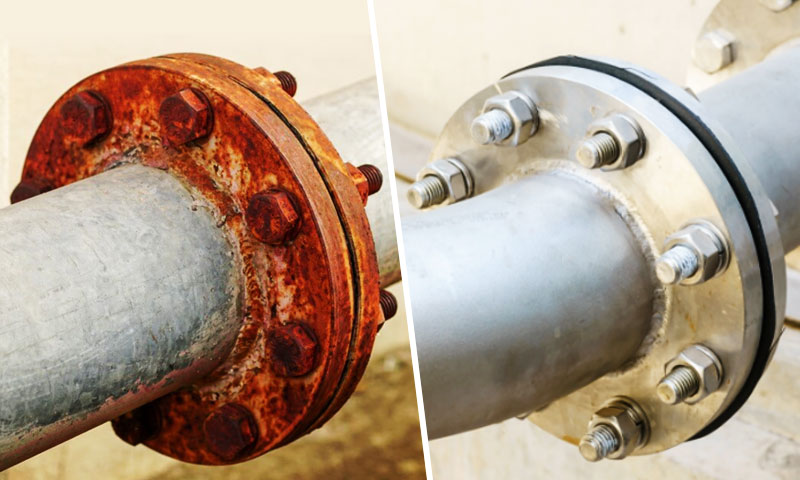
Corrosion is a natural, electrochemical process that degrades materials—particularly metals—when they interact with their environment.
در سطح جهان, corrosion-related damage consumes a significant fraction of industrial maintenance budgets, affects safety-critical infrastructure, and shortens asset lifetimes.
Effective corrosion prevention is therefore not a single technique but a systematic engineering strategy that integrates materials science, design principles, کنترل محیطی, and lifecycle management.
Preventing corrosion is not about eliminating it entirely—an unrealistic goal—but about slowing corrosion rates to acceptable, سطوح قابل پیش بینی while ensuring structural integrity, ایمنی, و زنده ماندن اقتصادی.
2. Material-Oriented Prevention: Fundamentally Enhancing Corrosion Resistance
The selection and optimization of materials are the foundational steps in corrosion prevention.
By choosing inherently corrosion-resistant materials or modifying material compositions, the thermodynamic tendency of corrosion can be reduced. This section focuses on two core approaches: material selection and alloy optimization.

Rational Material Selection Based on Environmental Conditions
Material selection must align with the specific corrosion environment (به عنوان مثال, غلظت کلرید, pH value, دما, فشار) to ensure long-term stability.
Key principles and examples include:
- General Atmospheric Environment: فولاد کربن is cost-effective but requires additional protection (به عنوان مثال, نقاشی).
فولادهای کم آلیاژ (به عنوان مثال, A36 with Cu addition) improve atmospheric corrosion resistance by 30-50% compared to plain carbon steel, suitable for building structures and bridges. - Chloride-Containing Environments (آب دریا, آبسری): فولادهای زنگ نزن آستنیتی (316L, PREN≈34) resist pitting corrosion in low-chloride media,
while super duplex stainless steels (به عنوان مثال, CD3MWCuN, PREN>40) and nickel-based alloys (Hastelloy C276) are preferred for high-chloride, high-pressure environments such as subsea pipelines. - Acidic/Basic Media: For strong reducing acids (H₂so₄), آلیاژهای تیتانیوم (Ti-6Al-4V) and Hastelloy B2 exhibit excellent resistance.
For alkaline media (سعادت), nickel-copper alloys (مونل 400) outperform stainless steels by avoiding hydroxide-induced cracking. - High-Temperature Oxidizing Environments: Chromium-rich alloys (به عنوان مثال, اینکونل 600, Cr=15-17%) form dense Cr₂O₃ passive films, maintaining stability at 800-1000℃, suitable for furnace components and gas turbines.
قابل توجه, material selection must balance corrosion resistance, هزینه, و قابلیت پردازش. Per NACE SP0108, a “corrosion severity classification” system (خفیف, معتاد, severe, extreme) should be used to match materials to environmental risks, avoiding over-specification or under-protection.
Alloy Optimization and Microstructural Modification
For scenarios where standard materials are insufficient, alloy modification can enhance corrosion resistance by adjusting chemical compositions or optimizing microstructures:
- Alloying Element Addition: Adding chromium (Cr), مولیبدن (مو), نیتروژن (ن), و مس (مس) to steels improves passive film stability and pitting resistance.
به عنوان مثال, 2205 فولاد ضد زنگ دوبلکس (Cr=22%, Mo=3%, N=0.15%) achieves a PREN of 32, outperforming 316L in chloride environments. تنگستن (دبلیو) addition in super duplex alloys further enhances high-temperature corrosion resistance. - Microstructural Control: Heat treatment regulates grain size, توزیع فاز, and precipitate formation to reduce corrosion susceptibility.
به عنوان مثال, solution heat treatment of stainless steels (1050-1150℃ quenching) prevents chromium carbide (CR₂₃C₆) بارش, avoiding intergranular corrosion (igc).
For carbon steels, tempering at 600-650℃ reduces residual stresses and improves resistance to stress corrosion cracking (SCC). - Purity Improvement: Reducing impurity content (گوگرد, فسفر, اکسیژن) minimizes corrosion initiation sites.
ذوب القایی خلاء (VIM) and electroslag remelting (ESR) reduce sulfur content in superalloys to ≤0.005%, eliminating sulfide inclusions that trigger pitting corrosion.
3. Environmental Regulation: Mitigating Corrosion-Causing Factors
Modifying the service environment to reduce its corrosiveness is a cost-effective strategy, especially for enclosed or controllable systems.
This approach targets key corrosion drivers such as moisture, اکسیژن, یون های کلرید, و مواد شیمیایی تهاجمی.
Controlling Moisture and Oxygen Content
Moisture and oxygen are essential for electrochemical corrosion (cathodic reaction: O2 + 2هوس + 4e⁻ → 4OH⁻). Mitigation measures include:
- Dehumidification: In enclosed spaces (به عنوان مثال, electronic equipment cabinets, storage warehouses), maintaining relative humidity (RH) زیر 60% reduces corrosion rates by 70-80%.
Desiccants (silica gel, molecular sieves) and dehumidifiers are commonly used; for precision components, RH is controlled to ≤40% per ASTM D1735. - Oxygen Removal: در سیستم های حلقه بسته (به عنوان مثال, boiler water, خط لوله نفتی), deaerators or chemical oxygen scavengers (به عنوان مثال, hydrazine, sodium sulfite) reduce oxygen content to ≤0.01 ppm, preventing oxygen-induced pitting and SCC.
For oil storage tanks, nitrogen blanketing displaces oxygen, minimizing internal corrosion of tank walls.
Reducing Aggressive Ions and Chemicals
Chloride (کلوچه), sulfide (S²⁻), and acidic/basic species accelerate corrosion by breaking down passive films or promoting chemical reactions. Key control methods:
- Filtration and Purification: In seawater cooling systems, reverse osmosis (RO) or ion exchange removes chloride ions (from 35‰ to ≤500 ppm),
enabling the use of 316L stainless steel instead of expensive nickel-based alloys. In chemical processes, activated carbon filtration removes organic acids and sulfides. - pH Adjustment: Maintaining a neutral to slightly alkaline pH (7.5-9.0) for aqueous systems forms a protective hydroxide film on metal surfaces.
به عنوان مثال, adding ammonia to boiler water adjusts pH to 8.5-9.5, reducing corrosion of carbon steel pipes by 50%. - Inhibitor Addition: Corrosion inhibitors are chemical substances that reduce corrosion rates by adsorbing on metal surfaces or modifying the corrosion reaction. They are classified by mechanism:
-
- Anodic Inhibitors (به عنوان مثال, کرومات ها, nitrates) enhance passive film formation, suitable for ferrous metals in neutral media.
با این حال, chromates are restricted by REACH due to toxicity, with trivalent chromium inhibitors as alternatives. - Cathodic Inhibitors (به عنوان مثال, zinc salts, phosphates) slow the cathodic reaction, widely used in cooling water systems (dosage 10-50 PPM) to prevent pitting.
- Mixed Inhibitors (به عنوان مثال, imidazolines, polyphosphates) act on both anodic and cathodic sites, offering broad-spectrum protection for multi-metal systems (فولاد, مس, آلومینیوم) in oilfield brines.
- Anodic Inhibitors (به عنوان مثال, کرومات ها, nitrates) enhance passive film formation, suitable for ferrous metals in neutral media.
کنترل دما
Corrosion rates generally increase with temperature (Arrhenius law), as higher temperatures accelerate electrochemical reactions and reduce inhibitor effectiveness.
به عنوان مثال, در آب دریا, corrosion rate of carbon steel increases by 2-3x when temperature rises from 25℃ to 60℃. Mitigation measures include:
- Insulating equipment to prevent temperature fluctuations and condensation (a major cause of localized corrosion).
- Using high-temperature resistant inhibitors (به عنوان مثال, polyamine derivatives) for systems operating above 100℃.
- Cooling critical components (به عنوان مثال, مبدل های حرارتی) to maintain temperatures within the optimal range for corrosion resistance.
4. حفاظت از سطح: Establishing Physical/Chemical Barriers
Surface protection is the most widely used anti-corrosion method, forming a barrier between the material and the environment to block corrosion reactions.
It is suitable for both new components and in-service maintenance, with diverse technologies tailored to different materials and environments.
Coating Technologies
Coatings are divided into organic, inorganic, and metallic categories, هر کدام با خواص و کاربردهای منحصر به فرد:

پوشش های ارگانیک:
- Paint and Varnish: Alkyd, حکیم, and polyurethane paints are commonly used for carbon steel structures.
پوشش (ضخامت 150-300 میکرومتر) offer excellent adhesion and chemical resistance, suitable for industrial equipment and pipelines. Polyurethane topcoats provide UV resistance, ideal for outdoor structures. - روکش پودری: Electrostatically applied polyester or epoxy powder (cured at 180-200℃) forms a dense film (50-200 میکرومتر) with no VOC emissions.
It is widely used in automotive parts, لوازم خانگی, and architectural components, with salt spray resistance ≥1000 hours (ASTM B117). - Polymer Liners: Thick rubber, پلی اتیلن (PE), or fluoropolymer (PTFE) liners protect tanks and pipelines from aggressive chemicals (به عنوان مثال, اسیدها, حلال ها).
PTFE liners are inert to nearly all chemicals, suitable for chemical reactors.
Inorganic Coatings:
- روکشهای سرامیکی: Plasma-sprayed alumina (Al2O3) یا زیرکونیا (Zro₂) پوشش ها (ضخامت 200-500 میکرومتر) provide superior wear and high-temperature corrosion resistance, used in gas turbine blades and engine components.
- Silicate Coatings: Water-based silicate coatings form a chemical bond with metal surfaces, offering corrosion resistance in high-humidity environments.
They are environmentally friendly alternatives to chromate coatings for aluminum components.
Metallic Coatings:
- گالوانیزه کردن: گالوانیزه گرم (Zn coating thickness 85-100 میکرومتر) provides cathodic protection to carbon steel, with a service life of 20-50 years in atmospheric environments. It is widely used in bridges, نرده ها, and steel structures.
- آبکاری/آبکاری: Chromium plating (کروم سخت) enhances wear and corrosion resistance for mechanical parts, while electroless nickel plating (Ni-P alloy) offers uniform coverage for complex-shaped components, suitable for aerospace fasteners.
- Thermal Spray Metallic Coatings: Spray-applied zinc, آلومینیوم, or their alloys provide cathodic protection for large structures (به عنوان مثال, سکوهای فراساحلی).
Aluminum-zinc coatings (85Al-15Zn) exhibit salt spray resistance ≥2000 hours, outperforming pure zinc coatings.
Critical to coating performance is surface preparation (به عنوان مثال, سندبلاست, تمیز کردن شیمیایی) to remove oil, زنگ زدگی, و اکسیدها, ensuring coating adhesion.
Per SSPC-SP 10 (near-white metal blast cleaning), surface roughness should be 30-75 μm for optimal coating bonding.
پوشش های تبدیل شیمیایی
Chemical conversion coatings form a thin (0.1-2 میکرومتر) adherent film on metal surfaces via chemical reactions, enhancing corrosion resistance and serving as a primer for organic coatings. Common types:
- پوشش های تبدیل کرومات: Traditional coatings for aluminum and zinc, offering excellent corrosion resistance, but restricted by environmental regulations.
Trivalent chromium conversion coatings (ASTM D3933) are alternatives, providing salt spray resistance of 200-300 ساعت. - روکش های تبدیل فسفات: Zinc phosphate or iron phosphate coatings are used as primers for steel and aluminum components, improving paint adhesion and corrosion resistance.
They are widely used in automotive bodies and electronic enclosures. - آندایز کردن: برای آلومینیوم, آندایز کردن (sulfuric acid or hard anodizing) forms a thick (5-25 میکرومتر) Al₂O₃ film, significantly improving corrosion and wear resistance.
Type II anodizing (تزئینی) and Type III hard anodizing (صنعتی) مشترک هستند, with salt spray resistance up to 500 ساعت.
Cathodic and Anodic Protection
These are electrochemical protection methods that alter the potential of the metal to suppress corrosion reactions, suitable for large metallic structures (خطوط لوله, تانک ها, سکوهای فراساحلی).
- حفاظت کاتدی (CP):
-
- Sacrificial Anode CP: Attaching more active metals (روی, آلومینیوم, منیزیم) to the protected structure.
The sacrificial anode corrodes preferentially, polarizing the structure to a cathodic potential.
Used in seawater systems (به عنوان مثال, بدنه کشتی, سکوهای فراساحلی) and buried pipelines, with anode replacement intervals of 5-10 سال. - Impressed Current CP: Applying an external direct current (دی سی) to the structure (کاتد) and an inert anode (پلاتین, titanium oxide).
It is suitable for large structures or high-resistivity environments (به عنوان مثال, desert pipelines), with precise potential control (-0.85 به -1.05 V vs. Cu/CuSO₄ electrode) to avoid over-protection (تردی هیدروژنی).
- Sacrificial Anode CP: Attaching more active metals (روی, آلومینیوم, منیزیم) to the protected structure.
- Anodic Protection: Applying anodic current to passivate the metal (به عنوان مثال, فولاد ضد زنگ, تیتانیوم) in acidic media.
It is used in chemical reactors (به عنوان مثال, sulfuric acid tanks) where passive film formation is feasible, with strict current and potential control to maintain passivity.
5. Structural Design Optimization: Avoiding Corrosion Hotspots
Poor structural design can create localized corrosion hotspots (به عنوان مثال, شکاف, stagnant zones, غلظت استرس) even with corrosion-resistant materials and protective coatings.
Design optimization focuses on eliminating these hotspots and facilitating maintenance.
Eliminating Crevices and Stagnant Zones
Crevice corrosion occurs in narrow gaps (<0.1 mm) where oxygen depletion and chloride accumulation create aggressive microenvironments. Design improvements include:
- Using welds instead of bolted joints where possible; for bolted joints, using gaskets (به عنوان مثال, EPDM, PTFE) to prevent crevice formation.
- Designing with smooth, rounded edges instead of sharp corners; avoiding recesses, سوراخ های کور, and overlapping surfaces that trap moisture and debris.
- Ensuring proper drainage and ventilation in enclosed structures (به عنوان مثال, tank bottoms, equipment casings) to prevent stagnant water accumulation.
Minimizing Galvanic Corrosion
Galvanic corrosion occurs when two dissimilar metals are in electrical contact in an electrolyte, with the more active metal corroding rapidly. Design strategies:
- Selecting metals with similar electrochemical potentials (per the galvanic series).
به عنوان مثال, pairing 316L stainless steel with copper is acceptable (potential difference <0.2 V), while pairing carbon steel with copper (potential difference >0.5 V) requires insulation. - Insulating dissimilar metals with non-conductive materials (به عنوان مثال, لاستیک, plastic washers) to break electrical contact.
- Using sacrificial anodes or coatings on the more active metal to protect it from galvanic corrosion.
Reducing Residual Stresses and Stress Concentrations
Residual stresses from manufacturing (جوشکاری, کار سرد) or service loads can induce SCC in corrosive environments. Design and process improvements:
- Using gradual transitions (فیله, مخروطی) instead of sharp changes in cross-section to reduce stress concentrations.
- Performing post-weld heat treatment (PWHT) برای رفع فشارهای باقیمانده (به عنوان مثال, 600-650℃ for carbon steel welds).
- Avoiding cold working beyond 20% for stainless steels, as it increases stress and reduces corrosion resistance.
Facilitating Maintenance and Inspection
Designing structures to allow easy access for inspection, تمیز کردن, and coating maintenance is critical for long-term corrosion prevention. این شامل:
- Installing inspection ports, manholes, and access platforms for large equipment.
- Designing coating systems with easy touch-up capabilities (به عنوان مثال, using compatible repair paints).
- Incorporating corrosion monitoring sensors (به عنوان مثال, کوپن های خوردگی, electrical resistance probes) into accessible locations.
6. Corrosion Monitoring and Predictive Maintenance
Corrosion prevention is not a one-time measure; continuous monitoring and proactive maintenance are essential to detect early corrosion signs and adjust protection strategies.
This section covers key monitoring technologies and maintenance practices.
Corrosion Monitoring Technologies
- تست غیر مخرب (NDT):
-
- تست اولتراسونیک (UT): Measures metal thickness to detect uniform corrosion and pitting, with accuracy up to ±0.1 mm. Used for pipelines, تانک ها, و کشتی های فشار (ASTM A609).
- آزمایش جریان گردابی (ECT): Detects surface and near-surface corrosion (depth ≤5 mm) in conductive materials, suitable for stainless steel and aluminum components (ASTM E2434).
- X-Ray Radiography (XR): Identifies internal corrosion and weld defects, used in critical aerospace and nuclear components (ASTM E164).
- Electrochemical Monitoring:
-
- Corrosion Coupons: Exposes metal samples to the environment for a set period, measuring weight loss to calculate corrosion rate (ASTM G1). Simple and cost-effective, used in cooling water systems.
- Linear Polarization Resistance (LPR): Real-time monitoring of corrosion rate by measuring polarization resistance, suitable for aqueous environments (ASTM G59).
- Electrochemical Impedance Spectroscopy (EIS): Evaluates the integrity of coatings and passive films, providing insights into localized corrosion mechanisms (ASTM G106).
- Smart Monitoring Systems: Integrating IoT sensors, تجزیه و تحلیل داده ها, and digital twins to monitor corrosion in real time.
به عنوان مثال, fiber optic sensors embedded in pipelines detect corrosion-induced strain, while wireless corrosion probes transmit data to cloud platforms for predictive analysis.
Predictive and Preventive Maintenance
Based on monitoring data, maintenance strategies can be optimized to avoid unplanned downtime:
- نگهداری پیشگیری: Regular cleaning, coating touch-ups, inhibitor replenishment, and anode replacement (for CP systems) at scheduled intervals.
به عنوان مثال, repainting steel bridges every 10-15 سال, and replacing sacrificial anodes on ships every 5 سال. - نگهداری پیش بینی کننده: Using monitoring data to predict corrosion progression and schedule maintenance only when needed.
به عنوان مثال, LPR data can forecast when pipeline thickness will reach the minimum allowable limit, enabling targeted repairs. - Root Cause Analysis: Investigating corrosion failures to identify underlying causes (به عنوان مثال, coating breakdown, inhibitor depletion, design flaws) and implement corrective actions.
Per NACE RP0501, root cause analysis should include material testing, environmental analysis, and process review.
7. Emerging Trends and Future Directions
With advancements in materials science, digital technology, و پایداری, corrosion prevention is evolving toward more efficient, سازگار با محیط زیست, and intelligent solutions:
- Smart Anti-Corrosion Materials: Self-healing coatings (incorporating microcapsules of healing agents) that repair scratches and cracks automatically, extending coating life by 2-3x.
Shape-memory alloys that adjust to reduce stress concentrations and corrosion risk. - Digitalization and AI-Driven Corrosion Management: AI algorithms analyze large-scale monitoring data to predict corrosion risks with high accuracy, optimizing maintenance schedules and reducing costs.
Digital twins of structures simulate corrosion behavior under different environmental conditions, enabling virtual testing of anti-corrosion strategies. - Green Corrosion Prevention: Developing environmentally friendly inhibitors (bio-based, biodegradable) to replace toxic chemicals.
Solar-powered impressed current CP systems for remote offshore platforms, reducing carbon emissions. Recyclable coatings that minimize waste during maintenance. - Nanotechnology-Enhanced Protection: روکش های نانوکامپوزیت (به عنوان مثال, ZnO nanoparticles in epoxy) that improve barrier properties and corrosion resistance.
Nanostructured passive films (via plasma treatment) that enhance stability in extreme environments.
8. نتیجه گیری
Corrosion prevention is fundamentally a چالش مهندسی سیستم, not a single technical fix.
Effective control of corrosion requires coordinated decisions across material selection, طراحی ساختاری, مهندسی سطح, fabrication quality, operational conditions, and long-term asset management.
When these elements are aligned, corrosion rates can be reduced to predictable, manageable levels over decades of service.
The most successful corrosion-prevention strategies are proactive rather than reactive.
Selecting materials with inherent corrosion resistance, designing components to avoid crevices and galvanic couples, and applying appropriate surface protection at the outset consistently outperform after-the-fact repairs or upgrades.
Equally important is recognizing that corrosion behavior evolves during service: changes in environment, در حال بارگذاری, or maintenance practices can alter degradation mechanisms and accelerate damage if not properly monitored.
As industries increasingly emphasize reliability, environmental responsibility, و عملکرد بلند مدت, corrosion prevention must be treated as a core design and management discipline, not merely a maintenance activity.
سوالات متداول
Is it possible to completely eliminate corrosion?
خیر. Corrosion is a natural thermodynamic process. Engineering efforts focus on slowing corrosion to acceptable and predictable rates rather than eliminating it entirely.
Why does corrosion still occur in corrosion-resistant alloys?
Even corrosion-resistant alloys can fail if exposed to conditions outside their design envelope, such as high chloride concentrations, دمای شدید, شکاف, استرس پسماند, or improper fabrication.
What is the most common cause of premature corrosion failure?
Incorrect material selection combined with poor design details—such as crevices, dissimilar metal contact, or inaccessible areas for maintenance—is the most frequent root cause.
Are coatings sufficient for long-term corrosion protection?
Coatings are effective barriers but are vulnerable to mechanical damage, پیری, and improper application. They perform best when combined with appropriate material selection and good design.