
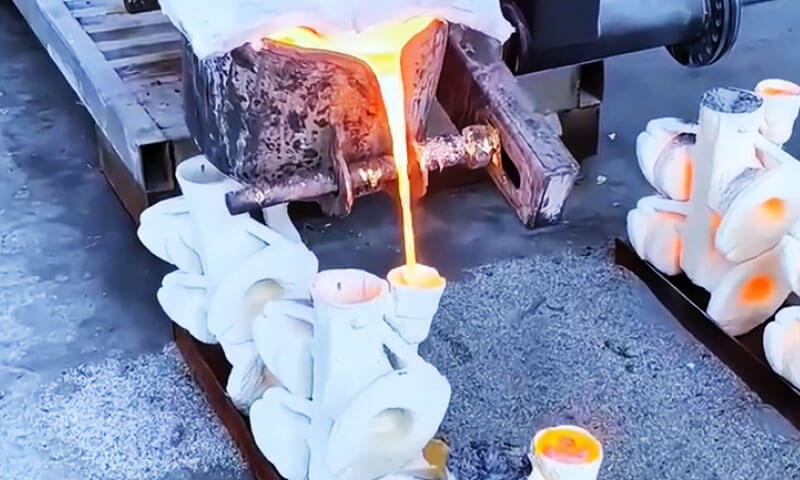
Pouring is one of the most critical process links in sand casting production, serving as the interface between molten metal preparation and mold cavity filling.
The stability, accuracy and controllability of the pouring process directly determine the internal soundness, surface quality and dimensional consistency of finished castings.
In industrial practice, a large proportion of recurring casting defects — including slag inclusions, dujų poringumas, sand erosion and short pours — are not caused by molding or melting alone, but originate from improper pouring operation, mismatched equipment selection and uncontrolled pouring parameters.
For many foundries, pouring equipment is often selected based on habit or initial cost rather than systematic matching with molding line characteristics, casting material and quality requirements.
Misselected pouring systems not only elevate defect rates and reduce process yield, but also disrupt molding line rhythm, increase energy consumption and shorten equipment service life.
1. What Is an Ideal Pouring Process?
Pouring is one of the most decisive operations in metalo liejimas, yet it is also one of the most misunderstood.
In modern foundry engineering, pouring is far more than simply transferring molten metal from a ladle into a mold.
It is a dynamic process involving fluid flow, šilumos perdavimas, pressure balance, oxidation control, and mold filling.
Even when melting, formų gamyba, and gating design are optimized, poor pouring practice can still lead to serious casting defects.
Ir atvirkščiai, an excellent pouring operation cannot compensate for deficiencies in gating design, mold permeability, or riser design.
Understanding what truly constitutes an ideal pouring process is therefore fundamental to improving casting quality, gamybos efektyvumą, and process stability.
Common Misconceptions About Pouring Quality
Many foundries evaluate pouring performance using overly simplistic criteria that do not accurately reflect the quality of the pouring process itself.
One common misconception is that successful pouring merely means delivering the required amount of molten metal into the mold within a specified pouring time.
While pouring time is undoubtedly important, it represents only one process parameter.
A casting filled within the target time can still suffer from turbulence, oksidacija, šlako įtraukimas, dujų poringumas, or mold erosion if the metal flow is unstable.
Another misconception is that ideal pouring should produce castings with absolutely no defects.
In reality, casting quality is the combined result of multiple interconnected systems, including melting practice, lydinio sudėtis, vartų ir stovų dizainas, mold materials, dangos, liejimo sąlygos, ir kietėjimo kontrolė.
Defects caused by an improperly designed gating system, insufficient mold permeability, or inadequate feeding should not be attributed to pouring alone.
Kitaip tariant, pouring is only one link in the manufacturing chain. Its performance should be evaluated according to whether it provides stable, kontroliuojamas, and repeatable mold filling under the designed process conditions.
The Fundamental Criterion of an Ideal Pouring Process
From both theoretical and industrial perspectives, the most widely accepted definition of optimal pouring is straightforward:
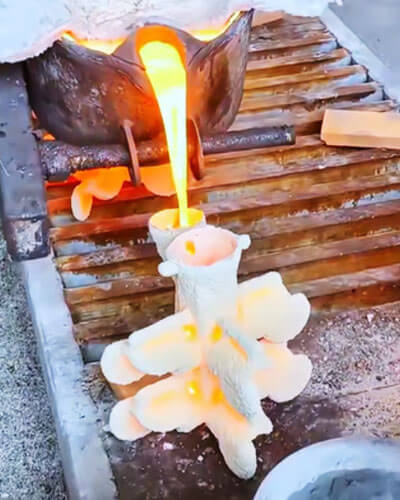
An ideal pouring process is one in which the operator or automated pouring system continuously maintains the sprue cup completely filled with molten metal throughout the entire pouring cycle—from the moment pouring begins until the mold cavity is fully filled.
Although simple in appearance, this principle reflects several fundamental concepts of casting fluid dynamics.
Maintaining a continuously full sprue cup establishes a stable hydrostatic head that drives molten metal smoothly through the sprue, bėgikas, ir vartai.
Instead of repeatedly accelerating and decelerating, the liquid metal flows under nearly constant pressure, producing a more predictable and uniform filling pattern.
A stable liquid level also prevents the formation of free-falling metal streams inside the sprue.
Whenever the sprue cup partially empties, molten metal falls vertically through air before entering the gating system.
This free-fall motion entrains air into the metal stream, dramatically increasing turbulence, oksidacija, ir dujų įstrigimas.
The resulting oxide films and bifilms can later become slag inclusions, pūtimo skylės, or fatigue crack initiation sites.
Another important advantage is that a calm, full sprue cup allows oxide films, slag particles, and floating impurities to remain on the molten metal surface instead of being drawn into the gating system.
As long as the liquid level remains stable, these contaminants are less likely to enter the mold cavity and become embedded within the casting.
Pouring Cannot Compensate for Poor Process Design
It is equally important to recognize the limitations of pouring control.
If the gating system is undersized and cannot accommodate the required metal flow rate, the sprue cup will inevitably overflow or pouring time will become excessively long.
Ir atvirkščiai, if the gating system is oversized, molten metal may drain too rapidly, preventing the sprue cup from remaining full and allowing air, šlakas, and mold debris to enter the system.
Panašiai, defects caused by inadequate mold permeability, prastas vėdinimas, insufficient coating quality, or improper gating geometry should not be interpreted as failures of the pouring operation.
These are engineering design issues that must be addressed independently.
The responsibility of pouring control is therefore not to correct deficiencies elsewhere in the casting process, but to provide the most stable, tęstinis, and controlled molten metal flow that the designed gating system is capable of handling.
Engineering Significance of Maintaining a Full Sprue Cup
Maintaining a continuously full sprue cup is far more than an operational guideline—it is the cornerstone of high-quality pouring practice.
This simple principle delivers multiple engineering benefits simultaneously:
- Establishes a stable hydrostatic head that promotes uniform mold filling.
- Minimizes turbulence and surface wave formation inside the gating system.
- Prevents air aspiration and reduces oxide film generation.
- Keeps floating slag and inclusions at the sprue cup surface instead of carrying them into the mold cavity.
- Produces more consistent filling velocity, improving dimensional accuracy and reducing flow-related defects.
- Enhances repeatability for both manual and automated pouring systems.
Galų gale, optimal pouring is not defined by how fast molten metal is transferred or whether every casting is defect-free.
Vietoj, it is defined by the ability to maintain a continuously full sprue cup and a stable, uninterrupted metal flow throughout the entire pouring operation, enabling the gating system to function under its intended hydraulic conditions.
This seemingly simple principle forms the foundation of modern casting technology and is one of the most effective ways to improve casting quality across virtually all foundry processes.
2. Common Casting Defects Caused by Improper Pouring
Pouring is the final operation before solidification begins, making it one of the most influential stages in determining casting quality.
During mold filling, molten metal undergoes rapid changes in velocity, spaudimas, temperatūra, and oxidation state.
Even when the melting process, pelėsių kokybė, and gating system are well designed, unstable pouring can disrupt the intended filling pattern and introduce defects that cannot be corrected during subsequent processing.
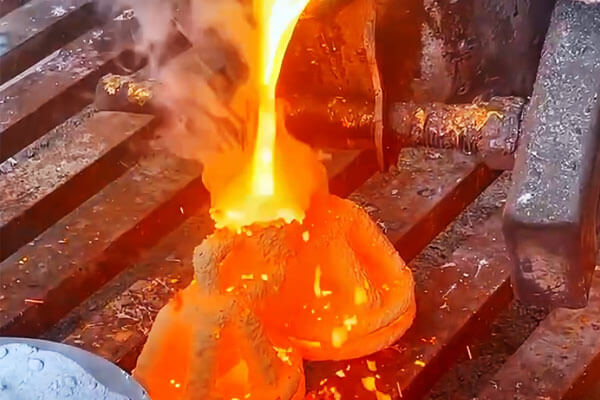
Iš inžinerinės perspektyvos, most pouring-related defects originate from one or more of the following mechanisms:
- Excessive turbulence during mold filling
- Air aspiration into the molten metal stream
- Oxide film generation and entrainment
- Inappropriate pouring temperature
- Improper pouring rate or interruptions
- Unstable liquid level in the sprue cup
- Excessive erosion of mold surfaces
- Premature solidification during filling
Each defect has its own formation mechanism, but many share the same root cause—loss of stable and controlled metal flow.
Slag Inclusions
Slag inclusion is among the most common defects associated with improper pouring.
It appears as non-metallic inclusions trapped within the casting and can significantly reduce mechanical strength, slėgio sandarumas, ir nuovargio gyvenimas.
Liejimo metu, the surface of molten metal is continuously exposed to oxygen.
If the pouring stream is interrupted or becomes turbulent, oxide films are repeatedly broken and folded into the liquid metal.
Surface slag floating in the ladle or pouring basin may also be drawn into the gating system when the sprue cup is not maintained at a full level.
Improper pouring can promote slag inclusions through several mechanisms. An excessively high pouring height increases turbulence and oxidation.
Repeated emptying of the sprue cup allows air and surface contaminants to enter the sprue.
Sudden changes in pouring rate disturb the liquid surface and carry slag into the runner system. Inadequate slag skimming before pouring further increases the likelihood of contamination.
Skirtingai nuo susitraukimo defektų, slag inclusions cannot be repaired by modifying riser design.
Preventing them depends primarily on maintaining a stable pouring stream, sumažinti turbulenciją, and ensuring that oxide films remain on the surface rather than being entrained into the casting.
Dujų poringumas
Gas porosity occurs when gases become trapped inside molten metal and cannot escape before solidification.
The resulting defects may appear as isolated spherical pores, clusters of blowholes, or dispersed microporosity.
Although dissolved hydrogen, mold moisture, and binder decomposition all contribute to gas generation, unstable pouring often provides the conditions that allow gases to become entrapped.
When the pouring stream breaks or falls freely through air, large quantities of air are mixed into the molten metal.
Turbulent flow further disperses these air pockets into fine bubbles that become increasingly difficult to remove before solidification.
If mold filling is excessively rapid, gases generated from coatings, filmai, or mold materials may also become trapped because they cannot escape through the mold quickly enough.
Proper pouring minimizes gas porosity by maintaining continuous metal flow, reducing turbulence, and providing sufficient time for gases to vent through the gating system and mold.
Sand Erosion and Sand Wash
Sand erosion, often referred to as sand wash, occurs when high-velocity molten metal damages the mold surface and carries loose sand particles into the casting cavity.
This defect is especially common near gates, bėgikai, and areas where the incoming metal directly impinges on the mold wall.
The severity of erosion depends not only on mold strength but also on the kinetic energy of the molten metal.
Excessively high pouring velocity, abrupt changes in flow direction, or localized jetting can rapidly destroy the mold surface before a solidified metal skin has time to form.
In V-Process casting, where dry unbonded sand is consolidated primarily by vacuum, excessive impact energy may also damage the refractory coating, exposing loose sand beneath it.
The resulting defects include rough casting surfaces, embedded sand inclusions, matmenų netikslumai, and reduced surface finish.
Metal Penetration and Burn-On
Metal penetration occurs when molten metal infiltrates the spaces between sand grains under high pressure or elevated temperature.
Burn-on develops when the metal reacts with the mold surface or mechanically bonds to sand particles, making cleaning difficult.
Although sand properties strongly influence these defects, pouring conditions often determine whether penetration actually occurs.
Excessive pouring temperature reduces metal viscosity and increases its ability to penetrate the mold surface.
High metallostatic pressure generated by unstable pouring or excessive head height further forces molten metal into the sand structure.
Turbulent filling may also locally destroy the protective coating layer, increasing direct contact between molten metal and the mold.
Maintaining appropriate pouring temperature and stable metal flow significantly reduces the risk of penetration-related defects.
Šaltas uždarymas
A cold shut is formed when two advancing streams of molten metal meet but fail to fuse into a continuous structure.
The defect typically appears as a smooth seam or thin crack on the casting surface.
Cold shuts indicate that the metal fronts have already begun to solidify before merging.
Improper pouring contributes to this defect when the pouring rate is too slow, the metal temperature is insufficient, or the pouring operation is interrupted.
Tokiomis sąlygomis, the first portion of molten metal loses heat rapidly while waiting for the remaining cavity to fill.
When the subsequent metal arrives, the two fronts cannot metallurgically bond.
Plonos sienos liejiniai, ilgi srauto takai, and alloys with limited fluidity are particularly susceptible.
Maintaining continuous pouring without interruption is one of the most effective methods for preventing cold shuts.
Misruns
A misrun occurs when molten metal solidifies before completely filling the mold cavity, leaving portions of the casting unformed.
Unlike cold shuts, which involve incomplete fusion between two metal fronts, misruns result from incomplete mold filling.
Pouring conditions play a decisive role in this defect. Metal that is poured too slowly loses temperature before reaching remote sections of the cavity.
Excessively low pouring temperature further reduces fluidity, while repeated interruptions allow localized solidification to begin before filling is complete.
Misruns frequently occur in thin sections, Sudėtingos geometrijos, and castings with long filling distances.
Stable pouring combined with appropriate pouring temperature is essential for complete mold filling.
Oxide Film (Bifilm) Defektai
Modern casting research has demonstrated that oxide films, commonly referred to as bifilms, are among the most detrimental internal defects in cast metals.
Whenever molten metal experiences turbulent folding, its oxidized surface can fold back onto itself, creating a double-layered oxide film with an unbonded interface.
These bifilms behave like pre-existing cracks embedded within the casting.
Improper pouring dramatically increases bifilm formation because unstable metal flow repeatedly folds the liquid surface.
Every interruption of the pouring stream, every splash inside the sprue, and every turbulent impact against the mold wall increases the probability of oxide entrainment.
Although bifilms are extremely thin and often invisible using conventional inspection methods, they significantly reduce fatigue strength, ausmingumas, lūžimo atsparumas, ir slėgio vientisumą.
Controlling turbulence during pouring is therefore one of the most effective strategies for improving long-term casting reliability.
Mold Splashing and Metal Splash Defects
Splashing occurs when molten metal strikes the mold cavity with excessive velocity or when gases generated during filling rapidly escape through the gating system.
Besides creating safety hazards, splashing introduces several quality problems.
The scattered droplets oxidize almost instantly, producing additional oxide films that may later become trapped within the casting.
Splashing also increases heat loss, contaminates mold surfaces with oxide particles, and may erode coatings around the gate area.
Sunkiais atvejais, splashing can damage the mold cavity, resulting in surface irregularities and localized inclusions.
Proper gating design, stable pouring velocity, and maintaining a continuously full sprue cup greatly reduce splashing tendencies.
Inclusion Chains Near the Parting Line
Certain castings, particularly those produced by the V-Process, occasionally exhibit chain-like inclusions distributed along the parting line or around regions where refractory coatings accumulate.
These defects often consist of a complex mixture of sand particles, dangos fragmentai, oksido plėvelės, and slag.
Their formation is closely related to both pouring conditions and mold preparation.
If thick coating deposits remain insufficiently dried, the decomposition products of the plastic film cannot escape efficiently during pouring.
As molten metal rapidly fills the cavity, partially decomposed film, dangos fragmentai, and sand particles may become wrapped together and encapsulated within the metal, forming characteristic chain-shaped inclusion defects.
Maintaining appropriate mold temperature, ensuring complete coating drying, optimizing venting, and avoiding excessive pouring turbulence are all essential for preventing this type of defect.
3. Pouring Equipment Selection and Its Influence on Casting Quality
Selecting the appropriate pouring equipment is just as important as designing the gating system.
Unfortunately, many foundries choose pouring machines based primarily on production speed or initial investment rather than considering casting type, molding line configuration, molten metal characteristics, and process stability.
An unsuitable pouring system can introduce excessive temperature loss, unstable flow rates, inconsistent pouring accuracy, and frequent casting defects.
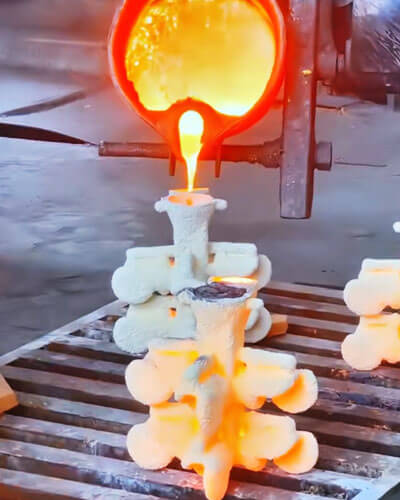
Horizontal Flask Molding Lines
For conventional horizontal flask molding lines with relatively low production rates, manual pouring or mechanically assisted ladle systems are often sufficient.
Tačiau, high-speed automatic molding lines require significantly greater process stability.
These production systems frequently experience temporary interruptions due to core setting, pelėsių tvarkymas, equipment maintenance, or downstream automation.
Under such conditions, the pouring equipment must maintain molten metal temperature without interrupting production.
For gray iron production, heated pressure pouring furnaces are generally considered the optimal solution because they:
- Maintain nearly constant metal temperature
- Provide precise pouring control
- Reduce oxidation
- Improve pouring repeatability
- Serve as thermal buffers during temporary production stops
- Improve casting consistency
Priešingai, non-heated ladle pouring systems may experience temperature losses of 5–8°C per minute, making them unsuitable for large, complex gray iron castings when production interruptions occur.
Ductile Iron Production
Kariuomenė geležis presents different challenges.
Because spheroidal graphite iron continuously generates oxide slag and magnesium gradually fades after treatment, prolonged holding inside heated pouring furnaces increases slag accumulation and maintenance requirements.
For many medium-volume ductile iron foundries, insulated non-heated pouring ladles are often preferred because:
- Metal is replenished every 8–10 minutes.
- Magnesium fading limits holding time regardless of furnace design.
- Slag removal is easier than in pressure pouring furnaces.
- Alloy changes are more flexible.
Nepaisant to, many advanced European and North American foundries still employ heated pressure pouring furnaces for high-quality ductile iron castings, accepting the additional maintenance in exchange for superior temperature stability, cleaner molten metal, and improved casting consistency.
4. Heated Pressure Pouring Furnaces: Coreless vs. Channel Type
Heated pressure pouring furnaces have become the preferred pouring solution for many modern automated foundries because they combine temperatūros valdymas, metal cleanliness, accurate dosing, and continuous production capability in a single system.
Unlike conventional ladle pouring, these furnaces maintain molten metal at a stable temperature while delivering metal through a pressurized siphon or riser tube, minimizing turbulence and oxidation throughout the pouring cycle.
Šiandien, heated pressure pouring furnaces are generally divided into channel-type (induction channel) ir coreless induction dizainas.
Although both employ pressure-assisted pouring and offer excellent process stability, their operating principles, techninės priežiūros reikalavimai, lankstumas, and economic performance differ significantly.
Selecting the appropriate furnace type should therefore be based on production volume, alloy variety, casting complexity, and plant operating strategy.
Advantages of Heated Pressure Pouring Furnaces
Regardless of furnace design, heated pressure pouring systems provide several important advantages over conventional pouring ladles.
The first advantage is excellent temperature stability.
Since the molten metal remains continuously heated, temperature fluctuations are minimal even during extended production runs or temporary interruptions.
Stable pouring temperature directly improves mold filling behavior, reduces cold shuts and misruns, and enhances dimensional consistency.
Antra, pressure pouring produces cleaner molten metal.
Eksploatacijos metu, slag and oxide films naturally float on the metal surface while clean metal is withdrawn through the submerged pouring tube.
Dėl to, the metal entering the gating system contains significantly fewer inclusions than metal poured from an open ladle.
Another major benefit is high pouring precision.
Modern pressure pouring furnaces integrate electronic weighing systems, laser positioning, and programmable pouring curves, enabling precise control of pouring weight, pouring rate, and pouring duration.
This is especially valuable for high-volume automated molding lines where repeatability directly affects casting yield.
Large furnace capacity also acts as an effective thermal buffer within the production line.
Because a considerable volume of molten metal is stored inside the furnace, short interruptions in molding operations rarely require immediate remelting or temperature correction, thereby improving overall production efficiency.
Channel-Type Heated Pressure Pouring Furnaces
Channel-type pressure pouring furnaces utilize an induction channel connected to the main molten metal bath.
The induction coil heats the metal circulating through the narrow channel, while electromagnetic circulation continuously transfers heat into the entire furnace.
This mature technology has been widely adopted in automotive foundries, engine block production, brake component manufacturing, and other large-scale casting operations where long-term continuous production is required.
Privalumai
The greatest strength of channel furnaces lies in their exceptional energy efficiency.
Because only the molten metal inside the induction channel is directly heated, electrical energy is utilized very efficiently, resulting in low operating costs during continuous production.
Another major advantage is excellent heat retention.
The large molten metal reservoir maintains highly stable temperatures with minimal fluctuations, making the furnace ideal for automated pouring systems operating around the clock.
The refractory lining also enjoys a relatively long service life.
Under stable production conditions, many channel furnaces can operate for two years or longer before requiring major refractory replacement, substantially reducing maintenance costs.
Their large holding capacity provides outstanding production buffering, and when nitrogen protection is employed, oxidation can be minimized while extending magnesium recovery during ductile iron production.
Apribojimai
Despite these advantages, channel furnaces are less flexible than other systems.
Because the induction channel must remain filled with molten metal, the furnace generally cannot be completely emptied during normal operation.
Todėl, changing alloy grades or switching between different casting materials is both time-consuming and expensive.
Continuous electrical power is also essential. Any prolonged power failure may damage the induction channel or cause metal solidification, meaning emergency backup power systems are often required for reliable operation.
These characteristics make channel furnaces most suitable for foundries producing large quantities of a single alloy over long production campaigns, where alloy changes are infrequent.
Coreless Heated Pressure Pouring Furnaces
Coreless pressure pouring furnaces represent a newer generation of heated pouring equipment.
Instead of relying on an induction channel, the entire molten metal bath is heated directly by a coreless induction system.
This design eliminates many of the operational restrictions associated with channel furnaces while retaining the fundamental advantages of pressure pouring.
Privalumai
The most significant benefit is production flexibility.
Since no induction channel must remain permanently filled, the furnace can be completely emptied whenever necessary.
Alloy changes become much simpler, making the system highly suitable for foundries producing multiple materials or small production batches.
Maintenance is also more convenient because the furnace can be cooled, emptied, and restarted without the operational constraints imposed by a permanent induction channel.
Coreless furnaces are therefore increasingly used in jobbing foundries, precision casting plants, and facilities that frequently switch between gray iron, Kariuomenė geležis, Nerūdijantis plienas, and alloy steel production.
Apribojimai
Greater flexibility comes with several trade-offs.
Coreless furnaces generally require higher residual metal volumes during operation to maintain stable electromagnetic heating efficiency.
Energy consumption is typically higher than that of channel furnaces, especially during continuous production, since the entire molten bath must be heated rather than only the induction channel.
Refractory wear is also more severe because the furnace experiences greater thermal cycling and direct electromagnetic stirring.
Todėl, lining service life is usually shorter than that of comparable channel furnaces.
Comparison Between Coreless and Channel-Type Furnaces
| Comparison Item | Channel-Type Pressure Furnace | Coreless Pressure Furnace |
| Heating principle | Induction channel heating | Direct coreless induction heating |
| Energijos efektyvumas | Puiku | Gerai |
| Temperature stability | Puiku | Puiku |
| Alloy change flexibility | Vargšas | Puiku |
| Emptying capability | Generally cannot be fully emptied | Can be completely emptied |
| Production mode | Continuous high-volume production | Lankstus, multi-alloy production |
| Refractory service life | Very long | Vidutinis |
| Maintenance complexity | Aukštesnis | Žemiau |
| Power interruption tolerance | Žemas | Aukštesnis |
| Tipiškos programos | Automobiliai, Variklio blokai, Stabdžių komponentai, masinės gamybos | Jobbing foundries, preciziniai liejiniai, multi-material production |
5. Engineering Strategies to Prevent Pouring Defects
Preventing pouring-related defects requires a systematic engineering approach rather than simply improving operator skills.
Modern foundries achieve high casting yields by integrating tirpimas, metalo apdorojimas, pouring technology, „Gating Design“, Pelėsių paruošimas, process monitoring, and equipment automation into a unified process control system.
Since pouring represents only one stage of the casting process, defect prevention should focus on maintaining stable molten metal flow while eliminating sources of turbulence, oksidacija, dujų įstrigimas, and temperature fluctuation.
Several engineering principles have proven particularly effective.
Pirma, pouring should always maintain a continuously full pouring basin.
A stable liquid level minimizes air aspiration, reduces oxidation, and ensures consistent metal flow throughout mold filling.
Antra, pouring temperature should be carefully matched to alloy characteristics, liejimo geometrija, sienos storis, and filling time.
Excessive temperatures increase oxidation and penetration, while insufficient temperatures promote cold shuts and misruns.
Trečia, pouring equipment should be selected according to the production line rather than treated as a universal solution.
High-speed automatic molding lines generally benefit from heated pressure pouring furnaces with precise temperature control, whereas conventional molding lines may achieve satisfactory performance with insulated ladles or mechanical pouring systems.
Equally important is proper ladle maintenance. Refractory wear, slag accumulation, and excessive heat loss all degrade pouring stability and should be monitored continuously.
Automation also plays an increasingly important role.
Modern pouring systems equipped with laser level sensing, thermal monitoring, and closed-loop control can maintain highly consistent pouring rates, improving repeatability while reducing dependence on operator experience.
Pagaliau, process optimization should consider the casting system as a whole. Pouring parameters, „Gating Design“, mold permeability, coating performance, and solidification behavior are interdependent.
Optimizing only one variable rarely eliminates defects unless the complete process is evaluated.
6. Išvada
Pouring is far more than the simple transfer of molten metal into a mold—it is the critical bridge between melting and solidification, where fluid dynamics, šilumos perdavimas, oksidacija, and metallurgical reactions converge.
Defects such as slag inclusions, dujų poringumas, smėlio erozija, klaidingai, Šaltas uždaromas, and oxide films often originate from unstable pouring conditions rather than from deficiencies in the molding process itself.
An ideal pouring operation maintains a continuously full pouring basin, delivers a smooth and uninterrupted metal stream, preserves consistent temperature, and minimizes turbulence throughout mold filling.
Achieving this requires more than skilled operators; it demands the proper selection of pouring equipment, scientifically designed gating systems, stable process parameters, and real-time control technologies.
As foundries continue to pursue higher productivity, tighter dimensional tolerances, and near-zero defect rates, pouring technology is evolving from a manual operation into an intelligent, data-driven manufacturing process.
Integrating automated pouring systems, tikslus temperatūros valdymas, optimized molten metal management, and systematic process engineering will not only reduce casting defects but also improve production efficiency, mažesnės išlaidos, and enhance the overall quality and reliability of cast components.

