I have spent most of my working life in precision casting shell rooms.
I have seen a shell that looked perfect in the drying room fail in the autoclave; I have seen a cheap sodium silicate shell save money on the quotation and lose it twice over in scrap.
And I have seen a well-controlled silica sol line turn out large stainless steel castings that customers barely had to touch after shot blasting.
For large stainless steel castings, the shell is not a peripheral consumable. It is the foundation of dimensional accuracy, kalidad ng ibabaw, and yield.
In China’s precision casting industry, four shell-making routes are widely used:
- A. Sodium silicate shell
- B. Composite shell
- C. Silica sol shell with low-temperature wax
- D. Silica sol shell with medium-temperature wax
The first three routes generally use low-temperature wax patterns. From a casting-quality standpoint, sodium silicate is the weakest; composite and silica sol–low-temperature wax are in the middle; silica sol–medium-temperature wax gives the best result.
From a shell-cost standpoint, sodium silicate is the cheapest, while silica sol–medium-temperature wax is the most expensive.
This article compares these four routes from the perspective of a foundry engineer—not a catalogue.
1. Why Shell Making Matters for Large Stainless Steel Castings
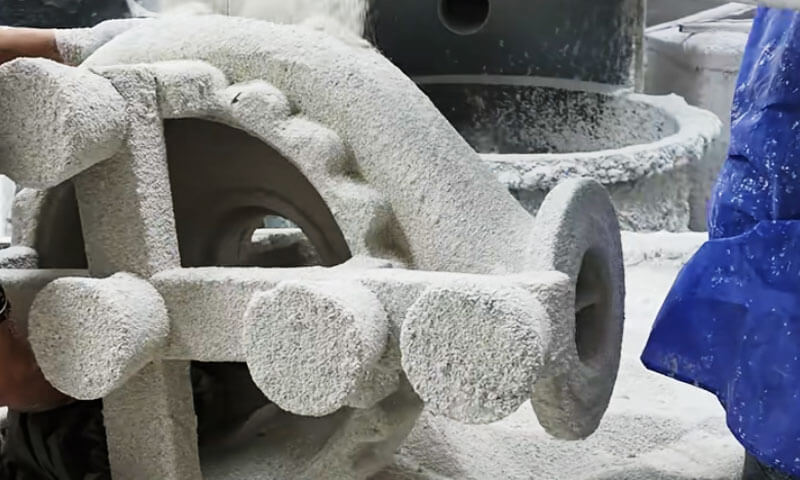
The ceramic shell serves as both the negative mold and the structural container for molten metal.
Its performance directly affects the surface quality, katumpakan ng sukat, panloob na kahusayan, and production yield of the finished casting.
For large stainless steel components, five shell characteristics deserve particular attention.

High-Temperature Strength and Creep Resistance
Stainless steel is generally poured at a relatively high temperature, depending on the alloy grade, Paghahagis ng Geometry, and foundry practice.
The ceramic shell must maintain sufficient mechanical strength during preheating, pagbubuhos ng, and solidification.
A shell with inadequate high-temperature strength may deform under the weight of the molten metal.
This can cause dimensional deviations, uneven wall thickness, local bulging, or distortion of critical machined surfaces.
Creep resistance is equally important. Ceramic shells experience sustained loading at elevated temperatures, and their deformation behavior can influence dimensional accuracy even when no immediate fracture occurs.
This is one reason silica-sol-bonded shells generally perform better than sodium silicate-bonded shells in demanding large-casting applications.
Permeability and Gas Evacuation
During pouring, air and other gases inside the mold cavity must escape as the molten metal fills the shell.
Kahalumigmigan, residual wax, and binder decomposition products can also contribute to gas-related defects.
If shell permeability is insufficient, gases may become trapped and cause porosity, blowholes, or incomplete filling.
Thin-walled sections, narrow passages, and complex impeller geometries are particularly sensitive to these conditions.
Permeability depends on several factors:
- Refractory particle size distribution and grain shape.
- Face-coat thickness and the number of shell layers.
- Binder content and the powder-to-liquid ratio.
- Drying and firing conditions.
- The presence of residual wax, kahalumigmigan, or other contaminants.
A high-quality shell must provide an appropriate balance between strength and gas permeability.
Increasing binder content or producing an excessively dense face coat may improve certain aspects of shell integrity while restricting gas evacuation.
Tapos na ang Ibabaw at Katumpakan ng Dimensyon
The face coat directly contacts the molten stainless steel and largely determines the as-cast surface condition.
Its refractory quality, particle distribution, wetting behavior, and resistance to metal-mold reactions influence surface roughness and defect formation.
For high-precision Mga Casting ng Pamumuhunan, surface roughness around Ra 0.8–4.3 μm and dimensional tolerance grades CT3–CT5 are cited in the original technical comparison for demanding applications.
These figures should be understood as process-dependent benchmarks rather than universal guarantees, particularly for large castings.
Medium-sized and large stainless steel castings with less demanding surface requirements may not justify the additional cost of a medium-temperature wax and silica-sol shell system.
Sa gayong mga kaso, low-temperature wax or composite-shell processes may offer better overall economics.
Thermal Shock Resistance and Shell Integrity
Large castings impose substantial thermal loads on the shell. Uneven heating, residual moisture, insufficient drying, rapid dewaxing, and inappropriate firing conditions can generate thermal stresses.
Shell cracking can lead to metal penetration, mga palikpik, Mga Depekto sa Dimensyon, or complete casting rejection.
For heavy components, repairing or replacing a failed shell also wastes considerable labor, enerhiya, and production time.
A robust shell-making process therefore requires controlled drying, uniform firing, suitable refractory materials, and a shell thickness matched to the casting’s mass and geometry.
Production Cost and Lead Time
The shell-making process affects more than the direct cost of ceramic materials.
It also determines labor requirements, equipment investment, pagkonsumo ng enerhiya, floor-space utilization, and the time needed to release a pattern assembly for pouring.
For a large impeller or valve body weighing tens of kilograms, a process that saves a small amount of refractory material but requires several additional days of drying may not be economical.
Sa kabilang banda, a premium shell system may be justified when its higher dimensional accuracy and lower rejection rate substantially reduce downstream machining and quality costs.
The most economical process is therefore the one that delivers the required casting quality at the lowest total manufacturing cost, not necessarily the one with the lowest shell material cost.
2. Overview of the Four Shell-Making Processes
The four processes differ primarily in binder chemistry, face-coat refractory materials, backup-shell construction, wax-pattern requirements, and production controls.
| Proseso | Binder system | Typical wax system | Main advantages | Main limitations |
| Sodium silicate shell | Sodium silicate | Low-temperature wax | Mababang gastos, short cycle, high permeability, relatively easy shell removal | Lower high-temperature strength, less stable quality, greater dimensional variation |
| Composite shell | Silica sol in face coats; sodium silicate in backup coats | Low-temperature wax | Better surface quality than conventional sodium silicate shells; relatively short production cycle | Backup-shell performance remains limited by sodium silicate |
Silica-sol shell with low-temperature wax |
Silica sol throughout the shell system | Low-temperature wax | Good shell strength, dimensional na katatagan, kalidad ng ibabaw, and adaptability to large castings | Higher cost and longer drying cycle |
| Silica-sol shell with medium-temperature wax | Silica sol throughout the shell system | Medium-temperature wax | Mataas na dimensional katumpakan, magandang tapusin ang ibabaw, low defect potential under controlled conditions | High wax and equipment costs; greater investment and operating requirements |
3. Sodium Silicate Shell: Cheap, Proven, But Quality-Limited
Sodium silicate shell making has a production history of nearly 60 mga taon in China. It still accounts for about 70% of Chinese precision casting factories.
That is not because it produces the best castings. It is because it is cheap, fast, and forgiving.
Sa paglipas ng mga dekada, improvements in back-up refractory materials and new hardeners have more than doubled shell strength.
Casting processability, katumpakan ng sukat, and yield have improved. Sodium silicate shells still hold a large market share and have replaced some overseas sand castings in batch export orders.
The advantages are real: mababang gastos, short production cycle, good knock-out behaviour, and high permeability. No other shell process matches sodium silicate on those points.
But casting quality—surface roughness, defect count, katumpakan ng sukat, ani, and failure rate—is worse than the other three routes.

The Core Problems
The fundamental weakness is the binder itself. Sodium silicate contains a high level of Na₂O.
Its high-temperature strength and creep resistance are far below those of silica sol shells—only about 1/30 sa 1/60 of silica sol.
Because of this, many foundries use low-cost, low-grade quartz sand and flour with poor particle-size grading for the back-up layers.
Hardeners are still largely limited to ammonium chloride. Under those conditions, high-quality precision castings are simply not achievable.
The second problem is process control. Shell production varies widely from batch to batch. Many workshops lack strict control of process parameters.
Hardener is corrosive, dust extraction equipment is often worn out, and few workshops have temperature-, humidity-, and dust-controlled environments.
Coating preparation, pagtigas ng ulo, pagpapatayo ng mga, and dewaxing are rarely controlled according to industry operating standards—viscosity, specific gravity, hardener concentration, and pH are not checked on schedule.
Drying-room temperature, kahalumigmigan, and air velocity are often uncontrolled. Bilang isang resulta, high- or low-temperature weather and humid seasons can produce batch scrap.
Sa madaling salita, many factories remain at the level of a manual workshop, relying on experience rather than scientific quality control.
That is a key reason sodium silicate castings have had unstable quality, high rejection rates, and high failure rates for decades.
Improvement Direction
Una, replace ordinary low-grade quartz sand flour with high-purity silica micro-powder, such as vein quartz.
Use a bimodal particle-size distribution of rounded quartz powder to prepare the face-coat slurry.
This improves the thermochemical stability of the face shell and allows a high powder-to-liquid ratio.
In one production example, with sodium silicate of modulus 3.4 at densidad 1.28 g/cm³, the powder-to-liquid ratio reached 2.7.
After wet ball milling, single-tank settling, magnetic separation, and deionised-water treatment, the rounded, bimodal, high-purity powder performed better than an artificially blended powder.
Second, improve on-site quality control and follow national standards. Separate the coating, stuccoing, and hardening areas from the shell drying room.
Control temperature and humidity in the former; improve dust removal and corrosion protection in the latter. This stabilises shell quality and improves the working environment.
Third, replace the first and second layers of calcite–sodium silicate shell with a calcite–silica sol face and transition layer, completely eliminating sodium silicate and ammonium chloride hardener from the face and transition layers.
Cost calculations showed the casting cost increased by only 0.46 yuan/kg, while the shell-making cycle remained comparable to that of a sodium silicate shell.
4. Silica Sol Shell with Low-Temperature Wax: The Pragmatic Middle Route
The silica sol–low-temperature wax route fits the Chinese market well.
It is especially adaptable for castings around 1 kg, and particularly around 5 kg and above—medium-heavy castings—where it offers greater flexibility and advantage than medium-temperature wax.
For most medium and large castings, pagkamagaspang ng ibabaw, katumpakan ng sukat, and tolerance requirements are not extremely high.
There is no need to use high-melting-point medium-temperature wax. Medium-temperature wax requires high-pressure wax injection—above 6–7 MPa—or liquid wax injection.
That means large equipment investment. Makapal, heavy medium-temperature wax patterns are prone to shrinkage, pagpapapangit, and higher cost.
Low-temperature wax is easy to form, requires simple equipment, and the wax pattern roughness difference is not large.
Compared with composite shells, this route gives more stable quality, especially dimensional accuracy. It contains no sodium silicate, so the shell has good high-temperature properties.
After sintering at about 1,500°C, the shell has high permeability and strong creep resistance.
It can be used for thin-wall parts and complex medium-large parts, and also for heavy parts up to 60–100 kg—pump casings, mga impeller, water deflector shells, Mga Katawan ng Bomba, mga katawan ng balbula, and similar components.
For thick-wall medium-large or heavy parts, fork-shell or lift-shell pouring directly in front of the furnace can achieve high yield.
Problems
Una, because low-temperature wax is used, most shells are dewaxed in water.
Saponified residue inevitably enters the shell—especially when composite and sodium silicate shells are dewaxed in the same water tank—causing surface inclusions and a slightly higher failure rate. This is the main weakness.
Second, the long shell-making cycle is the biggest drawback. For heavy parts with deep holes or deep grooves, each layer may need 24–47 hours of drying.
A 60 kg dual-channel impeller madalas na nangangailangan 10–15 days of shell making. Any undried blind zone can cause silica sol re-dissolution during water dewaxing and lead to shell cracks.
Third, the cost is about 5 times that of a sodium silicate shell—about 6,000 yuan per tonne of castings for shell making—and 18% mas mataas than a composite shell. Casting cost is therefore relatively high.
Improvement Direction
To avoid saponified inclusions from incompletely processed low-temperature wax and from sharing the same hot-water tank with composite or sodium silicate shells, gamitin ang steam dewaxing ha 0.3–0.5 MPa at 130–140°C instead of water dewaxing.
This avoids saponification inclusions and shell cracking.
If hot-water dewaxing is used, idagdag ang 1–3% by volume industrial hydrochloric acid to the water, and after dewaxing rinse the shells with acid-containing hot water to reduce saponified residue.
Do not share the same tank with sodium silicate or composite shells. Change the water or dewax separately to reduce saponified matter entering the shell.
For reclaimed wax treatment, gamitin ang 3–5% by volume sulfuric acid in the boiling water, with sufficient boiling and settling time.
In winter, hard water temperature is low, sodium silicate and composite shells contain more Na₂O, and wax saponification is more serious.
Add more sulfuric acid to the reclaimed wax. After wax treatment, immediate addition of polyether is also important.
To shorten the shell-making cycle, gamitin ang quick-dry silica sol. This process is maturing. Drying time for each layer can be reduced by about half.
For large parts, each layer except the final layer needs only about 3 mga oras. Shell-making time can drop from 62 hours to 24 mga oras.
For medium-heavy parts, the reduction is about 60% compared with conventional silica sol.
The market price is only 20–30% higher, and that premium can be recovered through reduced floor space, heat consumption, and higher yield. Quick-dry silica sol is an inevitable direction for silica sol shell reform.
To reduce cost, the most effective route is to replace zircon with fused quartz or synthetic quartz for the face-coat refractory. Zircon accounts for about 65% of total silica sol shell cost.
Replacing zircon with calcite or quartz reduced shell cost from 6,000 yuan/t casting to 2,210 yuan/t, a 55.8% pagbabawas. For medium-heavy parts, fused quartz sand/flour is gradually replacing zircon sand/flour.
5. Silica Sol Shell with Medium-Temperature Wax: The Quality Benchmark
Silica sol–medium-temperature wax is the internationally common precision casting route. It gives the best casting quality and the lowest failure rate.
It is especially suitable for medium-large and extra-large parts requiring high surface roughness—Ra 0.8–4.3—and high dimensional accuracy—CT3–CT5.
Because of equipment and cost limits, gayunpaman, it is rarely used for medium-heavy parts in the 5–100 kg saklaw.

Problems
Una, gastos. Shell cost is about 8 times that of sodium silicate, and about 20% mas mataas than low-temperature wax–silica sol.
The main reasons are higher shell and wax material costs, much higher equipment power consumption, and higher equipment investment.
Second, the production cycle is similar to low-temperature wax–silica sol and much longer than sodium silicate or composite shells.
Third, para sa 5–60 kg medium-heavy castings, medium-temperature liquid wax at 63–75°C and high injection pressure of about 7.1–8.0 MPa ay kailangan.
Thin-wall wax patterns are prone to shrinkage. Dimensional accuracy is not especially high.
Since medium-heavy parts do not require the same dimensional accuracy and roughness as large parts, silica sol–medium-temperature wax is rarely selected for them.
Improvement Direction
To control cost while maintaining quality, after solving the poor wettability of calcite with medium-temperature wax, replacing zircon with synthetic quartz or fused quartz is clearly the direction.
Fused quartz has a linear expansion coefficient of only 5 × 10⁻⁷/°C, and its price is only 1/6 that of zircon. Overseas, fused quartz is gradually expanding in application.
Quick-dry silica sol to shorten the shell cycle is a common direction in the industry.
Developing domestic medium-temperature wax or improving paraffin–polyether low-temperature wax is an important task.
The key is to solve the reclaimed-wax treatment problem so that wax properties remain stable in production.
6. Composite Shell: A Compromise, Not a Final Answer
To overcome the weaknesses of sodium silicate shells, many factories now use zircon and mullite–silica sol for the first and second layers, while keeping the original sodium silicate process for the back-up layers.
This is a compromise that combines the good processability of silica sol with the low cost and short cycle of sodium silicate.
Compared with sodium silicate shells, composite shells improve casting processability considerably: lower roughness, fewer surface defects, and lower failure rate.
They can be used for stainless steel, heat-resistant steel, and other high-alloy steels. The production cycle is much shorter than low-temperature wax–silica sol and similar to sodium silicate.
Key Problems
Una, because the back-up layers retain sodium silicate binder, the overall high-temperature strength and creep resistance of the shell are lower than those of a silica sol shell.
The shell sintering temperature is limited to below 960°C. Sa itaas 800°C, shell deformation increases by 30%.
A silica sol shell can be sintered up to about 1,500°C and does not deform before that temperature.
Kaya nga, the dimensional accuracy of composite-shell castings, including tolerances, is inferior to silica sol shells.
When pouring large castings around 10 kg, additional silica sol layers—usually at least 2 more layers—are needed to obtain high-temperature strength and prevent deformation.
Second, the first two layers are the main factor affecting shell permeability. Changing from sodium silicate to silica sol sharply reduces overall shell permeability.
When sintering temperature is low and holding time is insufficient, gas porosity, Mga Pagkakamali, and cold shuts often occur.
Composite shells are therefore difficult to use for thin-wall parts δ ≤ 3 mm, large parts, and extra-large parts below about 60 kg.
Because high-temperature strength is lower than silica sol, scrap can result. Sa madaling salita, composite-shell permeability is lower than both sodium silicate and silica sol shells.
Third, composite-shell quality is more stable than sodium silicate but less stable than silica sol. The back-up layers still contain sodium silicate binder.
To control cost, many factories still use low-cost, unstable refractories such as clay and granular sand. Process control is similar to sodium silicate, so quality stability is poor.
For heavy parts around 10 kg and large parts below 1 kg, rejection and failure rates are higher than with silica sol shells.
Fourth, because composite shells use expensive zircon for the face coat, shell cost is 6.3 times that of sodium silicate.
If mullite sand/flour is used for the back-up layers, the shell cost is nearly the same as silica sol—only about 1 yuan/kg casting pagkakaiba. The low-cost advantage is not significant.
Fifth, composite shells cannot use medium-temperature wax. Medium-temperature wax cannot be dewaxed in hot water.
In an autoclave at 171°C at 0.6 MPa, medium-temperature damar resin reacts strongly with sodium silicate and residual hardener in the back-up layers, forming a white sticky saponified substance that cannot be recycled without treatment.
Silica sol shells can use both low- and medium-temperature wax without this problem.
Sa buod, the composite shell is an improvement over sodium silicate. It is better in casting processability, ani, and failure rate, but it is still fundamentally different from a silica sol shell.
Apart from a shorter production cycle and slightly lower shell cost, its casting quality and reliability are inferior to silica sol.
Improvement Direction
Una, replace zircon sand with calcite for the face-coat refractory. Casting processability does not depend entirely on the face-coat refractory; it is closely related to the binder and also to the wax pattern—wax pattern roughness and saponified residue.
Composite shells can only use low-temperature wax and are mostly used for precision castings with medium roughness—Ra 6.3–11.5—and lower dimensional accuracy—CT4–CT6.
Production experience shows that replacing zircon–silica sol with calcite–silica sol for the face coat is entirely feasible.
This reduces shell cost from 4,150–4,830 yuan/t casting to 1,360 yuan/t, only 460 yuan more than sodium silicate.
Second, improve quality control and the environment for shell making, especially the back-up layers.
Third, the back-up layers should use stable, high-temperature-capable, relatively cheap refractories with moisture content compatible with the face coat.
Two common back-up materials are recommended. One is refractory clay–quartz powder coating at 60%/40%, stuccoed with granular sand made from crushed corundum brick waste and related refractory brick waste.
It is widely available, cheap, and gives higher high-temperature strength and creep resistance than mullite or bauxite, at only 1/2–1/3 the price of bauxite.
It suits zircon or synthetic quartz face coats. The second is refractory clay–granular powder coating at a volume ratio of 3:7, stuccoed with granular sand.
This option suits only zircon composite shells. Some factories use mullite sand/flour or bauxite for composite back-up layers.
Coating properties are stable, the shell is thin and easy to sinter, but the cost is too high and high-temperature properties are inferior to the two options above. Bauxite has poor knock-out behaviour.
Materials made from crushed waste porcelain, glazed tile, or floor tile are cheap, but they are not fired at high temperature, have complex composition, show a strong tendency to crack at high temperature, have lower refractoriness, and are difficult to knock out after pouring—especially for heavy parts. They are not recommended.
7. Future Development Trends in Shell Making for Large Stainless Steel Castings
The development of shell-making technology is increasingly focused on improving casting quality while reducing production cost, cycle time, at epekto sa kapaligiran.
Wider Use of Silica-Sol Binders
Silica-sol systems offer a strong technical foundation for high-quality investment casting because of their favorable shell properties and potential for stable production.
Their broader adoption depends on reducing the disadvantages associated with material costs and drying time.
Fast-drying silica sol, optimized shell construction, and more economical refractory systems can help close this gap.
Refractory Optimization
Replacing expensive zircon with qualified synthetic silica or fused silica can reduce material costs, but substitutions must preserve chemical compatibility and surface quality.
Future process development should focus on the entire face-coat system, including binder chemistry, powder loading, grain-size distribution, wetting behavior, and drying stability.
Optimizing these variables together is more effective than reducing refractory cost in isolation.
Faster and More Consistent Drying
Fast-drying binders, improved airflow management, controlled humidity, and better workshop environmental monitoring can reduce shell-making cycle times.
The objective is not simply to dry each layer as quickly as possible. It is to achieve sufficient strength and dimensional stability with minimum waiting time and acceptable process variation.
Data-Driven Process Control
Modern foundries can improve consistency by recording slurry properties, drying conditions, shell-layer counts, dewaxing parameters, firing profiles, and casting-inspection results.
Analyzing these records helps identify the process conditions associated with shell cracks, dimensional deviations, and surface defects.
Sa paglipas ng panahon, this enables more reliable operating windows and reduces dependence on individual operators’ experience.
Total-Cost Manufacturing
The long-term trend is toward evaluating shell-making processes by the cost of producing accepted castings rather than by shell materials alone.
A process that reduces rejection, machining allowances, and delivery delays may offer a better commercial result even when its initial material cost is higher.
This is particularly important for large stainless steel castings, where each rejected component can represent a substantial loss.
8. Pangwakas na Salita
The four major shell-making processes used in investment casting—sodium silicate shells, composite shells, silica-sol shells with low-temperature wax, and silica-sol shells with medium-temperature wax—each offer different advantages in terms of casting quality, gastos, and production cycle.
For large stainless steel castings, the most effective improvements are to strengthen process control, optimize face-coat refractories, adopt validated fast-drying silica-sol systems, improve wax recovery, and select shell construction according to casting geometry and production volume.
Sa huli, the best shell-making process is not necessarily the cheapest or the most sophisticated.
It is the process that consistently produces castings meeting the required quality standards at the lowest total manufacturing cost.
For foundries seeking better quality and more stable production, the combination of suitable silica-sol technology, qualified refractory materials, controlled drying, and data-driven process management offers a practical path toward higher-yield investment casting.
Mga FAQ
Which shell-making process gives the best quality for large stainless steel castings?
Silica sol shell with medium-temperature wax gives the best casting quality, katumpakan ng sukat, and lowest failure rate.
Silica sol with low-temperature wax is a practical alternative for medium-heavy parts.
Why is sodium silicate still used if its quality is lower?
Sodium silicate is cheap, has a short production cycle, good knock-out behaviour, and high permeability. It remains economically attractive for less demanding castings.
Why can’t composite shells use medium-temperature wax?
In autoclave dewaxing at 171°C and 0.6 MPa, medium-temperature damar resin reacts with sodium silicate and residual hardener in the back-up layers, forming a sticky saponified substance that cannot be recycled without treatment.
What is the future direction for large stainless steel casting shells?
Silica sol shells—especially with low-cost face-coat refractories and quick-dry binders—will gradually replace sodium silicate and composite shells as quality requirements rise.