Sa mga pamumuhunan paghahagis shop, wax is not just a consumable. It is the foundation of dimensional accuracy, tapos sa ibabaw, and yield.
I have seen a low-temp wax pattern collapse in a hot workshop, and I have seen a medium-temp wax pattern deliver thousands of precision parts with barely a reject.
The difference is not marketing. It is chemistry, Kontrol sa Proseso, and knowing which tool to use for which job.
The terms “low-temperature wax” and “medium-temperature wax” are old workshop names.
Strictly speaking, they refer to pattern materials classified by thermal stability and melting point.
Ngayon, the family includes wax-based, rosin-based, plastic-based, water-soluble, and filled pattern materials, plus new additive-manufacturing waxes.
But the old split between low-temp and medium-temp wax remains one of the most practical distinctions on the foundry floor.
This article explains that distinction from a process engineer’s point of view, preserves the key data, and gives you a clear framework for choosing between them.
1. How Do We Classify Pattern Materials?
Sa paghahagis ng pamumuhunan, pattern materials are commonly classified using two methods: thermal stability and melting point, or base material composition.
Classification by thermal stability and melting pointdivides pattern materials into low-, Katamtaman, and high-temperature categories.
Low-temperature materials generally have melting points below 70°C, medium-temperature materials fall within 70–100°C, and high-temperature materials have melting points above 100°C.
This is the classification most commonly used when foundry engineers discuss low-temperature and medium-temperature wax.
Classification by base material compositionincludes wax-based, rosin-based, plastic-based, water-soluble, and filled pattern materials.
Modern investment casting also uses rapid-prototyping materials designed for additive manufacturing.
Although technical references may group these categories differently, the underlying principle is to distinguish materials according to their primary constituents and processing characteristics.
For this article, we focus on the first classification: low-temperature and medium-temperature wax, with high-temperature wax mentioned for context.
| Pag-uuri | Typical Melting Point | Thermal katatagan (Reference) | Typical Shell System Compatibility | Typical Forming Method | Magagamit muli |
| Low-temperature pattern materyal na bagay | Below 70°C | Medyo mababa ang (about 30°C) | Sodium silicate | Paste forming, manual or simple molding methods | Sa pangkalahatan ay mataas |
| Medium-temperature pattern materyal na bagay | 70-100 ° C | Better (about 35°C) | Silica sol | Liquid-state injection using a wax injection machine | Sa pangkalahatan ay mabuti |
| High-temperature pattern materyal na bagay | Above 100°C | Sa pangkalahatan ay mataas | Silica sol or specialized shell systems | Specialized forming and removal processes | Generally limited; formulation-dependent |
Tala: The temperature values for thermal stability are traditional reference figures, not universal operating limits.
Actual performance depends on material formulation and process conditions. Shell compatibility and reusability must also be verified for the specific material and production system.
In traditional investment casting, a common rule of thumb is that low-temperature pattern materials are often used with sodium silicate shell systems, while medium-temperature materials are commonly paired with silica-sol shells.
This is a useful starting point, but the final selection should account for pattern geometry, dimensional requirements, shell properties, and dewaxing conditions.
3. Low-Temperature Wax in Investment Casting
Composition and Basic Properties
Low-temperature pattern materials generally have melting points below 70°C.
A traditional example used in some investment casting operations consists of 50% paraffin wax and 50% stearic acid.
This formulation illustrates the characteristics of conventional low-temperature materials, although actual industrial formulations vary by manufacturer and application.
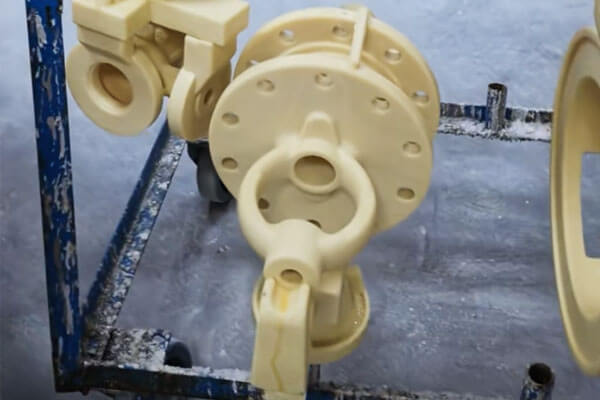
The principal characteristics include:
- Relatively low strength and limited resistance to deformation.
- Lower thermal stability, with approximately 30°C cited as a representative temperature level in traditional descriptions.
- Relatively high shrinkage and greater dimensional sensitivity to changes in room temperature.
- A comparatively coarse pattern surface finish under traditional processing conditions.
- Simple preparation and relatively low material cost.
- Good potential for recovery and reuse when collection, filtration, and quality-control procedures are properly managed.
The cited 30°C value should be understood as a traditional reference for thermal stability, not as a universal maximum service temperature.
Actual deformation can begin at different temperatures depending on formulation, pattern geometry, pag-load, at oras ng pagkakalantad.
Pattern Manufacturing Process
Traditional low-temperature materials are often prepared in a paste-like or semi-solid condition and formed using relatively simple equipment or manual methods.
Depending on the formulation and production system, patterns may be pressed into dies, formed through specialized tooling, or produced using other low-temperature molding techniques.
Compared with medium-temperature injection systems, traditional low-temperature processes may require less complex equipment.
This can reduce initial investment and make them practical for foundries with relatively simple pattern geometries and cost-sensitive production requirements.
Gayunpaman, the lower strength and thermal stability of these materials create limitations.
Manipis na mga seksyon, long unsupported features, and intricate details can be more susceptible to deformation during pattern handling and assembly.
Dimensional changes may also occur if patterns experience inconsistent storage temperatures or prolonged exposure to warm environments.
For the foundry engineer, this means that pattern design, storage conditions, and handling procedures must compensate for the material’s limitations.
Compatibility with Shell Systems and Dewaxing
Low-temperature pattern materials have traditionally been used with water-glass, or sodium silicate, bonded shell systems.
Water-glass shell systems are attractive because of their relatively low cost and straightforward production requirements. Low-temperature patterns can be compatible with these systems when the pattern formulation and shell-building process are properly matched.
Dewaxing may be carried out using hot water or other suitable methods, depending on the pattern material and shell system. The exact procedure must account for shell strength, pattern volume, pagpapalawak ng thermal, and the risk of cracking during pattern removal.
Where It Fails
The weakness is thermal stability. At about 30°C thermal katatagan, a low-temp wax pattern can soften or distort in a warm inspection room, during transport, or in a non-air-conditioned workshop. Shrinkage is large, so dimensional consistency is poor. Surface roughness is coarse, which limits the final casting finish. Thin fins and sharp edges are difficult to hold.
From experience: if your workshop temperature is not controlled, low-temp wax will punish you in summer. You will see pattern distortion, dimensional drift, and higher scrap. It is not the wax’s fault. It is the process environment.
4. Medium-Temperature Wax in Investment Casting
Composition and Basic Properties
Medium-temperature pattern materials generally have melting points between 70°C and 100°C. Common types include rosin-wax-based materials and filled pattern materials.
Compared with traditional low-temperature formulations, medium-temperature materials generally offer higher strength, better thermal stability, lower shrinkage, and improved dimensional consistency.

Their typical characteristics include:
- Higher mechanical strength and better resistance to pattern deformation.
- Improved thermal stability, with approximately 35°C cited as a representative reference level in traditional descriptions.
- Lower shrinkage and better dimensional stability.
- Finer pattern surface finish when processed under suitable conditions.
- Good replication of intricate die features.
- Compatibility with liquid-state injection molding and automated pattern production.
As with the 30°C figure for low-temperature materials, the cited 35°C value is a traditional reference rather than a universal material rating. The actual usable temperature range depends on the formulation, softening behavior, loading conditions, and required dimensional accuracy.
Injection Molding and Pattern Accuracy
Medium-temperature materials are commonly processed using wax injection machines. The material is heated to an appropriate processing condition, injected into a precision die, and allowed to cool sufficiently before the pattern is removed.
This process supports repeatable production and is particularly valuable when the casting requires complex geometry, consistent wall thickness, fine surface details, or accurate dimensional control.
From a production engineer’s perspective, one of the key advantages of medium-temperature materials is their ability to reproduce die geometry while maintaining adequate strength during pattern handling and assembly.
Gayunpaman, good pattern accuracy cannot be attributed to the material alone. Injection pressure, material temperature, die temperature, cooling time, gating design, and pattern removal technique all influence the final result. Improper process settings can still cause shrinkage variation, pahina ng digmaan, mga depekto sa ibabaw, or dimensional inconsistency.
Compatibility with Silica-Sol Shell Systems
Medium-temperature pattern materials are frequently used with silica-sol bonded ceramic shell systems. Silica-sol shells are widely applied when castings require good surface finish, katumpakan ng sukat, and reliable shell properties.
The pattern material and shell system must be compatible throughout the production cycle. During shell building, the pattern must maintain its shape while the ceramic slurry is applied and the shell dries. During dewaxing, the pattern must be removed without causing excessive stress or cracking in the ceramic shell.
Depending on the material formulation and foundry equipment, dewaxing may use hot water, steam, or microwave-based systems. Not every medium-temperature formulation is suitable for every removal method, so the process must follow the material supplier’s recommendations and the foundry’s validated operating parameters.
The Cost Side
Medium-temp wax is more expensive than low-temp wax. The pattern material itself costs more, the wax injector requires capital investment, and the process control is more demanding. But the total cost picture is often better because of higher yield, lower scrap, and fewer downstream problems.
I have seen projects switch from low-temp to medium-temp wax and reduce pattern-related scrap by more than half. The wax cost went up; the total cost went down.
4. High-Temperature Wax: A Brief Note for Context
High-temperature wax has a melting point above 100°C. The main families are rosin–plastic, plastik na plastik, and salt-based pattern materials. They offer high strength, good thermal stability, and low shrinkage, but the production process is complex, the material is generally not reusable, and dewaxing requires flash firing, tubig, or organic solvents. Cost is high.
Water-soluble pattern materials and 3D-printing pattern materials also fall into this broad high-temperature category in practice. One classic textbook note is important: high-temperature pattern materials have large thermal expansion, and during dewaxing the shell can crack because of insufficient strength. That is a real risk, not a theoretical one.
For most large stainless steel castings, medium-temp wax is the practical quality benchmark. High-temp wax is for special cases.
5. Low-Temperature vs. Medium-Temperature Wax: Mga Pangunahing Pagkakaiba
The fundamental difference between the two categories is not simply the temperature at which they melt.
It is the way their mechanical and thermal properties affect pattern production and the subsequent investment casting process.
Side-by-Side Comparison
| Comparison criterion | Low-temperature pattern material | Medium-temperature pattern material |
| Typical melting-point range | Below 70°C | 70-100 ° C |
| Representative traditional formulation | 50% paraffin wax + 50% stearic acid | Rosin-wax-based or filled formulations |
| Lakas ng loob | Medyo mababa ang | Generally higher |
| Thermal katatagan | Mas mababa; approximately 30°C cited in traditional descriptions | Better; approximately 35°C cited in traditional descriptions |
| Pag urong | Relatively high | Medyo mababa ang |
| Dimensional stability | More sensitive to ambient temperature | Generally more stable |
| Tapos na ang ibabaw | Relatively coarse in traditional processes | Finer finish achievable with controlled injection |
| Pattern production | May use simple forming or pressing methods | Commonly uses controlled injection molding |
Equipment requirements |
Often relatively simple | Typically requires injection equipment and tighter process control |
| Material recovery | Often economical and practical | Possible, but depends on formulation and recovery controls |
| Relative cost | Generally lower | Generally higher |
| Common shell system | Water-glass bonded shell | Silica-sol bonded shell |
| Typical application emphasis | Cost-sensitive and relatively simple castings | Precision castings with complex features or tighter tolerances |
These are general tendencies, not absolute rules. Modern formulations can differ substantially, and material selection should be based on measured properties, supplier data, and production trials rather than the category name alone.
Strength and Resistance to Deformation
Pattern strength affects whether a wax assembly can withstand handling, gating, shell building, and transfer between production stages without losing its intended geometry.
Low-temperature materials have relatively low strength, so thin walls, long projections, and unsupported details require careful handling.
Medium-temperature materials generally provide better resistance to deformation, making them more suitable for intricate patterns and repeatable production.
Gayunpaman, a stronger pattern is not automatically a better pattern.
Excessive stiffness, unsuitable shrinkage behavior, or poor die release can introduce other manufacturing problems. The complete material formulation must be matched to the pattern design.
Thermal Stability and Dimensional Consistency
Investment casting patterns may experience temperature changes during storage, assembly, shell building, at paghawak.
If the pattern material is sensitive to temperature, dimensional changes can affect the finished casting.
Low-temperature materials generally show greater sensitivity to ambient conditions.
Medium-temperature materials tend to provide better dimensional stability, although their actual performance still depends on formulation, storage conditions, and process control.
For components with tight dimensional tolerances, dimensional stability should be assessed through pattern measurement and process capability studies rather than inferred solely from melting-point classification.
Surface Finish and Detail Replication
The surface quality of the pattern is one factor influencing the surface quality of the ceramic shell and, sa huli, the casting.
Medium-temperature materials processed by controlled injection can reproduce fine die details and achieve a relatively smooth pattern surface.
This is particularly valuable for stainless steel investment castings with complex contours, functional surfaces, and limited machining allowances.
Low-temperature materials can still produce satisfactory patterns for many applications, but traditional forming methods and less stable pattern geometry may limit the achievable consistency of fine details.
It is also important to recognize that the final casting surface depends on the entire process chain, including die condition, slurry preparation, refractory particle size, shell drying, firing, pagbubuhos ng, and post-casting cleaning.
6. How Wax Selection Affects Investment Casting Quality
Selecting a pattern material is an upstream decision with consequences throughout the production process.
An unsuitable formulation can increase defects, reduce yield, and create additional machining or finishing work.
Pattern Shrinkage and Casting Dimensions
Pattern shrinkage affects the dimensions transferred from the die to the pattern and eventually to the casting.
Low-temperature materials generally exhibit higher shrinkage and greater sensitivity to temperature variation, so their dimensional behavior must be carefully controlled.
Medium-temperature materials generally provide lower shrinkage and better dimensional stability.
Gayunpaman, foundries must still account for die dimensions, pattern shrinkage, shell behavior, alloy solidification shrinkage, and subsequent heat treatment or machining.
Practical recommendation: For precision components, establish dimensional compensation using measured production data. Do not rely on a generic shrinkage allowance without verifying the complete process.
Pattern Deformation and Shell Cracking
A pattern that deforms during handling or shell building can produce dimensional errors and inconsistent shell thickness.
During dewaxing, thermal expansion and the removal characteristics of the pattern material can also influence the stresses imposed on the ceramic shell.
The relationship is not simply that a higher-melting material always causes greater or lower shell stress.
Pattern expansion, paglambot, paagusan ng tubig, shell strength, heating rate, and dewaxing method all play a role.
To reduce risk, foundries should:
- Control pattern storage temperature and handling procedures.
- Avoid unnecessary loading on thin or unsupported pattern features.
- Optimize shell drying and ensure adequate shell strength before dewaxing.
- Validate dewaxing temperature, presyon, and heating rate for the selected material.
- Inspect shells for cracks and other defects before pouring.
Surface Defects and Machining Allowances
Pattern surface roughness and defects can be transferred to the shell and casting.
Medium-temperature materials may help achieve a finer pattern surface, but they cannot compensate for damaged dies, poor slurry preparation, or inadequate shell drying.
For investment castings requiring high surface quality, the foundry should manage pattern quality, ceramic shell preparation, and pouring conditions as one integrated system.
Machining allowances should be determined according to functional requirements and process capability, rather than used as a substitute for controlling upstream defects.
7. Practical Shop-Floor Notes
Control the workshop temperature.
Low-temp wax at 30°C thermal stability is sensitive to summer heat.
Medium-temp wax at 35°C is better but not immune. Air conditioning or controlled storage is not a luxury; it is part of the process.
Do not mix wax systems.
Low-temp and medium-temp waxes have different recovery and dewaxing requirements. Cross-contamination causes saponification, mga inclusions, and shell defects. Keep them separate.
Treat reclaimed wax seriously.
Medium-temp wax recovery requires proper settling, filtration, and acid treatment. Poorly treated reclaimed wax is a hidden source of pattern defects.
Match wax to shell, not just to the drawing.
A medium-temp wax pattern in a sodium silicate shell is a mismatch. A low-temp wax pattern in a silica sol shell is also a mismatch. The wax–binder pair is a system.
Validate with a trial.
Before committing a production run, mold a sample pattern, measure it, store it, shell it, and pour it. Data beats opinion.
8. Pangwakas na Salita
Low-temperature and medium-temperature pattern materials differ in their melting-point ranges, lakas ng loob, thermal katatagan, pag urong, tapos sa ibabaw, and processing requirements.
Low-temperature materials, typically below 70°C, offer low cost, relatively simple production, and good recovery potential.
Medium-temperature materials, generally between 70°C and 100°C, provide higher strength, better dimensional stability, lower shrinkage, and finer pattern replication under suitable injection conditions.
The old engineer’s rule still holds: match the wax to the shell, the casting requirement, and the workshop environment.
Do that, and the wax will do its job. Ignore it, and no amount of process tweaking will save the run.
Mga FAQ
What is the main difference between low-temp and medium-temp wax?
Low-temp wax melts below 70°C and has poor thermal stability (about 30°C).
Medium-temp wax melts at 70–100°C and has better thermal stability (about 35°C), mas mataas na lakas, and finer surface reproduction.
Why is medium-temp wax more expensive?
The pattern material costs more, the wax injector requires capital investment, and process control is more demanding. Gayunpaman, higher yield and lower scrap often offset the cost.
Can medium-temp wax be reclaimed?
Oo nga, but recovery requires proper settling, filtration, and treatment. Poorly treated reclaimed wax causes defects.
Which wax gives better surface finish?
Medium-temp wax, especially with liquid injection, gives finer surface finish and better reproduction of pattern detail.