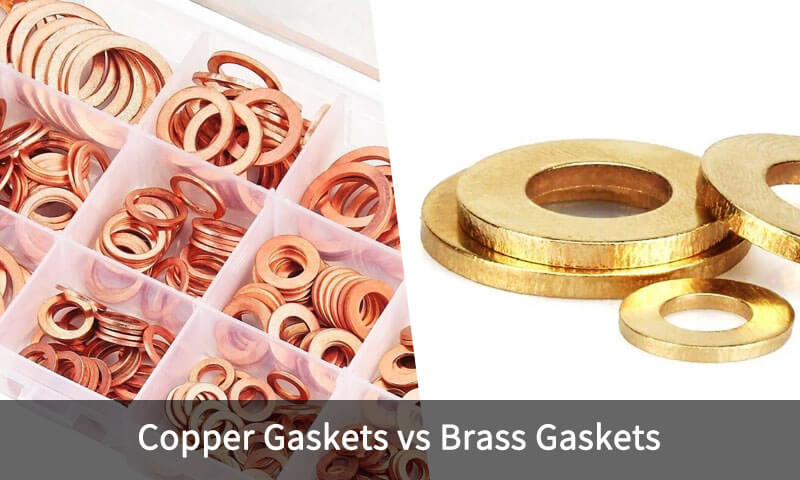
In hydraulic piping, যান্ত্রিক সরঞ্জাম, চাপ জাহাজ, and valve and pipeline sealing, copper flat gaskets are the quiet workhorses of industrial production.
They are soft, নমনীয়, seal tightly, resist high temperature, and do not age like elastomers. That is why they are used across so many precision sealing applications.
But “copper gasket” is not one material. It is two: copper gaskets এবং brass gaskets. They look similar on the bench. They are not interchangeable.
The difference in composition, কঠোরতা, নমনীয়তা, তাপমাত্রা ক্ষমতা, জারা প্রতিরোধের, and application determines whether a joint seals for years or leaks in a week.
This article explains the material differences, compares the five performance dimensions that matter in selection, gives clear application rules, and highlights the mixing mistakes that cause the most expensive failures.
1. What Are Copper Gaskets and Brass Gaskets?
Before comparing their performance, it is important to understand the fundamental difference between the two materials.
Copper Gaskets: উচ্চ-বিশুদ্ধতা তামা (Red Copper)
তামা gaskets, commonly called red copper gaskets, are typically made from high-purity electrolytic tough-pitch copper (Cu-ETP). Common material grades include UNS C11000 (American designation) and CW004A (European EN designation).
The Chinese equivalent is commonly designated T2. These grades typically contain at least 99.9% তামা, with only small amounts of other elements and impurities.
Their characteristic reddish or pinkish color reflects their high copper content. Compared with many copper alloys, pure copper has relatively low hardness, দুর্দান্ত নমনীয়তা, and good plastic deformation capability.
These characteristics are particularly valuable in static sealing applications. When a copper gasket is compressed between two mating surfaces, it deforms locally and conforms to small surface irregularities.
This helps establish continuous contact across the sealing interface and reduces potential leakage paths.
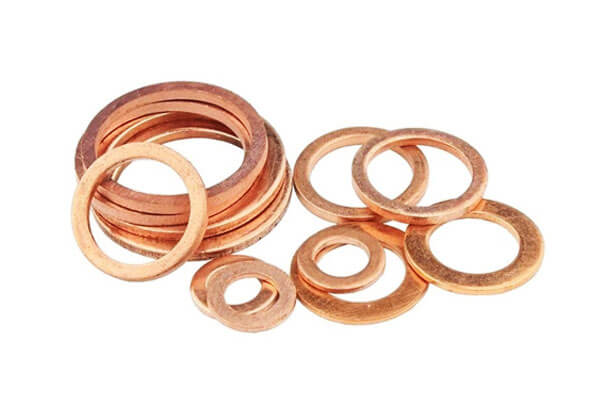
Key characteristics of copper gaskets:
- উচ্চ তামা সামগ্রী, সাধারণত 99.9% or above for T2 copper.
- Relatively low hardness and excellent ductility.
- ভাল তাপ এবং বৈদ্যুতিক পরিবাহিতা.
- Good resistance to atmospheric corrosion and many water-based environments.
- Strong conformability under compressive loading.
- Suitable for many high-temperature static sealing applications, subject to material condition and system design.
Copper gaskets are commonly used in hydraulic connections, ইঞ্জিন উপাদান, তাপ এক্সচেঞ্জার, চাপ সরঞ্জাম, and high-temperature mechanical assemblies.
Brass Gaskets: Copper-Zinc Alloy
পিতল gaskets are manufactured from brass, an alloy primarily composed of copper and zinc.
Depending on the intended application, manufacturers may use different brass grades with varying copper and zinc contents.
Some grades also contain small additions of other elements to improve machinability, শক্তি, বা জারা প্রতিরোধের.
Unlike pure copper, brass generally has higher hardness and greater resistance to mechanical deformation.
Its golden-yellow appearance also makes it easy to distinguish from red copper in many cases.
The exact properties of brass gaskets depend heavily on the alloy grade. উদাহরণস্বরূপ, কার্তুজ পিতল, নৌ পিতল, and free-machining brass do not have identical mechanical or corrosion characteristics.
সুতরাং, the term “brass gasket” should not be treated as a single material specification.
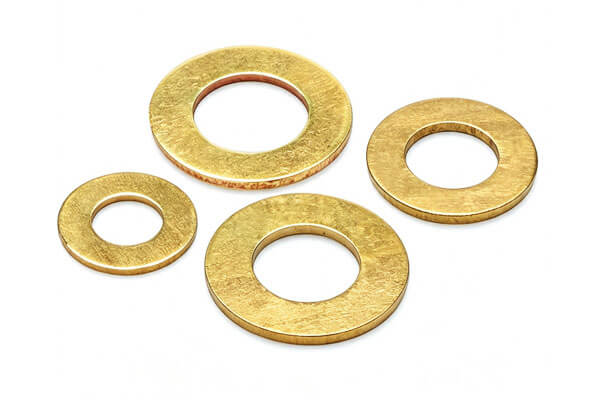
Key characteristics of brass gaskets:
- Primarily composed of copper and zinc.
- Generally harder and more rigid than pure copper.
- Good machinability and dimensional stability.
- Good wear resistance in suitable contact conditions.
- Generally lower thermal and electrical conductivity than pure copper.
- Corrosion resistance varies with alloy composition and service environment.
- Suitable for selected low- to moderate-temperature mechanical and sealing applications.
Brass gaskets are often used in general-purpose mechanical assemblies, নদীর গভীরতানির্ণয় উপাদান, ফিটিং, and applications where dimensional stability and mechanical support are important.
2. Copper Gaskets vs Brass Gaskets: মূল পার্থক্য
The main difference between copper and brass gaskets lies in the balance between ductility and mechanical strength.
Copper is generally softer and more conformable, while brass is usually harder and more resistant to deformation.
তবে, neither material is universally superior. Their suitability depends on gasket geometry, পৃষ্ঠ সমাপ্তি, bolt preload, অপারেটিং তাপমাত্রা, চাপ, and fluid compatibility.
Material Composition and Mechanical Properties
| সম্পত্তি | Copper Gaskets (T2 Copper) | Brass Gaskets |
| প্রধান রচনা | তামা, typically ≥99.9% | তামা-দস্তা খাদ |
| সাধারণ চেহারা | Reddish or pinkish | Golden yellow |
| Material structure | Relatively pure copper | Copper alloy |
| কঠোরতা | সাধারণত কম | সাধারণত উচ্চতর |
| নমনীয়তা | দুর্দান্ত | Usually lower than pure copper |
| প্লাস্টিকের বিকৃতি | উচ্চ | নিম্ন, গ্রেড উপর নির্ভর করে |
| অনমনীয়তা | তুলনামূলকভাবে কম | সাধারণত উচ্চতর |
| প্রতিরোধ পরিধান | মাঝারি | Generally better in suitable applications |
| তাপ পরিবাহিতা | সাধারণত উচ্চতর | সাধারণত কম |
| বৈদ্যুতিক পরিবাহিতা | সাধারণত উচ্চতর | সাধারণত কম |
| জারা প্রতিরোধের | Good in many atmospheric and water-based environments | Good in suitable environments, but susceptible to dezincification in certain conditions |
দ্রষ্টব্য: These are general material comparisons. Actual performance depends on the specific copper or brass grade, মেজাজ, উত্পাদন প্রক্রিয়া, এবং অপারেটিং শর্তাবলী.
Hardness and Ductility
Hardness and ductility are among the most important factors influencing gasket behavior during installation.
Copper gaskets: Soft and highly ductile
ASTM C11000 copper has excellent ductility and can undergo substantial plastic deformation under compressive loading.
When bolts tighten a joint, the copper gasket gradually conforms to the microscopic irregularities on the flange or mating surfaces.
This behavior helps compensate for minor surface imperfections, মেশিনিং চিহ্ন, and small deviations in flatness.
ফলস্বরূপ, copper gaskets can establish an effective sealing interface without requiring extremely smooth mating surfaces.
তবে, excessive softness can also become a disadvantage. If the gasket experiences excessive compressive stress, inadequate support, or repeated mechanical movement, it may undergo excessive thinning, এক্সট্রুশন, or permanent deformation.
Brass gaskets: Harder and more dimensionally stable
Brass generally has higher hardness and rigidity than pure copper. It resists deformation more effectively and can maintain its shape under certain mechanical loads.
This makes brass useful where the gasket also serves as a spacer, support element, or dimensional component.
তবে, greater hardness means that a brass gasket may not conform as easily to surface irregularities.
If the mating surfaces are rough, অসম, or insufficiently flat, the gasket may fail to establish continuous contact, creating potential leakage paths.
Sealing Performance and Contact Pressure
A gasket does not seal simply because it is placed between two components. It must develop and maintain sufficient contact pressure across the sealing interface.
For a static bolted joint, the sealing process generally involves three stages:
- Initial compression: Bolt preload compresses the gasket between the mating surfaces.
- Surface conformity: The gasket deforms to accommodate surface roughness and minor geometric deviations.
- Pressure retention: The joint must maintain sufficient residual contact stress to resist the internal fluid pressure and prevent leakage.
Copper’s high ductility makes it particularly effective during the second stage.
Under suitable installation conditions, a copper gasket can fill microscopic gaps and reduce the number of continuous leakage paths.
This is why annealed copper is widely used in precision static seals, including certain hydraulic, জ্বালানী, and high-pressure mechanical connections.
Brass gaskets, by comparison, generally require better-controlled surface conditions and sufficient contact pressure to achieve reliable sealing.
Their higher hardness can make them less forgiving when mating surfaces are uneven.
তবে, it is important to distinguish material hardness from pressure capability. A softer gasket is not automatically suitable for every high-pressure application, and a harder gasket is not inherently incapable of high-pressure sealing.
Temperature Resistance and Thermal Stability
Copper and brass both offer useful thermal performance, but their behavior differs as temperature increases.
Copper gaskets: Suitable for many elevated-temperature applications
Pure copper has a high melting point of approximately 1,085°C and retains useful mechanical properties across a broad temperature range.
Copper gaskets can be used in certain applications operating at approximately 300–400°C, provided the gasket condition, সংবেদনশীল চাপ, oxidation environment, and joint design are appropriate.
উন্নত তাপমাত্রায়, তবে, copper gradually loses strength. Stress relaxation and creep can reduce the residual gasket contact pressure, potentially causing leakage if the joint does not maintain sufficient preload.
এই কারণে, high-temperature copper gaskets often require careful consideration of material temper, annealing condition, bolt relaxation, এবং তাপ সাইক্লিং.
Brass gaskets: Better suited to moderate-temperature conditions
Brass has a lower melting range than pure copper, with the exact value depending on alloy composition. Its mechanical properties also vary significantly among grades.
উন্নত তাপমাত্রায়, brass can experience strength reduction, জারণ, and changes in mechanical behavior.
Certain brass alloys may also become susceptible to stress-related degradation under unsuitable thermal and environmental conditions.
ফলস্বরূপ, brass gaskets are generally more appropriate for ambient-temperature and moderate-temperature applications unless a specific alloy has been qualified for more demanding service.
| Temperature consideration | Copper Gaskets | Brass Gaskets |
| General suitability | Ambient to elevated temperatures | Primarily ambient to moderate temperatures |
| High-temperature reference | Approximately 300–400°C in suitable applications | Depends strongly on alloy grade and qualification |
| তাপ পরিবাহিতা | উচ্চ | সাধারণত কম |
| High-temperature strength retention | Decreases with temperature; creep and stress relaxation matter | Also decreases with temperature; খাদ-নির্ভর |
| Main engineering concern | Loss of contact stress and oxidation | Strength reduction, জারণ, and possible alloy-specific degradation |
Corrosion Resistance and Chemical Compatibility
Corrosion resistance is another important consideration, particularly in hydraulic systems, water pipelines, রাসায়নিক সরঞ্জাম, and outdoor installations.
Copper gaskets: Good resistance in many common environments
Copper forms a relatively stable surface oxide or protective patina under many atmospheric conditions. It generally performs well in dry environments and many water-based applications.
তবে, copper is not universally corrosion-proof. It can be attacked by oxidizing acids, ammonia-containing environments, certain sulfur compounds, and other chemically aggressive media.
High-velocity water and specific water chemistries can also cause erosion-corrosion.
Brass gaskets: ভাল জারা প্রতিরোধের, but dezincification must be considered
Brass can offer good corrosion resistance in many general industrial and plumbing environments. Its wear resistance and mechanical properties can be advantageous in certain assemblies.
তবে, some brass alloys are susceptible to dezincification, a selective corrosion process in which zinc dissolves preferentially from the alloy.
This can leave behind a porous, হ্রাস যান্ত্রিক অখণ্ডতা সঙ্গে তামা সমৃদ্ধ গঠন.
Dezincification risk depends on alloy composition, জল রসায়ন, তাপমাত্রা, and exposure conditions.
In applications involving hot water, stagnant water, or aggressive chloride-containing environments, selecting an appropriate dezincification-resistant brass grade may be necessary.
| পরিষেবা পরিবেশ | Copper Gaskets | Brass Gaskets |
| Dry atmospheric exposure | সাধারণত ভাল | সাধারণত ভাল |
| Fresh water | Often suitable, subject to water chemistry | Often suitable, with alloy selection |
| High-chloride water | Requires compatibility assessment | Dezincification risk may be significant |
| Ammonia-containing media | Can be unsuitable | Certain brass alloys are particularly vulnerable to stress corrosion cracking |
| Acidic media | Depends on acid type and concentration | Depends on alloy and acid chemistry |
| High-velocity fluid | Erosion-corrosion may occur | Erosion-corrosion may occur |
3. শিল্প অ্যাপ্লিকেশন: Where Should You Use Copper or Brass Gaskets?
The right gasket depends on what the joint needs to achieve. In fluid sealing systems, a gasket must maintain contact pressure, resist the operating medium, and accommodate temperature and mechanical loads throughout its service life.
Applications for Copper Gaskets
Copper gaskets are often the preferred option when the sealing interface requires good conformity and reliable static sealing.
Hydraulic pipelines and hydraulic equipment
Hydraulic systems operate under pressure, and even small leaks can lead to fluid loss, দূষণ, reduced system efficiency, or safety hazards.
Copper sealing washers are widely used in suitable hydraulic fittings, banjo connections, and certain threaded connection assemblies.
Their ductility helps them conform to the mating surfaces when tightened correctly.
তবে, not every high-pressure hydraulic connection should use a copper washer. Some systems require O-rings, bonded seals, metal-to-metal fittings, or specially designed high-pressure connections.
Engines and automotive equipment
Copper gaskets and sealing washers are used in selected engine and automotive applications, সহ:
- Oil drain plugs.
- Fuel-line connections.
- Certain coolant and fluid fittings.
- Selected high-temperature mechanical joints.
- Certain exhaust-related sealing assemblies, where the design specifically permits copper.
Copper’s ability to deform during tightening makes it useful in joints that require a reliable seal around a bolt or fitting.
Boilers and pressure equipment
Copper can be used in selected elevated-temperature sealing applications, including certain boiler and pressure-equipment connections. Its thermal stability and ductility can be advantageous.
তবুও, boiler and pressure-vessel gaskets must comply with the equipment’s design specifications, চাপ-তাপমাত্রার রেটিং, and relevant safety requirements.
A generic copper flat gasket should never be assumed suitable for every pressure-vessel joint.
ভালভ, পাম্প, এবং শিল্প যন্ত্রপাতি
Copper gaskets can be used in valve covers, pump connections, instrument fittings, and other static joints where the mating surfaces are compatible with a relatively soft metallic gasket.
They are particularly useful when the assembly requires a gasket that can accommodate minor surface irregularities without introducing an excessively thick sealing layer.
Applications for Brass Gaskets
Brass gaskets are more appropriate in applications where mechanical rigidity, মাত্রিক স্থায়িত্ব, and general-purpose sealing are important.
Plumbing systems and water fittings
Brass is widely used in plumbing fittings, ভালভ, সংযোগকারী, and mechanical assemblies.
Brass sealing washers may be suitable for selected low- or moderate-pressure water connections, provided the alloy is compatible with the water chemistry.
For potable-water applications, the material must also meet the applicable lead-content and drinking-water regulations. Not all brass grades are suitable for potable-water contact.
General mechanical equipment
Brass gaskets and washers can serve as sealing or support components in mechanical equipment where the joint does not require substantial plastic deformation.
Their dimensional stability can be useful in assemblies that require controlled spacing or resistance to compression.
কম- to moderate-pressure connections
For suitable applications involving relatively stable operating conditions, brass gaskets can provide adequate sealing when the mating surfaces are properly prepared and the joint is designed to maintain sufficient contact pressure.
Wear-resistant mechanical interfaces
Brass’s relatively good wear characteristics can be useful in certain sliding or contact applications.
তবে, a gasket intended to provide fluid sealing should not automatically be treated as a wear-bearing component.
If the part experiences repeated movement, the designer should evaluate friction, fretting, পৃষ্ঠ ক্ষতি, and sealing performance separately.
4. Can Copper Gaskets and Brass Gaskets Be Used Interchangeably?
বেশিরভাগ ক্ষেত্রেই, copper and brass gaskets should not be substituted without verifying the joint design and operating conditions.
Although they may have identical dimensions, their different hardness and deformation characteristics can produce different sealing results.
উদাহরণস্বরূপ, replacing a copper gasket with a brass gasket may reduce the joint’s ability to accommodate surface irregularities.
The replacement may therefore leak even if the original gasket sealed successfully.
বিপরীতে, replacing a brass gasket with a softer copper gasket may introduce excessive deformation in an assembly designed around the greater rigidity of brass.
This can affect spacing, কম্প্রেশন, or long-term joint stability.
Before making a substitution, confirm the following:
- The replacement material is chemically compatible with the working fluid.
- Its temperature and pressure limits meet the application requirements.
- Its hardness and compressibility are compatible with the joint design.
- The replacement thickness and contact dimensions are correct.
- The specified bolt preload can achieve the required sealing stress.
- The equipment manufacturer or responsible design engineer approves the substitution.
নিরাপত্তা-গুরুত্বপূর্ণ অ্যাপ্লিকেশনের জন্য, material substitution should be supported by engineering review and, যেখানে প্রয়োজন, pressure or leakage testing.
5. Common Mistakes When Selecting Copper and Brass Gaskets
Even experienced maintenance teams can make gasket selection mistakes when they rely on appearance or general material assumptions rather than operating conditions.
ভুল 1: Using Brass Gaskets in Unqualified High-Temperature Applications
Brass alloys generally have more limited high-temperature capability than pure copper.
If an unsuitable brass grade is exposed to prolonged elevated temperatures, its mechanical properties may deteriorate.
This can lead to reduced sealing stress, joint leakage, or material damage.
Better approach: For elevated-temperature service, evaluate copper or another qualified gasket material based on actual pressure-temperature conditions. Do not assume that every copper gasket is automatically suitable for 300–400°C operation.
ভুল 2: Assuming Copper Gaskets Can Solve Every Leakage Problem
Copper’s ductility makes it highly conformable, but it cannot correct severe mechanical defects.
If a flange is warped, a sealing face is deeply scratched, or bolt loading is uneven, replacing a brass gasket with copper may not solve the underlying problem.
Better approach: Inspect the mating surfaces, verify flange alignment, and check bolt preload before changing gasket materials.
ভুল 3: Selecting a Gasket Based Only on Hardness
A harder gasket is not necessarily better, and a softer gasket is not necessarily more reliable.
The gasket must have the correct balance of hardness, compressibility, শক্তি, and recovery for the joint design.
Better approach: Evaluate material hardness together with gasket thickness, contact geometry, পৃষ্ঠ সমাপ্তি, and required sealing stress.
ভুল 4: Ignoring Dezincification in Brass Gaskets
Some brass alloys can lose zinc when exposed to certain water environments. This can weaken the material and compromise its mechanical integrity.
Better approach: For water systems with elevated dezincification risk, specify a suitable dezincification-resistant brass grade or consider an alternative material after compatibility assessment.
ভুল 5: Reusing a Previously Compressed Copper Gasket
Copper gaskets often undergo permanent plastic deformation during installation. একবার সরানো হয়, the original geometry and surface contact characteristics may not be restored.
Reusing a compressed gasket can result in uneven contact pressure and leakage.
Better approach: Replace single-use crush washers and permanently deformed copper gaskets during maintenance unless the gasket manufacturer or equipment procedure explicitly permits reuse.
ভুল 6: Overtightening the Joint
Excessive tightening does not necessarily improve sealing. It can cause gasket extrusion, excessive thinning, থ্রেড ক্ষতি, flange distortion, or damage to the connected components.
Better approach: Follow the specified torque or bolt-preload procedure. Consider lubrication, thread condition, tightening sequence, and the effects of friction when establishing installation torque.
6. Practical Notes from the Field
Torque matters more than people think.
Copper gaskets require sufficient bolt load to achieve plastic deformation and conform to the flange. Under-torquing a copper gasket leaves it unable to fill surface imperfections.
Over-torquing a brass gasket can crack it. Follow the joint design specification, not a rule of thumb.
Surface finish of the flange affects performance.
Copper gaskets can tolerate rougher surfaces because they deform. Brass gaskets require a flatter, smoother surface to seal reliably. If the flange is pitted or worn, copper is the safer choice.
A joint that seals at room temperature may leak after thermal cycling if the gasket material cannot accommodate differential expansion. Copper’s ductility helps here; brass’s rigidity works against it.
Corrosion is not only about the medium.
The gasket must also be compatible with the flange material. Galvanic effects between the gasket and the flange can accelerate corrosion, especially in humid or conductive environments.
Traceability and certification.
For pressure vessels and safety-critical systems, the gasket material should be traceable to its heat number and accompanied by a material certificate. “Copper-colored” is not a material specification.
7. Custom Copper and Brass Gaskets from DEZE
এই টেক provides custom copper and brass gasket manufacturing solutions for industrial equipment manufacturers, fluid system suppliers, and OEM customers.
Whether you need high-purity copper gaskets made from T2, C11000, or CW004A, or brass gaskets manufactured from application-specific copper-zinc alloys, এই can produce components to meet your drawings, উপাদান স্পেসিফিকেশন, and dimensional requirements.
From simple flat sealing washers to precision-machined copper rings and customized gasket geometries, we support different designs, মাপ, পুরুত্ব, and production volumes.
এ এই, material selection and manufacturing accuracy are central to gasket performance.
Our manufacturing capabilities include Stamping, লেজার কাটিং, সিএনসি মেশিনিং, বাঁক, precision cutting, and other processes suited to the component’s geometry and production requirements.
We focus on critical dimensions such as inner and outer diameters, বেধ, সমতলতা, পৃষ্ঠ সমাপ্তি, and edge quality to ensure reliable assembly and consistent product quality.
Whether your application involves hydraulic fittings, ভালভ, পাম্প, পাইপলাইন, or general mechanical equipment, contact DEZE with your drawings, উপাদান প্রয়োজনীয়তা, and operating conditions to discuss a custom copper or brass gasket solution.
8. উপসংহার
Copper and brass gaskets may look similar, but their different material compositions lead to distinct mechanical and sealing characteristics.
Copper gaskets, particularly those made from high-purity UNS C11000 copper, offer excellent ductility, plastic deformation capability, এবং তাপ পরিবাহিতা.
They are often a good choice for static sealing applications that require conformity to mating surfaces, including selected hydraulic fittings, engine connections, and elevated-temperature joints.
Brass gaskets generally provide greater hardness, অনমনীয়তা, এবং মাত্রিক স্থায়িত্ব.
They are suitable for selected plumbing connections, general mechanical assemblies, and applications where resistance to deformation is more important than maximum conformability.
The key is to select the gasket based on the actual operating conditions rather than assuming that one material is always superior.
For reliable sealing, engineers should evaluate material grade, চাপ, তাপমাত্রা, fluid compatibility, পৃষ্ঠ সমাপ্তি, gasket geometry, and installation preload together.
A correctly selected and properly installed gasket can significantly reduce leakage risks, minimize maintenance requirements, and extend equipment service life.
FAQS
Why do copper gaskets seal better on uneven surfaces?
Because pure copper is soft and highly ductile. When the bolt is tightened, the gasket plastically deforms and conforms to the surface irregularities, compensating for flatness error.
Are copper gaskets better than brass gaskets?
Neither material is universally better. Copper is generally softer and more ductile, making it suitable for applications that require good conformity to mating surfaces.
Brass is usually harder and more rigid, making it useful in selected mechanical assemblies where dimensional stability is important.
The correct choice depends on pressure, তাপমাত্রা, fluid compatibility, gasket geometry, এবং যৌথ নকশা.
Do copper gaskets need to be replaced after removal?
সাধারণত, হ্যাঁ, particularly for copper crush washers and other gaskets that have undergone permanent plastic deformation.
Once compressed, the gasket may not recover its original thickness or surface geometry. Replacing it helps maintain predictable sealing performance.
Why do copper gaskets sometimes leak after installation?
Common causes include:
- Insufficient bolt preload.
- Excessive or uneven tightening.
- Damaged or contaminated sealing surfaces.
- Incorrect gasket dimensions.
- Excessive pressure or temperature.
- Gasket extrusion or excessive compression.
- Thermal cycling and stress relaxation.
The cause should be identified before selecting a replacement gasket material.