
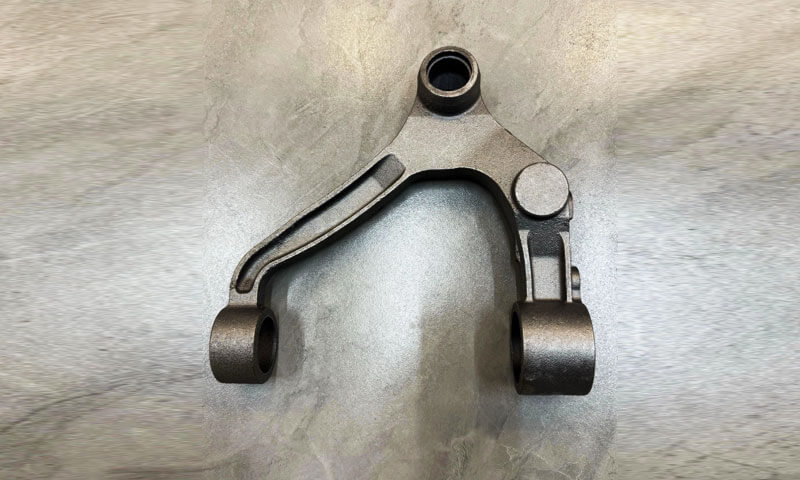
Automotive brackets are often required to withstand complex combinations of static loads, চক্রীয় চাপ, কম্পন, and occasional impact.
From suspension mounting brackets and engine supports to transmission housings and chassis components, these parts must deliver reliable mechanical performance while meeting increasingly demanding weight, ব্যয়, এবং উত্পাদন প্রয়োজনীয়তা.
Ductile iron is widely used for such applications because it offers a useful combination of strength, দৃ ness ়তা, castability, এবং ব্যয় দক্ষতা.
তবে, when selecting a ductile iron grade, manufacturers face an important decision: should the component be supplied in the as-cast condition, or should it undergo austempering to become Austempered Ductile Iron (এডিআই)?
The first reaction from most design teams is predictable: heat-treated material has better properties, so choose ADI.
That reaction is understandable, but it is wrong as a general rule. Material selection is not about choosing the highest performance.
It is about matching the material to the duty cycle, keeping cost under control, and ensuring that the process can be repeated reliably in production.
1. What Is the Difference Between As-Cast Ductile Iron and ADI?
Both as-cast ductile iron and ADI belong to the ductile iron family. Their key difference lies in the matrix microstructure and the manufacturing process used to achieve the required mechanical properties.
As-Cast Ductile Iron
যেমন-কাস্ট নমনীয় আয়রন is produced through melting, chemical composition adjustment, গোলককরণ, ইনোকুলেশন, and controlled solidification.
Magnesium treatment converts graphite into approximately spherical nodules, which reduce stress concentration compared with the flake graphite found in gray cast iron.
Depending on chemical composition, বিভাগের বেধ, শীতল হার, and inoculation practice, the matrix of as-cast ductile iron can be predominantly ferritic, pearlitic, বা উভয়ের সংমিশ্রণ.
For high-strength automotive brackets, a pearlitic or predominantly pearlitic matrix is often selected because pearlite provides higher tensile strength and hardness than ferrite.
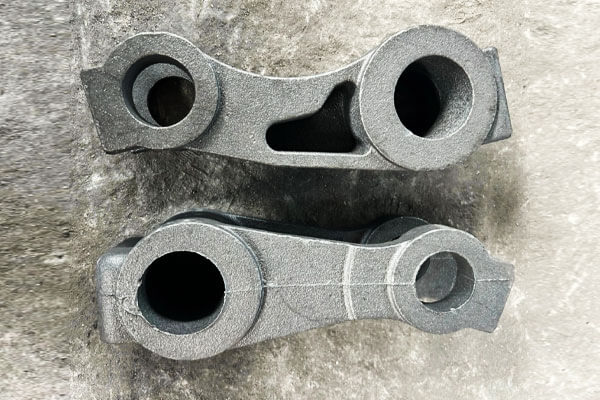
The main advantages of as-cast ductile iron include:
- No additional austempering process is required.
- Relatively short production cycles and lower manufacturing costs.
- Good castability for components with complex geometries.
- Suitable mechanical properties for many conventional automotive structural applications.
- Easier integration into high-volume foundry production.
উদাহরণস্বরূপ, the source material specifies an as-cast high-strength ductile iron target of at least 900 MPa tensile strength and 5% দীর্ঘকরণ.
This combination can be achieved through appropriate alloy design and casting process control, although it requires careful attention to section size, ম্যাট্রিক্স গঠন, এবং ঢালাই গুণমান.
International grade selection: The European grade EN-GJS-900-2 is a commonly recognized high-strength ductile iron reference with a minimum tensile strength of 900 এমপিএ.
তবে, its specified minimum elongation is 2%, না 5%. সুতরাং, it should not be treated as a direct equivalent to the source’s 900 এমপিএ / 5% প্রয়োজন.
যখন 5% elongation target is mandatory, the drawing or purchase specification should explicitly state the required mechanical properties rather than relying on the grade designation alone.
Austempered নমনীয় লোহা (এডিআই)
ADI is produced by applying a controlled heat-treatment process to ductile iron.
Unlike conventional quenching and tempering, austempering is designed to create a distinctive microstructure consisting primarily of ausferrite, a mixture of acicular ferrite and carbon-enriched retained austenite.
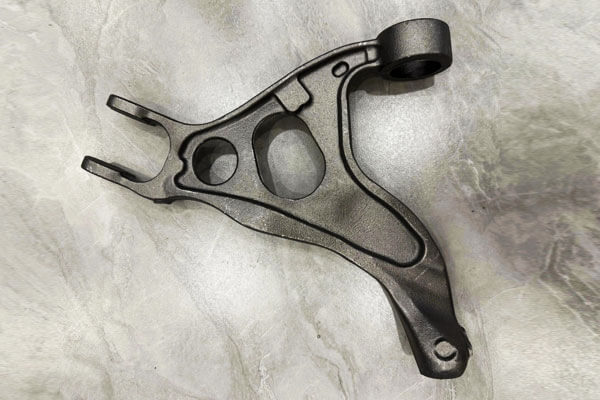
The typical ADI process involves three main stages:
- Austenitizing: The casting is heated to a suitable temperature, commonly within approximately 850–950°C, to obtain an austenitic matrix.
- শ্রুতিমধুর: The component is rapidly transferred to a controlled-temperature bath, often a salt bath, and held within the selected transformation range.
- নিয়ন্ত্রিত কুলিং: After the required transformation is achieved, the component is cooled to room temperature.
The final mechanical properties depend on austenitizing temperature, austempering temperature, সময় ধরে রাখা, খাদ রচনা, এবং বিভাগের বেধ.
Compared with conventional as-cast pearlitic ductile iron, ADI can provide a more favorable combination of tensile strength, শক্তি ফলন, দীর্ঘকরণ, প্রভাব প্রতিরোধের, এবং ক্লান্তি কর্মক্ষমতা.
তবে, ADI is not simply ductile iron with an additional heat-treatment step. Its properties depend on a carefully controlled transformation process.
Inadequate temperature control, insufficient holding time, or unsuitable cooling conditions can result in undesirable microstructures and inconsistent mechanical performance.
2. The Cost Comparison: Where ADI Pays a Premium
ADI involves more than an additional heat-treatment fee. Its total manufacturing cost includes several extra processing and quality-control requirements:
- Austenitizing furnace energy: Heating the castings to the required austenitizing temperature increases energy consumption.
- Salt bath processing and environmental management: Austempering requires controlled bath conditions, along with salt maintenance, হ্যান্ডলিং, and disposal costs.
- Quench distortion control and straightening: Heat treatment can cause dimensional distortion. ADI brackets may require additional straightening and inspection, increasing labor costs and potentially introducing residual stresses.
- Cleaning and shot blasting: Additional cleaning and surface treatment are generally required after salt bath processing.
- Higher scrap risk: ADI is sensitive to the quality of the original casting. সঙ্কুচিত, অন্তর্ভুক্তি, and other defects may become unacceptable during final inspection, increasing the risk of rejection after heat treatment.
ফলস্বরূপ, ADI brackets typically cost significantly more to manufacture than their as-cast equivalents, with longer production lead times.
For a conventional chassis bracket with moderate loading and fatigue requirements, as-cast ductile iron meeting the specified 900 MPa tensile strength and 5% elongation target may be sufficient, provided these properties are verified in the actual casting.
এই ধরনের ক্ষেত্রে, the additional cost of ADI may not deliver a meaningful engineering benefit.
The key consideration is that higher material performance does not automatically mean better overall value.
Over-specifying a bracket increases material and processing costs, extends lead time, and introduces additional risks associated with heat-treatment variability.
ADI is worth the premium when its improved fatigue resistance, শক্তি, or weight-saving potential addresses a clearly defined design requirement—not simply because its mechanical properties are higher.
3. How to Choose Between As-Cast Ductile Iron and ADI for Automotive Brackets
The most appropriate material depends on the bracket’s operating conditions, কাঠামোগত প্রয়োজনীয়তা, and production targets.
When to Choose As-Cast Ductile Iron
As-cast ductile iron is generally the more economical choice for:
- Conventional chassis and structural brackets.
- Components subjected to moderate static and cyclic loads.
- Applications with manageable fatigue requirements.
- High-volume production with strict cost targets.
- Components where the required strength and elongation can be achieved through stable casting processes.
উদাহরণস্বরূপ, a conventional automotive mounting bracket may not benefit significantly from ADI if its stress level and fatigue life are already within acceptable limits using a properly designed as-cast ductile iron grade.
In this situation, adding an austempering process increases cost and production complexity without necessarily delivering a meaningful improvement in component performance.
When to Choose ADI
ADI is worth considering when the application requires:
- High cyclic loading and demanding fatigue life.
- High strength without excessive component weight.
- Better strength-toughness balance than the selected as-cast grade can provide.
- High structural reliability under complex operating loads.
- Potential weight reduction through optimized component geometry.
ADI can be particularly valuable for heavily loaded suspension components, structural mounting brackets, and other automotive parts where fatigue performance and strength-to-weight ratio are major design considerations.
তবে, the higher material and processing costs must be justified by measurable improvements in component performance or design efficiency.
4. Do Not Select on Tensile Strength Alone
Tensile strength is an important material property, but it should not be the only selection criterion for automotive brackets.
In actual service, bracket failures are often associated with fatigue, impact loading, slag inclusions, and shrinkage porosity, rather than insufficient tensile strength.
Whether the component is supplied as-cast or processed into ADI, reliable performance starts with consistent casting quality.
The following parameters require particular attention:
- Graphite nodularity: Properly formed graphite nodules reduce stress concentration. Nodularity below 85% can negatively affect fatigue strength and ductility.
- Residual magnesium: Insufficient residual magnesium can lead to poor graphite spheroidization, while excessive levels may increase the risk of carbide formation and slag-related defects.
- Inoculation effectiveness: Consistent inoculation helps control graphite size and distribution while reducing the risk of chill and carbide formation.
- অন্তর্ভুক্তি নিয়ন্ত্রণ: Slag and oxide inclusions can act as fatigue crack initiation sites. Heat treatment cannot eliminate these defects.
ADI is particularly sensitive to the quality of the original casting. Poor nodularity, slag inclusions, and shrinkage porosity may lead to rejection after austempering, even when the casting appeared acceptable before heat treatment.
সুতরাং, casting quality must be established before selecting the ADI route. Austempering can improve the matrix microstructure, but it cannot compensate for fundamental casting defects.
| Quality Parameter | As-Cast Requirement | ADI Sensitivity |
| নোডুলারিটি | ≥85% | সমালোচনামূলক; poor nodularity reduces fatigue life |
| Free cementite | None permitted | সমালোচনামূলক; carbides can impair ductility and toughness |
| Residual magnesium | Controlled within the specified range | Requires tight control |
| ইনোকুলেশন | Effective and consistent | Critical for graphite refinement and distribution |
| স্ল্যাগ / অন্তর্ভুক্তি | Minimized | সমালোচনামূলক; potential fatigue crack initiation sites |
| সঙ্কুচিত porosity | Minimized | সমালোচনামূলক; internal defects can cause premature failure |
The key principle is simple: control the casting quality first, then determine whether ADI is necessary. A sound casting is the foundation of reliable performance in both manufacturing routes.
5. A Practical Selection Workflow
When a bracket program comes to me, I follow this sequence:
ধাপ 1: Define the load spectrum. What are the steady loads, the cyclic loads, and the shock loads? What is the expected number of cycles over the service life?
ধাপ 2: Define the safety classification. What happens if the bracket fails? Is it a controlled pull-over, or a loss of steering or suspension function?
ধাপ 3: Assess the fatigue requirement. Does the bracket need infinite life, or is a finite-life design acceptable? What is the allowable stress amplitude?
ধাপ 4: Evaluate the as-cast option first. Can as-cast 900-5 meet the fatigue and impact requirements with adequate margin? যদি হ্যাঁ, stop here. Do not over-specify.
ধাপ 5: If as-cast is marginal, evaluate ADI. Which ADI grade is appropriate? What is the fatigue and impact data for that grade at the relevant stress ratio? What is the cost and lead time impact?
ধাপ 6: Qualify the process. For ADI, qualify the heat treater’s austenitizing temperature control, salt bath temperature control, holding time control, and distortion control. For as-cast, qualify the foundry’s nodularity, ইনোকুলেশন, and inclusion control.
ধাপ 7: Validate with testing. Bench fatigue testing, impact testing, and dimensional inspection on production-representative samples. Do not rely on datasheet values alone.
ধাপ 8: Document the decision. Record the load spectrum, the fatigue requirement, the selected grade, the process qualification, and the test results. This is the traceability that a safety-critical bracket program requires.
6. চূড়ান্ত রায়: As-Cast Ductile Iron or ADI?
There is no universal winner between as-cast ductile iron and ADI. Each material has a different role in automotive bracket manufacturing.
- Choose as-cast ductile iron when the component’s strength, দীর্ঘকরণ, and fatigue requirements can be met through a stable casting process.
It offers a shorter production route, কম খরচ, and strong suitability for conventional high-volume automotive brackets. - Choose ADI when high cyclic loading, demanding fatigue performance, or weight reduction justifies the additional heat-treatment cost and process complexity.
The selection decision should be driven by the duty cycle, the safety classification, and the production economics—not by the assumption that heat treatment is always better.
And in both cases, the foundation is the casting quality: nodularity, ইনোকুলেশন, residual magnesium control, and inclusion level. No heat treatment can compensate for a poorly made casting.
Match the material to the job. That is the whole discipline.
FAQS
Is ADI always better than as-cast ductile iron?
না. ADI offers better mechanical properties, but it costs more, has a longer lead time, and requires tighter process control.
For standard brackets with modest fatigue requirements, as-cast 900-5 is entirely adequate and more economical.
Why does ADI have a higher scrap rate?
ADI is more sensitive to the original casting quality.
Nodularity problems, slag inclusions, and shrinkage porosity that might be tolerated in as-cast material can be exposed or amplified by the austempering cycle, increasing the scrap rate.
What is the cost difference between as-cast 900-5 and ADI?
ADI is significantly more expensive than as-cast 900-5. The additional cost includes austenitizing and salt bath energy, environmental handling, distortion control and straightening, পোস্ট-প্রসেসিং, and higher scrap risk.
How do I choose between as-cast and ADI for a bracket?
Define the load spectrum, safety classification, and fatigue requirement. Evaluate as-cast first. If it meets the requirements with adequate margin, use it. না হলে, evaluate ADI and qualify the heat treatment process.

