

I’ve been in the forjamento de alumínio business for over twenty-five years. I’ve seen it all—from the early days of manual hammer forging to today’s computer-controlled presses.
And I can tell you this: aluminum hot forging is one of the most unforgiving metalworking processes on the planet. It’s not like steel. Steel gives you some leeway. Alumínio? It punishes every mistake.
But that’s also why it’s so rewarding. When you get it right, you produce parts with exceptional strength-to-weight ratios, excelente resistência à fadiga, and near-net shapes that save machining time and material.
That’s why aluminum forgings are everywhere—in cars, Aeronave, motocicletas, outdoor gear, e equipamentos industriais.
Neste artigo, I want to pull back the curtain and talk honestly about the challenges. Not the marketing fluff. The real difficulties that keep forging engineers up at night.
And I’ll share how a one-stop manufacturing approach—like the one we use at DEZE Tech—can turn these challenges into competitive advantages.
1. The Narrow Temperature Window: Walking a Tightrope
If there is one factor that defines the success of aluminum hot forging, isso é Controle preciso da temperatura.
Aluminum alloys are highly sensitive to thermal conditions, and unlike many steel forging processes, they operate within a relatively narrow temperature window.
For most commonly forged aluminum alloys, the optimal forging temperature is typically between 350°C and 500°C, dependendo da composição da liga, geometria do componente, and deformation requirements.
À primeira vista, a 150°C processing range may seem sufficient. No entanto, in real production environments, maintaining consistent temperature throughout the entire forging cycle is much more challenging.
The billet temperature must be controlled accurately during heating, transferir, and deformation because even small variations can significantly affect material flow, forging pressure, and final part quality.

When the Temperature Is Too Low
If the billet temperature drops below the proper forging range, aluminum becomes less ductile and its resistance to deformation increases significantly.
As consequências incluem:
- Higher forging force requirements
- Poor material flow inside the die cavity
- Incomplete filling of complex features
- Increased risk of cold shuts, voltas, and internal cracks
Em casos graves, the material cannot properly fill the die, resulting in dimensional defects and unacceptable mechanical performance. The forged component must be rejected.
When the Temperature Is Too High
Excessive heating creates an equally serious problem. When aluminum alloys are overheated, localized melting can occur at grain boundaries, causing a phenomenon known as incipient melting ou overheating damage.
This type of defect severely weakens the internal structure and may appear as:
- Surface blistering
- Grain boundary damage
- Ductilidade reduzida
- Loss of fatigue strength
Once overheating occurs, subsequent heat treatment cannot restore the original material structure. The forging is permanently compromised.
I remember a batch we lost years ago because of a 20°C overshoot in the furnace.
The furnace thermocouple drifted, and nobody caught it until we saw the surface blisters. That was a $50,000 lesson. Desde então, I’ve been obsessive about temperature control.
This experience is common in aluminum forging — the difference between a high-quality forging and a failed batch can come down to only a small temperature deviation.
That is why experienced forging manufacturers treat thermal management as a core technology rather than a simple production parameter.
How We Control the Temperature Challenge
To achieve consistent aluminum forging quality, temperature control must cover the entire process — from billet heating to final forging.
Precise and Uniform Billet Heating
Uniform heating is the first requirement for stable forging performance.
Modern aluminum forging operations typically use controlled multi-zone heating systems with calibrated temperature sensors to ensure that billets are heated evenly throughout their cross-section.
Key controls include:
- Accurate furnace temperature calibration
- Regular thermocouple verification
- Prevention of local overheating
- Consistent heating cycles between batches
A billet with uneven temperature distribution will not deform uniformly, even if the average temperature appears correct.
Rapid Material Transfer
The forging process clock starts immediately after the billet leaves the furnace. During transfer, aluminum loses heat quickly, especially from the surface.
Excessive transfer time can cause:
- Uneven temperature distribution
- Reduced material flow
- Increased forging pressure
- Defeitos superficiais
Portanto, efficient handling systems and optimized production layouts are essential to minimize temperature loss before forging.
Preheated Dies
Die temperature also plays an important role in aluminum forging. Cold dies rapidly extract heat from the billet surface, reducing metal flow and increasing the risk of defects.
Preheating dies, commonly to approximately 200–300 ° C., ajuda:
- Reduzir o choque térmico
- Improve material filling
- Maintain more consistent deformation conditions
- Extend die service life
Real-Time Temperature Monitoring
Temperature control cannot rely only on furnace settings. The actual billet temperature, temperatura da matriz, and transfer conditions must be monitored throughout production.
Advanced forging operations use:
- Temperature measurement systems
- Process data recording
- Real-time monitoring equipment
to ensure every forging cycle remains within the required process window.
2. Sticking and Die Wear: The Hidden Cost Driver
One of the most common challenges in aluminum hot forging is material sticking between the aluminum billet and the die surface.
At elevated forging temperatures, aluminum has a strong tendency to adhere to tooling surfaces, creating friction, danos superficiais, and accelerated die degradation.
This problem directly affects both product quality and manufacturing cost.
The first issue is surface quality deterioration. When aluminum sticks to the die cavity, the forged part may develop defects such as tearing marks, irritante, rough areas, and inconsistent surface appearance.
These defects not only affect the appearance of the component but can also influence subsequent machining processes and final dimensional accuracy.
The second issue is premature die failure. Continuous adhesion and friction gradually damage the die surface, leading to increased wear, more frequent maintenance, and shorter tooling life.
In aluminum forging production, die replacement and repair are significant cost factors.
A die designed for tens of thousands of forging cycles can experience a much shorter service life if sticking is not properly controlled.
Do ponto de vista da fabricação, die wear is often a hidden cost because it affects more than just tooling expenses.
Frequent die maintenance interrupts production schedules, increases downtime, and reduces overall manufacturing efficiency.
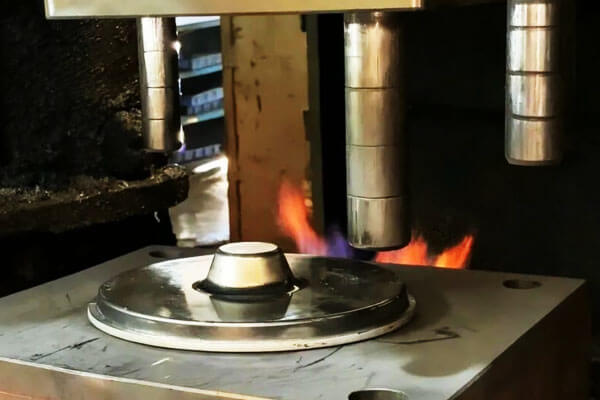
How We Control Sticking and Die Wear
Effective die life management starts with proper die material selection and heat treatment.
High-quality hot-work tool steels, such as H13, are commonly used because they provide a good balance of high-temperature strength, thermal fatigue resistance, e resistência ao desgaste.
Proper heat treatment is equally important to ensure the die maintains stable performance during repeated forging cycles.
Surface engineering also plays an important role. Treatments such as nitretação, Revestimentos em PVD (such as TiAlN), and other wear-resistant surface technologies can reduce aluminum adhesion, improve surface hardness, and extend die service life.
Lubrication is another critical factor. The purpose of lubrication is not simply to reduce friction; it also helps control material flow and protect the die surface.
Na prática, the effectiveness of a lubricant depends heavily on proper application. Even high-performance lubricants cannot perform well if coverage is uneven or process conditions are inconsistent.
Finalmente, die design has a direct influence on sticking behavior. Proper draft angles, smooth transition areas, suitable fillet radii, and effective venting reduce friction during material flow and help prevent localized adhesion.
Key takeaway:
Die wear is not just a tooling issue — it is a major factor affecting production cost, quality stability, and delivery efficiency.
Proper control of material selection, tratamento de superfície, lubrificação, and die design is essential for achieving reliable and economical aluminum forging production.
3. Grain Structure Control: The Inside Story
Aluminum forging is not only a process of changing shape — it is a process of controlling the internal microstructure do material.
The real performance advantage of forged aluminum components comes from what happens beneath the surface.
During hot forging, the combination of temperature and plastic deformation can trigger dynamic recrystallization, where new fine grains form and replace the original coarse structure from the billet.
A properly controlled forging process creates a refined and uniform grain structure, improving mechanical strength, resistência à fadiga, and overall reliability.
No entanto, achieving the ideal grain structure requires precise control of forging parameters. If the process conditions are not properly managed, several microstructural problems may occur.
Coarse grains reduce mechanical performance because larger grain sizes generally weaken strength consistency and fatigue resistance.
Uneven grain distribution can create inconsistent properties within the same component, causing some areas to become more vulnerable under repeated loading.
Insufficient recrystallization may leave an unstable internal structure with residual stresses and excessive work hardening, increasing the risk of cracking during service.
One of the most challenging aspects of grain structure control is that these problems are often invisible.
A forged component may look completely acceptable from the outside but still contain internal weaknesses that only appear after long-term operation.
I have seen forged parts with excellent surface appearance fail earlier than expected because the internal grain flow and microstructure were not properly controlled.
Em forjamento de alumínio, appearance does not always represent performance — the real quality is built inside the material.
How We Control Grain Structure
The first step is process simulation and analysis. Advanced forging simulation tools can predict material flow, temperature distribution, deformation behavior, and potential microstructural changes before production begins.
This helps optimize the forging process and reduce trial-and-error during tooling development.
The second factor is controlled deformation. Forging reduction ratio, deformation speed, and temperature must be carefully balanced to achieve the desired recrystallization behavior.
Too little deformation may not effectively refine the structure, while excessive or uncontrolled deformation can create uneven grain distribution.
Finalmente, experience remains essential. Simulation software provides valuable data, but practical forging knowledge is required to interpret results and make the right process decisions.
Understanding how aluminum alloys respond during forging comes from years of working with different materials, geometrias, e condições de produção.
Key takeaway:
Grain structure is the hidden quality factor in aluminum forging. It cannot be judged by appearance, but it directly determines whether a component achieves reliable performance over thousands or millions of operating cycles.
Proper microstructure control is what separates a basic forged part from a high-performance aluminum forging.
4. Heat Treatment Distortion: The Unpredictable Demon
Depois de forjar, most aluminum components require heat treatment to achieve the required mechanical properties.
Processos como Tratamento térmico da solução, têmpera, e envelhecimento artificial are essential for improving strength and fatigue performance, but they also introduce one of the most difficult challenges in aluminum forging: distorção dimensional.
The root cause is uneven cooling during the quenching stage. Complex forged parts often contain different wall thicknesses, varying cross-sections, and irregular geometries.
Thin areas cool faster than thicker sections, creating non-uniform thermal contraction and significant internal stresses.
These residual stresses can lead to deformação, torcendo, mudanças dimensionais, and loss of machining accuracy, especially in precision components with strict tolerance requirements.
I’ve seen parts that were perfectly forged come out of the quench tank looking like pretzels. And you can’t just bend them back—you’ll introduce new stresses and compromise the material.
How We Control Heat Treatment Distortion
At DEZE Tech, we consider forging and heat treatment as a connected process rather than independent operations.
The potential distortion caused by heat treatment must be evaluated during the early design stage, including part geometry, forging allowance, and die compensation.
Process simulation and finite element analysis are used to predict deformation behavior before production.
By understanding stress distribution and cooling patterns, we can optimize die design and machining allowances to compensate for expected dimensional changes.
Quenching parameters are also carefully controlled. Factors such as quench medium, taxa de refrigeração, part orientation, and fixturing method directly influence final distortion.
For complex aluminum forgings, controlled quenching systems and dedicated fixtures help reduce deformation while maintaining the required metallurgical properties.
The ultimate goal is to achieve near-net-shape forging, where distortion is controlled before machining rather than corrected afterward.
This reduces material waste, minimizes CNC machining allowance, improves dimensional consistency, and increases overall production efficiency.
Key takeaway:
Heat treatment is not simply a finishing step after forging. It is a critical part of the forging process design.
Without proper control and prediction, even a high-quality forged part can fail to meet final dimensional and performance requirements.
5. Industry Pain Points: Beyond the Forge
The technical challenges are only half the story. The other half is the business and operational side.
High Comprehensive Costs
Aluminum hot forging requires significant investment in tooling, forging equipment, material preparation, tratamento térmico, e controle de qualidade.
Die development alone can represent a considerable upfront cost, especially for complex components with strict dimensional and performance requirements. Many small shops struggle to stay competitive.
The one-stop solution: By integrating die development, forjamento, tratamento térmico, and CNC machining under one roof, we eliminate the middlemen, reduce communication errors, and optimize the entire process chain. This lowers costs and improves quality.
Process Stability and Consistency
Mass production is unforgiving. You might make one perfect part, but can you make 100,000 identical parts? Consistency is the hallmark of a world-class forging operation.
The one-stop solution: Standardized work instructions, Controle de processo estatístico (CEP), and a robust quality management system (ISO 9001) ensure that every part meets the same specifications, lote após lote.
From Drawing to Finished Part: The Integration Gap
Many customers complain about the disconnect between the forging shop and the machining shop.
The forging shop leaves too much stock; the machining shop complains about inconsistent datum points. The result is wasted material, Tempos de entrega mais longos, and higher costs.
The one-stop solution: When forging and CNC machining are under one roof, we design the forging with the machining process in mind.
We optimize machining allowances, establish consistent datum schemes, and even pre-machine features during forging. The result is a finished part that’s ready to use, with minimal waste.
6. How a One-Stop Approach Turns Challenges into Advantages
No ESTA tecnologia, we understand that aluminum hot forging challenges cannot be solved by forging technology alone.
Consistent production requires the integration of tooling development, forging process control, tratamento térmico, Usinagem CNC, and quality management into one complete manufacturing system.
Instead of operating as a traditional forge shop, DEZE Tech provides a full-service manufacturing solution that helps customers reduce process risks, melhorar a eficiência da produção, and achieve stable part quality from prototype development to mass production.
| Desafio | DEZE Tech’s Solution | Customer Benefits |
| Narrow temperature window | Multi-zone heating systems, controlled material transfer, and real-time temperature monitoring | Stable material flow, reduced forging defects, and consistent part quality |
| Sticking and die wear | Optimized die materials, tratamentos de superfície, and controlled lubrication processes | Extended die life, melhor acabamento superficial, and reduced tooling costs |
| Grain structure control | Simulação de processo, optimized deformation parameters, and experienced forging engineering | Improved mechanical properties and enhanced fatigue performance |
| Heat treatment distortion | Integrated forging and heat treatment design, simulation analysis, and controlled quenching | Reduced deformation, improved dimensional accuracy, and lower machining allowance |
High comprehensive cost |
In-house tooling development, forjamento, tratamento térmico, and CNC machining capabilities | Reduced supply chain complexity, shorter lead times, and optimized total cost |
| Process stability | Standardized production procedures, SPC control, and quality systems including ISO 9001 | Reliable batch-to-batch consistency and stable long-term supply |
| Forging-machining disconnect | Complete process integration from drawing review to finished precision components | Better design coordination, resíduos de material reduzido, and faster delivery |
A one-stop manufacturing approach allows every stage of production to work together.
From the initial forging design and die development to final machining and inspection, DEZE Tech focuses on eliminating process gaps and delivering aluminum forged components with reliable performance, qualidade consistente, and competitive manufacturing efficiency.
7. Conclusão
Aluminum hot forging is hard. It’s a constant battle against temperature, atrito, microestrutura, e distorção. But that’s what makes it so valuable.
When you master these challenges, you produce parts that are lighter, mais forte, and more reliable than anything else on the market.
The key is to stop thinking of forging as an isolated process. It’s part of a chain—from die design to heat treatment to machining. The most successful manufacturers are the ones who control the entire chain.
If you’re sourcing aluminum forgings, don’t just look at the price per piece.
Look at the total cost of ownership; look at the supplier’s technical depth; look at whether they can solve the hard problems—not just the easy ones.
That’s what we do at DEZE Tech. We don’t shy away from the difficult parts. We embrace them. Because that’s where the real value is.
Perguntas frequentes
Can aluminum forgings be used in automotive applications?
Absolutamente. Aluminum forgings are widely used in automotive suspension, direção, engine, and structural components due to their high strength-to-weight ratio.
What alloys are commonly hot forged?
Common alloys include 6061, 6082, 7075, 2024, e 2618. The choice depends on strength, resistência à corrosão, and temperature requirements.
How do you ensure batch-to-batch consistency?
Through standardized procedures, CEP, rigorous quality control, and a certified quality management system (ISO 9001).
What is near-net-shape forging?
Near-net-shape forging produces parts that are very close to final dimensions, minimizing machining and material waste. It requires precise control of forging and heat treatment distortion.

