

1. Introductio
Investment casting—often called the lost‐wax process—enables manufacturers to produce complex, near‐net‐shape metal components with exceptional surface finish and dimensional accuracy.
When paired with high‐performance Alloy Steels, this technique delivers parts that withstand extreme loads, mordax ambitus, et elevatum temperaturis.
This article explores alloy steel investment castings from fundamental principles through material selection, processus imperium, microstructure, applications, design guidelines, and concluding best practices.
2. Alloy Steel Investment Casting
Investment casting—also known as the lost-wax process—delivers precision components by combining a disposable wax pattern with a durable ceramic mold.
When applied to Alloy Steels, it unlocks intricate geometries and superior performance that rival costly machining or multi-piece fabrication.
Inferius, we break down the core steps, benchmark its accuracy against sand casting and CNC machining, and highlight the decisive advantages.
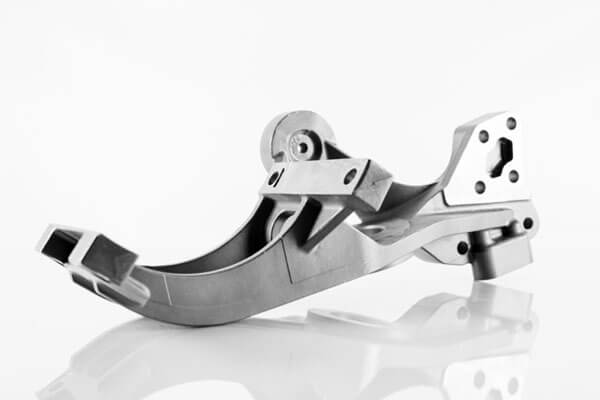
Processus Overview
- Cera exemplar creaturae
• Injection mold a high-precision wax replica of the final part—tolerances can reach ±0.1 mm.
• Pattern trees may group multiple parts for batch processing, boosting throughput. - Ceramic testa aedificationem
• Dipping: The wax assembly enters a fine-grain ceramic slurry (viscosity ~15 cP).
• Stuccoing: After draining, the shell receives a layer of refractory sand (15-30 μm).
• Repeating: Alternate dipping and stuccoing 4–8 times yields a 4–8 mm thick shell with Ra 1–3 µm achievable. - Dewaxing and Shell Strengthening
• Autoclave or steam heat melts out wax, leaving a void exactly matching the desired geometry.
• Shells then dry at 200–300 °C to drive off residual moisture and strengthen the mold. - Pouring Molten Alloy Steel
• Melt alloy steel (E.g., 4140) in an EAF or induction furnace to 1 450-1 550 N ° C.
• Pour into pre-heated (>200 N ° C) shells to minimize thermal shock and ensure complete filling. - Crusta remotionem & Final Finishing
• Shake-out knocks away the ceramic, secutus blast-cleaning et molitus.
• Critical machined surfaces receive allowances of 1–2 mm to hit ±0.25 mm tolerances.
Comparison to Sand Casting and Machining
| Aspectus | Alloy Steel Investment Casting | Harenae mittentem | CNC Machining from Bar Stock |
|---|---|---|---|
| Dimensional tolerantia | ±0.25 mm | ±1.0 mm | ± 0.05 mm |
| Superficiem metam (Ra) | 1-3 µm | 10-25 μm | 0.4-1.6 µm |
| Geometria complexu | Highly complex, muros | Moderor, draft required | Limited by tool access |
| Material Yield | > 90 % | 60-70 % | 30-50 % |
| Secundarium Machining | 30-50 % reductionem | Often extensive | Primary process |
3. Typical Alloy Steel Grades for Investment Castings
Selecting the right alloy steel grade dictates an investment casting’s mechanical performance, corrosio resistentia, et calor tolerantia.
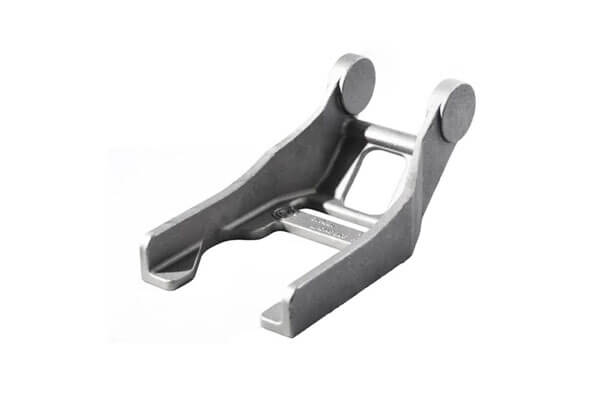
Below is a breakdown of commonly cast grades—organized by category—with their hallmark properties and typical applications.
| Gradus | Genus | Key Alloying Elementa | Tensile viribus (MPA) | Durities (HRC) | Typical applications |
|---|---|---|---|---|---|
| 8620 | Case-hardenable low-alloy | C 0.18%, In 0.40%, Credo 0.40%, MO 0.15% | 550-650 | 20-30 | Case-hardened gears, sagittae, bushlings |
| 4140 | Chrome-moly low-alloy | C 0.40%, Credo 1.00%, MO 0.25%, Mn 0.75% | 800-950 | 28-40 | High-strength shafting, rocker arms |
| 4340 | Nickel-chrome-moly low-alloy | C 0.40%, In 1.80%, Credo 0.80%, MO 0.25% | 900-1 100 | 32-45 | Aircraft fittings, heavy-duty axles |
| 17-4PH | Precipitation-hardening SS | Fe–17Cr–4Ni–4Cu–0.3Nb | 850-1 100 | 28-40 | Corrosion-resistant pump housings, valvae partes |
| 316L | Austenitic immaculatam | Fe–18Cr–12Ni–2Mo | 480-620 | ≤25 | Processus eget apparatu, Marine caerimonias |
| 410 | Martensitic intemerata | Fe–12Cr | 450-600 | 30-45 | Wear-resistant housings, CYMBALON |
| A217 WC6 | Cr–Mo pressure-vessel steel | C 0.10%, Credo 2.25%, MO 1.00% | 550-700 | ≤30 | High-temperature valves, steam piping |
| A217 WC9 | Cr–Mo–V pressure-vessel steel | C 0.08%, Credo 9.00%, MO 1.00%, V 0.20% | 600-750 | ≤32 | Ultra-superheated steam valves, heavy-duty boiler parts |
4. Microstructure and Heat Treatment
Investment‐cast alloy steels solidify into dendritic structures with non-uniform solute distribution and blocky carbides concentrated in interdendritic regions.
Pro exemplo, as-cast AISI 4140 often exhibits a primary dendrite arm spacing ex 50-200 μm, with chromium-rich M₇C₃ carbides and molybdenum-rich M₆C carbides forming at grain boundaries.
Such inhomogeneities lead to variable hardness (circum 280–320 HBW) and localized stress concentrators, which compromise fatigue life and machinability.
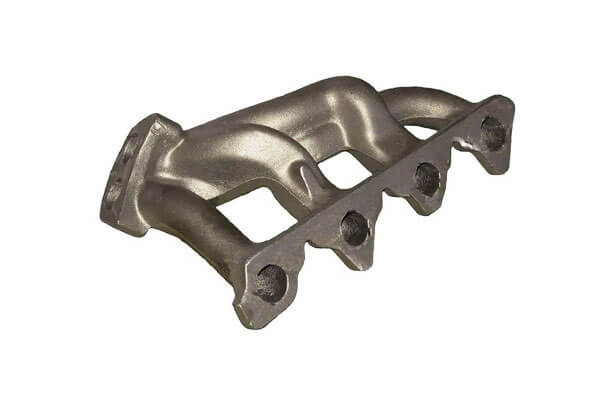
Annaeus and Grain Refinement
To homogenize the microstructure, foundries commonly annea castings at 800-8 °C for 2–4 hours, followed by furnace cooling at ≤20 °C/hour.
This cycle promotes spheroidization of carbides and reduces hardness to 180-220 HBW, easing machining.
Ut, grain size refines from an ASTM 4–6 rating to 6–8, enhancing ductility by 15-25 % and reducing internal stresses by up to 90 %.
Normalizing and Uniform Properties
Deinde, normalizing in 900-950 ° C with air cooling refines grains further to ASTM 5–7 and produces a more uniform pearlitic–ferritic matrix.
Normalised 4340 castings achieve tensile strengths of 850-950 MPA and Charpy impact values near 35 J, improving toughness by 20 % compared to the as-cast condition.
Quench & Temper for High Strength
For maximum strength, alloy steels undergo extinguo & ingenium: austenitizing at 840–860 °C, oil quench to room temperature, then tempering at 550-600 °C enim 2 × 2 horulus. This sequence transforms the matrix to tempered martensite, disperses fine carbides (10–50 nm), and boosts hardness to HRC 45–50 distrahentes viribus usque ad 1 200 MPA. Tempering also restores toughness to 15–25 J, balancing strength and impact resistance.
Solution Treat & Age for Stainless Alloys
Stainless grades like 17-4PH benefit from solution curatio in 1 040 N ° C, quenching in water, et senectus in 480 N ° C enim 4 horulus.
This precipitation-hardening cycle produces nano-scale Ni₃(Al,Cu) particulae, elevating hardness to HRC 38–42 and yield strength to 850 MPA while maintaining corrosion resistance.
5. Key Advantages of Alloy Steel Investment Castings
Alloy steel investment casting delivers a unique combination of precision, performatio, and cost-effectiveness that few processes can match:
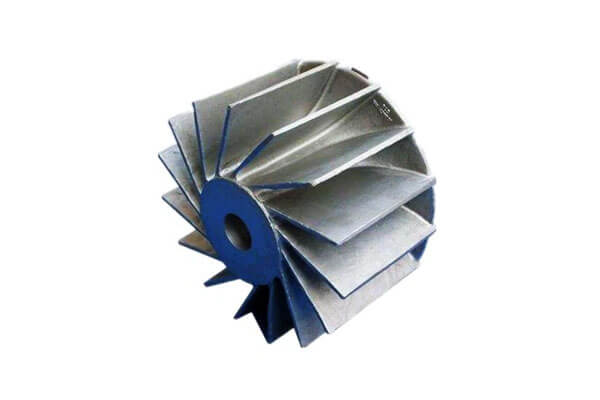
Complex Geometry and Design Freedom
Investment casting handles shapes impossible or prohibitively expensive with other methods—undercuts, interiora, thin walls down to 1 mm, and intricate lattice structures.
Ut, designers reduce part counts by up to 50 % by replacing multi-piece weldments or assemblies with a single investment-cast component.
Tight Tolerances and Superior Surface Finish
Typical dimensional accuracy of ±0.25 mm and as-cast surface finishes of Ra 1–3 µm eliminate extensive secondary machining.
Proinde, manufacturers report 30-50 % citius CNC cycle times and up to 40 % inferior finishing costs compared with sand-cast parts.
Excellent Material Utilization and Yield
Near-net shapes reduce raw-material waste, achieving material yields exceeding 90 % versus 60-70 % for sand casting or 30-50 % for billet machining.
Lower scrap rates directly translate into 15-25 % savings in material costs for high-value alloys.
Broad Alloy Compatibility
From low-alloy steels (8620, 4140, 4340) to stainless and heat-resistant grades (17-4PH, 316L, H13), investment casting accommodates virtually any alloy formulation.
Foundries can tightly control chemical composition and melt cleanliness (inclusion levels < 100 ppm),
ensuring consistent mechanical properties—tensile strengths from 350 ut 1 200 MPA, hardness up to HRC 55, and Charpy toughness values of 10–60 J.
Repeatability and Scalability
Ceramic molds resist deformation for 50–100 pours, yielding consistent results across production runs.
Repeatability better than 95 % on critical dimensions lets OEMs confidently ramp from prototype batches of 10 parts to full-scale production of 1 000+ pieces with minimal requalification.
6. Applications of Alloy Steel Investment Castings
Aerospace
- Key components: Turbine Lamina, structural uncis, engine aggeris, housing parts.
Automotive industria
- Key components: Turbocharger insterni, partes tradendae, brake system components, engine partes.
Oleum et Gas
- Key components: Valvae corporum, Sentinam Housings, impellers, drilling tools, connexiones.
Machinery industriae
- Key components: Gears, councus, cams, mechanical arms, hydrau components.
Militum et defensionem
- Key components: Weapon components, armored vehicle parts, missile system elements.
Medical Equipment
- Key components: Chirurgicam instrumenta, orthopaedicarum implantatorum, dental tools.
Power and Energy
- Key components: Vapor Turbine partium, gas turbine blades, generator components, boiler fittings.
7. Choose DEZE for Your Alloy Steel Investment Castings
Hoc is committed to delivering high-quality alloy steel investment castings that meet the stringent demands of modern industry.
With advanced lost-wax casting technology and precision-controlled processes, Hoc ensures exceptional dimensional accuracy, repeatability, et superficies metam.
Each casting is tailored to meet specific mechanical, scelerum, et corrosio resistentia requisitis,
factio Hoc a trusted partner across sectors such as aerospace, petrochemical, industria, translatio, et medicinae apparatu.
From initial design consultation to final inspection, Hoc integrates strict quality control and metallurgy expertise to provide durable, high-performance alloy steel components that perform reliably in the most demanding environments.
8. Conclusio
Alloy steel investment casting merges DESPICIO cum high‐performance metallurgy.
Through precise control of wax patterns, ceramic conchas, effusio, and heat treatments,
manufacturers deliver components with tensile strengths up to 1 200 MPA, surface finishes of Ra 1–3 µm, et dimensional tolerances of ±0.25 mm.
As digital simulation, additive wax production, and advanced alloys evolve, investment casting will continue to shape the future of mission‐critical parts in aerospace, industria, medicamen, et ultra.

