
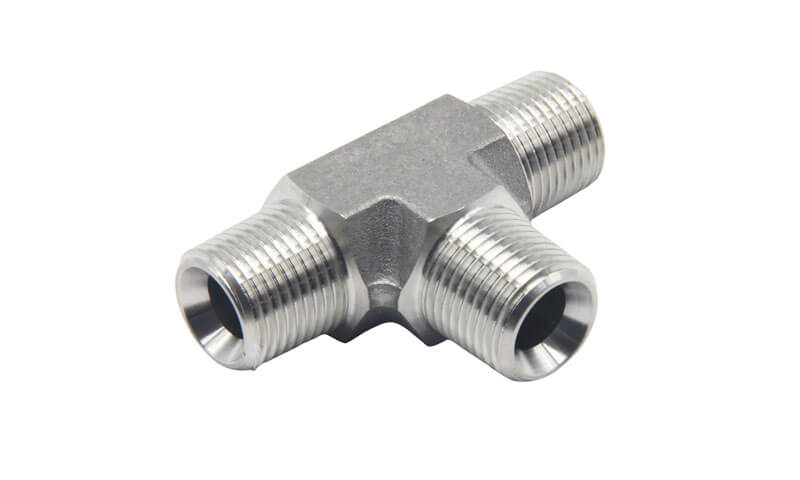
A majice od nehrđajućeg čelika is a three-port pipe fitting designed to divide, kombinirati, or redirect fluid flow within a piping system.
Unlike a simple section of pipe, a tee must integrate three flow passages into a single pressure-containing body while maintaining sufficient mechanical strength, controlled wall thickness, točnost dimenzije, and reliable connections to adjacent piping.
U zahtjevnim primjenama, the geometry of the branch junction also affects flow distribution, local stress concentration, gubitak tlaka, and long-term service reliability.
For complex custom tees, casting (izgubljeni voštani lijev) provides an efficient way to reproduce the three-dimensional junction between the run and branch passages while keeping the body as an integrated casting.
The casting establishes the overall structural geometry, while CNC machining can subsequently produce threads, bušilice, brtvene površine, socket dimensions, and other functional interfaces to the required tolerances.
1. What Is a Stainless Steel Tee?
A majice od nehrđajućeg čelika is a three-way pipe fitting with one main passage and one branch passage intersecting at a controlled geometry.
It is used to split a fluid stream into two directions, combine two streams into one, or provide a branch connection to another section of a piping system.
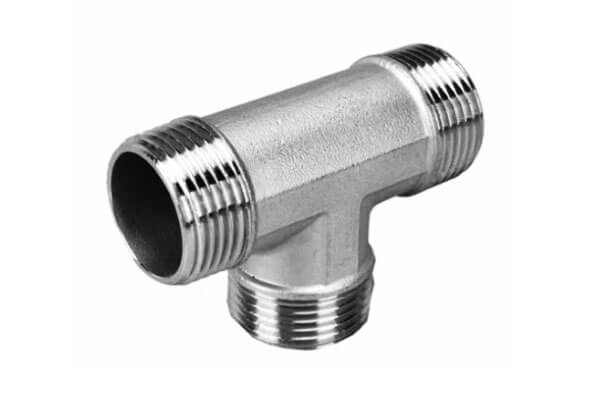
The three openings are normally referred to as the two ends of the run I branch. In an equal tee, the three connection sizes are nominally the same. In a reducing tee, the branch or one side of the run has a smaller diameter.
Because the three passages intersect within a relatively compact body, the junction is more technically demanding than a straight pipe fitting.
The manufacturer must simultaneously control the internal passage geometry, external wall thickness, material soundness, and connection dimensions.
2. Material Engineering & Metalurgija
Material selection is fundamental to the performance of a custom nehrđajući čelik tee because the fitting must simultaneously withstand internal pressure, korozija, temperatura, mehaničko opterećenje, and the manufacturing conditions of investment casting.
Austenitni nehrđajući čelici: Cf8, Cf8m, CF3, and CF3M
CF8 nehrđajući čelik
ASTM A351 CF8 is a cast austenitic stainless steel broadly corresponding to wrought 304 nehrđajući čelik.
It typically contains approximately 18–21 wt.% chromium and 8–11 wt.% nickel, with carbon limited to approximately 0.08 wt.% maximum.
CF8 provides good general corrosion resistance, žilavost, i odvezenost, making it suitable for water, pari, prerada hrane, and many general industrial fluid systems.
CF8M nehrđajući čelik
ASTM A351 CF8M is the cast 316-type grade and typically contains approximately 18–21 wt.% chromium, 9–12 wt.% nickel, and 2–3 wt.% molybdenum.
The molybdenum addition improves resistance to localized corrosion, posebno pitting and crevice corrosion, in many chloride-containing environments.
CF8M is therefore widely considered where chemical exposure, marine conditions, or more demanding fluid service is involved.
For welded or weld-repaired assemblies, the low-carbon grades CF3 and CF3M can provide an important metallurgical advantage.
Their carbon content is generally limited to 0.03 wt.% maximum, reducing the tendency for chromium-carbide precipitation at grain boundaries during thermal exposure.
This helps reduce the risk of sensitization and associated intergranular corrosion, particularly around welded regions.
Duplex i Super Duplex nehrđajući čelici
When a stainless steel tee is exposed to high chloride concentrations, morska voda, offshore environments, or demanding pressure and temperature conditions, duplex stainless steels can provide a useful combination of strength and corrosion resistance.
Dupleks 2205 Nehrđajući čelik
Dupleks 2205, commonly identified by US S32205 and associated cast grade CD3MN, contains a mixed ferritic-austenitic microstructure, typically targeted near a balanced phase ratio after appropriate solution treatment.
This dual-phase structure gives the alloy substantially higher yield strength than conventional austenitic cast stainless steels while maintaining strong resistance to chloride-related corrosion mechanisms.
Compared with CF8M, 2205 can provide approximately twice the yield strength, depending on the applicable product specification and heat-treatment condition.
It also offers good resistance to chloride stress corrosion cracking, zadirkivanje, i pukotinska korozija.
Super duplex 2507 Nehrđajući čelik
Super duplex 2507, commonly designated US S32750 and associated with cast grade CD3MWCuN, contains higher levels of chromium, molibden, and nitrogen than 2205.
It therefore provides higher strength and stronger resistance to localized corrosion, making it appropriate for severe marine, na obali, and process environments.
CK3MCuN Stainless Steel
CK3MCuN is different from duplex stainless steels. To je a visokolegirani austenitni nehrđajući čelik with substantial molybdenum and nitrogen additions and is intended for highly corrosive environments where conventional 304- or 316-type materials may not provide sufficient resistance.
It should therefore be considered separately from duplex and super duplex materials when selecting a cast stainless steel tee.
3. Precizno inženjerstvo & Production Process Flow
Producing a custom stainless steel tee by casting involves a sequence of carefully controlled steps.
Each step influences the final quality, točnost dimenzije, i mehanička svojstva.

CAD/CAM Mold Tooling and Solidification Simulation
The process begins with the customer’s drawing or 3D model. The foundry’s engineering team creates a CAD model of the tee, including allowances for shrinkage, obrada, and draft.
Mold tooling is then designed and machined using CAM software.
Before tooling is cut, solidification and flow simulation is performed using software such as ProCAST or MAGMA. This simulation predicts:
- Mold filling behavior and potential cold shuts.
- Solidification sequence and shrinkage porosity.
- Hot spots and residual stresses.
- Location of risers and chills.
Simulation allows the foundry to optimize gating and risering before any metal is poured, reducing trial-and-error and shortening development time.
Automated Pattern Injection and Robotic Ceramic Shell Building
Wax patterns are produced by injecting molten wax into the mold tooling under pressure.
Automated injection machines ensure consistent pattern dimensions, gustoća, i površinski završetak. Patterns are then assembled onto a central runner or sprue, forming a tree.
The tree is dipped repeatedly in ceramic slurry and coated with stucco to build a ceramic shell.
This is often done using robotic shell building sustava, which ensure consistent coating thickness and drying.
A silika sol postupak is commonly used for stainless steel castings because it produces a smooth, strong shell with excellent dimensional stability.
Dewaxing, Shell Sintering, and Melting
After the shell reaches sufficient thickness, it is heated to melt out the wax (deparafinacija) and then sintered at high temperature to strengthen the ceramic.
The sintered shell is a hollow mold ready for pouring.
Melting is performed in an indukcijska peć, either in air or under vacuum, ovisno o leguri i zahtjevima kvalitete.
Chemistry is verified by spectrographic analysis before pouring. Molten metal is poured into the preheated shell, and the casting is allowed to solidify under controlled conditions.
Post-Casting Finishing
Nakon skrućivanja, keramička ljuska je odlomljena, and the castings are cut from the tree. Gates and risers are removed by grinding or cutting.
The castings then undergo:
- Pucanj: To remove residual ceramic and surface scale.
- Grinding and finishing: To remove gate stubs and blend surfaces.
- Otopina: To restore corrosion resistance and optimize properties.
- Pasivacija: To remove free iron and enhance the passive oxide layer.
- CNC threading: For NPT, BSP, or metric threaded ends.
- Socket or butt weld end preparation: To meet ASME B16.9 or B16.11 requirements.
- Inspection and testing: Dimenzionalno, vizualni, NDT, and pressure testing.
Each step is documented and traceable, ensuring that the finished tee meets the customer’s specifications.
4. Stainless Steel Tee vs. Forged and Fabricated Tees
Investment-cast, kovani, and fabricated stainless steel tees can all be used to create three-way piping connections,
but their manufacturing routes produce different combinations of geometry, metalurška struktura, zahtjevi za strojnu obradu, ekonomika proizvodnje, and customization capability.
The choice should therefore be based on the actual pressure class, stupanj materijala, geometrija, obujam proizvodnje, and applicable piping requirements rather than assuming that one manufacturing process is universally superior.
| Core Characteristic | Investment-Cast Stainless Steel Tee | Forged Stainless Steel Tee | Fabricated Stainless Steel Tee |
| Princip proizvodnje | Molten stainless steel solidifies in a precision ceramic mold | Heated wrought billet is plastically deformed under controlled forging forces | Cijev, ploča, or forged components are cut, fitted, and welded |
| Kompleksna geometrija | Izvrstan | Dobro, but shape is constrained by forging practice | Visok, but complex geometry may require multiple pieces |
| One-Piece Construction | Da | Da | Commonly assembled and welded |
| Internal Passage Geometry | Excellent for suitable investment-cast designs | Good for relatively conventional passages | Vrlo fleksibilan, but fabrication is more involved |
| Material Structure | Cast microstructure, controlled through solidification and heat treatment | Kovan, worked structure | Wrought/fabricated material plus weld zones |
| Prilagođavanje | Excellent for non-standard dimensions and branch configurations | Dobro, but tooling and forging constraints increase with complexity | Excellent for special or very large configurations |
| Zahtjevi za strojnu obradu | Umjeren; connection and sealing surfaces normally machined | Often moderate to high | Moderate to high depending on fabrication |
Welds |
No structural weld required in the basic tee body | No structural weld required in the forged body | Multiple welds may be required |
| Tooling Requirement | Pattern/tooling required | Forging dies may be required | Lower dedicated tooling requirement |
| Complex Small-to-Medium Parts | Vrlo pogodan | Prikladno | Can be less economical |
| Large Special Tees | Process-dependent | Process-dependent | Often practical |
| Repeat Production | Excellent once tooling is established | Izvrstan | Dobro |
| Main Manufacturing Advantage | Complex integrated geometry with near-net shape | Wrought mechanical structure and established forging routes | Flexible fabrication with relatively low initial tooling |
| Main Limitation | Requires rigorous control of casting soundness and solidification | Less flexible for intricate geometry | Weld quality, izobličenje, and residual stress require control |
5. Industrijska primjena & Real-World Case Studies
Custom stainless steel tees are used across a wide range of industries and applications.

Chemical and petrochemical: Piping systems for acids, otapala, and reactive chemicals. CF8M and duplex alloys are common.
Nafta i plin: Offshore platforms, rafinerije, i cjevovoda. Duplex and super duplex tees are used for seawater and high-chloride service.
Stvaranje energije: Pare, voda za hlađenje, i sustavi za odsumporavanje dimnih plinova. CF8M and high-alloy stainless steels are used.
Pharmaceutical and biotechnology: Clean steam, purified water, and process piping. CF3M and electropolished tees are common.
Food and beverage: Process piping for dairy, kuhanje piva, i prerada hrane. CF8M and hygienic designs are used.
Morski: Cjevovod za morsku vodu, balastni sustavi, and deck drainage. Duplex and super duplex tees are preferred.
Obrada vode: Desalinizacija, otpadne vode, and chemical dosing systems. CF8M and duplex alloys are used.
6. Choose DEZE as Your Custom Stainless Steel Tee Manufacturer
Ova tehnologija provides integrated custom stainless steel casting and CNC machining solutions for complex pipe fittings and industrial components.
From initial engineering review and material selection to investment casting, toplotna obrada, CNC obrada, završnica površine, i završni pregled, OVAJ manages the key manufacturing stages within an integrated workflow.
As an ISO 9001:2015-ovjeren manufacturer, OVAJ maintains production traceability and quality control throughout the manufacturing process. Inspection and testing can be arranged according to project requirements.
Kontaktirajte OVO with your drawing, 3D model, specifikacija materijala, dimenzije, or application requirements.
Our engineering team can review the design and develop a suitable custom stainless steel tee casting solution for your project.
7. Zaključak
Custom stainless steel tees are critical components in piping systems where corrosion resistance, cjelovitost pritiska, and reliability are essential.
Investment casting offers a unique combination of design freedom, fleksibilnost materijala, and cost-effectiveness that makes it ideal for complex tees in medium to high volumes.
From CF8 and CF8M austenitic grades to duplex and super duplex alloys, the material selection must match the service environment.
Solution annealing is essential to restore corrosion resistance and optimize mechanical properties.
Precision machining ensures that end preparations, niti, and dimensions meet the requirements of the piping system.
Choosing the right manufacturing partner is essential. A foundry with engineering expertise, in-house machining, heat treatment capabilities, and a strong quality system can help ensure that every tee performs reliably in its intended application.
DEZE is positioned as such a partner, offering the technical depth and production capability needed for custom stainless steel tee projects.
Česta pitanja
Why use investment casting for a stainless steel tee?
Investment casting is suitable for complex tee geometry because it can produce the run, branch, junction, and external structure as an integrated casting.
Critical interfaces such as threads, bušilice, and sealing surfaces can then be CNC machined.
Does a stainless steel tee require heat treatment?
Many cast stainless steel grades require or benefit from a specified heat-treatment condition.
For austenitic and duplex castings, solution treatment is commonly important for achieving the required metallurgical and corrosion properties. The exact cycle is grade-specific.
What is the difference between an equal tee and a reducing tee?
An equal tee has all three openings the same size. A reducing tee has a branch opening smaller than the run openings. Reducing tees are used when only a portion of the flow is diverted.
Can investment cast tees be used in high-pressure service?
Da, when properly designed, cast, termički obrađen, i pregledan. Investment cast tees can meet pressure and leak-test requirements for many high-pressure applications.
For extreme pressures, forged tees may be preferred.
What end preparations are available for stainless steel tees?
Common end preparations include threaded (NPT, BSP), zavareni spoj, sučeoni zavar, and flanged. The choice depends on the piping system, pritisak, i zahtjevi za montažu.

