1. Tabhairt isteach
Copar remains a cornerstone of modern engineering, celebrated for its exceptional electrical and thermal conductivity, friotaíocht creimthe, and malleability.
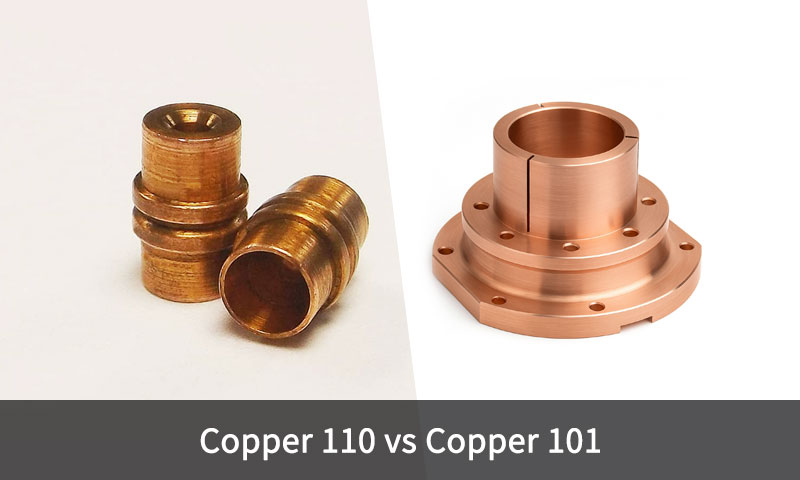
Among commercially pure coppers, Copar 110 (C11000, ETP) is Copar 101 (C10100, OFE) are two widely used grades, each optimized for specific applications.
While both offer outstanding conductivity and formability, their differences in purity, oxygen content, micreastruchtúr, and suitability for vacuum or high-reliability applications make the choice between them critical for engineers, dearthóirí, and materials specialists.
This article provides an in-depth, technical comparison of these two copper grades, supported by property data and application guidance.
2. Caighdeáin & Nomenclature
Copar 110 (C11000) is commonly referred to as Cu-ETP (Copar diana leictrealaíoch diana).

It is standardized under UNS C11000 and the EN designation Cu-ETP (CW004A). C11000 is widely manufactured and supplied in various product forms including wire, rod, scód, and plate, making it a versatile choice for general electrical and industrial applications.
Copar 101 (C10100), Ar an láimh eile, is known as Cu-OFE (Oxygen-Free Electronic Copper).

It is ultra-pure copper with extremely low oxygen content, standardized under UNS C10100 and EN Cu-OFE (CW009A).
C10100 is specifically refined to eliminate oxygen and oxide inclusions, which makes it ideal for folamh, high-reliability, and electron-beam applications.
Specifying the UNS or EN designation along with the product form and temper is critical for ensuring the material meets the required performance characteristics.
3. Chemical Composition and Microstructural Differences
The chemical composition of copper directly influences its purity, seoltacht leictreach agus teirmeach, iompar meicniúil, and suitability for specialized applications.
While both Copper 110 (C11000, ETP) agus Copar 101 (C10100, OFE) are classified as high-purity coppers, their microstructures and trace element content differ significantly, affecting performance in critical applications.
| Eilimint / Saintréith | C11000 (ETP) | C10100 (OFE) | Nótaí |
| Copar (Rise) | ≥ 99.90% | ≥ 99.99% | OFE has ultra-high purity, beneficial for vacuum and electronic applications |
| Ocsaigin (O) | 0.02–0.04 wt% | ≤ 0.0005 wt% | Oxygen in ETP forms oxide inclusions; OFE is essentially oxygen-free |
| Airgead (Ag) | ≤ 0.03% | ≤ 0.01% | Trace impurity, minor impact on properties |
| Fosfar (P) | ≤ 0.04% | ≤ 0.005% | Lower phosphorus in OFE reduces risk of embrittlement and oxide formation |
4. Airíonna fisiceacha: Copar 110 vs 101
Physical properties such as dlús, leáphointe, Seoltacht theirmeach, agus seoltacht leictreach are fundamental for engineering calculations, seift, agus roghnú ábhar.
Copar 110 (C11000, ETP) agus Copar 101 (C10100, OFE) share very similar bulk properties because both are essentially pure copper, but minor differences in purity and oxygen content can slightly affect performance in specialized applications.
| Maoin | Copar 110 (C11000, ETP) | Copar 101 (C10100, OFE) | Nótaí / Impleachtaí |
| Dlús | 8.96 g/cm³ | 8.96 g/cm³ | Identical; suitable for weight calculations in structures and conductors. |
| Leáphointe | 1083–1085 °C | 1083–1085 °C | Both grades melt at nearly the same temperature; processing parameters for casting or brazing are equivalent. |
| Seoltacht Leictreach | ~100 % IACS | ~101 % IACS | OFE offers marginally higher conductivity due to ultra-low oxygen and impurity content; relevant in high-precision or high-current applications. |
| Seoltacht theirmeach | 390–395 W·m⁻¹·K⁻¹ | 395–400 W·m⁻¹·K⁻¹ | Slightly higher in OFE, which improves heat transfer efficiency in thermal management or vacuum applications. |
| Cumas teasa ar leith | ~0.385 J/g·K | ~0.385 J/g·K | Same for both; useful for thermal modeling. |
| Comhéifeacht leathnú teirmeach | ~16.5 × 10⁻⁶ /K | ~16.5 × 10⁻⁶ /K | Negligible difference; important for joint and composite design. |
| Friotachas leictreach | ~1.72 μΩ·cm | ~1.68 μΩ·cm | Lower resistivity of C10100 contributes to slightly better performance in ultra-sensitive circuits. |
5. Mechanical Properties and Temper/Condition Effects
Mechanical performance of copper depends strongly on processing temper, including annealing and cold working.
Copar 101 (C10100, OFE) generally offers higher strength in cold-worked conditions due to its ultra-high purity and oxide-free microstructure,
whereas Copper 110 (C11000, ETP) taispeántais superior formability agus insínteacht, making it well-suited for forming-intensive applications such as deep drawing or stamping.

Mechanical Properties by Temper (Luachanna tipiciúla, ASTM B152)
| Maoin | Temper | Copar 101 (C10100) | Copar 110 (C11000) | Modh Tástála |
| Neart teanntachta (MPA) | Anúite (O) | 220–250 | 150–210 | ASTM E8/E8M |
| Neart teanntachta (MPA) | Fuar-Oibrithe (H04) | 300–330 | 240–270 | ASTM E8/E8M |
| Neart teanntachta (MPA) | Fuar-Oibrithe (H08) | 340–370 | 260–290 | ASTM E8/E8M |
| Neart táirgeachta, 0.2% seachtrach (MPA) | Anúite (O) | 60–80 | 33–60 | ASTM E8/E8M |
| Neart táirgeachta, 0.2% seachtrach (MPA) | Fuar-Oibrithe (H04) | 180–200 | 150–180 | ASTM E8/E8M |
| Neart táirgeachta, 0.2% seachtrach (MPA) | Fuar-Oibrithe (H08) | 250–280 | 200–230 | ASTM E8/E8M |
| Fadú ag sos (%) | Anúite (O) | 45–60 | 50–65 | ASTM E8/E8M |
| Fadú ag sos (%) | Fuar-Oibrithe (H04) | 10–15 | 15–20 | ASTM E8/E8M |
| Cruas brinell (HBW, 500 kg) | Anúite (O) | 40–50 | 35–45 | ASTM E10 |
| Cruas brinell (HBW, 500 kg) | Fuar-Oibrithe (H04) | 80–90 | 70–80 | ASTM E10 |
Léargais Eochair:
- Anúite (O) Temper: Both grades are soft and highly ductile. C11000’s higher elongation (50–65%) dhéanann sé iontach do líníocht dhomhain, ag stampáil, and electrical contact manufacturing.
- Fuar-Oibrithe (H04/H08) Temper: C10100’s ultra-purity enables more uniform work hardening, mar thoradh ar tensile strength 30–40% higher than C11000 in H08 temper.
This makes it suitable for load-bearing or precision components, including superconducting coil windings or high-reliability connectors. - Cruas brinell: Increases proportionally with cold working. C10100 achieves higher hardness for the same temper due to its clean, oxide-free microstructure.
6. Manufacturing and fabrication behavior
Copar 110 (C11000, ETP) agus Copar 101 (C10100, OFE) behave similarly in many fabrication operations because both are essentially pure copper, ach tá an difference in oxygen and trace impurities produces meaningful practical contrasts during forming, machining and joining.
Forming and cold-working
- Ductility and bendability:
-
- Annealed material (O temper): both grades are highly ductile and accept tight bends, deep drawing and severe forming.
Annealed copper can typically tolerate very small inside bend radii (close to 0.5–1.0 × sheet thickness in many cases), making it excellent for stamping and intricate shaped parts. - Cold-worked tempers (H04, H08, srl.): strength rises and ductility falls as temper increases; minimum bend radii must be increased accordingly.
Designers should size bend radii and fillets based on temper and intended post-forming stress relief.
- Annealed material (O temper): both grades are highly ductile and accept tight bends, deep drawing and severe forming.
- Work hardening & drawability:
-
- C10100 (OFE) tends to harden more uniformly during cold work because of its oxide-free microstructure; this yields higher achievable strength in H-tempers and can be advantageous for parts that require higher mechanical performance after drawing.
- C11000 (ETP) is extremely forgiving for progressive drawing and stamping operations because oxide stringers are discontinuous and typically do not interrupt forming at commercial strain levels.
- Annealing and recovery:
-
- Athchriostalú for copper occurs at relatively low temperatures compared with many alloys; depending on prior cold work, recrystallization onset may begin within roughly 150–400 °C.
- Industrial full-anneal practice commonly uses temperatures in the 400–650 °C raon (time and atmosphere selected to avoid oxidation or surface contamination).
OFE parts intended for vacuum use may be annealed in inert or reducing atmospheres to preserve surface cleanliness.
Eisiúil, rolling and wire drawing
- Wire drawing: C11000 is the industry standard for high-volume wire and conductor production because it combines excellent drawability with stable conductivity.
C10100 is also draw-able to fine gauges but is selected when downstream vacuum performance or ultra-clean surfaces are required. - Eisiúil & reolachán: Both grades extrude and roll well. Surface quality of OFE is typically superior for high-precision rolled products because of the absence of oxide inclusions; this can reduce interdendritic tearing or micro-pits in demanding surface finishes.
Meaisínithe
- General behavior: Copper is relatively soft, thermally conductive and ductile; it tends to produce continuous, gummy chips if parameters are not optimized.
Machinability for C11000 and C10100 is similar in practice. - Tooling and parameters: Use sharp cutting edges, rigid fixturing, positive rake tools (carbide or high-speed steel depending on volume), controlled feeds and depths, and ample cooling/flush to avoid work hardening and built up edge.
For long continuous cuts, chip breakers and intermittent cutting strategies are recommended. - Surface finish and burr control: OFE material often achieves a marginally better surface finish in precision micromachining due to fewer micro-inclusions.
Joining — soldering, prásála, táthú, diffusion bonding
- sádráil: Both grades solder readily after proper cleaning.
Because C11000 contains trace oxygen and oxide films, standard rosin or mildly active fluxes are typically used; thorough cleaning before soldering improves joint reliability.
OFE’s cleaner surface can reduce flux requirement in some controlled processes. - Brazing: Brazing temperatures (>450 ° C) can expose oxide films; C11000 brazing generally requires appropriate fluxes or controlled atmospheres.
Faoi vacuum brazing or fluxless brazing, C10100 is strongly preferred, as its negligible oxide content prevents oxide vaporization and contamination of the vacuum environment. - Arc welding (TIG/ME) agus táthú friotaíochta: Both grades can be welded using standard copper welding practices (high current, preheating for thick sections, and inert gas shielding).
OFE offers cleaner weld pools and fewer oxide-related defects, which is advantageous in critical electrical joints. - Electron-beam and laser welding: These high-energy, low-contamination methods are commonly used in vacuum or precision applications.
C10100 is the material of choice here because its low impurity and oxygen levels minimize vaporized contaminants and improve joint integrity. - Diffusion bonding: For vacuum and aerospace assemblies, OFE’s cleanliness and near-single-phase microstructure make it more predictable in solid-state bonding processes.
Ullmhú dromchla, cleaning and handling
- Faoi C11000, degreasing, mechanical/chemical oxide removal and proper flux application are normal prerequisites for high-quality joins.
- Faoi C10100, strict cleanliness control is required for vacuum use: handling with gloves, avoiding hydrocarbons, ultrasonic solvent cleaning, and cleanroom packaging are common practices.
Vacuum bake-out (E.g., 100–200 °C depending on condition) is often used to remove adsorbed gases prior to UHV service.
7. Creimthe, vacuum performance and hydrogen/oxygen effects
These three interrelated topics—corrosion resistance, vacuum behavior (outgassing and contaminant vaporization), and interactions with hydrogen/oxygen—are where Copper 110 agus Copar 101 diverge most in functional performance.
Corrosion behavior (atmospheric and galvanic)
- General atmospheric corrosion: Both grades form a stable surface film (paitín) that limits further corrosion under normal indoor and many outdoor environments.
Pure copper resists general corrosion much better than many active metals. - Local corrosion and environments: In chloride-rich environments (muirí, salainn dí-oighrithe), copper can experience accelerated attack if crevices are present or deposits allow localized electrochemical cells to form.
Design to avoid crevice geometries and allow drainage/inspection. - Galvanic coupling: Copper is relatively noble compared with many structural metals.
When electrically coupled to less-noble metals (E.g., alúmanam, Mainistreach, some steels), the less noble metal will corrode preferentially.
Practical design rules: avoid direct contact with active metals, insulate dissimilar-metal joints, or use corrosion-allowance/coatings where needed.
Vacuum performance (outgassing, vaporization and cleanliness)
- Why vacuum performance matters: In ultra-high-vacuum (UHV) córais, even ppm levels of volatile impurities or oxide inclusions can create contamination,
increase base pressure, or deposit films on sensitive surfaces (optical mirrors, semiconductor wafers, electron optics). - C11000 (ETP): trace oxygen and oxide stringers can lead to increased outgassing and potential vaporization of oxide particles at elevated temperatures in vacuum.
For many low-vacuum or rough-vacuum applications this is acceptable, but UHV users must be cautious. - C10100 (OFE): its ultra-low oxygen and impurity content results in significantly lower outgassing rates, reduced partial pressures of condensable species during bake-out, and far less contamination risk under electron-beam or high-temperature vacuum exposure.
For bake-out cycles and residual-gas analysis (RGA) cobhsaíocht, OFE typically outperforms ETP by a wide margin in practical systems. - Best practices for vacuum use: vacuum-grade cleaning, solvent degrease, ultrasonic baths, cleanroom assembly, and controlled bake-out are mandatory.
Specify OFE for components exposed directly to UHV or to electron/ion beams.
Hidrigin, oxygen interactions and embrittlement risks
- Briseadh hidrigine: Tá copar nach bhfuil susceptible to hydrogen embrittlement in the same way steels are;
typical copper alloys do not fail by the classical hydrogen-induced cracking mechanisms seen in high-strength steels. - Hydrogen/oxygen chemistry: cibé dóigh, faoi high-temperature reducing atmospheres (hydrogen or forming gas at elevated temperature),
copper that contains oxygen or certain deoxidizer residues can undergo surface reactions (water formation, oxide reduction) that may alter surface morphology or promote porosity in brazes.
OFE’s low oxygen content mitigates these concerns. - Service considerations: in hydrogen service at high temperature or in processes where hydrogen is present (E.g., certain anneals or chemical processing), specify OFE if surface chemistry and dimensional stability are critical.
8. Typical Industrial Applications
C11000 (ETP):
- Power distribution busbars, cáblaí, agus chónaisc
- Transformers, mótar -mhópáil, switchgear
- Architectural copper and general fabrication
C10100 (OFE):
- Vacuum chambers and ultra-high-vacuum equipment
- Electron-beam, RF, and microwave components
- Semiconductor manufacturing and cryogenic conductors
- High-reliability laboratory instrumentation
Achoimre: C11000 is suitable for general electrical and mechanical use, whereas C10100 is required when vacuum stability, minimal impurities, or ultra-clean processing atá riachtanach.
9. Costas & infhaighteacht
- C11000: This is the standard, high-volume copper product.
It is generally níos saoire and more widely stocked by mills and distributors, making it the default choice for mass production and budget-sensitive applications. - C10100: Carries a praghas préimhe due to additional refining steps, special handling requirements, and smaller production volumes.
It is available, but typically only in limited product forms (barra, plátaí, sheets in select tempers) and often requires amanna luaidhe níos faide.
For high-volume components where cost efficiency is critical, C11000 is usually specified.
Os a choinne sin, faoi niche applications such as vacuum or high-purity electronic components, the performance benefits of C10100 justify the higher cost.
10. Comparáid Chuimsitheach: Copar 110 vs 101
| Príomhscannán | Copar 110 (C11000, ETP) | Copar 101 (C10100, OFE) | Impleachtaí Praiticiúla |
| Copper Purity | ≥ 99.90% | ≥ 99.99% | OFE copper offers ultra-high purity, crucial for vacuum, high-reliability, and electron-beam applications. |
| Oxygen Content | 0.02–0.04 wt% | ≤ 0.0005 wt% | Oxygen in C11000 forms oxide stringers; C10100’s near-zero oxygen prevents oxide-related defects. |
| Seoltacht Leictreach | ~100 % IACS | ~101 % IACS | OFE offers slightly higher conductivity, relevant in precision electrical systems. |
| Seoltacht theirmeach | 390–395 W·m⁻¹·K⁻¹ | 395–400 W·m⁻¹·K⁻¹ | Minor difference; OFE slightly better for heat-sensitive or high-precision applications. |
| Airíonna meicniúla (Anúite) | Tensile 150–210 MPa, Elongation 50–65% | Tensile 220–250 MPa, Elongation 45–60% | C11000 more formable; C10100 stronger in annealed or cold-worked states. |
| Airíonna meicniúla (Cold-Worked H08) | Tensile 260–290 MPa, Elongation 10–15% | Tensile 340–370 MPa, Elongation 10–15% | C10100 benefits from higher work hardening due to ultra-clean microstructure. |
Fabrication/Forming |
Excellent formability for stamping, lúbúil, líníocht | Formability den scoth, superior work hardening and dimensional stability | C11000 suited for high-volume fabrication; C10100 preferred for precision components or high-reliability parts. |
| Le linn (Brazing/Welding) | Flux-assisted brazing; standard welding | Fluxless brazing, cleaner welds, preferred for electron-beam or vacuum welding | OFE critical for vacuum or high-purity applications. |
| Vacuum/Cleanliness | Acceptable for low/medium vacuum | Required for UHV, minimal outgassing | OFE chosen for ultra-high-vacuum or contamination-sensitive environments. |
| Cryogenic Performance | Go maith | Thar cionn; stable grain structure, minimal thermal expansion variation | OFE preferred for superconducting or low-temperature instrumentation. |
| Costas & Infhaighteacht | Íseal, widely stocked, multiple forms | Préimh, limited forms, amanna luaidhe níos faide | Choose C11000 for cost-sensitive, iarratais ard-toirte; C10100 for high-purity, specialized applications. |
| Feidhmeanna tionsclaíocha | Busbars, sreangú, cónascairí, leathán miotail, general fabrication | Vacuum chambers, electron-beam components, high-reliability electrical paths, cryogenic systems | Match grade to operational environment and performance requirements. |
12. Deireadh
C11000 and C10100 are both high-conductivity coppers suitable for a wide range of applications.
The primary difference lies in oxygen content and impurity level, which influence vacuum behavior, ag gabháil, and high-reliability applications.
C11000 is cost-effective and versatile, making it the standard for most electrical and mechanical applications.
C10100, with ultra-high purity, is reserved for folamh, electron-beam, crióigineach, and high-reliability systems where oxide-free microstructure is essential.
Material selection should prioritize functional requirements over nominal property differences.
Ceisteanna Coitianta
Is C10100 significantly better electrically than C11000?
Níl. The electrical conductivity difference is minor (~100% vs 101% IACS). The primary advantage is ultra-low oxygen content, which benefits vacuum and high-reliability applications.
Can C11000 be used in vacuum equipment?
Tá, but its trace oxygen may outgas or form oxides under ultra-high vacuum conditions. For strict vacuum applications, C10100 is preferred.
Which grade is standard for power distribution?
C11000 is the industry standard for busbars, cónascairí, and general electrical distribution due to its conductivity, Foirmiúlacht, agus éifeachtúlacht costais.
How should OFE copper be specified for procurement?
Include UNS C10100 or EN Cu-OFE designation, oxygen limits, minimum conductivity, product form, and temper. Request Certificates of Analysis for trace oxygen and copper purity.
Are there intermediate copper grades between ETP and OFE?
Tá. Phosphorus-deoxidized coppers and high-conductivity variants exist, designed for improved solderability or reduced hydrogen interaction. Selection should match the application requirements.