Ball valve vs butterfly valve are among the most widely used quarter-turn valves in industry. Both provide rapid operation and compact installations, but they serve very different needs:
- Ball valves deliver excellent tight shutoff, low pressure drop when full open, ruggedness and generally superior sealing performance — ideal for isolation, service with higher pressures / temperatures and where leakage cannot be tolerated.
- Butterfly valves provide a lighter, lower-cost alternative that excels at large diameters, mababa ang- to medium-pressure systems and applications where space, weight and cost are critical (hal., HVAC, water distribution).
High-performance designs narrow performance gaps, but tradeoffs remain.
This article compares the two valve families from design, hydraulic, mekanikal, materials and lifecycle perspectives so you can choose the correct valve for a given application.
1. Structural Principles and Classifications of Ball Valve vs Butterfly Valve
Ball valve
A ball valve uses a hollowed, rotating sphere (the “ball”) with a through-hole (bore) that aligns with the pipe to permit flow or rotates 90° to block it.
Operation is quarter-turn (90°) between fully open and fully closed. Variants include floating ball and trunnion-mounted ball designs; port styles include full-port, reduced-port, and V-port (for throttling).

Mga Klasipikasyon
- By Body Construction:
-
- One-Piece Ball Valve – Compact, matipid, minimal leak paths, non-serviceable.
- Two-Piece Ball Valve – Easier maintenance, common in industrial piping.
- Three-Piece Ball Valve – Removable center section for in-line servicing; favored in high-purity and sanitary processes.
- By Ball Support Type:
-
- Floating Ball Valve – Ball floats against downstream seat for sealing; typical in small to medium sizes.
- Trunnion-Mounted Ball Valve – Ball fixed on trunnions, reducing seat load and operating torque; suitable for large diameters and high pressure.
- By Port Design:
-
- Full Port Ball Valve – Bore diameter equals pipe ID, minimal pressure drop.
- Reduced Port Ball Valve – Smaller bore, pagtitipid sa gastos, slightly higher pressure drop.
- V-Port Ball Valve – V-shaped notch in ball for precise flow control.
- By Special Features:
-
- Cryogenic Ball Valve, Metal-Seated Ball Valve, Fire-Safe Ball Valve, Cavity-Filler Ball Valve for slurry service.
Butterfly valve
A balbula ng paruparo uses a flat, circular disc mounted on a shaft. Rotating the shaft 90° turns the disc from parallel (open) to perpendicular (closed) to flow.
Configurations include concentric (zero-offset), double-offset (mataas na pagganap), and triple-offset (metal-seat, high-pressure/temperature sealing).

Mga Klasipikasyon
- By Body Type:
-
- Wafer Type Butterfly Valve – Fits between flanges, held by bolts; compact and lightweight.
- Lug Type Butterfly Valve – Threaded inserts for independent flange connection.
- Flanged Butterfly Valve – Integrated flanges for high-pressure service.
- By Disc Offset:
-
- Concentric Butterfly Valve – Stem axis coincides with disc center; low-pressure duty.
- Double Offset Butterfly Valve – Stem offset from disc and body center, reducing seat wear; higher pressure capability.
- Triple Offset Butterfly Valve – Adds third offset for metal-to-metal sealing; high-temperature service up to ~600°C.
- By Seat Design:
-
- Resilient-Seated Butterfly Valve – Rubber/elastomer seat, Class VI shutoff, up to ~150°C.
- PTFE-Lined Butterfly Valve – Excellent chemical resistance for corrosive media.
- Metal-Seated Butterfly Valve – For abrasive or extreme temperature applications.
2. Impact of Material Selection on the Performance of Ball and Butterfly Valves
Material selection directly influences valve performance in sealing reliability, buhay ng paglilingkod, paglaban sa kaagnasan, and suitability for specific media and operating conditions.
Parehong mga balbula ng bola at Mga balbula ng paruparo require careful matching of body, trim, and seat materials to the intended application environment.
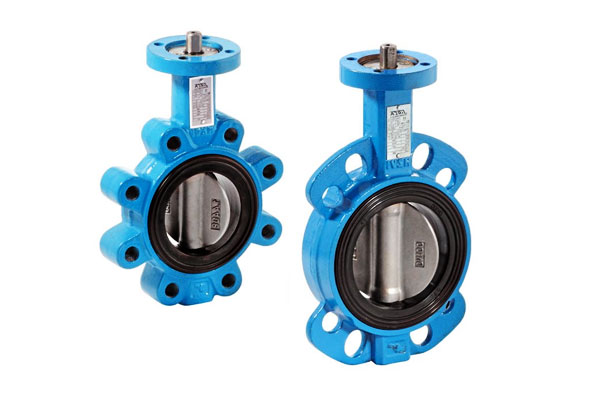
Material Selection for Ball Valves
Valve Body Material
- Carbon Steel (WCB / A216) – High strength and cost-effective; suited for non-corrosive fluids in oil & gas pipelines. Temperature limit: ~425°C.
- Hindi kinakalawang na asero (CF8 / CF8M) – Superior corrosion resistance; CF8M (316) withstands chlorides and seawater.
- Duplex & Super Duplex hindi kinakalawang na asero – Excellent resistance to pitting and crevice corrosion; ideal for seawater and offshore platforms.
- tanso / tanso – Good for potable water, HVAC, and low-pressure industrial systems; moderate corrosion resistance.
- Alloy Steels & Mga haluang metal ng Nickel (Inconel, Monel) – Selected for extreme chemical resistance, mataas na temperatura, or sour gas service.
Ball and Seat Material
- Ball:
-
- Chrome-Plated Carbon Steel – Good hardness and wear resistance for general duty.
- 316 Hindi kinakalawang na asero – Corrosion-resistant for chemical and food-grade applications.
- Ceramic-Coated Balls – Exceptional wear resistance for abrasive media.
- Upuan:
-
- PTFE (Teflon) – Wide chemical compatibility, up to ~200°C.
- Reinforced PTFE (R-PTFE) – Enhanced wear resistance, higher pressure handling.
- Metal Seats (Stellite, Tungsten Carbide) – Suitable for high-temperature steam and abrasive slurries, up to ~600°C.
Material Selection for Butterfly Valves
Valve Body Material
- Cast Iron / Ductile Iron – Common for water supply and HVAC; ductile iron offers higher strength.
- Carbon Steel – Used in oil & gas, pagbuo ng kapangyarihan, and moderate-pressure steam service.
- Hindi kinakalawang na asero (304, 316) – Ideal for food processing, kemikal na, at mga kapaligiran na nakakasira.
- Aluminyo Bronze – Excellent resistance to seawater and marine biofouling.
Disc and Seat Material
- Disc:
-
- Hindi kinakalawang na asero (316) – Excellent corrosion resistance in aggressive media.
- Duplex hindi kinakalawang na asero – High strength and chloride resistance.
- Coated Discs (Epoxy, Naylon, or PTFE) – For abrasion or chemical resistance in municipal and chemical service.
- Upuan:
-
- EPDM – Good for water and mild chemicals; temperature range ~–40°C to +120°C.
- NBR (Nitrile Rubber) – Oil and fuel resistance; –30°C to +100°C.
- PTFE-Lined – Excellent for corrosive acids and solvents.
- Metal Seats – For high-temperature or abrasive conditions; used in triple offset designs.
3. Comparison of Sealing Performance of Ball Valve vs Butterfly Valve
Sealing capability is one of the most critical parameters in valve selection, as it directly impacts leakage rates, operational safety, and maintenance intervals.
Industry standards such as ANSI/FCI 70-2 at ISO 5208 define leakage classes, ranging from Class I (highest permissible leakage) to Class VI (bubble-tight shutoff).
| Uri ng balbula | Seat Type | Typical Leakage Class | Key Service Range |
| Balbula ng Bola | Malambot na (PTFE, elastomer) | Class VI | Clean liquids, mga gas, low-abrasion service |
| Balbula ng Bola | Metal | Class IV–V | Mataas na temperatura, abrasive, steam service |
| Butterfly balbula | Concentric (Resilient) | Class III–IV | Low/medium pressure water, HVAC |
| Butterfly balbula | Double Offset | Class IV–V | Steam, moderate pressure gas/liquid |
| Butterfly balbula | Triple Offset | Class VI | Mataas na temperatura, high-pressure critical isolation |
4. Flow Control Performance of Ball Valve vs Butterfly Valve
Flow performance is a key determinant in valve selection, influencing pump sizing, system efficiency, and energy consumption.
The two most important parameters here are flow coefficient (CV) at pressure drop (ΔP), both defined by standards such as ISA S75.02 at IEC 60534.

Flow coefficient (CV)
Cv is the flow of water (GPM) at 60°F that results in a 1 psi pressure drop across the valve. Valve Cv depends on size and design.
- Ball valves: Full-port ball valves typically have high Cv for their nominal size and produce very low pressure drop when fully open because the bore nearly matches pipe ID.
Reduced-port ball valves lower Cv. Ball valves with V-ports are designed to provide more linear throttling characteristics. - Butterfly valves: For a given nominal diameter, butterfly valves often have a higher Cv than reduced-port ball valves because the disc open area is large;
gayunpaman, because the disc obstructs the flow profile even when open (especially in eccentric designs), pressure drop and flow profile differ.
Sa pagsasanay, a butterfly valve tends to show a more gradual change in flow coefficient vs angle than a standard ball valve (except V-ball).
Throttling/control behavior
- Ball valves: Not ideal for fine throttling unless specially designed (V-port or characterized trim).
Abrupt change around small openings; risk of seat damage/erosion if used for long-term modulation with particulate slurry. - Butterfly valves: Generally better for coarse throttling in larger pipelines—double-offset and specially profiled discs can be used for control.
Triple-offset valves with metal seats can handle higher temperatures and provide tighter control than concentric elastomeric butterfly valves.
Flow Performance Summary Table
| Uri ng balbula | Port / Disc Design | CV (4″ Example) | Flow Characteristic | Relative ΔP |
| Balbula ng Bola (Full Port) | Full bore, unobstructed | 740–800 | Quick-opening | Very low |
| Balbula ng Bola (Reduced Port) | Reduced bore | 550–600 | Quick-opening | Mababa ang |
| Butterfly balbula (Resilient) | Concentric disc | 500–550 | Modified equal-percentage | Katamtaman |
| Butterfly balbula (Mataas na Pagganap) | Streamlined double offset disc | 550–600 | Modified equal-percentage | Medium-low |
5. Pressure/temperature ratings, size ranges and typical duty envelopes
Ball valves
- Typical pressure ratings: Klase ng ANSI 150 (~285 psi), Klase 300 (~740 psi), up to Class 600/900 for forged/trunnion designs.
Trunnion ball valves are common above ~6–8″ and/or > Klase 300. - Temperatura: Depends on seat material (PTFE seats commonly limited to ~200°C; metal seats for higher temperatures).
- Sukat: common from 1/4″ up to 24″+ in trunnion designs.
Butterfly valves
- Typical pressure ratings: wafer/lug concentric up to ~PN10/PN16 (150–230 psi); lugged and double/triple offset up to PN25–PN40 and higher for special designs.
High-performance triple-offset units are available for Class 150–600 equivalent pressures. - Temperatura: elastomer seats limited (–40°C to ~150°C); PTFE seats higher (~200°C); metal seats suitable for >200°C.
- Sukat: very common from 2″ to 48″+; cost/weight advantages become pronounced at larger diameters.
6. Media Adaptability of Ball Valve vs Butterfly Valve
The suitability of a valve for various media types depends on its flow path geometry, sealing design, at materyal na pagkakatugma.
Choosing the right valve type is essential to avoid premature wear, clogging, or leakage in demanding service conditions.

Mga Ball Valve
Ball valves are highly adaptable and can handle a broad spectrum of media, kasama na ang:
- Clean Fluids & Gases: Tubig, langis, natural na gas, compressed air.
- Corrosive Liquids: Mga Asido, mga alkali, at tubig dagat (with appropriate corrosion-resistant materials such as CF8M stainless or Hastelloy®).
- High-Viscosity Media: Asphalt, mga syrup, and heavy oils — the unobstructed bore minimizes pressure drop.
- Particle-Laden Media: Mud, ore slurry, and sludge. Metal-seated designs resist scratching from abrasive particles, and the spherical closure minimizes media retention.
- High-Temperature & Steam: With metal seats, ball valves can handle saturated or superheated steam in industrial service.
Their low turbulence flow path at robust sealing interface make them especially effective for slurry transport in mining, sludge discharge in wastewater plants, and chemical processing involving mixed-phase fluids.
Mga Valve ng Butterfly
Butterfly valves have moderate adaptability, with performance strongly influenced by sealing type:
- Soft-Seal Designs: Best for clean media such as potable water, compressed air, and low-pressure steam.
They can be damaged by large particles or fibers, leading to leakage or seal degradation. - Hard-Seal Designs: More tolerant of fine particles, but abrasive or high-solids service can still reduce sealing life over time.
- Corrosive or Special Media: PTFE-lined or rubber-lined butterfly valves can handle seawater, mild chemicals, and some slurries, though high-viscosity or high-abrasion media may still be better suited to ball valves.
Pangkalahatang, butterfly valves excel in clean or lightly contaminated fluids where space savings, weight reduction, and quick shut-off are priorities, such as municipal water supply, HVAC chilled water loops, and low-pressure steam distribution.
7. Dimensions and Weight of Ball Valve vs Butterfly Valve
The physical footprint of a valve directly impacts installation space, supporting structure design, and handling requirements.
Ball valves and butterfly valves differ significantly in size and mass for equivalent nominal diameters (DN) and pressure ratings.

Mga Ball Valve
- Mga Dimensyon: Generally longer in face-to-face length due to the ball housing and seat support structure. Full-bore designs require a larger valve body to maintain unrestricted flow.
- Timbang: Heavier than butterfly valves of the same DN and pressure class because of thicker wall sections, larger housings, and denser internal components.
- Halimbawa (DN300, Klase 150):
-
- Harap-sa-mukha: ~457 mm (flanged)
- Timbang: 180–250 kg (depending on body material and bore design)
- Epekto: Increased weight and length may require additional pipe support and more clearance for installation, especially in confined spaces.
Mga Valve ng Butterfly
- Mga Dimensyon: Slim, compact design with short face-to-face lengths (often complying with ISO 5752 / API 609 short pattern dimensions). Disc occupies only the flow path space, reducing housing bulk.
- Timbang: Significantly lighter than ball valves for equivalent size and class, reducing installation labor and support requirements.
- Halimbawa (DN300, Klase 150):
-
- Harap-sa-mukha: ~127 mm (wafer type)
- Timbang: 35–50 kg (depending on disc and body material)
- Epekto: Ideal for applications where weight reduction is critical — e.g., suspended piping, shipboard systems, and tall industrial structures.
Dimension & Weight Comparison Table
| Sukat ng Balbula & Klase | Balbula ng Bola (Full Bore) | Butterfly balbula (Wafer Type) | Pagkakaiba |
| DN100, Klase 150 | 229 mm / ~28 kg | 64 mm / ~8 kg | Butterfly ~70% lighter |
| DN300, Klase 150 | 457 mm / ~200 kg | 127 mm / ~40 kg | Butterfly ~80% lighter |
| DN600, Klase 150 | 762 mm / ~900 kg | 152 mm / ~150 kg | Butterfly ~83% lighter |
Data based on typical carbon steel construction, ANSI B16.10 face-to-face dimensions, and API 6D/API 609 mga disenyo.
8. Installation, Pagpapanatili, and Cost Comparison
When selecting valves for industrial or municipal systems, installation complexity, maintenance requirements, and total cost-of-ownership are critical considerations.
Ball and butterfly valves differ significantly across these dimensions.
Installation Requirements
Mga Ball Valve:
- Require more space due to longer face-to-face dimensions and heavier weight.
- Flanged, hinangin, or threaded connections are common; careful alignment is critical to prevent stress on the valve body.
- Actuator installation (manu-manong, mga elektriko, or pneumatic) may need additional clearance for rotation of the handwheel or stem.
Mga Valve ng Butterfly:
- Extremely compact and lightweight, ideal for tight piping spaces.
- Typically installed as wafer or lug types, sandwiched between flanges, which reduces installation time.
- Actuators are easier to mount due to lower torque requirements and lighter disc.
Installation Summary: Butterfly valves are generally easier and faster to install, especially in large-diameter systems or retrofits.
Mga Gastos sa Pagpapanatili
Mga Ball Valve:
- Maintenance involves seat and seal replacement, lubrication of the stem, and inspection of ball and body.
- Full-bore and trunnion-mounted designs are more complex, often requiring system shutdowns for servicing.
- Long-term maintenance costs are higher due to heavier, multi-component assemblies.
Mga Valve ng Butterfly:
- Maintenance is simpler; madalas na, seat and disc replacement can be done in-situ without complete valve removal (for lugged designs).
- Fewer moving parts and lighter weight reduce wear on bearings and stem seals.
- Soft-seal butterfly valves may require more frequent seat replacement when handling abrasive media, but overall maintenance remains lower than ball valves.
Paghahambing ng Gastos
| Uri ng balbula | Paunang Gastos | Installation Cost | Maintenance Cost | Total Cost-of-Ownership |
| Balbula ng Bola (DN300, Klase 150) | Mataas na (~$5,000–7,000) | Mataas na (mabigat, complex alignment) | Katamtaman hanggang sa Mataas | Mataas na |
| Butterfly balbula (DN300, Klase 150) | Katamtaman (~$2,000–3,500) | Mababa ang (compact na compact, fast install) | Mababa ang | Katamtaman |
Key Takeaways:
- Ball valves offer superior sealing reliability and media versatility, but at a premium in weight, pag-install, and long-term maintenance.
- Butterfly valves provide matipid sa gastos, space-saving solutions, particularly suitable for large diameters, clean media, and applications where weight reduction is beneficial.
9. Development Trends and Technological Innovation
Modern valve engineering emphasizes Mga Matalinong Teknolohiya, mga advanced na materyales, and optimized designs to meet increasingly complex industrial demands.
Ball Valve Trends
Smart and IoT-Enabled Valves:
- Pag unlad ng sensor-integrated smart ball valves enables real-time monitoring of valve position, presyon, temperatura, and leakage.
- Data transmission via IoT platforms allows predictive maintenance and remote diagnostics, enhancing safety and reducing downtime—for example, detecting leaks in natural gas pipelines and triggering automatic shut-off.
Mga Advanced na Materyal:
- Paggamit ng mga composite na materyales (hal., ceramic-reinforced polymers) for balls and seats improves Paglaban sa Pagsusuot, paglaban sa kaagnasan, and reduces weight, making valves suitable for extreme conditions.
Pag optimize ng Istruktura:
- Specialized ultra-high-pressure and cryogenic ball valves (hal., LNG service at -196°C) feature optimized sealing structures and materials to maintain performance under severe conditions.
Butterfly Valve Trends
High-Performance Sealing:
- Triple-offset butterfly valves are being refined to achieve metal-to-metal hard sealing, enabling zero leakage even under high-pressure conditions.
- This extends the applicability of butterfly valves to areas previously dominated by ball valves.
Energy-Efficient Actuation:
- Pag unlad ng low-power electric actuators with servo motors and precision gearboxes reduces energy consumption, Pag-align sa green and sustainable engineering requirements.
Large-Diameter Solutions:
- Expansion to extra-large diameters (DN4000+) allows butterfly valves to serve major hydraulic, municipal, and industrial piping systems efficiently.
Cross-Cutting Trends
- Digitalization and Predictive Maintenance: Both valve types are increasingly compatible with Industriya ng Industriya 4.0 frameworks, using embedded sensors for monitoring pressure, metalikang kuwintas, at temperatura.
- Enhanced Lifecycle Performance: Advanced materials, optimized designs, and smart actuation collectively bawasan ang mga gastos sa pagpapanatili, Pagbutihin ang kaligtasan, and increase energy efficiency.
10. Mga Pangunahing Pagkakaiba: Ball Valve vs Butterfly Valve
| Tampok / Parameter | Balbula ng Bola | Butterfly balbula |
| Sealing Mechanism | Spherical ball presses against seat for tight shut-off | Disc rotates to block flow; soft or hard seat sealing |
| Kontrol ng Daloy | Excellent throttling; precise on/off control | Moderate throttling; better for quick on/off or large flows |
| Flow Resistance | Mababa hanggang katamtaman; minimal pressure drop | Low in fully open position, but disc introduces some obstruction |
| Presyon & Saklaw ng Temperatura | High pressure, wide temperature range (-196°C to 500°C) | Moderate pressure, generally lower temperature limits |
| Media Adaptability | Handles water, langis, gas, steam, viscous liquids, and media with particles | Best for clean media or small particles; soft-seal sensitive to abrasive media |
| Sukat & Timbang | Typically smaller and heavier per unit length; compact for piping | Mas magaan, more compact for large diameters; suitable for DN up to 4000+ |
| Installation | Requires more space for full rotation; flanged or threaded | Slim design; easier to install in large pipelines |
| Pagpapanatili | Seat replacement or seal repair can be more involved | Simpler maintenance; fewer moving parts |
Gastos |
Mas mataas na upfront gastos, especially for high-pressure and specialty materials | Lower cost for large diameters; simpler construction |
| Katatagan / Kakayahang umangkop ng Materyal | Can be made from metals, mga haluang metal, at mga composite; high wear/corrosion resistance | Wide material range; suitable for metal or rubber-lined bodies |
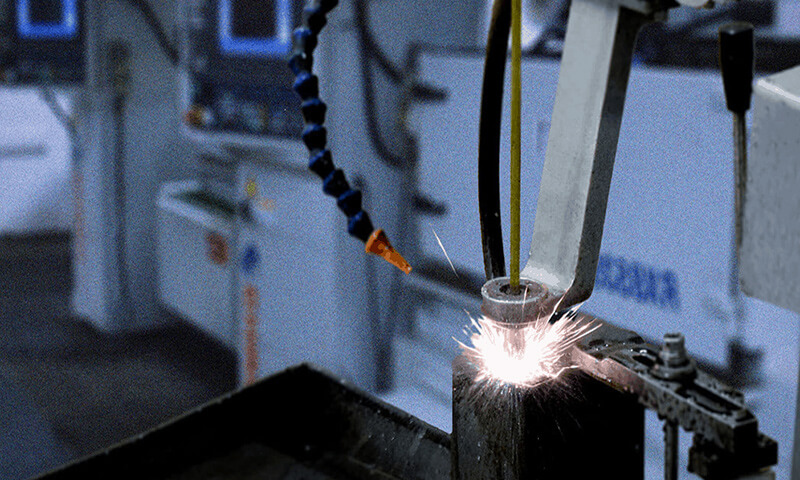
| Weldability | Mabuti na lang, depends on material and body design | Napakahusay; disc-body design allows easy joining |
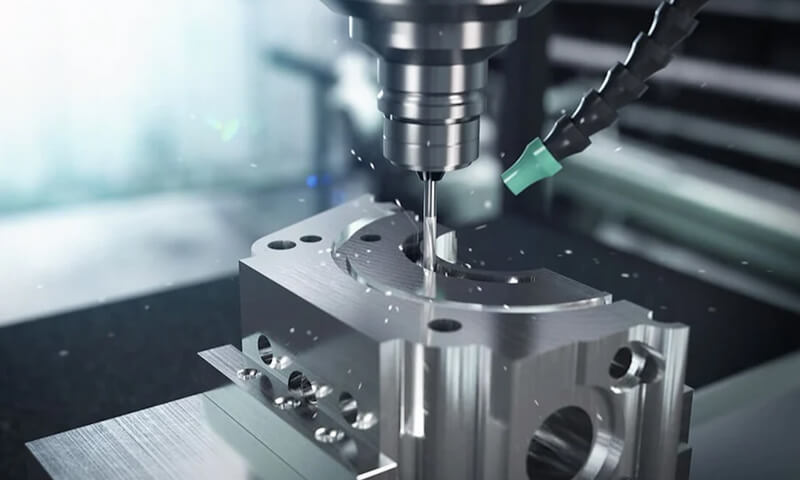
| Machinability | Katamtaman hanggang sa mataas; precise ball and seat machining required | Mas madali; less precision needed for disc seating |
| Mga Karaniwang Aplikasyon | Petrochemical, langis & gas, high-viscosity or particulate media, high-pressure systems | Water supply, HVAC, large-diameter pipelines, clean media applications |
| Technological Trends | Smart sensors, low-temperature optimization, high-strength composite materials | Energy-efficient actuators, larger diameters, improved triple-offset sealing |
11. Pangwakas na Salita
Ball valve vs butterfly valve, each occupies a distinct niche in fluid control systems, with their strengths and limitations shaped by structural design, pagpili ng materyal, and operational requirements.
- Ball valves excel in tight shut-off, media versatility, at mataas na presyon ng mga application, making them ideal for oil & gas, pagproseso ng kemikal, and steam systems.
Their robust sealing, tibay ng katawan, and emerging smart technologies make them reliable for critical and extreme-condition operations. - Butterfly valves offer compact size, magaan na disenyo, at kahusayan sa gastos, particularly suited for large-diameter pipelines, clean media, and moderate pressure systems.
Advances in triple-offset designs and energy-efficient actuation are expanding their applicability into higher-pressure and industrial settings.
Selection Considerations:
- Piliin ang mga balbula ng bola for applications requiring precision, full closure, and media containing particles or high viscosity.
- Piliin ang Mga balbula ng paruparo para sa space-constrained systems, large flow volumes, or cost-sensitive projects.
Sa huli, a thorough evaluation of mga kondisyon ng pagpapatakbo, media characteristics, pressure/temperature requirements, and lifecycle costs is critical to ensure optimal valve performance and long-term reliability.
By understanding their comparative advantages, engineers can make informed decisions that balance efficiency, kaligtasan, at pagiging epektibo sa gastos.
Mga FAQ
Can I use a butterfly valve for gas service?
Yes—elastomer-seat butterfly valves can be used for low-pressure gas, but ensure seats are gas-rated and leakage class is acceptable.
For pipeline gas isolation, metal-seated or ball valves are usually preferred.
Are ball valves suitable for throttling?
Standard ball valves are not designed for fine throttling—V-ball or specifically characterized ball valves are available for coarse control.
For precise modulation, use a control valve (globo) or a V-ball with a positioner.
Which valve is better for slurry?
Neither is ideal without specific design. Use hardened trims, sacrificial linings or slurry-specific valves.
Butterfly valves with rugged discs and bio-compatible coatings are common in large slurry lines; metal-seated ball valves can work in small bore slurry duty.
How big can a ball valve be?
Ball valves are manufactured in very large sizes (>24″ and higher) using trunnion designs, but cost and weight increase significantly. Butterfly valves become more economical above ~10–12″.