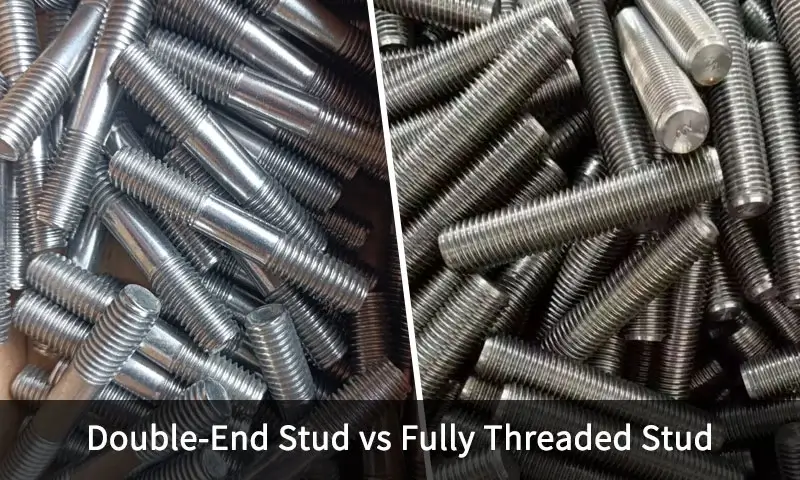
I’ve been in the fastener business for over thirty years. I’ve seen every kind of stud, bout, and screw you can imagine.
En ek kan jou dit vertel: one of the most common questions I get from customers is, “What’s the difference between a double-end stud and a fully threaded stud? They both look like threaded rods to me.”
It’s a fair question. At a glance, they do look similar. Both are threaded fasteners, both are used to join components, and both are often made from 304 vlekvrye staal. But they are not the same.
The difference isn’t just cosmetic—it affects how they’re used, how they perform, and how you should specify them.
In hierdie artikel, I’ll break down the structural differences, explain the application scenarios where each one shines, and give you a practical checklist for choosing the right stud for your project.
I’ll also touch on the 304 vs. 316 question, because that comes up almost as often.
1. What Is a 304 Stainless Steel Double-End Stud?
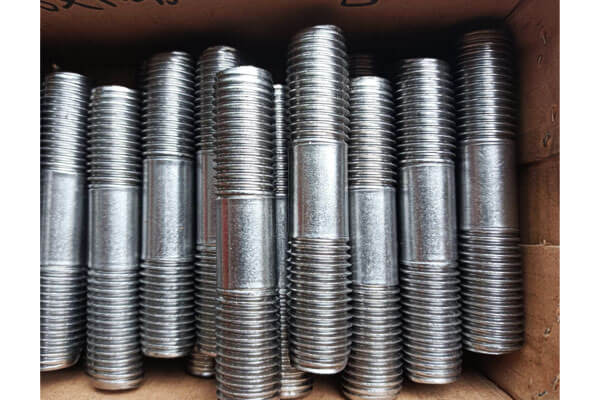
N 304 vlekvrye staal double-end stud, also known as a double-ended stud, is a threaded fastener with threads at both ends and, in a common design, an unthreaded shank in the middle.
Depending on the specification, both ends may have equal thread lengths, or one end may have a longer thread for engagement in a tapped hole. The latter configuration is commonly referred to as a tap-end stud.
Vervaardig van 304 vlekvrye staal, these studs offer good general corrosion resistance, duursaamheid, and suitability for a wide range of industrial fastening applications.
One end typically screws into a tapped hole in a machine body or component, while the other end secures a mating part with a nut.
Key Features of Double-End Studs
- Threads at both ends:The thread lengths can be specified to suit the required engagement depth and fastening arrangement.
- Unthreaded central shank:Where included, the smooth section provides clearance or support and may assist positioning when designed to fit the mating hole appropriately.
- Defined dimensions:Overall length, shank diameter, and thread lengths determine how the stud fits into the assembly and how much thread remains available for fastening.
- Reusable connection:The stud can often remain installed in the base component while the attached part is removed by loosening the nut, simplifying inspection and maintenance.
Tipiese toepassings
304 stainless steel double-end studs are commonly used in:
- Equipment bases and machine mounting points
- Pump and valve assemblies
- Flanged connections where the specified stud design is suitable
- Mechanical housings and covers
- Industrial equipment requiring regular maintenance or disassembly
Why Choose a Double-End Stud?
The main advantage of a double-end stud is its defined fastening arrangement and convenient assembly.
One end can remain engaged in a tapped component, while the opposite end allows another part to be secured with a nut. A properly specified unthreaded shank can also provide a suitable bearing surface or assist alignment.
Nietemin, the smooth shank does not automatically function as a precision locating pin or guarantee improved vibration resistance.
These benefits depend on the shank dimensions, hole clearance, gesamentlike ontwerp, and applied loads.
When selecting a 304 stainless steel double-end stud, confirm the thread diameter and pitch, overall length, thread lengths at both ends, shank dimensions, and material requirements to ensure compatibility with the intended assembly.
2. What Is a 304 Stainless Steel Fully Threaded Stud?
N 304 stainless steel fully threaded stud, also known as a threaded rod, all-thread rod, or continuous threaded stud, is a fastener with threads extending along essentially its entire length.
Unlike a conventional double-end stud with a designated unthreaded shank, a fully threaded stud provides continuous threading, allowing nuts and compatible threaded components to be positioned at different points along the rod.
Made from 304 vlekvrye staal, these fasteners offer good general corrosion resistance and are widely used in industrial equipment, konstruksie, pipe supports, and general mechanical installations.
They are available in various diameters and lengths, with standard stock sizes and cut-to-length options depending on the supplier.

Key Features of Fully Threaded Studs
- Continuous threading:Threads extend along nearly the entire usable length, providing flexibility in nut positioning and thread engagement.
- Adjustable connection points:Nuts can be positioned to accommodate different component thicknesses, spacing requirements, and installation dimensions.
- Flexible length options:Fully threaded rods are available in standard lengths or can be cut to suit specific applications, provided the cut ends are properly finished.
- Versatile fastening design:They can be used with nuts, wassers, hakies, and other compatible components to create a range of fastening and support arrangements.
Tipiese toepassings
304 stainless steel fully threaded studs are commonly used in applications requiring flexible positioning or adjustable fastening, insluitende:
- General mechanical fastening:Connecting components using nuts and washers.
- Suspended installations:Supporting pipes, kanale, cable trays, en toerusting.
- Clamping assemblies:Securing multiple components or layers of material.
- Equipment mounting:Adjusting the spacing or position of brackets and support structures.
- Electrical and plumbing systems:Supporting conduits, pype, and related installations.
Why Choose a Fully Threaded Stud?
The main advantage of a fully threaded stud is its adjustability and installation flexibility.
Because threads extend along nearly the entire usable length, nuts can be positioned as required without being restricted to designated threaded ends.
This makes fully threaded studs particularly convenient for installations where spacing or component thickness may vary.
Nietemin, continuous threading does not automatically mean higher load capacity.
Performance depends on the stud’s diameter, draadsteek, Materiële eienskappe, effective tensile stress area, and connection design.
When selecting a 304 stainless steel fully threaded stud, confirm the required dimensions, thread specification, lengte, and operating environment to ensure a reliable and compatible fastening solution.
3. Double-End Studs vs. Fully Threaded Studs: Belangrike verskille
| Vergelykingsfaktor | 304 Stainless Steel Double-End Studs | 304 Stainless Steel Fully Threaded Studs |
| Basic Struktuur | Threads at both ends; commonly features an unthreaded central shank, afhangende van die ontwerp. | Threads extend along essentially the entire usable length. |
| Gare Opset | Thread lengths may be equal or different, depending on the stud type and application. | Continuous threading allows nuts to engage at various positions along the rod. |
| Installasie Metode | Typically installed by engaging one end in a tapped hole or specified mating component, with the other end secured by a nut. | Commonly secured using nuts and washers, or installed in a tapped hole when the design permits. |
Adjustment Flexibility |
Suited to assemblies with defined thread engagement and installation dimensions. | Offers greater flexibility for adjusting nut positions and component spacing. |
| Belyning en Steunstuk | A correctly dimensioned central shank may provide a bearing surface or assist alignment when matched to the mating hole. | Positioning depends primarily on the threaded connection and the design of the mating components. |
| Lengte Spesifikasie | Requires the overall length, thread length at each end, and any central shank dimensions to be specified. | Primarily specified by overall length, nominale deursnee, draadsteek, and end requirements. |
| Aanpassing | Can be manufactured with specific thread lengths, shank dimensions, and end configurations. | Can be supplied in standard lengths or cut to the required length, subject to thread and end-finishing requirements. |
Tipiese toepassings |
Machine mounting, toerusting omhulsels, pump and valve assemblies, and suitable flange connections. | Suspended supports, pipe and conduit installations, adjustable brackets, clamping assemblies, and general fastening. |
| Hoof Voordeel | Provides a defined fastening arrangement and can simplify assembly and maintenance. | Provides continuous threading and greater flexibility in positioning fastening components. |
| Sleutel Keuring Oorweging | Verify thread engagement, shank dimensions, overall length, and the intended connection arrangement. | Verify thread diameter, toonhoogte, effective engagement, lengte, and load requirements. |
The Big Fatigue Difference Nobody Talks About
This is the point most new buyers miss entirely. In cyclic or vibration-loaded joints — pumps, kompressors, rotating equipment — a double-end stud will almost always outlast a fully threaded stud of the same nominal size and material.
I learned this the hard way on a refinery pump upgrade back in 1998. We installed fully threaded studs on a high-vibration centrifugal pump flange.
Eighteen months later, we were pulling cracked studs out on every maintenance shutdown.
We switched to equal-end double studs of the same diameter and 304 graad, and those same joints ran for another six years without a single fatigue failure.
Hoekom? The smooth shank has no thread root stress concentrations in the high-load zone.
On a fully threaded stud, every thread root is a potential crack initiation point, and peak load falls right on those sharp notches.
On a double-end stud, load is carried by the smooth, uniform shank, and the threaded ends sit outside the main load zone where stress is lower.
4. 304 vs. 316 Vlekvrye staal: Which Should You Choose?
| Vergelykingsfaktor | 304 Vlekvrye staal | 316 Vlekvrye staal |
| Chemies Komposisie | Primarily iron, chroom (approximately 18–20%), en nikkel (approximately 8–10.5%). | Contains chromium (approximately 16–18%), nikkel (approximately 10–14%), en molibdeen (approximately 2–3%). |
| Korrosie Teenstand | Provides good corrosion resistance in general industrial and atmospheric environments. | Generally offers better resistance to chloride-induced pitting and crevice corrosion due to its molybdenum content. |
| Chloried Teenstand | More susceptible to localized corrosion in saltwater, coastal environments, and chloride-containing media. | Better suited to many chloride-exposed environments, although it is not immune to corrosion in seawater or concentrated chlorides. |
| Meganies Eienskappe | Bied goeie krag, selfpiriteit, en vormbaarheid. Actual fastener properties depend on the product specification and manufacturing condition. | Provides broadly comparable properties to 304 in baie toepassings; actual strength depends on the specified fastener grade and manufacturing condition. |
Temperatuur prestasie |
Suitable for many applications involving elevated or low temperatures, subject to design requirements. | Also suitable for a wide range of temperatures; suitability depends on the specific service conditions and mechanical requirements. |
| Tipies Aansoeke | Algemene masjinerie, toerusting samestellings, indoor installations, voedselverwerkingstoerusting, and suitable outdoor environments. | Mariene toerusting, coastal installations, chemiese verwerkingstoerusting, and applications exposed to more aggressive corrosive media. |
| Geskiktheid vir Studs | A cost-effective choice for double-end studs and fully threaded studs in many general-purpose applications. | Often preferred when improved resistance to chloride-related corrosion is required. |
| Familielid Koste bereken | Generally lower material cost. | Generally higher material cost because of its alloy composition. |
| Keuring Prioriteit | Choose when corrosion conditions are moderate and the required performance can be achieved economically. | Choose when the operating environment justifies the additional corrosion resistance. |
5. What Should You Confirm When Purchasing 304 Stainless Steel Studs?
When a customer asks me, “Which one should I use?” I don’t just say “double-end” or “fully threaded.” I ask them a series of questions. Here’s the checklist I use.
What is the application?
- If you need precise alignment or a fixed distance between components: Choose a double-end stud. The unthreaded shank acts as a locating pin, ensuring the parts line up perfectly.
- If you need to clamp or adjust components at different positions: Choose a fully threaded stud. The continuous threads give you unlimited adjustment.
What are the load conditions?
- Shear loads: Double-end studs are better because the unthreaded shank has a larger cross-section and resists shear forces more effectively.
- Tension loads: Both work, but double-end studs have better fatigue resistance because the smooth shank reduces stress concentrations.
- Vibrasie: Double-end studs are less likely to loosen because the unthreaded shank provides a tighter fit in the clearance hole.
What is the environment?
- Korrosiewe omgewings (kus, chemies, hoë humiditeit): Kies 316 stainless steel for better corrosion resistance. 304 is fine for general industrial environments.
- Hoë temperature: Consider the temperature limits of the material. 304 en 316 are both good to about 800°C, but check specific grades.
What are the dimensional requirements?
- Deursnee: M8, M12, M16, M20, ens. Make sure the stud diameter matches the tapped hole or nut.
- Lengte: Specify the overall length and the thread lengths on each end (for double-end studs).
- Draadsteek: Coarse or fine? Coarse is standard; fine is used for precision or vibration resistance.
- Hoeveelheid: Are you buying from stock or custom ordering? Custom double-end studs may have a minimum order quantity.
Is it a non-standard requirement?
- Special lengths, thread combinations, or materials: If it’s not a standard catalog item, you’ll need a custom manufacturer. That’s where a veteran supplier can help you avoid costly mistakes.
6. Closing Thought
If you want the one-sentence shortcut to remember: Double-end studs are for positioning, belyning, and fixed load-critical joints. Fully threaded studs are for flexibility, field adjustment, and general-purpose fastening.
But the real lesson from years of this work is: never stop at “double vs. full.” Material grade, deursnee, toonhoogte, thread length, shank design, and environment matter just as much — if not more.
A correctly specified double-end stud in the right material will outlast and outperform a generic fully threaded stud every time in load-critical joints.
And a full-thread stud will save you when field dimensions don’t match the drawing and you need to adapt on site.
Pick the right tool for the job, specify it fully, and your bolted joints will stay tight.
Vrae
When should I use a double-end stud instead of a fully threaded stud?
Use a double-end stud when you need precise alignment, a fixed distance between components, or better resistance to shear and fatigue loads.
When should I use a fully threaded stud?
Use a fully threaded stud when you need maximum adjustability, veelsydigheid, or the ability to cut the stud to length on site.
Can I use a fully threaded stud in place of a double-end stud?
In sommige gevalle, ja, but you may lose the alignment and shear benefits of the unthreaded shank. Vir kritieke toepassings, use the correct stud type.
What is the difference between equal-end and tap-end double-end studs?
Equal-end studs have threads of equal length on both ends. Tap-end studs have a shorter thread on one end (for permanent installation) and a longer thread on the other (for the nut).
How do I specify the length of a double-end stud?
Specify the overall length and the thread lengths on each end. Byvoorbeeld, “M12 x 100 mm, equal-end, 25 mm thread each end.”
Can I cut a fully threaded stud to length?
Ja, fully threaded studs can be cut to length with a hacksaw or an abrasive cut-off wheel. Clean up the threads with a file or a thread chaser.