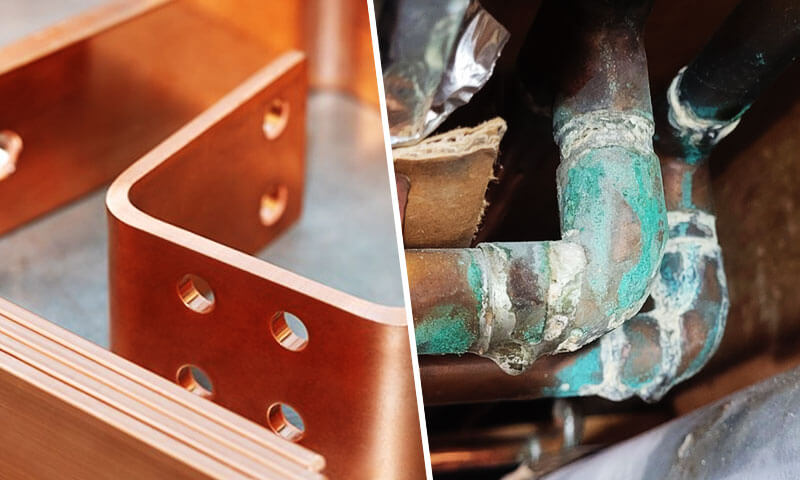
走过任何一座古城, 你会看到它——铜屋顶上独特的绿色铜绿, 雕像, 和建筑细节.
This iconic verdigris is often mistaken for rust, but is it? Does copper rust like iron? The short answer is no, but the complete story is far more nuanced and scientifically rich.
Copper is one of humanity’s oldest and most versatile metals, used for thousands of years in everything from electrical wiring and plumbing to artwork and coinage.
Its durability and corrosion resistance have made it indispensable across countless applications. Yet confusion persists about how copper behaves when exposed to the elements.
This article provides a rigorous, comprehensive examination of copper’s corrosion behavior.
We will explore the chemical definition of rust, the actual corrosion mechanisms of copper, the different types of copper corrosion, the environmental factors that affect its durability, and the practical implications for engineering and design.
1. 铜会生锈吗?
The answer is 不.
铜 做 不是 rust because rust is a corrosion product that forms only on iron and iron-based alloys, such as carbon steel and cast iron.
Rust is chemically composed of hydrated iron oxides, 主要是 Fe2O₃·nH2O 和 fe₃o₄, which develop when iron reacts with oxygen and moisture.
Unlike many protective oxide films found on non-ferrous metals, 铁锈是多孔的, 脆, and loosely attached to the underlying metal.
As it flakes away, fresh iron is continuously exposed, allowing corrosion to progress deeper into the material.

Copper behaves fundamentally differently.
Instead of producing rust, copper undergoes 氧化, gradually forming thin surface layers of copper oxides.
Over extended periods of atmospheric exposure, these oxide layers react with moisture, 二氧化碳, 硫化合物, and other environmental elements to produce a dense, stable surface film commonly known as 铜绿.
This distinction is one of the most important differences between ferrous and non-ferrous metals.
与生锈不同, copper patina is strongly bonded to the substrate and acts as a natural protective coating.
Rather than accelerating corrosion, it significantly reduces the rate at which oxygen, 水分, and pollutants can reach the underlying metal.
因此, corrosion slows dramatically after the protective layer becomes fully established.
2. The Complete Copper Corrosion Process
Copper corrosion is not a sudden event but a gradual electrochemical transformation that occurs over many years.
As the metal interacts with oxygen, 水分, 二氧化碳, and atmospheric pollutants, its surface undergoes a series of predictable changes.
阶段 1: Fresh Metallic Copper
Newly manufactured copper exhibits a bright reddish-orange metallic appearance with a smooth, 反射表面.
在这个阶段, the metal is highly reactive because no protective oxide film has yet developed.
Immediately after exposure to air, oxygen molecules begin reacting with the copper surface.
Although this reaction starts within minutes, the resulting oxide layer is initially only a few nanometers thick and is almost invisible to the naked eye.
This ultrathin oxide film represents the first line of defense against environmental exposure.
阶段 2: Initial Oxidation
As exposure continues, the surface gradually forms cuprous oxide (氧化铜).
This oxide appears as a reddish-brown film and remains compact and tightly bonded to the underlying metal. Unlike iron rust, it does not crack or peel away.
反而, it serves as a protective barrier that slows oxygen diffusion into the copper substrate.
The oxidation rate during this stage depends on several environmental factors, 包括温度, 湿度, and oxygen availability.
Under normal atmospheric conditions, the process is relatively slow and uniform.
阶段 3: Development of a Dark Oxide Layer
With prolonged exposure, part of the cuprous oxide further oxidizes into cupric oxide (铜).
The surface color gradually changes from reddish-brown to dark brown or nearly black, a transformation commonly observed on exposed copper roofing panels, 工业设备, and outdoor sculptures after several years of service.
Although the appearance changes significantly, the oxide layer remains adherent and protective.
在这个阶段, corrosion penetration into the base metal remains extremely limited because the oxide film continues to restrict the transport of oxygen and moisture.
阶段 4: Formation of the Protective Green Patina
In outdoor environments, particularly where moisture and atmospheric carbon dioxide are present, the oxide layer undergoes additional chemical reactions.
Copper compounds gradually convert into stable corrosion products such as 碱式碳酸铜 (Cu₂(哦)₂CO₃), while sulfur-containing environments may also produce basic copper sulfate compounds.
Coastal regions with elevated chloride concentrations can generate additional copper chloride-based corrosion products.
These reactions create the distinctive green or blue-green patina associated with historic copper structures.
Contrary to popular belief, this green surface is not a sign of material failure. 反而, it represents the mature protective layer that significantly reduces future corrosion rates.
Once fully developed, the patina acts as an effective environmental barrier, limiting the diffusion of oxygen, 水分, and pollutants toward the underlying metal.
The time required for natural patina formation varies widely.
In clean rural environments, complete development may require several decades, whereas industrial or marine atmospheres often accelerate the process because of higher humidity and greater concentrations of reactive compounds.
阶段 5: Long-Term Surface Stability
After the patina has fully matured, copper enters a remarkably stable stage of service.
The corrosion rate decreases substantially because the dense surface film functions as a self-healing protective barrier.
Minor scratches or localized damage are typically repaired naturally through continued oxidation and patina growth, allowing the protective layer to regenerate over time.
This self-protective behavior is one of the principal reasons copper is widely specified for long-life infrastructure and demanding engineering applications.
Architectural cladding, 屋顶系统, 海洋组成部分, 热交换器, plumbing systems, and precision industrial castings can maintain excellent structural integrity for many decades with minimal maintenance.
3. Types of Copper Corrosion
Although copper is renowned for its excellent corrosion resistance, it is not completely immune to degradation.

Uniform Atmospheric Corrosion
Uniform atmospheric corrosion is the most common and least harmful form of copper corrosion.
It occurs when the entire exposed surface reacts gradually with oxygen, 水分, 二氧化碳, and trace atmospheric contaminants.
Rather than penetrating deeply into the metal, the reaction forms a thin oxide film that slowly develops into a stable green patina.
Because the corrosion products remain tightly bonded to the substrate, they effectively shield the underlying copper from further environmental attack.
This predictable corrosion behavior explains why copper roofing, architectural façades, monuments, and outdoor sculptures can remain structurally sound for well over a century with minimal maintenance.
电腐蚀
Galvanic corrosion occurs when copper is electrically connected to a more active metal while both are exposed to an electrolyte such as rainwater, 海水, or industrial condensate.
Since copper is relatively noble in the galvanic series, the less noble metal becomes the anode and corrodes preferentially.
Materials such as carbon steel, 锌, 铝, and magnesium are particularly susceptible when directly coupled with copper.
Improper combinations may accelerate corrosion of adjacent components even though the copper itself remains largely unaffected.
Electrical insulation, dielectric fittings, and careful material selection are therefore essential when joining dissimilar metals.
点腐蚀
Pitting corrosion is a localized form of attack characterized by the formation of small but deep cavities on the metal surface.
Although copper is generally resistant to pitting, unfavorable water chemistry—including low pH, 高氯化物浓度, elevated dissolved oxygen, or stagnant water—can initiate localized breakdown of the protective oxide film.
Because pits may penetrate deeply while leaving most of the surface intact, they are difficult to detect during routine inspection.
In plumbing systems, 热交换器, and cooling equipment, untreated pitting corrosion can eventually cause leakage or pressure loss.
Erosion-Corrosion
Copper performs exceptionally well in flowing liquids under normal operating conditions.
然而, excessively high flow velocities, suspended abrasive particles, or turbulent flow can gradually remove the protective oxide film from the surface.
Repeated stripping of this protective layer exposes fresh metal to continuous corrosion, resulting in accelerated wall thinning.
This combined mechanical and electrochemical degradation is known as erosion-corrosion.
The phenomenon is particularly important in pump impellers, 冷凝器管, 海洋管道, 阀, and hydraulic systems where fluid velocity is high.
Proper hydraulic design, 流动路径更顺畅, and appropriate alloy selection significantly reduce erosion-corrosion risk.
应力腐蚀破裂 (SCC)
Stress corrosion cracking develops when tensile stress and a corrosive environment act simultaneously on susceptible materials.
Pure copper exhibits excellent resistance to SCC, but certain copper alloys—particularly some brasses exposed to ammonia-containing environments—can experience cracking through a mechanism historically known as season cracking.
Residual manufacturing stresses, 冷工作, or external loading can accelerate crack initiation. Proper stress-relief heat treatment and appropriate alloy selection are effective preventive measures.
Microbiologically Influenced Corrosion (MIC)
In certain industrial water systems, microorganisms can influence corrosion by altering local chemical conditions or producing corrosive metabolic by-products.
Although copper possesses natural antimicrobial properties that inhibit bacterial growth, biofilms may still develop under stagnant conditions.
These localized biological environments can increase the likelihood of pitting or under-deposit corrosion.
MIC is most commonly encountered in cooling water systems, marine facilities, and industrial process equipment where water quality management is insufficient.
4. Factors That Affect Copper Corrosion
Copper corrosion is governed not only by the material itself but also by the surrounding environment and service conditions.
The rate at which copper oxidizes—and whether the resulting corrosion remains protective or becomes localized—depends on multiple interacting factors.

Atmospheric Environment
Environmental exposure is one of the primary determinants of copper corrosion behavior.
In clean rural atmospheres, oxidation proceeds slowly, allowing a dense protective patina to develop over several decades.
相比之下, coastal regions expose copper to chloride-rich salt spray, while industrial cities introduce sulfur dioxide and nitrogen oxides that accelerate chemical reactions on the metal surface.
Humidity also plays a critical role because moisture provides the electrolyte required for electrochemical corrosion.
Frequent wet-dry cycling generally accelerates patina formation more rapidly than continuously dry environments.
Water Chemistry
When copper operates in plumbing systems, 热交换器, 冷凝器, or cooling circuits, water quality becomes the dominant factor affecting corrosion.
Aggressive water with low pH, excessive dissolved oxygen, 高氯化物浓度, or elevated ammonia content can destabilize the protective oxide layer.
反过来, water with balanced chemistry promotes the formation of a stable passive film that significantly extends service life.
Water velocity is equally important. Moderate flow helps maintain clean surfaces, whereas stagnant water encourages localized corrosion and biological growth.
Excessively high flow rates may produce erosion-corrosion by mechanically removing protective films.
温度
Temperature influences nearly every electrochemical reaction involved in corrosion.
Higher temperatures generally increase reaction kinetics, accelerate oxide formation, and may alter the composition of corrosion products.
In heat exchangers, 锅炉, and industrial processing equipment, elevated operating temperatures require careful consideration of alloy selection and water chemistry.
Thermal cycling can also create differential expansion stresses that influence long-term corrosion performance.
大气污染物
Industrial emissions significantly affect the appearance and corrosion behavior of exposed copper.
Sulfur-containing gases promote the formation of copper sulfate compounds, while carbon dioxide contributes to the development of basic copper carbonate.
Coastal chloride deposits may produce copper chlorides that modify the patina’s composition and color.
As environmental regulations have reduced sulfur emissions worldwide, the natural patina formed on modern copper structures often differs from that observed on historical buildings.
Contact with Dissimilar Metals
Copper’s relatively noble electrochemical potential makes galvanic compatibility an important design consideration.
Direct contact with aluminum, 镀锌钢, 碳钢, or magnesium in wet environments can create galvanic cells that accelerate corrosion of the less noble material.
正确的关节设计, insulating washers, dielectric unions, and compatible fastening materials are widely used to minimize galvanic corrosion in engineering systems.
Surface Condition and Manufacturing Method
The initial surface condition influences how quickly protective films develop.
Highly polished copper generally oxidizes more uniformly than rough or heavily machined surfaces.
Surface contaminants, machining residues, or embedded foreign particles may disrupt oxide formation and create localized corrosion sites.
Manufacturing processes such as casting, 锻造, 滚动, 加工, and welding can also influence grain structure and residual stresses, indirectly affecting long-term corrosion performance.
5. Does Green Patina Mean Copper Is Damaged?
不, green patina does not mean copper is damaged. 实际上, the green patina on copper is a sign of protection, not degradation. Here’s why:
The Protective Nature of Patina
| 特征 | 铜绿 (绿色的) | 锈 (Red-Brown) |
| Adherence | Adherent, tightly bonded to the metal | Non-adherent, flakes off |
| 孔隙率 | 稠密, relatively non-porous | 多孔的, allows moisture penetration |
| 保护作用 | Slows further corrosion significantly | Accelerates corrosion (catalytic) |
| Volume change | 最小 (no spalling) | 大的 (spalling, 破裂) |
| Mechanical integrity | Maintains structural integrity | Causes structural weakening |
The Patina Layer Structure
The green patina on copper is a multi-layered structure:
| 层 | 厚度 (µm) | 作品 | 功能 |
| Outer layer | 10-50 | 铜二氧化铜(哦)₂ (碱式碳酸铜) + CuSO₄·3Cu(哦)₂ (basic copper sulfate) | Weather protection; aesthetic layer |
| Middle layer | 5-20 | 氧化铜 (cuprous oxide) | Adhesion and protection |
| Inner layer | 5-10 | 铜 (铜) | 碱金属 |
Patina as an Architectural Feature
The green patina is not just protective—it is also highly prized for its aesthetic qualities. Iconic examples include:
- 自由女神像 (New York): The copper statue developed its green patina over 20-30 年.
The patina is approximately 0.1 mm thick and has protected the statue for over 130 年. - Copper roofs of European cathedrals: Many historic buildings have copper roofs that have developed beautiful green patinas over centuries.
- Roofs of public buildings: Copper roofing on public buildings often develops a patina that is both protective and aesthetically pleasing.
6. Corrosion Resistance of Different Copper Alloys
Although all copper alloys inherit a degree of corrosion resistance from copper itself, alloying elements significantly influence performance in different environments.
| 合金 | 主要合金元素 | Atmospheric Corrosion Resistance | Marine Corrosion Resistance | 耐化学性 | 典型的应用 |
| 纯铜 (C11000) | 铜≥99.9% | 出色的 | 好的 | 好的 | 电导体, 屋顶, 管道, 热交换器 |
| 无氧铜 (C10100) | Cu ≥99.99% | 出色的 | 好的 | Excellent in high-purity environments | 真空设备, 电子产品, 半导体产业 |
| 黄铜 (Cu-Zn) | 铜 + 锌 | 非常好 | 缓和 | 缓和 | 阀, 配件, plumbing components, 装饰硬件 |
| 青铜 (与sn) | 铜 + 锡 | 出色的 | 非常好 | 好的 | 轴承, 衬套, 海洋硬件, 齿轮 |
硅青铜 (和他的) |
铜 + 硅 | 出色的 | 出色的 | 非常好 | Architectural fasteners, 海洋组成部分, 投资铸件 |
| 铝青铜 (随着) | 铜 + 铝 | 出色的 | 杰出的 | 出色的 | 泵叶轮, 阀, offshore equipment, 船舶螺旋桨 |
| 杯子 (90/10, 70/30) | 铜 + 镍 | 出色的 | 杰出的 | 出色的 | 海水管道, 冷凝器, 淡化植物, offshore systems |
| 铍铜 (立方体) | 铜 + 铍 | 非常好 | 好的 | 好的 | 航空航天组件, 弹簧, 精密模具, 电连接器 |
7. 铜与. 铁: A Comparative Analysis of Corrosion Behavior
Copper and iron represent two fundamentally different approaches to corrosion behavior.
While both metals undergo electrochemical reactions when exposed to oxygen and moisture, the nature of their corrosion products determines whether corrosion becomes destructive or protective.
| 方面 | 铜 | 铁 (Steel/Cast Iron) |
| Corrosion product | Copper oxides, 碳酸盐, sulfates, 氯化物 | 水合氧化铁 (锈) |
| Corrosion product colour | 红棕色, 黑色的, 绿色的, blue-green | 红棕色, orange-brown |
| 体积膨胀 | 最小 (1-1.5×) | 大的 (3-7×) |
| 保护作用 | 是的 (铜绿具有保护作用) | 不 (生锈加速腐蚀) |
| Spalling/Flaking | 最小 | 广泛的 |
| Mechanical weakening | 慢的 (decades to centuries) | 迅速的 (months to years) |
Corrosion rate (大气的) |
0.1-2.0 µm/year | 10-100 µm/year |
| Underwater corrosion | 缓和 (with protective films) | 迅速的 (severe in seawater) |
| Life expectancy (结构) | 100+ 年 (many buildings centuries) | 10-50 年 (if uncoated) |
| 维护 | 最小 (passive protection) | 高的 (涂层, 绘画, 监视) |
| Cost of corrosion | 低的 | 很高 |
8. How to Prevent Copper Corrosion
Although copper is naturally corrosion-resistant, proper engineering practices are still required to maximize service life, particularly in aggressive environments such as marine systems, chemical processing facilities, and industrial water circuits.

Select the Appropriate Copper Alloy
Material selection is the first and most important corrosion-control strategy.
Different copper alloys provide different levels of environmental resistance:
- 纯铜 is ideal for electrical applications and general atmospheric exposure.
- Cupronickel alloys provide outstanding seawater resistance.
- 铝青铜 offers excellent resistance to marine erosion, 空化, 并穿.
- 硅青铜 provides excellent corrosion resistance for architectural and industrial components.
Choosing an alloy based on the actual service environment prevents premature failure and reduces maintenance requirements.
Control Environmental Conditions
Corrosion rates can often be reduced by controlling exposure conditions.
重要的控制措施包括:
- Maintaining proper water chemistry.
- Controlling chloride concentration.
- Preventing stagnant water zones.
- Reducing excessive flow velocity.
- Limiting exposure to industrial pollutants.
- Avoiding unnecessary moisture accumulation.
In cooling systems and process equipment, water treatment programs are especially important because chemical imbalance can damage otherwise corrosion-resistant copper alloys.
Prevent Galvanic Corrosion
Many copper failures are not caused by copper itself but by improper contact with dissimilar metals.
When copper contacts aluminum, 锌, 镁, or carbon steel in a wet environment, an electrochemical cell can form. The less noble metal becomes the anode and corrodes faster.
Common prevention methods include:
- Using dielectric isolation components.
- Selecting compatible fasteners.
- Applying protective coatings at connection points.
- Avoiding direct metal-to-metal contact in humid environments.
Proper system design is often more effective than surface treatment alone.
Apply Protective Surface Treatments
Although copper naturally forms a protective patina, additional surface treatments may be required for specific applications.
| 治疗 | 过程 | Protection | 申请 |
| 涂漆 | 透明丙烯酸或聚氨酯涂层 | 防止变色; protects decorative surfaces | 建筑, 装饰性的, 电气 |
| 钝化 | 硝酸浸 (10-25%, 40-60°C) | Forms protective oxide film; removes surface contaminants | Electrical contacts, 精度组件 |
| 铬酸盐转换 | 铬酸处理 | 增强的耐腐蚀性 | 电气, 海军陆战队, 航天 |
| 电镀 | 锡, 镍, or silver plating | 腐蚀保护; 电导率 | Electrical contacts, 管道 |
| 苯并三唑 (苯甲酸) | Chemical inhibitor | Forms protective film | 电气, 冷却系统 |
Proper Design and Maintenance
Good engineering design significantly influences copper corrosion performance.
推荐的做法包括:
- Avoiding sharp corners where deposits accumulate.
- Designing drainage systems to prevent stagnant water.
- Maintaining smooth internal flow passages.
- Inspecting areas exposed to chemicals or seawater.
- Monitoring corrosion rates in critical equipment.
Copper’s natural corrosion resistance provides an advantage, but correct design ensures that advantage is fully realized.
9. Does Copper Corrosion Affect Electrical Conductivity?
Copper is widely regarded as the preferred electrical conductor because of its excellent electrical conductivity, 高延展性, 和长期可靠性.
然而, the assumption that copper corrosion has no impact on electrical performance is incorrect.
Copper corrosion can affect electrical conductivity, especially at contact interfaces, connection points, and high-current applications.
The degree of impact depends on the type of corrosion products formed, the thickness of the corrosion layer, 环境条件, and whether the affected surface is part of the main current-carrying path.
How Copper Corrosion Products Influence Electrical Conductivity
Copper corrosion is not a single chemical reaction. Different environments produce different corrosion compounds, and each compound has a different effect on electrical performance.
| Corrosion Product | Effect on Electrical Conductivity | Corrosion Characteristics and Mechanism |
| 氧化铜 (Cuprous Oxide) | 轻微降低 | A semiconductor with relatively low resistance compared with other copper corrosion products. Thin Cu₂O films usually have limited impact on conductivity. |
| 铜 (Cupric Oxide) | Moderate reduction | More electrically resistive than Cu₂O. As the oxide layer becomes thicker, contact resistance increases significantly. |
硫化铜 (Copper Sulfide) |
Significant reduction | Forms in sulfur-containing environments. It has poor electrical conductivity and can severely degrade electrical contacts. |
| 铜二氧化铜(哦)₂ (Basic Copper Carbonate / 铜绿) | 低电导率; potentially insulating when thick | The green patina found on outdoor copper structures is highly stable but electrically non-conductive, making it unsuitable on contact surfaces. |
| 氯化铜 (Copper Chloride) | Significant reduction | Common in marine or chloride-rich environments. It promotes localized corrosion and creates unstable, high-resistance regions. |
The key point is that a thin oxide film on exposed copper usually has little influence on current flow, but corrosion layers at electrical interfaces can have a major impact.
Effect of Copper Corrosion on Electrical Contacts
Electrical contacts require extremely low resistance to ensure efficient current transfer.
Even a very thin corrosion film can interfere with metal-to-metal contact because current must pass through a higher-resistance barrier instead of directly through copper.
The impact varies depending on the contact material and protection method.
| Contact Type | Effect of Corrosion | Typical Prevention Methods |
| Gold-Plated Contacts | Minimal impact because gold is highly corrosion-resistant and chemically stable. | Usually requires little protection; widely used in precision electronics. |
| Tin-Plated Contacts | Moderate impact; tin oxide forms slowly but may increase resistance under certain conditions. | Periodic inspection and proper contact pressure control. |
| Silver-Plated Contacts | Moderate impact; silver may tarnish in sulfur-containing environments, forming silver sulfide. | Protective coatings and controlled operating environments. |
Bare Copper Contacts |
Significant impact; oxide and sulfide layers increase contact resistance. | Tin plating, 镀镍, 镀金, antioxidant compounds, or contact lubricants. |
| Brass Contacts | Moderate impact; dezincification can weaken the alloy and affect electrical reliability. | Corrosion-resistant brass grades, 电镀, and environmental control. |
For demanding electrical systems, bare copper is rarely used directly as a contact surface. 反而, copper components are commonly plated with tin, 镍, 银, or gold to maintain stable electrical performance.
10. Common Myths About Copper Rust and Corrosion
| Myth | Fact |
| “Copper rusts just like iron.” | Copper does not rust. It corrodes by forming oxides, 碳酸盐, and sulfates—not iron oxide. The green patina is not rust. |
| “Green patina means the copper is rotting away.” | The green patina is a protective layer that actually slows further corrosion. It does not indicate damage. |
| “Copper is completely corrosion-proof.” | No metal is completely corrosion-proof. Copper is corrosion-resistant but not immune. It can be corroded by certain chemicals, acidic water, and galvanic coupling. |
| “All copper alloys have the same corrosion resistance.” | Corrosion resistance varies significantly between pure copper and different copper alloys. High-zinc brasses are susceptible to dezincification; nickel-aluminium bronze is highly corrosion-resistant. |
“Copper cannot be used in seawater.” |
铜合金 (especially nickel-aluminium bronze, 硅青铜, and copper-nickel alloys) are widely used in seawater applications. 然而, some brasses are vulnerable to dezincification. |
| “Copper corrosion is always visible.” | Corrosion can occur beneath the surface (例如。, 点缀, 消毒) and may not be visible until failure occurs. |
| “Tarnishing is the same as corrosion damage.” | Tarnishing is a surface discolouration that may be protective (铜绿) or purely aesthetic. It is not necessarily damaging. |
11. 结论
Copper does not rust like iron, but it does undergo a controlled corrosion process that creates protective oxide layers and a stable patina.
This unique corrosion behavior is one of the primary reasons copper and copper alloys have remained essential engineering materials for thousands of years.
然而, copper corrosion behavior depends strongly on environmental conditions, 合金成分, manufacturing quality, 和申请要求.
While pure copper provides excellent corrosion resistance and electrical conductivity, specialized copper alloys such as bronze, 铝青铜, 硅青铜, and cupronickel provide enhanced performance for more demanding applications.
For engineers selecting materials, the key consideration is not whether copper corrodes, but whether its corrosion mechanism is compatible with the intended service environment.
常见问题解答
Does copper rust in saltwater?
不, copper does not rust in saltwater—it corrodes. Some copper alloys (such as nickel-aluminium bronze and silicon bronze) are highly resistant to saltwater corrosion.
然而, high-zinc brasses can be susceptible to dezincification.
Why does copper turn green?
The green colour is a patina—a protective layer of basic copper carbonate and sulfate.
This layer forms over years of exposure to atmospheric CO₂, 水分, and sulfur compounds. It is natural and protective.
Is green copper safe to touch?
是的, the green patina is safe to touch. It is a stable, non-toxic copper compound. 然而, wash hands after handling as a general hygiene practice.
Can copper be used in drinking water systems?
是的. Copper is widely used in drinking water systems. It is approved for contact with potable water and is naturally antimicrobial.
Dezincification-resistant (DR) brasses are preferred for fittings.
What is the difference between tarnish and corrosion?
Tarnishing is a surface discolouration from a thin reaction layer—it may be protective or aesthetic. Corrosion is the chemical degradation of the metal; it may be uniform or localised.
Does copper react with acid?
是的. Copper reacts with acids to form copper salts and hydrogen gas (or other products). This is why acidic water can cause copper plumbing corrosion.
How do you clean green patina from copper?
You can clean it with a mixture of salt and vinegar, or lemon juice and salt.
然而, removing patina is not recommended as it protects the underlying metal. For decorative purposes, you can use a commercial copper cleaner.
Is copper corrosion dangerous?
Generally not. Copper corrosion products are non-toxic in solid form.
然而, copper salts can be toxic in high concentrations, especially in drinking water (though copper is a required micronutrient).
Does copper corrode in the atmosphere?
是的, it forms a protective patina. In rural areas, the patina is predominantly copper carbonate (绿色的); in industrial areas, it may be copper sulfate (绿色的) or copper sulfides (grey-black).
The patina protects the underlying metal.
How long does copper take to turn green?
通常 5-20 年, 取决于环境. In aggressive environments (沿海, 工业的), patina forms faster; in dry, clean environments, it can take decades.