1. Увођење
D2 tool steel has long been recognized for its exceptional wear resistance and dimensional stability, making it a staple in cold-working applications.
Originating from the early 20th century’s advancements in alloying technology, D2 is a high-carbon, high-chromium steel that sets the benchmark for tools operating under severe wear conditions.
This article delves into the properties, прерада, and applications of D2 tool steel, answering key questions about its suitability for various industries.
By exploring its chemical composition, physical and mechanical attributes, heat treatment protocols, and machining challenges,
We aim to provide a comprehensive understanding of why D2 remains a preferred choice for demanding tooling requirements.
2. Хемијски састав
Д2 алатни челик owes its exceptional wear resistance and dimensional stability to a carefully engineered alloy chemistry.
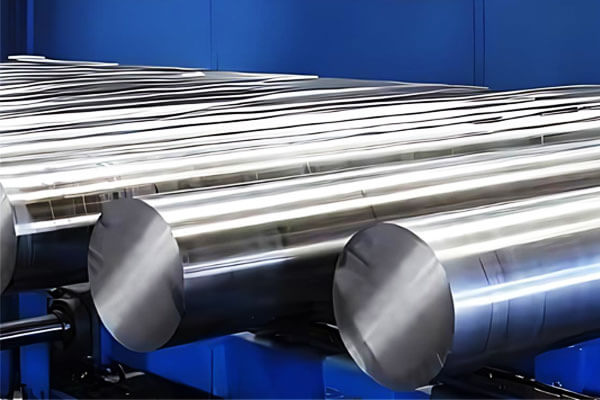
By combining high carbon content with strategic additions of chromium, молибден, и ванадијум, metallurgists create a matrix rich in hard carbides that resist abrasion and retain cutting edges under heavy load.
Key Alloying Elements and Their Roles
| Елемент | Типичан садржај (%) | Metallurgical Role |
|---|---|---|
| Угљеник (Ц) | 1.40 - 1.60 | Forms cementite and complex chromium carbides; directly correlates with hardness and wear resistance |
| Хром (ЦР) | 11.00 - 13.00 | Promotes formation of hard M₇C₃ and M₂₃C₆ carbides; adds corrosion resistance; повећава очвршћавање |
| Молибден (Мо) | 0.70 - 1.40 | Refines prior carbides; enhances toughness and red-hardness; retards grain growth during austenitizing |
| Ванадијум (У) | 0.30 - 1.10 | Creates extremely hard MC-type carbides that improve edge retention and resist micro-cracking |
| Манган (Мн) | ≤ 1.00 | Делује као деоксидант; assists in hardenability but can reduce toughness if over-added |
| Силицијум (И) | ≤ 1.00 | Деоксидатор; contributes modestly to strength and contributes to carbide morphology |
Characteristic Carbide Phases
D2’s wear resistance stems from a dual-carbide system:
Chromium-Rich Carbides (М₇ц₃, М₂₃Ц₆)
- These chromium carbides appear as blocky or angular precipitates within the tempered martensite matrix.
- They account for roughly 30-40% of the microstructure by volume, providing bulk resistance to abrasive wear.
Vanadium-Rich MC Carbides
- Nanoscale MC particles (rich in vanadium and carbon) distribute uniformly throughout the steel.
- Чак и а 5–10% volume fraction of MC carbides dramatically boosts edge retention by impeding crack initiation.
3. Equivalent Brands and Standards
D2 tool steel aligns with several international specifications. Below are the primary equivalents up to the ASTM designation:
| Standard/Brand | Означавање | Еквивалентно | Регион |
|---|---|---|---|
| AISI/SAE | Д2 (UNS T30402) | - | САД |
| Од | 1.2379 | D-2 | Germany/Europe |
| Он | SKD11 | D-2 | Japan/Asia |
| Бс | BS 1407M40 | D-2 | УК |
| АФНОР | X210Cr12 | D-2 | Француска |
| Астм | A681 | D-2 | Интернатионал |
4. Механичка својства
D2 tool steel balances extreme hardness with sufficient toughness, enabling it to withstand high wear while resisting brittle failure.

The table below summarizes its key mechanical metrics in the quenched-and-tempered condition (обично 60 ХРЦ), followed by a brief discussion of their implications.
| Имовина | Типична вредност | Јединице | Белешке |
|---|---|---|---|
| Затезна чврстоћа (σₜ) | 2 000 - 2 200 | МПА | High ultimate strength supports heavy loads in cold-working operations. |
| Снага приноса (σᵧ 0.2%) | 1 850 - 2 000 | МПА | Minimal plastic deformation under high compressive forces preserves dimensional accuracy. |
| Rockwell C Hardness | 58 - 62 | ХРЦ | Exceptional surface hardness ensures superior abrasion resistance. |
| Бринелл тврдоћа (Хбв) | 700 - 750 | Хбв | Corresponds with HRC for cross-referencing in international standards. |
| Цхарпи В-Нотцх Импацт | 10 - 15 | Лукавство | Adequate energy absorption prevents catastrophic cracking in shearing and trimming applications. |
| Издужење на паузи | 2 - 3 | % | Limited ductility; design must account for low deformation capacity in hardened sections. |
| Modulus of Toughness | 20 - 25 | MJ/m³ | Area under stress-strain curve quantifies overall energy absorption before fracture. |
5. Физичка својства
Изван својих механичких перформанси, D2 tool steel exhibits a set of physical characteristics that influence heat flow, Димензионална стабилност, and electromagnetic behavior in service.
Below is a summary of its key physical properties in the hardened (60 ХРЦ) стање:
| Имовина | Типична вредност | Јединице | Белешке & Импликације |
|---|---|---|---|
| Густина | 7.75 Г / цм³ | Heavier than water, affecting die mass and handling. | |
| Иоунг'с Модул (Еластични модул) | 205 ГПА | High stiffness ensures minimal elastic deflection under load. | |
| Поиссонов омјер | 0.28 | Indicates moderate lateral contraction when stretched. | |
| Топлотна проводљивост | 20 В / м · к | Relatively low thermal conductivity aids in heat retention in tooling faces. | |
| Специфични топлотни капацитет | 460 Ј / кг · к | Energy required to raise temperature, relevant for tempering and quench design. | |
| Коефицијент топлотне експанзије | 11.5 μм / м · к | Thermal expansion effects are moderate, facilitating tight die clearances over temperature cycles. | |
| Електрична отпорност | 0.70 ω · м | Higher resistivity than low-alloy steels, impacting EDM parameters and electrical heating behavior. | |
| Магнетна пропустљивост (Relative μᵣ) | 1.002 | Nearly identical to free space; confirms D-2’s non-magnetic (дијамагнетна) character in most applications. | |
| Rockwell C Hardness (Типичан, quenched/tempered) | 60 ХРЦ | Although a mechanical property, hardness influences surface contact, трење, and heat generation in use. |
6. Топлотни третман & Прерада
Optimizing D2 tool steel’s performance hinges on precise heat treatment and careful processing.
By controlling annealing, austenitizing, гашење, каљење, and optional cryogenic steps,
manufacturers tailor the steel’s hardness, жилавост, and dimensional stability to demanding cold-working tasks.

Жарење и ублажавање стреса
Сврха: Soften D2 for machining, ослободити заостала напрезања, and spheroidize carbides.
- Поступци: Heat slowly to 800–820 °C, hold for 2–4 сата, then cool in the furnace at 20 ° Ц / сат до 650 ° Ц, праћен хлађењем ваздуха.
- Резултат: Постиже ~240 HBW, with uniformly spheroidized carbides that minimize tool wear on cutting edges and prevent chipping.
Before any hardening cycle, користити а pre-stress relief у 650 ° Ц за 1 hour to remove machining-induced stresses.
Стврдњавање (Austenitizing and Quenching)
Циљ: Transform to martensite and dissolve sufficient carbides for maximum wear resistance.
Аустенитизинг:
- Температура: 1 020-1 040 ° Ц
- Натопити се: 15-30 минута (у зависности од дебљине пресека)
- Атмосфера: Controlled-atmosphere furnace or salt bath to prevent decarburization and oxidation.
Гашење:
- Медији: Warm oil (50–70 °Ц) or air for minimal distortion; salt bath quench (400–500 °C) for faster cooling and reduced stress.
- Контрола изобличења: Use fixtures or interrupted quench techniques, посебно за сложене геометрије.
Исход: Yields ~62 HRC maximum and a martensitic matrix with fine, дисперговани карбиди.
Tempering Cycles
Гол: Balance hardness and toughness, смањити ломљивост, and relieve quench stresses.
- Каљење на ниским температурама (150-200 ° Ц):
-
- Резултат: Hardness remains 60–62 ХРЦ, with modest toughness. Ideal for applications demanding extreme wear resistance and edge retention.
- Каљење на средњим температурама (500–550 °C):
-
- Резултат: Hardness drops to 55–58 HRC while toughness increases by 20-30%. Best for tools exposed to impact or moderate shocks.
- Поступци: Перформ two consecutive tempering cycles, држећи 2 сати сваки, праћен хлађењем ваздуха.
Криогенски третман
Сврха: Convert retained austenite to martensite and refine carbide distribution.
- Процес: После гашења, cool to –80 °Ц (dry ice/ethanol) за 2 сати, then return to room temperature.
- Корист: Increases hardness by 2–3 HRC and marginally improves wear resistance without notable loss in toughness.
Final Stress Relief and Straightening
Following tempering (and cryogenic treatment, ако се користи), conduct a final stress relief у 150-200 ° Ц за 1 сат. This step stabilizes dimensions and minimizes the risk of warping during service.
7. Обрада & Измишљотина
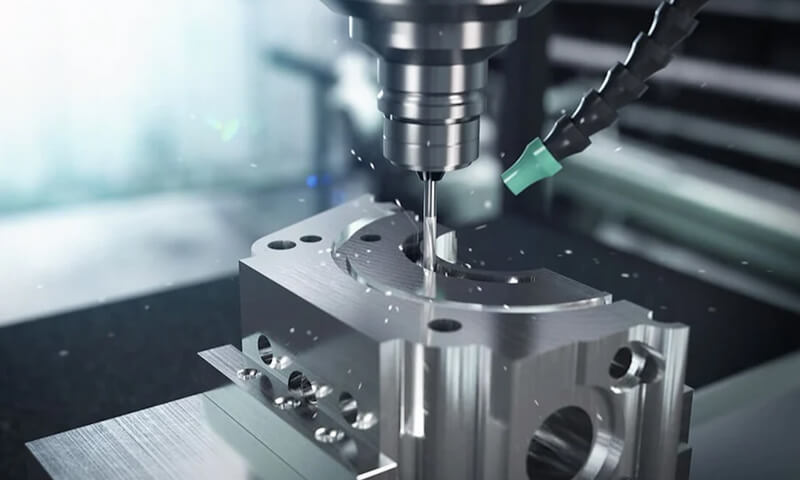
D2 tool steel’s high carbide content and pre-hardened microstructure pose unique challenges during machining and fabrication.
By selecting appropriate tooling, optimizing cutting parameters, and following specialized welding and finishing practices,
manufacturers can produce accurate, high-quality parts while preserving D2’s wear-resistant properties.

Machining Hardened D2
Although annealed D2 (∼240 HBW) machines readily, many applications start with pre-hardened stock (50 ± ± 2 ХРЦ). In this condition:
- Алат за алате:
-
- Карбидни умеци with TiC or TiCN coatings resist abrasion from hard chromium and vanadium carbides.
- Polycrystalline cubic boron nitride (PCBN) excels for high-volume roughing of hardened surfaces.
- Резање параметара:
-
- Брзина: 60–90 m/min for carbide; 100–150 m/min for PCBN.
- Feed: 0.05–0.15 mm/rev to balance tool life and surface finish.
- Depth of cut: 0.5–2 мм; shallow passes reduce cutting forces and heat generation.
- Расхладна течност: Flood coolant or through-tool delivery minimizes built-up edge and keeps cutting zones below 200 ° Ц, preventing carbide pull-out.
Transitionally, adopting these recommendations enhances surface integrity and dimensional accuracy, critical for tight-tolerance tooling.
Welding and Repair
Welding D2 demands careful control to avoid cracking and preserve the martensitic matrix:
- Pre-heat: Bring parts to 200–300 °Ц to reduce thermal gradients.
- Интерпасс Температуре: Одржавајте 200–250 °Ц between passes to alleviate residual stresses.
- Filler Metals: Use low-alloy, high-hardness rod (Нпр., AWS A5.28 ER410NiMo) compatible with D2’s chemistry.
- Пост-заваривање топлоте: Stress-relieve at 500 ° Ц за 2 сати, then temper according to Section 5 to restore toughness and hardness.
These steps minimize hydrogen-induced cracking and ensure weld zones match base-metal performance.
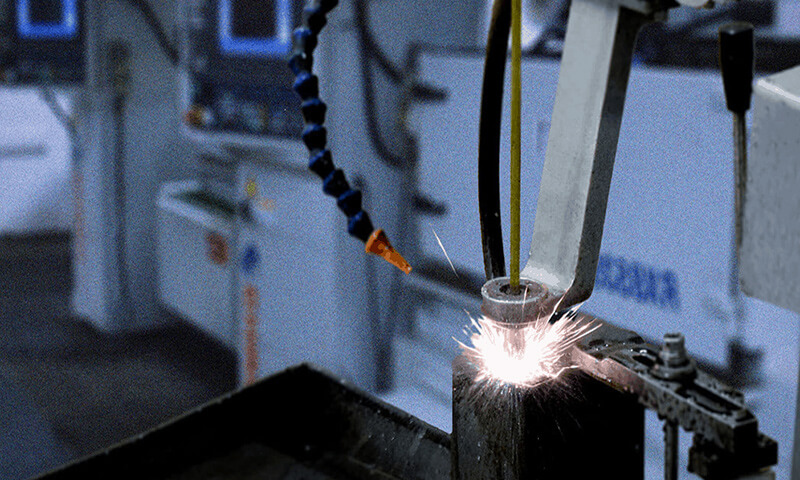
Grinding and Electrical Discharge Machining (ЕДМ)
For intricate geometries and fine finishes, non-conventional methods excel:
- Млевење:
-
- Wheel Selection: Use aluminum-oxide or cubic boron nitride wheels (46A60H–54A80H) with soft bonds to prevent glazing.
- Параметри: Light infeed (0.01–0.05 mm) and high wheel speed (30 м / с) yield Ra ≤ 0.4 μм.
- ЕДМ:
-
- Die Sinking or Wire EDM creates complex cavities without inducing mechanical stresses.
- Диелектрична течност: Hydrocarbon oil with controlled flushing prevents re-deposition of carbides.
- Machining Rates: Typically 0.1–0.5 mm³/min, depending on electrode geometry and power settings.
Incorporating EDM and precision grinding allows D2 components to achieve near-net shapes and mirror finishes while maintaining the full hardness of the tool steel.
Surface Finishing and Coating
To further extend tool life, consider these finishing options:
- Полирање: Final polish to Ra ≤ 0.2 µm reduces friction and debris adhesion.
- PVD Coatings: Титанијум нитрид (ТиН) or aluminum titanium nitride (Злато) layers add a hard, low-friction surface, increasing wear life by up to 50%.
- Нитрирање: Low-temperature gas nitriding (500 ° Ц) diffuses nitrogen to form a hardened case, enhancing surface hardness to HRC 70+ without distorting core dimensions.
8. Key Applications of D2 Cold Working Tool Steel
D2’s balance of wear resistance and toughness suits:
- Cold-work dies: Бланкинг, формирање, and trimming operations exceeding 1 милион циклуса.
- Cutting blades: High-speed shear knives maintaining sharp edges under abrasive slurries.
- Punch and die sets: Reliable performance in stamped components for automotive and appliance industries.
- Wear parts: Роллерс, игле за избацивање, and bushings in high-abrasion environments.
- Additive-assisted tooling inserts: Hybrid mold inserts combining D2 with conformal cooling channels.
9. Performance Comparison: D2 vs. Other Tool Steels
D2 cold working tool steel is widely recognized for its exceptional wear resistance and moderate toughness.
Међутим, in selecting tool steel for manufacturing applications, it’s critical to compare D2 with other popular tool steels to assess trade-offs in performance, издржљивост, и коштати.
This section provides a detailed comparison of D2 with A-2, M-2, and S-7, supported by data and real-world case insights.
Tool Steel Comparison Table
| Имовина / Steel Type | D-2 | A-2 | M-2 | S-7 |
|---|---|---|---|---|
| Primary Strength | Отпорност на хабање | Жилавост & Димензионална стабилност | Red hardness & cutting performance | Отпорност на удар |
| Тврдоћа (ХРЦ) | 55–62 | 57–62 | 62–66 | 54–58 |
| Отпорност на хабање | ★★★★☆ | ★★★☆☆ | ★★★★★ | ★★☆☆☆ |
| Жилавост | ★★☆☆☆ | ★★★★☆ | ★★☆☆☆ | ★★★★★ |
| Обрада | ★★☆☆☆ | ★★★★☆ | ★☆☆☆☆ | ★★★☆☆ |
| Red Hardness | ★★☆☆☆ | ★★☆☆☆ | ★★★★★ | ★★☆☆☆ |
| Heat Treatment Stability | ★★★☆☆ | ★★★★☆ | ★★☆☆☆ | ★★★☆☆ |
| Најбоље апликације | Бланкинг, подрезивање, ударци | Forming dies, tooling blocks | High-speed cutters, бушилице | Длета, injection dies, чекићи |
| Ниво трошкова | Средњи | Средњи | Високо | Средњи |
10. Закључак
D2 cold working tool steel stands out for its unparalleled combination of wear resistance, Димензионална стабилност, и топлотна стабилност.
Its versatility across a wide array of applications—from traditional cold work dies to emerging additive manufacturing techniques—makes it an indispensable material in modern manufacturing.
Understanding the nuances of D2’s chemical composition, механичка својства, and processing techniques empowers
engineers and designers to leverage its full potential, ensuring optimal performance and efficiency in their projects.