
Dugo su me zvali da istražim pukotine u lijevanju, and the first thing I always do is stop the conversation about “how to fix the crack” and redirect it to a more basic question: which kind of crack is it?
Because hot tearing and cold cracking are not variations of the same problem. They form at different temperatures, by different mechanisms, in different locations, with different morphology, and they require different—sometimes opposite—corrective actions.
A shop that treats a hot tear as a cold crack will keep adding chills and reducing pouring temperature and wonder why the defect persists.
A shop that treats a cold crack as a hot tear will keep adjusting gating and never address the residual stress that is actually opening the casting.
This article is a systematic treatment of both defect types: the mechanism, the morphology, the causes, the prevention measures, and the differential diagnosis that should come before any corrective action.
1. What Are Casting Cracks?
Lijevanje cracks are fractures caused by tensile stresses that exceed the metal’s ability to withstand deformation during solidification or subsequent cooling.
The most important distinction between the two main types is when the crack forms.
Vruće suzenje occurs near the end of solidification or shortly afterward, when the casting is still at a high temperature and has very limited strength and ductility.
U ovoj fazi, a solid dendritic skeleton has formed, but thin films of liquid metal remain between the dendrites.
If contraction is restricted and the remaining liquid cannot adequately feed the developing separation, cracks initiate and propagate mainly along grain boundaries. This is known as intergranular cracking.
Cold cracking develops after the casting has cooled into the elastic state.
U ovoj fazi, the metal is fully solid, but uneven cooling and restricted contraction can generate residual tensile stresses. When these stresses exceed the alloy’s ultimate strength, the casting fractures.
Unlike hot tearing, cold cracks generally propagate through the grains rather than along grain boundaries, a mechanism known as transgranular cracking.
Understanding this difference is essential for accurate defect identification and process correction.
Although both defects involve tensile stress, hot tearing is primarily associated with the vulnerable semi-solid stage, while cold cracking is related to residual stress in the solidified casting.
| Značajka | Hot Tearing | Hladno pucanje |
| Formation stage | End of solidification or shortly afterward | After cooling into the elastic state |
| Propagation path | Along grain boundaries (intergranular) | Through grains (transgranular) |
| Fracture surface | Oksidirano, generally without metallic luster | Relatively clean, with metallic luster or slight oxidation |
| Crack shape | Irregular, often wide at the surface and narrow internally | Relatively uniform width, straight or zigzag |
| Tipična lokacija | Hot spots, kutovi, and abrupt section changes | Regions subjected to high tensile stress |
| Detectability | May be visible externally or remain internal | Often visible to the naked eye |
The key to distinguishing these defects is to combine crack morphology, fracture-surface characteristics, and metallographic evidence rather than relying on appearance alone.
This distinction also determines whether corrective measures should focus on solidification and feeding or on cooling conditions and residual-stress control.
2. Hot Tearing: Uzroci, Karakteristike, and Formation Mechanism
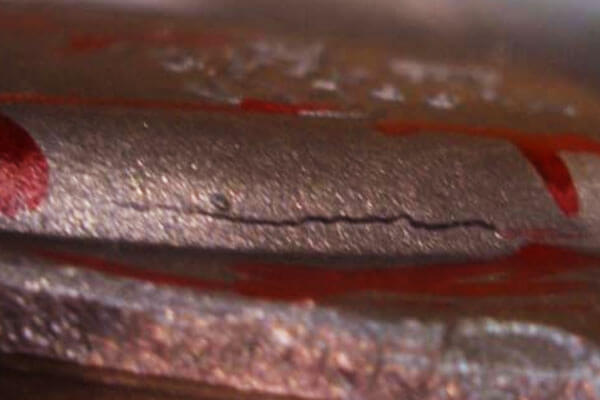
Hot tearing is a high-temperature cracking defect that develops during the final stages of solidification or shortly afterward, when the casting has very limited strength and ductility.
It is particularly common in cast steel, konopljivo lijevano željezo, and certain aluminum alloy castings.
The fundamental cause is restrained contraction of the semi-solid casting. As the metal solidifies, a connected dendritic skeleton begins to form while liquid metal remains between the dendrite arms.
If this skeleton cannot contract freely and the remaining liquid cannot adequately feed the developing separation, the grain boundaries may open and form a hot tear.
Understanding the relationship between dendritic structure, liquid feeding, toplinski stres, and mold restraint is essential for preventing this defect.
Formation Mechanism: The Solidification Skeleton and Liquid Film
Kada rastaljeni metal uđe u kalup, it transfers heat primarily through the mold walls. Solidification therefore generally starts at the casting surface and progresses inward.
During the later stages of solidification, dendrites grow and gradually connect to form a continuous solid skeleton. U ovom trenutku, the casting begins to undergo solid-state contraction.
Međutim, the structure is not yet completely solid: thin films of residual liquid metal remain between the interconnected dendrites.
These liquid films are important because they provide the last opportunity for liquid metal to compensate for local separation and contraction.
If the dendritic skeleton can contract freely, it may accommodate the resulting strain without cracking.
Međutim, kalupi za pijesak, jezgre, adjacent casting sections, and other rigid structures can restrict this movement. The resulting tensile stress acts on the weak semi-solid network.
When the tensile stress or imposed strain exceeds the material’s limited strength and deformation capacity at that temperature, the dendrites separate along their boundaries and a hot tear develops.
The risk is particularly high in regions where solidification is nearly complete but the remaining liquid films have become thin and poorly connected.
Why Some Hot Tears Heal and Others Remain
An important factor in hot tearing is whether liquid metal can feed the developing separation.
A small opening between dendrites does not automatically become a permanent casting defect.
If the dendritic network separates gradually and sufficient liquid metal remains nearby, the liquid can flow into the opening and compensate for the separation. The defect may therefore heal before final solidification.
Međutim, if the opening develops too quickly, the remaining liquid cannot reach the affected region, or the feeding channels have already become disconnected, the separation cannot be repaired.
The crack remains after solidification and becomes a permanent hot-tearing defect.
This explains why feeding is not only a shrinkage-control issue but also an important part of hot-tearing prevention.
Pravilan dizajn uspona, liquid feeding paths, and solidification control all influence whether an opening can be compensated for before the metal becomes fully solid.
Which Alloys Are Most Susceptible to Hot Tearing?
The alloy’s solidification range and solidification mode have a significant influence on hot-tearing susceptibility.
| Alloy Solidification Behavior | Hot-Tearing Tendency | Metallurgical Explanation |
| Širok raspon smrzavanja | Visok | The alloy remains in the vulnerable semi-solid state over a relatively broad temperature interval |
| Mushy or spongy solidification | Visok | A weak dendritic network develops while liquid films remain between solid grains |
| Narrow freezing range | Relativno nizak | The vulnerable semi-solid interval is shorter |
| Eutectic composition with near-constant-temperature solidification | Općenito nizak | Solidification occurs over a narrow temperature interval, reducing the duration of the vulnerable state |
In alloys with a wide freezing range, the dendritic skeleton may remain weak for a relatively long period. During this interval, even moderate contraction strain can cause grain-boundary separation.
Za usporedbu, alloys with narrow freezing ranges generally pass through the vulnerable semi-solid stage more quickly.
Eutectic compositions that solidify at an approximately constant temperature typically have the lowest hot-tearing tendency among these solidification behaviors.
This metallurgical difference has direct implications for foundry process design.
Alloys with different freezing ranges may require different feeding arrangements, gating configurations, and mold-restraint controls, even when produced in the same foundry.
Thermal Stress and Contraction Stress: The Two Main Driving Forces
Hot tearing is associated with two interacting sources of stress: thermal stress within the solidifying structure and contraction stress caused by external restraint.
Toplinski stres develops because different regions of the casting cool and solidify at different rates.
The solid grain skeleton in a hotter region may be restrained by surrounding sections that have already become rigid. This can produce localized tensile stress and contribute to external or subsurface hot tearing.
Contraction stress results when the casting cannot freely shrink during solidification and cooling.
The outer shell of a solidifying casting experiences linear contraction, but its movement may be restricted by:
- Sand cores and core supports.
- Mold walls and the mechanical strength of molding sand.
- Friction between the casting surface and the mold.
- Rigid connections between different casting sections.
- Gating and riser systems that interfere with normal contraction.
These restraints generate tensile stress within the casting shell. Hot spots are particularly vulnerable because they remain hot and weak while surrounding sections have already solidified.
Sharp corners and abrupt section transitions further concentrate stress, making them common locations for hot-tear initiation.
U praksi, hot tearing usually results from the combined effects of thermal gradients, contraction strain, inadequate liquid feeding, and insufficient mold collapsibility.
Hot Tearing Morphology and Characteristics
Hot tears have distinctive macroscopic and microscopic features that help distinguish them from cold cracks.
Njihove tipične karakteristike uključuju:
- Irregular shape: The crack follows a curved, navijanje, and uneven path, often with variable width.
- Torn appearance: The fracture may look partially connected, with an irregular surface rather than a clean separation.
- Uneven opening: External hot tears are often relatively wide at the casting surface and narrower toward the interior.
- Oxidized fracture surface: The fracture generally lacks metallic luster because the crack forms at high temperature and its exposed surfaces undergo oxidation.
- Intergranular propagation: The crack primarily follows grain boundaries.
- Dendritic features: Internal hot tears may show dendritic structures on the fracture surface.
In steel castings, the fracture surface is often dark or nearly black. In aluminum alloy castings, it commonly appears dark gray.
External hot tears
External hot tears are visible on the casting surface. They commonly occur at:
- Sharp corners and internal angles.
- Abrupt changes in wall thickness.
- Locally slow-solidifying regions.
- Areas with high mechanical restraint or stress concentration.
Their characteristic appearance is a relatively wide surface opening that becomes narrower toward the interior. U teškim slučajevima, the crack may extend through the entire casting cross-section.
Internal hot tears
Internal hot tears generally develop in the last-to-solidify regions, such as isolated hot spots and heavy sections.
Their shape is highly irregular, and their fracture surfaces may contain dendritic features.
These defects do not necessarily extend to the casting surface, making them difficult to identify through visual inspection.
Za kritične odljeve, radiografsko ispitivanje (Rt), ultrazvučno testiranje (UT), or destructive sectioning and metallographic examination may be required, depending on the defect’s size, orijentacija, and location.
| Tip | Typical Location | Visibility | Suitable Inspection |
| External hot tear | Površinski, kutovi, and section transitions | Usually visible | Visual inspection and surface NDT |
| Internal hot tear | Last-to-solidify internal regions | Generally not visible | Rt, UT, or sectioning and metallography |
Main Causes of Hot Tearing in Foundry Production
Although the fundamental mechanism is restrained contraction during the low-strength solidification interval, several production factors can increase the risk.
Casting Structure and Geometry
- Uneven wall thickness creates differences in cooling rates and contraction.
- Sharp internal corners concentrate tensile stress.
- Excessive branching and complex junctions create multiple restricted contraction paths.
- Outer frames and ribs may prevent the casting from shrinking freely.
- In wheel-type castings, curved spokes may be considered to improve contraction flexibility.
The design objective is to avoid abrupt changes in section thickness and excessive structural rigidity.
Gating and Riser System
Gating and riser systems should provide effective filling and feeding without unnecessarily restricting casting contraction.
Risers located too close to flask bars or arranged so that the sand between them becomes highly compacted and mechanically strong may restrict local contraction.
Poorly positioned gates can also create rigid connections between sections that need to shrink independently.
Riser size requires careful optimization. An undersized riser may provide insufficient feeding capacity, while an oversized or poorly positioned riser can create additional hot spots and mechanical restraint.
Alloy Composition and Melt Quality
Certain alloying elements and impurities can increase hot-tearing susceptibility by affecting the freezing range, grain-boundary properties, and high-temperature ductility.
In cast steel and cast iron, excessive sulfur and phosphorus are particularly undesirable.
These elements may promote low-melting-point constituents or weaken grain boundaries during solidification.
Poor melt cleanliness can also aggravate cracking. Oxide inclusions and other nonmetallic contaminants may interfere with metallurgical integrity and reduce the reliability of the solidifying structure.
Suitable refining and melt-treatment practices should therefore be applied according to the alloy and production requirements.
Premature Shakeout
Removing castings from the mold too early can expose them to rapid and uneven cooling.
This increases thermal gradients and may aggravate cracking, particularly in large castings or components with significant differences in section thickness.
The mold should provide sufficient thermal protection until the casting has developed adequate strength for safe shakeout and handling.
How to Prevent Hot Tearing
Effective prevention requires coordinated control of casting design, alloy quality, feeding conditions, and mold behavior.
Improve Casting Geometry
Maintain reasonably uniform wall thickness and use generous fillets at corners and section transitions.
Avoid excessive rib intersections and rigid structural connections that restrict contraction. For wheel-type castings, curved spokes may help accommodate shrinkage where the design permits.
Improve Melt Quality
Use suitable refining and melt-treatment procedures to control oxide inclusions and dissolved gases.
Keep sulfur, fosfor, and other harmful impurities within the specified composition limits.
Proper chemical control helps maintain the high-temperature ductility and metallurgical consistency required for reliable solidification.
Optimize Gating, Hranjenje, i skrućivanje
Position and size gates and risers to ensure adequate feeding of last-solidifying regions while avoiding unnecessary mechanical restraint.
Promote a suitable solidification sequence and reduce excessive temperature differences between casting sections.
Simultaneous solidification can be beneficial for certain geometries because it helps reduce differences in cooling and contraction. Međutim, it should not be applied indiscriminately.
Castings requiring directional solidification and effective riser feeding need a process design that supports their specific solidification requirements.
Control Mold Residence Time and Improve Collapsibility
The sand mold provides thermal insulation, allowing thick and thin sections to approach a more uniform temperature during cooling.
Appropriate mold residence time helps reduce temperature differences and the associated thermal stresses.
Mold and core collapsibility are equally important. After the casting has developed sufficient strength, removing flask weights, loosening clamping devices, or releasing selected mold restraints can reduce resistance to contraction.
Za velike odljevke, partially removing molding sand or core sand after pouring may also help reduce contraction resistance and promote more uniform cooling, provided the casting has sufficient structural stability.
Control Shakeout and Handling
Avoid premature shakeout and sudden cooling. During shakeout, čišćenje, i prijevoz, prevent impacts, cijeđenje, and excessive mechanical loading.
These precautions are particularly important for large, kompleks, or relatively brittle castings.
Apply Stress-Relief Heat Treatment When Required
Castings with high residual stress may require stress-relief heat treatment to reduce the risk of subsequent cold cracking.
Additional treatment may be necessary after gate and riser removal or weld repair, depending on the material specification and component requirements.
It is important to distinguish the purpose of this treatment: stress relief primarily addresses residual stress in the solidified casting.
It cannot repair an existing hot tear or replace the need to correct the original solidification and feeding problems.
3. Hladno pucanje: Uzroci, Karakteristike, and Formation Mechanism
Cold cracking is a casting defect that develops after the metal has completely solidified and cooled into the elastic state. Tijekom hlađenja, different sections of the casting contract at different rates.
If this contraction is restricted by the casting structure, sand mold, jezgre, ili gating sustav, residual tensile stresses develop.
When the local stress exceeds the ultimate strength of the alloy, the casting fractures.
Unlike hot tearing, which develops along grain boundaries in the semi-solid structure, cold cracking generally propagates through the grains (transgranular cracking).
It is therefore closely associated with residual stress, neravnomjerno hlađenje, structural restraint, and insufficient material toughness.
Cold cracks are particularly likely to occur in regions subjected to tensile stress, especially at sharp corners, prijelazi odjeljaka, rigid structural connections, and areas where contraction is mechanically restricted.
Formation Mechanism and Typical Characteristics
Nakon skrućivanja, the casting continues to lose heat and undergo thermal contraction. Međutim, different sections rarely cool at exactly the same rate.
Thin sections generally cool faster than thick sections, while cores, stijenke kalupa, and rigid connections may prevent certain regions from shrinking freely.
These differences generate internal tensile stresses. If the casting has sufficient ductility and toughness, it can accommodate some of the resulting strain.
Međutim, when the accumulated stress exceeds the material’s strength, a crack initiates and propagates through the solid metal.
The typical characteristics of cold cracking include:
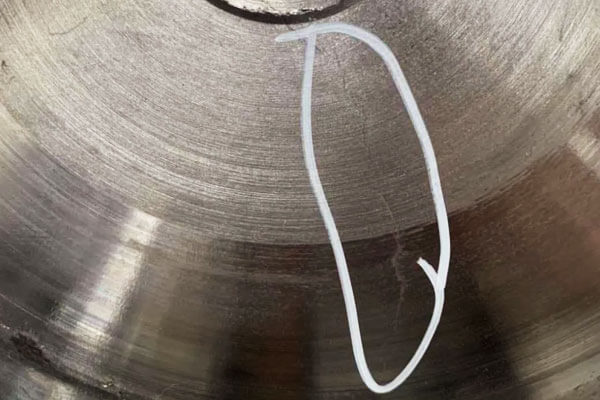
- Crack shape: Relatively narrow, with a fairly uniform width. The crack path is usually straight or zigzag rather than highly curved and irregular.
- Propagation direction: Općenito transgranularno, extending through individual grains rather than following grain boundaries.
- Fracture surface: Relatively clean, often showing metallic luster or slight oxidation.
- Crack depth: May extend through a substantial portion of the casting or even across the entire cross-section.
- Tipična lokacija: Regions under high tensile stress, particularly around sharp corners, nagle promjene presjeka, rigid connections, and core-restrained areas.
The fracture surface of a cold crack is generally smoother and cleaner than that of a hot tear.
Međutim, its appearance can vary with alloy composition, cooling conditions, and the time elapsed before inspection.
The key metallurgical distinction is the crack propagation path. Hot tears follow grain boundaries because the semi-solid structure contains residual liquid films along these boundaries.
Cold cracks develop after complete solidification, when the metal has become a continuous solid structure and fractures through the grains under excessive tensile stress.
Main Causes of Cold Cracking
Cold cracking occurs when casting stress exceeds the strength of the solidified alloy. Stoga, any factor that increases residual stress or reduces material strength and toughness can increase the risk.
Casting Structure and Geometric Restraint
Uneven wall thickness is a common source of casting stress. Thin sections cool and contract faster than thick sections, creating temperature differences and nonuniform shrinkage.
When the casting structure prevents these sections from contracting independently, internal tensile stress increases.
Rigid casting structures are particularly vulnerable because their geometry restricts normal contraction.
A typical example is a uniform-wall, thin-walled box casting with a large internal sand core.
Although the wall thickness may be relatively consistent, the large core can mechanically restrain the inward contraction of the casting walls.
This creates temporary contraction stress. If the resulting tensile stress exceeds the alloy’s strength, a cold crack may develop.
Oštri kutovi, abrupt section transitions, and rigid junctions further increase the risk by concentrating stress in localized regions.
Improper Gating and Riser Design
Gating and riser arrangements can influence both cooling uniformity and the freedom of casting contraction.
For castings with uneven wall thickness, placing an ingate in a heavy section may further delay the cooling of that region.
This increases the temperature difference between thick and thin sections, potentially intensifying thermal stress during subsequent cooling.
Gating arrangements can also create direct mechanical restraint. Because an ingate is generally thinner than the casting section it connects to, it may solidify first.
As the main casting continues to contract, the solidified gate can restrict its movement.
Tensile stress may then concentrate in the casting wall, particularly in the region between two ingates, increasing the possibility of cold cracking.
Risers and other connections should therefore be positioned to provide effective feeding without unnecessarily restricting the casting’s contraction.
Excessive Mold and Core Strength
Molding sand and core sand must provide sufficient strength to maintain cavity geometry during pouring and solidification.
Međutim, excessively high hot strength or dry strength can prevent the mold and core from yielding as the casting contracts.
If the sand system has poor hot collapsibility, the casting remains mechanically restrained during cooling. The resulting tensile stress may become high enough to initiate cold cracks.
This is particularly important for large castings, complex core assemblies, and components with extensive internal surfaces.
Foundries must balance mold stability with adequate collapsibility rather than maximizing sand strength without considering contraction behavior.
Unfavorable Chemical Composition and Material Brittleness
Alloy composition directly affects the strength, duktilnost, and toughness of castings.
In steel castings, excessive carbon and alloying-element contents can increase hardenability and promote brittle microstructures under certain cooling conditions.
This may reduce the casting’s ability to accommodate contraction strain.
Phosphorus is another important harmful element. When the phosphorus mass fraction in steel exceeds 0.05% (ω(P) > 0.05%), cold brittleness increases, making the material more susceptible to brittle fracture and cold cracking.
In gray cast iron, excessive graphitization-inhibiting elements can promote carbide formation and increase contraction-related stress. The resulting reduction in toughness can further increase cracking susceptibility.
Chemical composition should therefore remain within the specified material grade, with particular attention to elements that influence brittleness and low-temperature mechanical properties.
Premature Shakeout and Improper Cleaning
Shakeout timing has a direct influence on cooling stress and casting integrity.
If a casting is removed from the mold too early, it may experience rapid and uneven cooling.
The temperature difference between thick and thin sections can increase, producing additional thermal stress before the casting has developed sufficient resistance to cracking.
Cleaning operations can introduce further mechanical loads. Removing sand at excessively high temperatures, striking the casting during shakeout, or applying impact and squeezing forces during cleaning and transportation may initiate cracks or extend existing ones.
For large or structurally complex castings, shakeout temperature and handling procedures should be controlled according to the alloy, casting mass, i debljina presjeka.
How to Prevent Cold Cracking
Effective cold-cracking prevention focuses on reducing residual tensile stress, improving material toughness, and allowing the casting to contract freely during cooling.
Design for Uniform Cooling and Lower Stress Concentration
Maintain reasonably uniform wall thickness and use generous fillets at internal corners and section transitions.
Avoid excessively rigid structures and complicated junctions that restrict normal contraction.
Gdje je moguće, adjust the geometry to reduce local stress concentration and allow different sections to contract more freely.
Optimize Gating and Riser Placement
Avoid placing ingates in heavy sections when this arrangement unnecessarily delays local cooling.
Arrange gates and risers to support filling and feeding without creating rigid connections that restrain contraction.
Particular attention should be paid to thin gates that may solidify early and restrict the subsequent shrinkage of the main casting.
Improve Mold and Core Collapsibility
Control the hot strength and dry strength of molding and core sands. The mold system must maintain dimensional stability during pouring while providing sufficient collapsibility during cooling.
Za velike odljevke, selected molding sand or core sand may be removed after pouring when the casting has adequate strength. This can reduce mechanical restraint and help the casting contract more uniformly.
Control Alloy Chemical Composition
Keep carbon and alloying elements within the specified composition range. In steel castings, pay particular attention to phosphorus control.
A phosphorus mass fraction exceeding 0.05% should be avoided where the applicable material specification requires lower limits.
For gray cast iron, control graphitization-inhibiting elements to avoid excessive carbide formation and deterioration of toughness.
Control Shakeout and Cleaning Conditions
Do not remove castings from the mold prematurely. Allow sufficient cooling time to reduce temperature differences and residual stress before shakeout.
Avoid cleaning castings at excessively high temperatures and prevent impact, cijeđenje, or rough handling during sand removal, rezanje, i prijevoz.
Apply Stress-Relief Heat Treatment When Necessary
Castings with high residual stress should receive appropriate stress-relief heat treatment according to their material grade and technical requirements.
This is particularly important for large, kruta, and dimensionally sensitive components.
Additional stress relief may also be required after gate and riser cutting or weld repair, depending on the casting specification and repair procedure.
Stress relief helps reduce residual tensile stress, but it should complement—not replace—improvements in casting geometry, mold collapsibility, sastav legure, and cooling control.
4. Differential Diagnosis: The Checklist I Use
Before selecting corrective measures, the first task in a casting defect investigation is to determine whether the crack is a hot tear or a cold crack.
Although both defects may appear as fractures on the casting surface, their formation mechanisms are fundamentally different.
Treating them as the same defect can lead to ineffective adjustments—for example, changing the pouring temperature when the actual problem is excessive residual stress, or modifying the mold when the root cause is inadequate feeding during final solidification.
In a defect review meeting, I use the following five-step checklist. No single feature should be treated as conclusive.
The diagnosis should combine crack morphology, fracture-surface condition, propagation path, mjesto, and the production timeline.
Korak 1: Examine the Crack Shape
Start with the external morphology, including the crack’s direction, širina, and overall profile.
- Vruće suzenje: Usually irregular, tortuous, and uneven in width. The opening may be relatively wide at the casting surface and narrow toward the interior. Branching or discontinuous features may also appear.
- Cold cracking: Generally has a more uniform width and follows a relatively straight or zigzag path. It may extend across a substantial portion of the casting section.
Crack shape provides a useful initial indication, but it is not sufficient for final identification.
Casting geometry, sastav legure, and the direction of crack propagation can all influence the visible appearance.
Korak 2: Examine the Fracture Surface
The fracture surface often provides stronger evidence than the external crack shape. Carefully inspect its color, oxidation condition, i metalni sjaj.
- Vruće suzenje: Typically produces a dark, oxidized fracture surface with little or no metallic luster.
This appearance is associated with crack formation at high temperatures, when the exposed metal reacts with the surrounding atmosphere. - Cold cracking: Usually presents a relatively clean fracture surface with metallic luster, particularly when the crack forms after the casting has cooled.
Some oxidation may still occur if the crack remains exposed for an extended period.
The fracture surface must be interpreted in relation to the casting’s handling and storage history.
A cold crack that remains exposed for a long time may become oxidized, while a hot tear may show different surface characteristics depending on the alloy and atmosphere.
Korak 3: Determine the Crack Propagation Path
When the external evidence is inconclusive, metallographic examination can help distinguish the two mechanisms.
- Vruće suzenje: Typically propagates along grain boundaries during the final stages of solidification.
Internal fracture surfaces may retain dendritic features, indicating separation within the semi-solid structure. - Cold cracking: Generally propagates through the grains rather than along grain boundaries.
Metallographic examination may reveal a transgranular fracture path associated with tensile stress after solidification.
For internal cracks, dendritic features on the fracture surface are particularly useful evidence of hot tearing.
Međutim, sample preparation and fracture-surface contamination can affect interpretation, so metallographic findings should be considered alongside other inspection results.
Korak 4: Check the Crack Location
The crack location helps identify the conditions that may have generated the stress, but it does not independently confirm the defect type.
Locations commonly associated with hot tearing include:
- Hot spots and last-to-solidify regions.
- Sharp corners and abrupt changes in wall thickness.
- Rigid structural connections that restrict solidification shrinkage.
- Areas with inadequate feeding or poor liquid-metal supply during final solidification.
Locations commonly associated with cold cracking include:
- Regions exposed to high residual tensile stress.
- Areas between two ingates or near rigid gating connections.
- Thin-wall castings with large cores that restrict contraction.
- Heavy-to-thin section transitions where cooling rates differ significantly.
An important distinction is that corners, prijelazi odjeljaka, and rigid connections can be susceptible to both defects.
The decisive question is whether the fracture developed while the metal was still semi-solid or after it had fully solidified.
Korak 5: Establish When the Crack Formed
The time when a crack is discovered is not necessarily the time when it formed. Review the entire production history, from solidification and shakeout to cleaning, skladištenje, I obrada.
- Vruće suzenje: Often becomes visible during shakeout or initial inspection because the fracture formed during the final stages of solidification. Its oxidized surface provides additional evidence of high-temperature formation.
- Cold cracking: May develop during cooling after solidification and become visible during shakeout, čišćenje, skladištenje, odnosno strojna obrada. A relatively clean fracture surface can support this diagnosis.
Do not automatically classify a crack discovered after machining as a cold crack. Machining may simply expose a pre-existing internal hot tear.
Gdje je potrebno, compare the defect location with machining records and use radiographic testing, ultrazvučno testiranje, or sectioning to determine whether the crack existed before machining.
5. Zaključak
Casting cracks are primarily related to tensile stress, but their formation mechanisms depend on the solidification and cooling stages.
Hot tearing develops when a semi-solid dendritic structure cannot withstand contraction strain and the remaining liquid cannot adequately feed the developing separation.
Cold cracking occurs after solidification when residual tensile stress exceeds the strength of the solidified metal.
For foundries, effective prevention starts with correct defect identification. Hot-tearing control should focus on solidification behavior, feeding conditions, sastav legure, bacanje geometrije, and mold collapsibility.
Cold-cracking prevention requires particular attention to cooling uniformity, structural restraint, shakeout timing, material toughness, and stress-relief treatment.
Na OVA TEH, casting quality control involves evaluating material composition, geometrija komponenti, mold and core design, ponašanje skrućivanja, and post-casting processes as an integrated system.
By identifying the actual cracking mechanism and correcting its underlying process causes, manufacturers can reduce scrap rates, improve casting reliability, and deliver components that meet demanding dimensional and mechanical requirements.
Česta pitanja
What is the difference between a hot tear and a cold crack in castings?
Hot tears form at the end of solidification, propagate along grain boundaries, and have an oxidized, irregular fracture surface.
Cold cracks form after the casting cools to the elastic state, propagate through the grains, and have a clean, uniform-width fracture with metallic luster.
Which alloys are most prone to hot tearing?
Alloys with a wide freezing range and mushy or spongy solidification are most prone.
Narrow freezing range alloys are less prone, and eutectic composition alloys that solidify at a constant temperature are the least prone.
How can mold and core design reduce cracking?
Improving mold and core collapsibility (yielding) reduces the restraint on contraction.
Removing flask weights early, loosening clamps, and digging out sand after pouring for large castings all reduce contraction stress.
Can a hot tear heal by itself?
Da, u nekim slučajevima. If the dendrite skeleton is pulled apart slowly and enough liquid metal flows into the opening to feed it, the tear heals. If the opening cannot be fed, the tear remains as a defect.

