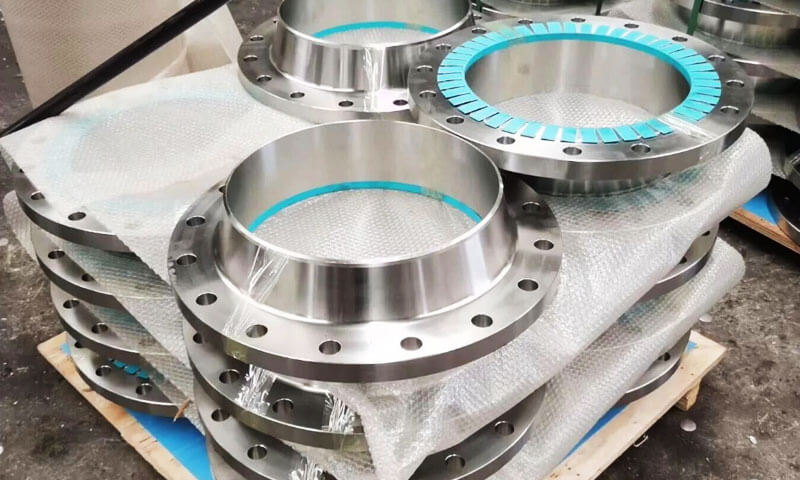
The stainless steel welding neck flange—universally abbreviated as WN flange—is the default choice for high-pressure, mataas na temperatura, and cyclic service.
But the word “default” hides a critical question: how is it made? A WN flange can be cut from plate, rolled from bar, cast to shape, or integrally forged.
These routes are not equivalent, and the differences show up in ultrasonic testing, in fatigue life, in weldability, and eventually in the failure report.
This article is a working engineer’s guide to custom stainless steel welding neck flanges produced by integral forging.
1. What Is a Stainless Steel Welding Neck Flange?
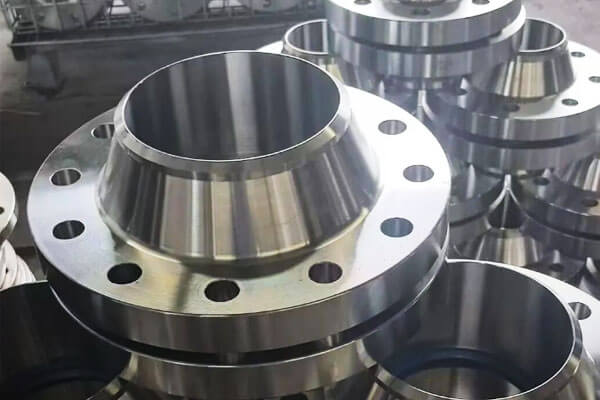
A hindi kinakalawang na asero welding neck flange, also known as a weld neck flange or WN flange, is a pipe flange with a long, tapered hub designed for butt welding to a pipe.
The flange is bolted to a matching flange, balbula, pump, pressure vessel, or other piping component, with a gasket positioned between the mating faces to create a sealed connection.
Its defining feature is the tapered neck, which gradually transitions from the thicker flange section to the pipe wall.
This geometry helps reduce abrupt changes in stiffness and supports a more gradual transfer of loads through the connection.
How Does a Welding Neck Flange Work?
A welding neck flange forms a permanent connection with the pipe through a circumferential butt weld.
The opposite flange is connected using bolts or studs, while a suitable gasket is compressed between the two facing surfaces.
The connection performs three main functions:
- Mechanical connection: Bolting joins the two flanged components and maintains the required joint assembly.
- Pressure sealing: The gasket is compressed between the flange faces to prevent process fluid from leaking.
- Load transfer: The flange, tapered hub, hinang hina, and connected pipe collectively carry pressure-related and external mechanical loads.
The tapered hub is particularly important because it reduces the abrupt geometric transition between the flange plate and pipe.
This can help limit local stress concentration compared with a connection that has a more abrupt change in section.
Gayunpaman, flange reliability depends on the complete joint design. Bolt preload, gasket selection, facing condition, kalidad ng weld, pipe alignment, and operating conditions all influence sealing performance.
2. Why Integral Forging Matters in Welding Neck Flange Manufacturing
Integral forging is more than an alternative manufacturing method for stainless steel welding neck flanges.
For demanding pressure and cyclic-service applications, it offers important metallurgical and structural advantages over plate-cut, hinangin, or cast construction.
Continuous Grain Flow
During forging operations such as upsetting, piercing, and ring rolling, the metal undergoes plastic deformation that can align the grain flow with the component’s geometry.
In a properly designed forging process, grain flow follows the flange profile through the hub and into the flange ring.
This supports structural integrity along the load-transfer path and cannot be replicated by simply cutting the flange profile from plate.
Elimination of Fabrication Weld Seams
A flange manufactured by rolling and welding may contain a circumferential weld seam in its ring.
This weld introduces an additional inspection requirement and may become a potential location for fatigue damage or localized corrosion if fabrication and welding are not properly controlled.
An integrally forged flange has no such fabrication seam between the flange body and ring.
Reduced Risk of Plate Laminations
Plate-cut flanges inherit the metallurgical characteristics of the original plate, including the possibility of planar discontinuities such as laminations.
These defects can reduce through-thickness integrity and may affect performance under tensile or bending loads.
Proper forging deformation can help close internal voids and improve material continuity, provided the starting billet is sound and the forging process is adequately controlled.
Pinahusay na Mga Katangian ng Mekanikal
Forging can produce a refined and more uniform microstructure, contributing to favorable strength, ductility, tigas na tigas, at pagganap ng pagkapagod.
Compared with cast products, properly forged stainless steel generally offers more consistent mechanical properties.
This is particularly important for welding neck flanges exposed to high pressure, cyclic na pag load, at mekanikal na stress.
Dimensional and Metallurgical Consistency
A controlled forging process, combined with appropriate heating, pagpapapangit, at paglamig, helps achieve consistent material properties.
For duplex stainless steel grades, subsequent heat treatment is especially important for maintaining the required austenite-ferrite phase balance and avoiding detrimental intermetallic phases.
Greater Confidence in Internal Inspection
Forged flanges can be examined using ultrasonic testing (UT) to detect relevant internal discontinuities.
A sound and properly processed forging generally provides a more reliable basis for evaluating internal integrity.
Sa kabilang banda, plate laminations may be difficult to identify through dimensional inspection alone and can affect ultrasonic examination results.
3. Stainless Steel Materials for Custom Welding Neck Flanges
Material selection is one of the most important decisions when specifying a stainless steel welding neck flange.
The selected grade must provide the required mechanical strength, paglaban sa kaagnasan, weldability, and temperature capability under actual operating conditions.
ASTM A182/A182M is a commonly specified material standard for forged or rolled alloy and stainless steel pipe flanges, forged fittings, at mga balbula.
It includes several austenitic, duplex, and other alloy steel grades used in industrial piping.
Austenitic Stainless Steel Grades
Austenitic stainless steels are widely used for welding neck flanges because of their corrosion resistance, ductility, and generally good weldability.
| Hindi kinakalawang na asero Grade | ASTM A182 Grade | Main Characteristics | Mga Karaniwang Aplikasyon |
| 304 | F304 | General-purpose corrosion resistance and good fabrication properties | Water systems, general industrial piping |
| 304L | F304L | Lower carbon content helps reduce sensitization risks after welding | Welded piping and equipment |
| 316 | F316 | Molybdenum improves resistance to pitting and crevice corrosion in many environments | Chemical processing and marine-related equipment |
316L |
F316L | Low-carbon version of 316, suitable for welded components | Chemical and pharmaceutical piping |
| 317L | F317L | Higher molybdenum content than 316L, offering improved resistance in selected corrosive media | Kagamitan sa pagproseso ng kemikal |
| 321 | F321 | Titanium-stabilized grade designed to reduce susceptibility to sensitization | Elevated-temperature welded piping |
| 347 | F347 | Niobium-stabilized grade with good resistance to intergranular corrosion after certain thermal exposures | High-temperature and welded process systems |
Duplex and Super Duplex Stainless Steel
Duplex stainless steels have a mixed austenitic-ferritic microstructure.
They generally offer higher strength than common austenitic grades and improved resistance to chloride-induced localized corrosion and stress corrosion cracking in suitable environments.
| Grade | Common ASTM A182 Designation | Main Characteristics | Mga Karaniwang Aplikasyon |
| Duplex 2205 | F51 | High strength and good resistance to pitting, bitak na kaagnasan, and chloride stress corrosion cracking | Offshore piping, pagproseso ng kemikal, seawater systems |
| Super Duplex 2507 | F53 | Higher alloy content and enhanced localized corrosion resistance compared with standard duplex grades | Offshore platforms, seawater handling, desalination |
Duplex and super duplex welding neck flanges require careful control during forging and heat treatment.
Their corrosion resistance and mechanical properties depend on maintaining an appropriate phase balance and avoiding harmful intermetallic phase formation.
Dahil dito, heat-treatment temperature, holding time, Rate ng paglamig, and subsequent material verification are particularly important.
Super Austenitic Stainless Steel
For highly corrosive applications, super austenitic grades may be considered.
| Grade | Common ASTM A182 Designation | Mga Pangunahing Katangian | Potential Applications |
| 904L | F904L | High nickel and molybdenum content with copper addition; good resistance in selected acidic environments | Chemical processing and acid-handling systems |
| 6% Mo alloys, such as UNS S31254 | F44 | High molybdenum and nitrogen content; strong resistance to pitting and crevice corrosion | Seawater systems and aggressive chloride environments |
These materials are not universal solutions to corrosion. Actual performance depends on fluid chemistry, temperatura, concentration, flow velocity, deposits, crevice geometry, and fabrication quality.
4. Welding Neck Flange Dimensions, Mga Uri, and Standards
Custom stainless steel welding neck flanges must still meet the dimensional requirements of their mating pipes, Mga balbula, and gaskets.
Kaya nga, dimensions are generally specified according to recognized international standards, even when the flange is manufactured to a custom design.
Major Flange Standards
The applicable standard determines key dimensions, Mga rating ng presyon, facing configurations, and other interface requirements.
| Pamantayan | Saklaw |
| ASME B16.5 | Covers NPS ½–24 flanges in Classes 150, 300, 600, 900, 1500, at 2500. |
| ASME B16.47 | Covers large-diameter flanges, generally NPS 26–60, in Series A and Series B. |
| ASME B16.36 | Specifies requirements for orifice flanges. |
| EN 1092-1 | Covers PN-designated steel flanges; Uri ng 11 identifies the welding neck configuration. |
| JIS B2220 | Japanese standard for steel pipe flanges. |
ASME and EN flange systems use different dimensional and rating conventions. Their dimensions are not directly interchangeable, so the specified standard must be confirmed before manufacturing.
Welding Neck Flange Facing Types
The flange facing determines how the gasket seals against the mating component. Three common configurations are:
- Raised Face (RF): The most widely used facing for general industrial applications. It provides a raised sealing surface for compatible gaskets, including spiral-wound and sheet gaskets.
- Flat Face (FF): Features a flat sealing surface and is commonly used when mating with cast-iron flanges or when a full-face gasket is required.
- Ring Type Joint (RTJ): Uses a precision-machined annular groove to accommodate a metallic ring gasket. It is commonly specified for high-pressure and high-temperature service.
Key Dimensional and Machining Tolerances
During manufacturing, critical dimensions must be controlled to ensure accurate fit-up, proper gasket seating, and reliable bolted connections. Typical machining targets may include:
| Tampok | Typical Tolerance or Requirement |
| Flange outside diameter | ±1.5 to ±3.0 mm, depending on size |
| Flange thickness | ±1.5 to ±3.0 mm, with tighter control on the sealing face |
| Bolt circle diameter | Approximately ±1.5 mm |
| Bolt hole diameter and position | Accurate hole size, spacing, and positional alignment |
| Bore diameter | Matched to the specified pipe schedule; typically +1.5/−0 mm where applicable |
| Hub dimensions | Weld-end diameter and hub length typically ±1.0 to ±2.0 mm |
| Face finish | Typically Ra 3.2–6.3 μm for RF, subject to gasket and standard requirements |
| Squareness and parallelism | Flange face must be properly aligned with the bore and mating face |
These values are general manufacturing references, not universal acceptance limits.
Actual tolerances and surface-finish requirements must follow the applicable flange standard, pagguhit, and gasket specification. RTJ grooves, sa partikular na, require precise control of groove geometry and surface finish.
For custom welding neck flanges, dimensional compatibility is essential. Even a correctly forged flange can cause installation or sealing problems if its bolt pattern, bore, nakaharap sa, or hub dimensions do not match the mating components.
All critical interface dimensions should therefore be verified against the specified standard and approved engineering drawing before production.
5. Custom Stainless Steel Welding Neck Flange Manufacturing Process
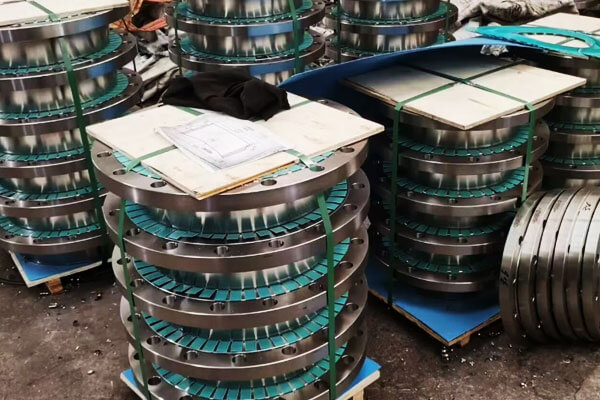
Producing a custom WN flange by integral pagkukubli involves a sequence of carefully controlled operations. Each one leaves a signature in the final part.
Hakbang 1: Raw material verification.
The incoming bar or billet is verified by certificate and by positive material identification (PMI).
Chemistry is confirmed, and for critical orders a sample is taken for mechanical testing and grain size analysis.
Hakbang 2: Cutting and weighing.
The billet is cut to a weight calculated from the finished volume plus flash and scale allowance.
An undersized billet produces an incomplete hub; an oversized billet wastes material and can create folding defects.
Hakbang 3: Pag init ng katawan.
The billet is heated to the forging temperature range. For austenitic stainless steels this is typically 1,150–1,250°C.
For duplex grades, the range is narrower and must be controlled to avoid sigma phase formation.
Overheating causes grain growth and, in severe cases, incipient melting. Underheating causes cracking and incomplete filling.
Hakbang 4: Upsetting and punching.
The heated billet is upset to form the flange ring, then punched to create the bore.
Hakbang 5: Ring rolling (for larger sizes).
The punched preform is rolled between a mandrel and a main roll to expand the ring and form the hub profile.
Ring rolling produces a continuous circumferential grain flow that is particularly favorable for flange rings.
Hakbang 6: Controlled cooling.
The forged part is cooled under controlled conditions. For austenitic grades, rapid cooling after forging avoids sensitization; for duplex grades, cooling rate controls the phase balance.
Hakbang 7: Lunas sa init.
Solution annealing for austenitic grades is typically 1,040–1,120°C, followed by water quenching or rapid air cooling.
Duplex grades are annealed in a controlled range and quenched to achieve the correct ferrite-austenite balance.
Hakbang 8: Rough machining.
The forging is machined to near-final dimensions, with stock left for finishing passes.
Hakbang 9: Finishing and inspection.
Final machining, face finishing, bolt hole drilling, marking, and the full inspection regime.
Hakbang 10: Dokumentasyon.
Mill certificates, heat treatment records, NDT reports, PMI results, dimensional reports, and certificates of conformity.
The forging temperature and the heat treatment are not interchangeable knobs. A forging made at the correct temperature but annealed incorrectly will have the wrong grain size and may be sensitized.
A forging annealed correctly but forged at the wrong temperature will have a mixed grain structure and may contain internal laps. Both must be controlled.
6. Applications of Custom Stainless Steel Welding Neck Flanges
Custom WN flanges appear wherever the standard catalog does not fit the requirement—non-standard bore, special face, unusual alloy, or a size or class not stocked.
Langis at gas:
Wellhead equipment, flowlines, mga manifold, and sour service piping. Duplex and super duplex WN flanges are common offshore.
Chemical and petrochemical:
Reactor piping, heat exchanger connections, and acid service lines. F316L and F904L are common; duplex for chloride-bearing streams.
Power generation:
Steam piping, boiler connections, and flue gas desulfurization systems. F321 and F347 for elevated temperature; super duplex for FGD scrubber service.
Pharmaceutical and food:
Hygienic piping with specific bore and surface finish requirements. F316L with electropolished or specially finished bores.
Water treatment and desalination:
Seawater piping, where F53, F55, and F44 flanges are used for chloride resistance.
Marine and shipbuilding:
Deck piping, mga sistema ng balagtasan, and exhaust gas cleaning systems.
Pulp and paper:
Digester and bleach plant piping, where duplex and high-molybdenum grades are required.
7. Integral Forging vs. Other Manufacturing Routes
The manufacturing route has a direct impact on the structural integrity and mechanical properties of a stainless steel welding neck flange.
A product described simply as a “forged flange” does not necessarily indicate how its shape was formed or whether the forging process produced favorable grain flow.
Integral Forging
Integral forging starts with a solid billet that is heated and formed through operations such as upsetting, pagsuntok sa, and ring rolling.
The metal undergoes plastic deformation, allowing the grain flow to follow the flange geometry through the hub and into the ring.
When properly controlled, this process produces a continuous forged structure without fabrication weld seams or the plate-related laminations associated with some plate-cut products. It also avoids the cast dendritic structure found in cast components.
Plate Cutting
Plate-cut flanges are manufactured by flame cutting, pagputol ng waterjet, or sawing a flange profile from steel plate, followed by machining.
This route is often economical for large-diameter flanges and small production quantities.
Gayunpaman, the grain structure remains aligned primarily with the plate.
Through-thickness mechanical properties are generally lower than longitudinal properties, and thick plates may contain laminations or other planar discontinuities that affect structural integrity.
Rolled and Welded Construction
Sa prosesong ito, a steel section is rolled into a ring and welded closed before machining. Although it can be suitable for certain flange applications, it introduces a circumferential weld seam into the flange ring.
The weld requires appropriate inspection and may become a potential location for fatigue damage or localized corrosion if welding quality and subsequent processing are not adequately controlled.
Paghahagis
Casting forms the flange by pouring molten metal into a mold. It offers flexibility in producing complex geometries, but the process carries a risk of shrinkage porosity and other casting defects.
Compared with properly processed forged stainless steel, cast material generally has lower elongation and toughness.
Dahil dito, casting is less commonly selected for welding neck flanges in critical pressure-service applications.
8. Why Choose DEZE Tech for Custom Welding Neck Flanges?
DEZE Tech provides precision manufacturing solutions for custom stainless steel welding neck flanges, combining material selection, forging coordination, CNC machining, and dimensional inspection to meet specific project requirements.
From austenitic and duplex stainless steels to super-austenitic grades, each material is selected according to the required pressure rating, operating temperature, corrosion environment, at mekanikal na pagganap.
Close control of critical dimensions—including flange thickness, bilog ng bolt, bore, hub geometry, and sealing-face finish—helps ensure compatibility with mating pipes, Mga balbula, and gaskets.
Whether you require standard-compliant flanges or custom designs based on technical drawings, DEZE Tech can support your project from engineering review and material selection to machining and quality verification.
Contact DEZE Tech to discuss your flange specifications, Mga Kinakailangan sa Materyal, drawings, and application conditions, and work with our team to develop a reliable manufacturing solution for your project.
9. What Can Be Customized?
A custom WN flange is not limited to a non-standard dimension. The following can be specified:
- Alloy and grade — including grades not held in stock.
- Pressure class and size — including non-standard combinations.
- Bore — matched to any pipe schedule or to a specific ID.
- Face type and finish — RF, FF, RTJ, serrated, or special groove.
- Hub geometry — extended hub, short hub, or modified taper.
- Bolt pattern — non-standard bolt circle, hole count, or hole size.
- Weld bevel — matched to the pipe wall and welding procedure.
- Marking — customer part number, heat number, or traceability code.
- Kondisyon ng ibabaw — machined, pickled, passivated, or coated.
- Pagsubok — additional UT, RT, PMI, or metallographic examination.
- Dokumentasyon — customer-specific certificate format and data book.
What should not be customized is the interface dimensions that mate with standard components. A custom flange that does not match the mating valve or gasket is not custom—it is wrong.
10. Pangwakas na Salita
Custom stainless steel welding neck flanges are important components in piping systems that require reliable bolted connections and permanent butt-welded pipe joints.
Their performance depends on the combined effects of flange geometry, pagpili ng materyal, manufacturing route, paggamot ng init, machining accuracy, at inspeksyon.
Integral forging offers an effective manufacturing route for producing one-piece flange bodies with controlled deformation and the potential for favorable metallurgical properties.
Gayunpaman, the quality of the finished flange still depends on billet integrity, forging parameters, paggamot ng init, machining, and compliance with the specified material and dimensional standards.
When selecting a custom flange supplier, engineers and procurement teams should verify the material grade, product form, applicable standards, pressure-temperature requirements, inspection scope, and traceability documentation.
A clear technical specification and controlled manufacturing process are essential to obtaining stainless steel welding neck flanges that meet the demands of their intended service.
Mga FAQ
What is the main advantage of a stainless steel welding neck flange?
Its main advantage is the tapered hub and butt-weld connection. The hub provides a gradual transition between the flange plate and pipe, helping distribute mechanical loads through the connection.
Stainless steel grades also provide corrosion resistance suited to a wide range of industrial environments.
What is the difference between a forged welding neck flange and a cast welding neck flange?
A forged flange is shaped through compressive deformation of solid metal, while a cast flange is formed by pouring molten metal into a mold.
Forging can produce favorable grain flow and mechanical properties when properly controlled.
Casting offers greater flexibility for complex shapes but requires specific controls for solidification-related defects.
The correct choice depends on the applicable material specification, design code, service conditions, and customer requirements.
Are Class 150 and Class 300 flange ratings equivalent to 150 psi and 300 psi?
Hindi. ASME Class designations are not direct pressure values. The allowable working pressure depends on the material group and operating temperature under the applicable standard.
Engineers must consult the relevant pressure-temperature rating tables rather than converting the class designation directly into a pressure value.
Why is heat treatment important after forging?
Heat treatment establishes the required microstructure and mechanical properties after hot deformation.
For austenitic stainless steels, solution treatment can help restore corrosion resistance by dissolving chromium-rich carbides.
For duplex grades, controlled heat treatment is essential to maintain the intended austenite-ferrite balance and avoid harmful phases.