

Melting Point of Brass: A Precise Answer to a More Complicated Question
tanso is one of the most widely used metal alloys in engineering, pagmamanupaktura, arkitektura, mga instrumentong pangmusika, pagtutubero, at pandekorasyon na mga aplikasyon.
It is valued for its corrosion resistance, attractive appearance, machinability, and relatively low cost compared with many other copper-based alloys.
Yet when people ask for the “melting point of brass,” they are often asking a question that does not have a single exact answer.
The technically correct answer is this: brass does not have one fixed melting point. Because brass is an alloy, not a pure metal, it typically melts over a saklaw rather than at one precise temperature.
For many common brasses, that range is roughly 900°C to 940°C (tungkol sa 1650°F to 1725°F), though specific compositions can fall outside that interval.
Understanding why requires looking at brass from several angles: metallurgy, pagmamanupaktura, and practical use.
1. Brass Is Not a Pure Substance
Pure metals such as copper or aluminum have a single melting point under standard conditions.
Brass is different. It is primarily an alloy of copper and zinc, and the proportion of those two elements can vary significantly depending on the intended application.
That variation matters. The more zinc a brass contains, the more its thermal behavior changes.

In alloy systems, melting is usually described by two temperatures:
- Solidus: the temperature at which the first liquid begins to form
- Liquidus: the temperature at which the alloy becomes fully liquid
Between those two temperatures, brass exists as a mixture of solid and liquid phases. That is why speaking of a single “melting point” is a simplification.
For practical purposes, many common brasses start to soften and partially melt around 900°C, and become fully molten somewhere around 930°C to 940°C. But the exact numbers depend on grade.
2. Typical Melting Ranges for Common Brass
The values below are shown as solidus–liquidus ranges, since brass is an alloy and therefore melts over a temperature interval rather than at a single point.
| Brass Type | Tipikal na komposisyon (approx.) | Saklaw ng Pagtunaw (°C) | Saklaw ng Pagtunaw (K) | Saklaw ng Pagtunaw (°F) |
| Gilding Brass (UNS C21000 / EN CW500L) | Cu 94.0–96.0%, Zn balance; Pb ≤0.05%, Fe ≤0.05% | 1049–1066 | 1322–1339 | 1920–1950 |
| Commercial Bronze / 90-10 tanso (UNS C22000 / EN CW501L) | Cu 89.0–91.0%, Zn balance; Pb ≤0.05%, Fe ≤0.05% | 1021–1043 | 1294–1316 | 1870–1910 |
| Pulang tanso (UNS C23000 / EN CW502L) | Cu 84.0–86.0%, Zn balance; Pb ≤0.05%, Fe ≤0.05% | 988–1027 | 1261–1300 | 1810–1880 |
| Low Brass (UNS C24000 / EN CW503L) | Cu 78.5–81.5%, Zn balance; Pb ≤0.05%, Fe ≤0.05% | 966–999 | 1239–1272 | 1770–1830 |
| Cartridge tanso (UNS C26000 / EN CW505L) | Cu 68.5–71.5%, Zn balance; Pb ≤0.07%, Fe ≤0.05% | 916–954 | 1189–1228 | 1680–1750 |
| Dilaw na Tanso (UNS C26800 / EN CW506L) | Cu 64.0–68.5%, Zn balance; Pb ≤0.09%, Fe ≤0.05% | 904–932 | 1178–1205 | 1660–1710 |
Dilaw na Tanso (UNS C27000 / EN CW507L) |
Cu 63.0–68.5%, Zn balance; Pb ≤0.09%, Fe ≤0.07% | 904–932 | 1178–1205 | 1660–1710 |
| Dilaw na Tanso (UNS C27400 / EN CW508L) | Cu 61.0–64.0%, Zn balance; Pb ≤0.09%, Fe ≤0.05% | 870–920 | 1143–1193 | 1598–1688 |
| Muntz Metal (UNS C28000 / EN CW509L) | Cu 59.0–63.0%, Zn balance; Pb ≤0.09%, Fe ≤0.07% | 899–904 | 1172–1178 | 1650–1660 |
| Brass na may libreng pagputol (UNS C36000 / EN CW603N) | Cu 60.0–63.0%, Pb 2.5–3.0%, Zn balance; Fe ≤0.35% | 888–899 | 1161–1172 | 1630–1650 |
| Admiralty Brass (UNS C44300 / EN CW706R) | Cu 70.0–73.0%, Sn 0.8–1.2% (tubular products may require ≥0.9%), Zn balance; | 899–938 | 1172–1211 | 1650–1720 |
| Tanso ng Naval (UNS C46400 / EN CW712R) | Cu 59.0–62.0%, Sn 0.2–1.0%, Zn balance; Pb ≤0.5%, Fe ≤0.10% | 888–899 | 1161–1172 | 1630–1650 |
3. Composition Is the Main Driver of the Melting Range
Sa tanso, composition is the primary factor that determines melting behavior because brass is not a pure metal but a copper–zinc alloy.
Instead of melting at one fixed temperature, most brasses melt across a solidus-to-liquidus interval.
Copper-rich brasses generally melt at higher temperatures, while zinc-rich brasses melt earlier and more sharply.
Halimbawa na lang, UNS C26000 cartridge brass is listed with a solidus of 1680°F and a liquidus of 1750°F, whereas UNS C36000 free-cutting brass is lower, ha 1630°F to 1650°F.
UNS C22000 commercial bronze is higher still, ha 1870°F to 1910°F, showing how a higher copper content shifts the melting range upward.
The reason is metallurgical: changing the Cu/Zn ratio changes the phase relations in the alloy, which alters both the temperature at which the first liquid appears and the temperature at which the alloy becomes fully molten.
This is why the same broad label “brass” covers alloys with materially different thermal behavior.
Sa praktikal na mga termino, a fabricator cannot assume that one brass behaves like another simply because both look yellow or copper-colored.
The official alloy tables show that even within common brasses, melting intervals differ by dozens of degrees Fahrenheit depending on alloy designation and composition.
Minor alloying additions also matter. Tin, humantong sa, arsenic, Silicon, aluminyo, and manganese can modify oxidation resistance, machinability, pag-uugali ng kaagnasan, and thermal response; they can also slightly move the melting interval.
Halimbawang, UNS C44300 admiralty brass, which contains tin and trace arsenic for corrosion resistance, is listed at 1650°F to 1720°F, while UNS C28000 Muntz metal is listed at 1650°F to 1660°F.
These differences are not arbitrary; they reflect the combined effect of composition and alloy phase structure.
For engineering and manufacturing, the implication is straightforward: alloy designation matters more than color or generic name.
If you know the UNS or EN/CEN designation, you can estimate the melting range with much greater confidence than if you only know that the part is “brass.”
That is why standards-based identification is essential in casting, brazing, hot working, and recycling operations.
4. Why Melting Point Matters in Practice
Sa mga aplikasyon ng engineering, the melting behavior of brass is not treated as a single temperature but as a process window bounded by the solidus at likido.
This interval defines safe and effective operating temperatures for manufacturing processes.
Operating too close to the solidus risks incomplete melting or poor material flow, while exceeding the liquidus excessively can lead to overheating, oksihenasyon, and compositional drift—particularly due to zinc loss.

Paghahagis
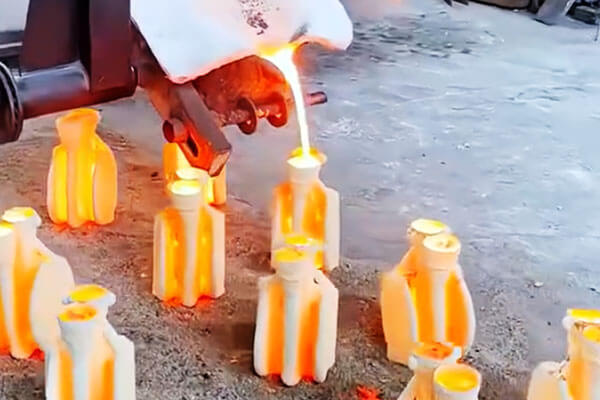
When brass is cast, the metal must be heated above its liquidus so it flows properly into a mold.
Kung ang temperatura ay masyadong mababa, hindi kumpletong pagpuno, malamig na mga shut, or poor surface finish may occur.
If too high, zinc can oxidize or volatilize, which changes composition and can degrade the final casting.
Forging and hot working
Brass can also be hot worked, but it must be processed within a temperature window below the melting range. Heating brass too aggressively can make it brittle or cause localized melting at grain boundaries.
That is particularly important for components that must retain dimensional accuracy and structural integrity.
Brazing and joining
In joining operations, the melting behavior of brass is crucial because the base metal should usually remain solid while the filler or joint material flows.
If heating is excessive, the brass part itself may begin to melt or lose zinc. This is one reason temperature control is central to reliable brazing practice.
Machining and free-cutting brass
Some brass grades are chosen specifically for machinability. Those compositions may contain lead or other additives that improve cutting performance, but they may also alter thermal response slightly.
In production environments, the exact alloy designation is always more important than the generic term “brass.”
5. Common Misconceptions About Brass Melting Point
Misconception 1: Brass has one exact melting point
This is the most common misunderstanding. Brass melts over a range because it is an alloy. The idea of a single melting temperature is only an approximation.
Misconception 2: Brass behaves like copper
Brass is copper-based, but it is not copper. Copper has a much higher melting point.
Brass generally melts much earlier because zinc lowers the alloy’s thermal threshold.
Misconception 3: All “yellow metals” are the same
tanso, tanso, and other copper alloys are often confused in casual conversation.
Bronze is usually copper-tin based, and its melting behavior differs from brass. Even visually similar alloys can have distinct thermal and mechanical properties.
Misconception 4: Heating brass just means “making it red hot”
That is not a safe or reliable temperature measure. Brass can oxidize, discolor, or lose zinc before obvious melting occurs.
Visual color is an imprecise indicator of thermal state, especially in controlled manufacturing.
6. Safety Considerations When Heating Brass
Any serious discussion of brass melting must include safety. Heating brass to near or above its melting range is not benign.

Zinc fume hazard
Sa mataas na temperatura, zinc can vaporize and oxidize, producing fumes that are hazardous to inhale.
This is a major occupational concern in foundries, workshops, and recycling operations. Adequate ventilation and respiratory protection may be necessary, depending on the process.
Composition changes
If brass is overheated, zinc can be preferentially lost from the alloy. That changes the composition of the remaining material and can reduce performance in the finished part.
Fire and equipment hazards
Because brass melts at a relatively moderate temperature compared with many other metals, uncontrolled heating can damage crucibles, mga amag, at mga kagamitan.
Temperature monitoring and appropriate furnace design are essential.
7. Pagsusuri ng Comparative: tanso vs. Other Copper Alloys and Industrial Metals
| Materyal | Tipikal na komposisyon (approx.) | Saklaw ng Pagtunaw (°C) | Saklaw ng Pagtunaw (K) | Saklaw ng Pagtunaw (°F) | Key Engineering Characteristics |
| tanso (general) | Cu–Zn (5–45% Zn) | 880–1020 | 1153–1293 | 1616–1868 | Magandang machinability, katamtamang lakas, wide melting interval, zinc volatility at high temperature |
| tanso (general) | Cu–Sn (5–12% Sn) | 900–1050 | 1173–1323 | 1652–1922 | Mataas na kaagnasan paglaban, good wear properties, typically narrower freezing range than brass |
| Puro Tanso | Cu ≥99.9% | 1085 (single point) | 1358 | 1985 | Very high thermal/electrical conductivity, no melting range (purong metal) |
| Aluminyo Bronze | Cu–Al (5–12% Al) | 1020–1060 | 1293–1333 | 1868–1940 | Mataas na lakas, उत्कृष्ट corrosion resistance, higher melting than most brasses |
Silicon tanso |
Cu–Si (1–4% Si) | 965–1025 | 1238–1298 | 1769–1877 | Good casting fluidity, paglaban sa kaagnasan, widely used in welding filler metals |
| Copper-Nickel (Cupronickel) | Cu–Ni (10–30% Ni) | 1170–1240 | 1443–1513 | 2138–2264 | Excellent seawater corrosion resistance, elevated melting range, matatag na microstructure |
| Aluminyo (puro na lang) | Al ≥99% | 660 (single point) | 933 | 1220 | Mababang density, mababang temperatura ng pagkatunaw, mataas na thermal kondaktibiti |
| Carbon Steel | Fe–C (0.1–1.0% C) | 1425–1540 | 1698–1813 | 2597–2804 | Mataas na lakas, wide industrial use, significantly higher melting than copper alloys |
Hindi kinakalawang na asero |
Fe–Cr–Ni alloys | 1375–1530 | 1648–1803 | 2507–2786 | Corrosion resistant, good high-temperature stability |
| Cast Iron | Fe–C (2–4% C) | 1150–1200 | 1423–1473 | 2102–2192 | Napakahusay na katatagan, lower melting than steel, brittle behavior |
| Sink (puro na lang) | Zn ≥99% | 419.5 (single point) | 693 | 787 | Very low melting point, high vapor pressure at elevated temperature |
| Humantong sa (puro na lang) | Pb ≥99% | 327.5 (single point) | 601 | 621 | Very low melting point, malambot na, often used as alloying addition |
8. Pangwakas na Salita
The melting point of brass is not a single fixed number. As an alloy of copper and zinc, brass typically melts over a saklaw, commonly around 900°C to 940°C
From a scientific perspective, the key idea is simple: composition controls melting behavior
So the most accurate answer is not just “what is the melting point of brass?” but rather: which brass are you talking about?

