1. Panimula
The short answer is wala na: aluminum does not rust. Rust is the corrosion product associated with iron and iron-rich alloys such as steel.
Aluminyo behaves differently: when exposed to oxygen, it forms a thin, tightly adherent aluminum oxide film that slows further attack rather than flaking away and exposing fresh metal.
That oxide film is the key reason aluminum is widely regarded as a naturally corrosion-resistant metal.
That does not mean aluminum is immune to corrosion. It means the corrosion mechanism is different.
Aluminum can stain, pit, suffer galvanic attack, and degrade in aggressive environments; it simply does not form “rust” in the technical sense.
The real question, pagkatapos ay, is not whether aluminum rusts, but under what conditions its protective oxide layer fails or becomes insufficient.
2. Defining Rust: The Critical Distinction Between Rust and Corrosion
What is rust?
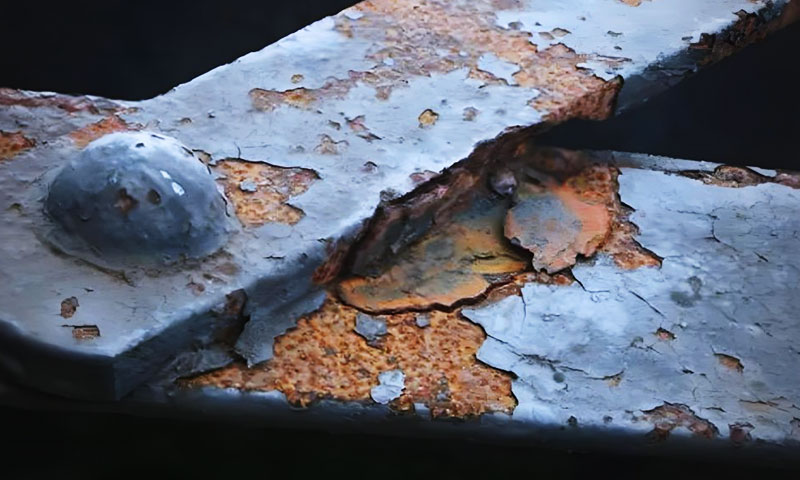
Rust is the familiar reddish-brown corrosion product produced when iron or steel reacts with oxygen and moisture. It is porous, poorly adherent, and does not protect the underlying metal.
Bilang isang resulta, corrosion can continue to spread once rust has formed. Aluminum does not produce that iron-oxide rust chemistry. Sa halip, its surface quickly develops a compact aluminum-oxide film.
Kaagnasan kumpara sa. kalawang na: a broader perspective
Corrosion is the broader materials-science term. It refers to the environmental degradation of a metal through electrochemical or chemical reactions.
Many engineering alloys rely on passive films for their usefulness; when those films break down locally, the result is localized corrosion such as pitting or crevice corrosion rather than rust in the narrow iron sense.

Aluminum’s oxidation: not rust, but a protective shield
Aluminum resists the kind of progressive oxidation that causes steel to rust away. Its exposed surface combines with oxygen to form an inert aluminum-oxide film only a few ten-millionths of an inch thick.
That film clings tightly, is transparent, and blocks further oxidation. If it is scratched, it reseals rapidly.
| Phenomenon | What forms | Protective? | Typical appearance |
| Iron rusting | Iron oxides/hydroxides | Hindi | Red-brown, flaky, porous |
| Aluminum oxidation | Aluminum oxide | Oo nga, karaniwan ay | Manipis na manipis, transparent, often invisible |
3. The Science of Aluminum Oxidation: Mechanisms and Properties
The oxidation process: fast, manipis na, and self-limiting
Aluminum does oxidize very quickly when it is exposed to air or moisture, but the reaction behaves very differently from iron corrosion.
On freshly exposed aluminum, a thin oxide film forms almost immediately, and that film slows further oxygen transport to the metal surface.
In most ordinary environments, the result is passivation na lang, not visible corrosion in the rust sense.
The native oxide layer is extremely thin, adherent, and stable enough to make aluminum naturally corrosion-resistant in atmospheric service.
This is the central metallurgical reason aluminum does not rust.
Rust is a porous, non-protective corrosion product; aluminum’s oxide is a compact barrier film that suppresses further reaction rather than encouraging it.
Sa praktikal na mga termino, aluminum’s surface chemistry is self-protecting under many common conditions, which is why the metal remains so widely used in transportation, konstruksiyon, at mga produkto ng mamimili.

Key properties of aluminum oxide (Al O)
The reason aluminum oxide works so well as a protective layer is that it has a property profile that is fundamentally different from iron rust.
Rust tends to be coarse, porous, and flaky, so it does not shield the underlying steel effectively.
Sa kabilang banda, aluminum oxide is compact, tightly adherent, and chemically stable across a useful environmental window.
Aluminum corrosion references note that the native oxide film is stable in roughly the pH 4 sa 8 saklaw, while stronger acids or alkalis can dissolve it.
A more detailed comparison is shown below.
| Pag-aari | Aluminum oxide (Al O) | Iron oxide / kalawang na (Fe₂O₃·nH₂O and related rust products) |
| Pagdikit | Tightly adherent; remains bonded to the metal surface. | Poorly adherent; tends to flake and detach. |
| Porosity | Very low porosity in the native film; forms an effective barrier to oxygen and moisture. | Highly porous and permeable, allowing corrosive species to penetrate. |
| Chemical stability | Stable and protective in moderate environments; native film is stable roughly in the pH 4–8 range. | Chemically unstable as a protective film; corrosion can continue when moisture and oxygen remain available. |
Paglaban sa pagsusuot |
Mahirap, lumalaban sa gasgas, and used in abrasive/ceramic applications. | Malambot na, malutong na, and easily abraded. |
| Hitsura | Usually transparent or colorless in the natural film; anodized films can be intentionally colored. | Typically reddish-brown to orange-brown. |
Self-healing mechanism: the critical advantage
One of aluminum’s most valuable features is that the oxide film is self-healing. If the surface is scratched or freshly exposed, oxygen immediately reacts with the new aluminum surface and a fresh oxide layer forms again.
That does not mean aluminum is immune to all corrosion, but it does mean small surface damage usually does not behave like the spreading, self-propagating corrosion seen in iron.
This self-passivating behavior is the key reason aluminum is corrosion-resistant in air.
The oxide film is only a few nanometres thick in its natural state, but it is enough to block further rapid attack in many environments.
When anodized, the oxide layer becomes much thicker and more protective, which is why anodized aluminum can be used where both appearance and durability matter.
4. When Aluminum Corrodes: Limitations of the Oxide Layer
Environmental conditions that break down the oxide layer
Acidic and alkaline environments
Aluminum’s native oxide is stable only within a moderate pH window. In acidic conditions, the oxide dissolves by acid attack; in alkaline conditions, it dissolves by forming aluminate species such as Al(OH)₄⁻.
Sa praktikal na mga termino, strong acids and strong bases can overwhelm the protective film and expose fresh aluminum continuously.
Chloride-rich environments
Chlorides are especially aggressive because they interfere with passivation and promote localized breakdown of the film.
A classic corrosion review on pitting explains that pitting occurs when a protective passive film breaks down, and that chloride ions are usually the key aggressive species involved.
Chloride-rich environments therefore pose one of the most important corrosion risks for aluminum alloys.
High-temperature environments
Sa nakataas na temperatura, the native oxide remains important, but the design problem changes.
Mga patong, ibabaw ng paggamot, and alloy selection become more significant because thermal exposure can amplify oxidation and disrupt surface protection.
Para sa aluminyo, engineered anodic oxide films are often used precisely because they provide a more robust and controllable protective barrier than the native film alone.

Common types of aluminum corrosion — not rust
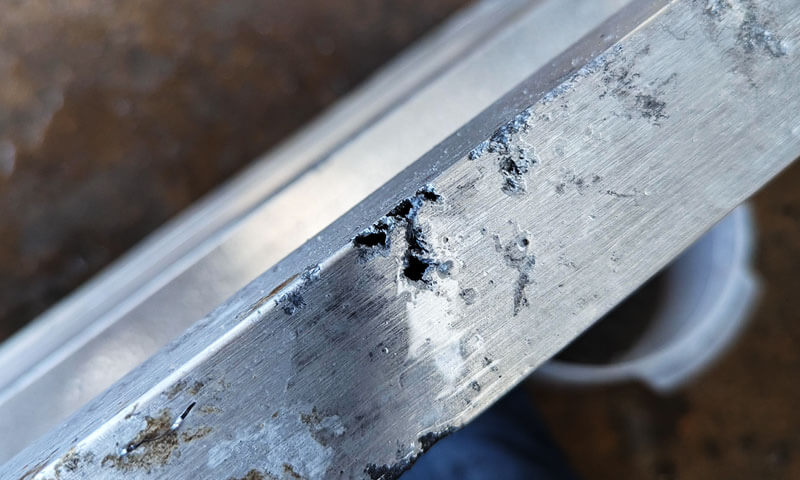
Pitting kaagnasan
Pitting is localized dissolution that develops where the passive film breaks down.
It is one of the most important corrosion modes for aluminum because it can be deep, Naisalokal, and difficult to detect early. Chloride contamination is a classic trigger.
Galvanic kaagnasan
When aluminum is electrically coupled to a more noble metal in the presence of moisture, the aluminum may corrode preferentially.
This is a design issue as much as a chemistry issue: dissimilar-metal contact, trapped moisture, and poor isolation all increase risk.
Crevice corrosion
Crevice corrosion occurs in sheltered occluded zones where local chemistry differs from the open surface.
It is closely related to pitting because both arise from passive-film breakdown and localized electrochemical imbalance.
Filiform corrosion
Filiform corrosion appears as random, non-branching white tunnels of corrosion product, often under coatings or on unprotected metal.
It is typically more damaging to appearance than strength, although thin sheet can be perforated.
Intergranular na kaagnasan
Certain aluminum alloy families are vulnerable to intergranular attack when alloying or heat treatment produces unfavorable grain-boundary precipitation.
A classic example is higher-magnesium wrought alloys, where nearly continuous Al₈Mg₅ precipitation at grain boundaries can increase susceptibility to exfoliation or stress-corrosion cracking.
Copper-rich alloys can also be vulnerable to intergranular forms of attack in some conditions.
Aluminum “white rust”: a misnomer
“White rust” properly belongs to zinc and galvanized steel, not aluminum.
When aluminum shows white spots or white surface residue, the phenomenon is usually a form of oxide staining or corrosion product rather than true rust.
Sa madaling salita, the appearance may look similar to “white rust,” but the chemistry is different.
5. Mga Alloys ng Aluminyo: How Composition Affects Corrosion Resistance
Aluminum corrosion resistance is not determined by “aluminum” alone. In engineering practice, the corrosion behavior of an aluminum part depends strongly on its alloy series, pag-uugali, mikroistruktura, and environment.

Key alloying elements and their corrosion impact
Magnesium (Mg)
Magnesium is one of the most important alloying elements in aluminum, lalo na sa mga 5xxx serye ng mga.
It is often associated with excellent corrosion resistance, partikular na sa mga kapaligiran ng dagat.
Alloys tulad ng 5052 at 5083 are widely used because they combine good strength with strong resistance to seawater and atmospheric corrosion.
Magnesium helps the alloy retain a stable protective oxide behavior and supports good performance in chloride-bearing environments. This is why 5xxx alloys are common in:
- paggawa ng barko,
- offshore structures,
- hardware ng dagat,
- presyon vessels,
- and transport equipment.
Gayunpaman, there is an important limitation. When magnesium content becomes high and the alloy is exposed to sustained tensile stress, the risk of stress kaagnasan pag crack ay maaaring dagdagan ang.
Sa madaling salita, magnesium improves corrosion resistance in many settings, but only within the right composition and service window.
Tanso (Cu)
Copper is added primarily to increase strength, lalo na sa mga 2xxx serye ng mga tulad ng 2024 at 2017.
These alloys are valued where mechanical performance is critical, but copper generally reduces corrosion resistance.
The reason is metallurgical: copper-rich regions can become electrochemically active sites that encourage localized attack. Bilang isang resulta, 2xxx alloys are more prone to:
- intergranular kaagnasan,
- pitting,
- at pag-crack ng kaagnasan ng stress.
Dahil dito, 2xxx alloys are widely used in aerospace structures where strength is essential, but they often require protective treatments such as anodization, mga cladding, or coatings to achieve acceptable durability.
Silicon (Si Si)
Silicon is commonly used to improve katatagan, lalo na sa mga 3xxx at 4xxx families.
These alloys tend to offer moderate corrosion resistance and good manufacturing behavior. They are widely used in:
- mga bahagi ng automotive,
- Mga kagamitan sa pagluluto,
- heat-exchanger parts,
- and cast products where fluidity and processability matter.
Silicon generally does not create the same corrosion penalty associated with copper-rich alloys.
Sa halip, it is more often used as a processing aid that helps control casting behavior and mechanical response without severely compromising corrosion performance.
Sink (Zn)
Zinc is the main strengthening element in the 7xxx serye ng mga, including alloys such as 7075 at 7050.
These are among the strongest aluminum alloys available, but they are also more vulnerable to corrosion-related problems than lower-alloyed series.
High-strength 7xxx alloys often need careful temper selection because they can be susceptible to:
- stress kaagnasan pag crack,
- intergranular kaagnasan,
- and property loss in aggressive environments.
Dahil dito, special heat-treatment conditions, tulad ng T73, are often used when corrosion resistance must be improved, even if some peak strength is sacrificed.
Here again, the engineering rule is clear: maximum strength does not automatically mean maximum durability.
Chromium (Cr) and Titanium (Ti)
Chromium and titanium are typically added in small amounts to refine grain structure and improve metallurgical control.
They are not usually the main strength elements, but they play an important supporting role.
These minor additions help improve:
- pagpipino ng butil,
- property consistency,
- strength stability,
- and in many cases the overall balance between strength and corrosion resistance.
A good example is the 6xxx serye ng mga, tulad ng 6061 at 6063.
These alloys use magnesium and silicon as the main strengthening system, while chromium and titanium help refine the structure and support a useful combination of corrosion resistance, lakas ng loob, at pagiging formable.
That is one reason 6xxx alloys are often considered general-purpose engineering materials.
Corrosion behavior by common aluminum alloy families
| Alloy family | Main alloying logic | Corrosion resistance trend | Typical engineering use |
| 1xxx | Nearly pure aluminum | Napakataas | Chemical handling, mga de koryenteng, atmospheric service |
| 3xxx | Manganese-strengthened | Napakaganda | Bubong, Mga Kagamitan, Mga kagamitan sa pagluluto, heat-exchanger parts |
| 5xxx | Magnesium-strengthened | Napakaganda, especially in marine service | Paggawa ng barko, offshore structures, transportasyon |
6xxx |
Magnesium + Silicon | Good to very good | Structural extrusions, mga frame, general-purpose engineering |
| 2xxx | Copper-strengthened | Lower than 1xxx, 3xxx, 5xxx, 6xxx | Aerospace structures where strength is critical |
| 7xxx | Zinc-strengthened | Often lower; SCC-sensitive in some tempers | High-strength aerospace and defense components |
6. Protecting Aluminum: Enhancing Corrosion Resistance
Anodization: thickening the oxide layer
Anodizing is one of the most important surface treatments for aluminum because it intentionally thickens and controls the oxide layer.
Anodic oxide film literature distinguishes barrier-type and porous-type films, and notes that sealed porous films can be used where excellent corrosion resistance is required.
Sa praktikal na mga termino, anodizing turns aluminum’s natural passive film into a more engineered protective layer.
Protective coatings
Protective coatings act as a physical barrier between aluminum and its environment, preventing corrosive agents from reaching the metal surface. Common coatings include:
- Paint and Powder Coating: Applied to aluminum surfaces for both aesthetic and protective purposes. Powder coating is particularly durable, offering excellent resistance to chipping, nalalabo na, at kaagnasan.
Gayunpaman, it is less effective than anodization in harsh environments, as coatings can peel or crack over time. - Mga Coating ng Chemical Conversion: Manipis na manipis, adherent coatings (hal., chromate, phosphate) that form a protective layer on aluminum.
These coatings are often used as a primer before painting, enhancing adhesion and corrosion resistance. - Ceramic Coatings: Used for high-temperature applications (hal., aerospace engine components), ceramic coatings provide heat resistance and corrosion protection at temperatures above 500°C.
Avoiding galvanic corrosion
Aluminum assemblies should be designed to minimize electrically coupled contact with more noble metals in the presence of moisture.
Isolation washers, mga sealant, mga patong na patong, and good drainage all help reduce galvanic attack. In mixed-metal structures, design details often matter more than the alloy itself.
Proper maintenance and cleaning
Cleaning matters because deposits, salt films, trapped moisture, and contamination can all change local chemistry.
A clean, tuyo na, and well-drained aluminum surface is far less likely to develop staining or localized attack than a surface that remains wet or contaminated for long periods.
7. Pangwakas na Salita: Aluminum Does Not Rust—But It Can Corrode
To answer the question “Does aluminum rust?” with absolute clarity: Hindi, aluminum does not rust.
Aluminum is not invulnerable. In acidic or alkaline media, Mga kapaligiran na mayaman sa klorido, Mga bitak, galvanic couples, and certain alloy/temper conditions, the passive film can fail locally and corrosion can progress.
In those cases, the right question is not “Why did aluminum rust?” but “Which aluminum corrosion mechanism is present, and how should it be controlled?”
The most accurate summary is therefore this: aluminum does not rust, but it can corrode — and understanding that difference is the key to using it well.
Mga FAQ
Does aluminum rust in water?
Hindi. Aluminum does not rust in the iron sense. It usually forms a protective oxide film, though water staining or localized corrosion can still occur depending on the environment.
Why does aluminum sometimes turn white?
White surface residue is usually oxide staining or corrosion product, not true rust. The term “white rust” is generally used for zinc, not aluminum.
Can aluminum corrode faster if it touches steel?
Oo nga. Dissimilar-metal contact in the presence of moisture can cause galvanic corrosion, especially if the joint is not isolated or coated properly.
Is anodized aluminum rust-proof?
No material is absolutely rust-proof or corrosion-proof. Anodizing does improve corrosion resistance by thickening the oxide layer and making it more protective.