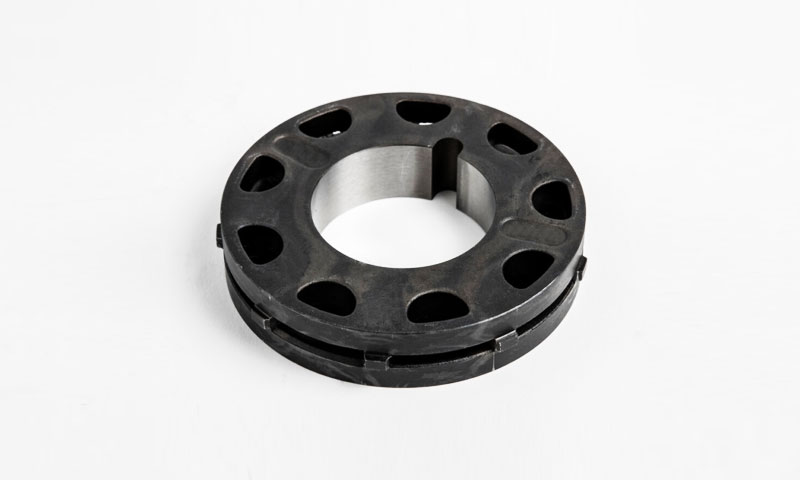
In demanding mechanical systems, a pulley is far more than a simple grooved wheel.
It is a load-bearing transmission component that must continuously manage rope or cable movement, radial forces, epekto naglo load, alitan, and repeated cyclic stress.
When a pulley operates in cranes, mining equipment, marine machinery, heavy lifting systems, or other severe-service environments, the quality of its material and manufacturing process directly influences equipment reliability.
Dito na nga ba custom cast steel pulleys offer a decisive engineering advantage.
This article explores the technical considerations behind custom cast steel pulley production, from steel grades and precision casting to machining, paggamot ng init, inspeksyon, mga aplikasyon, and supplier selection.
1. What Is a Cast Steel Pulley?
A cast steel pulley is a rotating mechanical component manufactured by casting steel into a mold and subsequently machining critical surfaces to the required dimensions.
In lifting and rope-handling systems, it is also commonly referred to as a sheave.
Its primary function is to guide, redirect, or support a wire rope or similar flexible element while transferring the associated mechanical load through the hub and shaft or bearing assembly.
Unlike a simple wheel, a pulley has carefully engineered functional geometry. Ang rope groove controls how the rope sits on the sheave, while the hub and bore transmit the load to the supporting shaft or bearing arrangement.
Flanges help retain the rope within the groove and can contribute to the overall structural stiffness of the component.
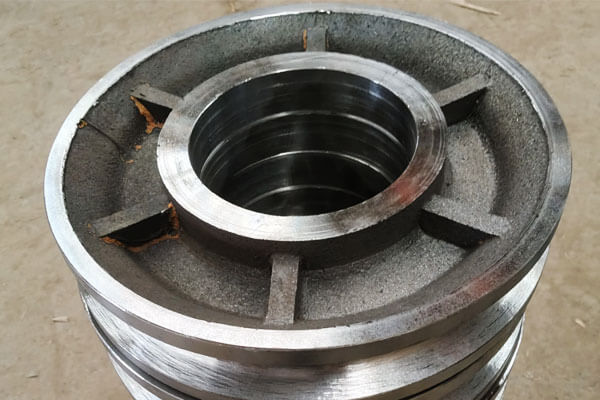
Main Components of a Cast Steel Pulley
| Component | Function | Key Manufacturing Consideration |
| Sheave/Rim | Supports and guides the rope | Groove profile, kapal ng pader, Paglaban sa Pagsusuot |
| Rope Groove | Receives and guides the rope | Radius, lalim, profile accuracy, Kondisyon ng ibabaw |
| Flange | Helps retain the rope on the sheave | Height, kapal naman, concentricity |
Hub |
Connects the pulley to the shaft or bearing | Dimensional accuracy, structural strength |
| Bore | Accommodates shaft, bushing, or bearing arrangement | Diameter, pag ikot, concentricity |
| Keyway | Transmits torque where applicable | Position and dimensional accuracy |
| Mounting Features | Interfaces with surrounding equipment | Posisyon, patag, alignment |
For a precision cast steel pulley, these features do not all require the same manufacturing accuracy.
The casting process can establish most of the structural geometry, while CNC machining is used for the bore, tindig ibabaw, groove, keyway, mga mukha sa dulo, and other critical interfaces.
2. Common Cast Steel Grades for Custom Pulleys
Material selection for a cast steel pulley should be based on the working load, impact conditions, wear requirements, operating temperature, corrosion exposure, and required service life.
In addition to conventional carbon cast steel, customized pulley designs may use low-alloy steels, high-manganese wear-resistant steel, or corrosion-resistant stainless steel when the operating environment demands additional performance.
| Materyal / Grade | Alloy Family | Key Performance Attributes | Typical Pulley Applications |
| ASTM A216 Gr. WCB | Carbon cast steel | Good strength, mahusay na castability, magandang machinability, matipid sa gastos | General-purpose pulleys, industrial material handling, liwanag- to medium-duty lifting systems |
| ASTM A216 Gr. WCC | Carbon cast steel | Higher specified strength than WCB, good toughness and castability | Heavy-duty industrial pulleys, crane components, demanding material-handling systems |
| Low-Alloy Cast Steel, Cr-Mo / Ni-Cr-Mo | Low-alloy cast steel | Mas mataas na lakas, improved hardenability, maganda ang tigas, better fatigue performance after heat treatment | Heavy-duty crane sheaves, construction hoists, mining equipment, high-load pulleys |
| ASTM A148 High-Strength Grades | High-strength cast steel | Mataas na makunat at lakas ng ani, suitable for heat treatment, strong load-bearing capability | Main sheaves, heavy lifting equipment, large industrial pulleys, high-load machinery |
ASTM A352 LCB / LCC |
Low-temperature cast steel | Improved impact toughness at low temperatures, suitable for cold-service conditions | Outdoor cranes, cold-region mining equipment, marine and offshore lifting systems |
| Austenitic Stainless Cast Steel, CF8 / CF8M | Stainless cast steel | Napakahusay na paglaban sa kaagnasan, maganda ang tigas, suitable for chloride-containing environments with grade-specific limitations | Marine pulleys, corrosive material-handling systems, chemical and food-processing equipment |
| Hadfield Steel, ASTM A128 Gr. B | High-manganese austenitic steel | Excellent impact toughness and strong work-hardening response under abrasive service | Mining equipment, abrasive material handling, high-impact pulley and sheave applications |
| Boron-Alloyed Cast Steel | Boron alloy steel | High hardenability, strong wear resistance after heat treatment, suitable for demanding cyclic loading | Katamtaman- to heavy-duty pulleys, high-wear material-handling equipment |
3. Custom Cast Steel Pulley Manufacturing Process
The manufacturing process for a custom cast steel pulley is a controlled sequence in which pattern accuracy.
Because the pulley is a load-bearing component, the foundry must pay particular attention to the sheave section, hub, flange transitions, and other areas where local changes in section thickness can influence solidification and internal casting quality.
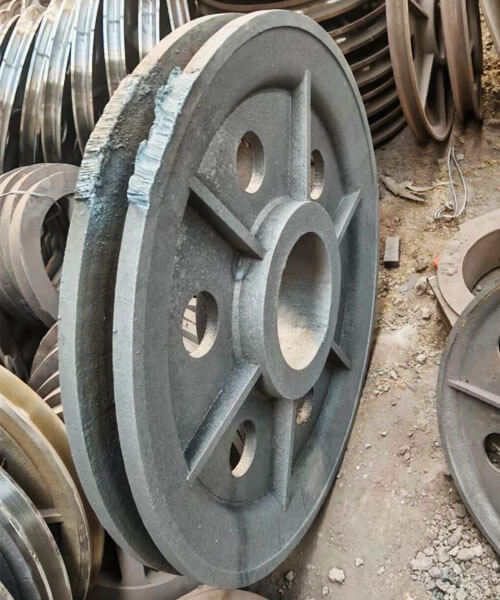
Paggawa ng Pattern
Pattern making determines the basic geometry of the pulley cavity and therefore has a direct influence on casting accuracy.
The pattern must reproduce the sheave, hub, flange, and other cast features while incorporating appropriate shrinkage allowance and machining allowance.
Para sa pamumuhunan paghahagis, a wax pattern is normally produced by injecting wax into a precision die.
The wax pattern closely represents the final pulley geometry and is subsequently used to create the ceramic shell.
For sand casting, the pattern is typically made from resin, kahoy na kahoy, metal, or other suitable materials and is used to form the mold cavity.
Depending on the pulley design, the pattern may also incorporate draft and parting arrangements to allow reliable mold removal.
For custom pulley production, the pattern design should distinguish clearly between cast surfaces and surfaces requiring final machining.
Excessive machining allowance increases material removal and cost, while insufficient allowance can make it difficult to achieve the specified final dimensions.
Mold and Core Making
The mold defines the external geometry of the cast steel pulley, while cores are used where internal cavities or passages cannot be formed directly by the pattern.
Sa buhangin paghahagis, selected sand and binder systems are compacted around the pattern to create the mold cavity.
A core may be positioned to produce the central bore or other internal features.
Core strength, katumpakan ng sukat, pagkamatagusin, and positioning are particularly important because displacement during pouring can affect bore alignment and wall thickness.
Sa pamumuhunan paghahagis, the wax pattern is repeatedly coated with refractory ceramic slurry and stucco to build a multilayer shell.
After sufficient shell strength has been achieved, the wax is removed and the ceramic mold is fired.
The mold or shell must provide sufficient strength to withstand molten steel while also providing suitable permeability and thermal behavior.
For precision pulley castings, defects in the mold can be transferred directly to the casting surface or alter the dimensional accuracy of critical features.
Steel Melting and Chemical Control
The selected cast steel is melted according to the requirements of the specified alloy.
Induction melting or electric arc melting may be used depending on the alloy, foundry equipment, at mga kinakailangan sa produksyon.
Before pouring, the molten metal is normally checked using chemical analysis, madalas na may isang spectrometer, to verify that carbon and alloying elements fall within the specified composition range.
Melt preparation may also involve:
- Slag removal
- Deoxidation
- Temperature adjustment
- Inclusion control
- Heat identification and traceability
Chemical control is particularly important for custom pulleys because the steel grade determines the response to subsequent heat treatment and influences strength, tigas na tigas, wear behavior, and low-temperature performance.
Mga Tip sa Pag-install, Feeding, and Pouring
The gating and feeding system must be designed so that the molten steel fills the pulley cavity smoothly and that solidification shrinkage can be compensated effectively.
Pulley geometry can include relatively heavy sections around the hub and hub-to-sheave transition.
These regions may remain liquid longer than thinner sections and therefore require appropriate feeding.
The gating and riser system is designed to control:
Metal flow → filling sequence → thermal balance → directional solidification → shrinkage compensation
During pouring, temperature and pouring rate must be controlled within the process window established for the alloy and mold system.
Excessively low metal temperature can lead to incomplete filling or cold shuts, while unsuitable flow conditions can increase turbulence and the possibility of oxide or inclusion-related defects.
Where necessary, casting simulation can be used to evaluate filling and solidification before production and to identify potential hot spots or feeding problems.
Solidification at Paglamig
Once the cavity has been filled, the molten steel begins to solidify.
This stage is critical because steel undergoes volumetric contraction during cooling, and poorly controlled solidification can produce shrinkage cavities, internal porosity, mainit na pag-crack, and residual stress.
The objective is generally to promote a controlled and preferably directional solidification pattern, with heavier sections remaining feedable until sufficient metal has solidified elsewhere.
Depending on the casting design, the foundry may use:
- Mga Riser
- Mga panginginig
- Controlled mold temperatures
- Optimized section transitions
- Specific pouring conditions
The cooling behavior also influences the resulting microstructure and mechanical properties.
Excessively severe or uneven thermal gradients can contribute to distortion and residual stress, particularly in large or geometrically complex pulleys.
Shakeout and Casting Cleaning
After the casting has cooled sufficiently, the mold or ceramic shell is removed.
For sand castings, this operation is generally referred to as shakeout, during which the hardened sand mold and cores are broken away from the casting.
For investment castings, the ceramic shell is mechanically removed or otherwise processed to expose the steel casting.
The casting is then separated from its gating and riser system. Typical cleaning operations include:
- Cutting off gates and risers
- Paggiling
- Shot blasting
- Removal of adhering mold material
- Local dressing of non-functional surface irregularities
The purpose of this stage is to obtain a clean casting suitable for heat treatment and inspection while avoiding unnecessary removal of base metal.
4. Precision Machining of Cast Steel Pulleys
Katumpakan CNC machining converts the cast steel pulley from a near-net-shape casting into a finished functional component.
The rope groove, bore, keyway, hub, and mounting faces are the primary machined features because their dimensional accuracy and positional relationship directly affect rope tracking, rotation, load distribution, and assembly.
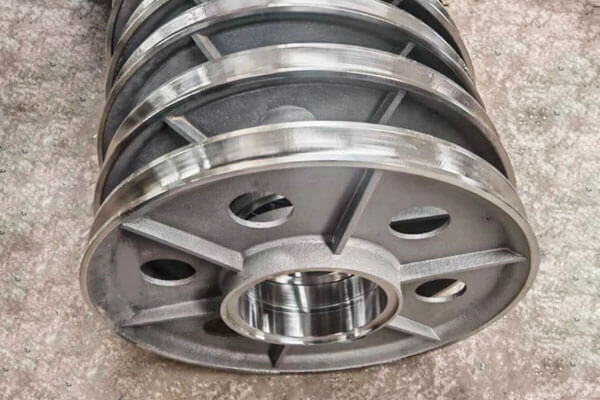
Rope Groove Machining
The rope groove is one of the most critical functional surfaces of the pulley. Its radius, lalim, lapad ng katawan, and profile must be matched to the rope type and diameter.
An undersized groove can excessively constrain the rope, while an oversized or improperly shaped groove can provide insufficient support and increase rope deformation and wear.
For wire-rope pulleys, the groove radius is therefore normally designed to provide proper rope seating rather than simply matching the nominal rope radius.
The groove is commonly machined on a CNC turning machine using a form or profiling tool.
After rough and finish turning, grinding or polishing may be applied where a finer and more consistent surface is required.
Bore Machining
The bore provides the interface with the shaft, pagdadala ng, or bushing, so its diameter, pag ikot, and concentricity must be carefully controlled.
The bore is typically produced by boring, reaming, or precision grinding.
Depending on the required fit and application, dimensional tolerances may be specified in the hundredths of a millimeter, for example around ±0.02 to ±0.05 mm for some precision applications.
The actual tolerance should be determined by the shaft/bearing fit, pulley size, and applicable engineering specification.
Most importantly, the bore must maintain the required positional relationship with the rope groove and outer sheave surface.
Keyway and Spline Machining
Where the pulley is mounted directly to a keyed shaft, the keyway width, lalim, and angular position must be accurately machined.
Its alignment with the pulley groove is important for correct assembly and load transmission.
For applications requiring greater torque capacity or more precise rotational engagement, splined connections may be used.
In either case, machining accuracy is required to prevent excessive backlash, local stress concentration, or assembly interference.
Hub, Face, and Flange Machining
The hub and end faces may require turning, paggiling, or grinding to obtain the required dimensions and surface condition.
Mounting faces must be sufficiently flat and properly aligned to ensure consistent assembly.
The flange geometry also requires control because excessive variation can affect rope retention and the relationship between the groove and the surrounding structure.
Concentricity and Runout
The concentricity of the bore relative to the rope groove is particularly important for a rotating pulley.
Excessive eccentricity or radial runout can produce non-uniform rope movement, panginginig ng boses, uneven loading, and additional bearing stress.
Runout is normally verified using a dial indicator, precision gauge, or coordinate measurement equipment.
For critical components, the applicable TIR (Total Indicator Reading) requirement should be defined on the engineering drawing rather than using a generic value.
Dynamic Balancing
High-speed rotating pulleys may require dynamic balancing after machining.
An imbalance generates centrifugal forces that increase with rotational speed and can contribute to vibration and bearing loading.
Balancing is performed on a dedicated balancing machine. Depending on the correction method, small amounts of material may be removed or balancing weights may be added to achieve the required balance condition.
For low-speed, heavily loaded sheaves, balancing requirements may be less stringent than for high-speed rotating pulleys.
5. Surface Finish and Heat Treatment of Cast Steel Pulleys
Heat treatment determines the mechanical condition of the cast steel, while surface finishing establishes the required condition of the functional and exposed surfaces.
Both must be considered together with the intended load, magsuot ng, rope type, operating environment, at buhay ng serbisyo.
Paggamot ng Heat
The heat-treatment cycle is selected according to the cast steel grade and required mechanical properties. Common treatments include:
| Paggamot ng Heat | Pangunahing Layunin |
| Normalizing | Refine the casting microstructure and establish a more uniform mechanical condition |
| Annealing | Reduce hardness, improve machinability, at mapawi ang mga panloob na stress |
| Pagpapawi at Pagtitimpi | Develop higher strength and toughness with controlled hardness |
| Nakakawala ng stress | Reduce residual stresses from casting, hinang, o machining |
| Pagpapatigas ng Ibabaw | Increase wear resistance of selected surfaces such as the rope groove |
For load-bearing pulleys, quenching and tempering may be selected for suitable carbon and low-alloy cast steels when higher mechanical performance is required.
The tempering temperature must be established according to the steel grade and the required balance between hardness and toughness.
Surface Hardening of the Groove
Where rope contact produces significant wear, localized surface hardening may be considered.
Depending on the material and design, methods such as induction hardening, flame hardening, or nitriding may be applicable.
The treatment should be applied selectively because excessive surface hardness or an unsuitable hardened depth can reduce toughness or create undesirable residual stresses.
The groove material condition therefore needs to be considered together with the rope material and actual contact conditions.
Groove Surface Finish
Surface finish directly affects the interaction between the pulley groove and the rope.
A rough surface can increase local abrasion and accelerate rope wear, while an appropriately finished groove provides smoother contact.
A typical target for machined pulley grooves may be around Ra 1.6–3.2 μm, although the required value should be specified according to the rope type, operating speed, pag-load, pagpapadulas, and design standard.
Surface finish should not be considered independently of groove geometry.
A smooth but incorrectly profiled groove can still cause excessive rope wear, while the correct profile with controlled surface texture provides a more stable contact condition.
Coating and Corrosion Protection
Cast steel pulleys used outdoors or in humid and corrosive environments may require protective coatings. Common options include:
- Epoxy coatings
- Polyurethane coatings
- Zinc-rich primers
- Other industrial corrosion-protection systems
For marine or offshore service, more aggressive corrosion-protection systems may be specified according to the environmental exposure and coating specification.
The rope-contact groove is often treated differently from non-contact surfaces. Coating thickness must not change the groove dimensions or interfere with rope seating.
In applications where dimensional accuracy is critical, the groove may therefore remain uncoated or receive a carefully controlled treatment.
Rope Compatibility
Surface finish and groove geometry must ultimately be considered together with the rope specification. Wire rope and synthetic rope do not necessarily require identical groove designs.
For wire rope, the groove should provide adequate support while avoiding excessive pinching or deformation.
Synthetic ropes may require different groove geometry and surface characteristics because of their lower bending stiffness and different contact behavior.
Kaya nga, the pulley manufacturer should confirm the rope diameter, konstruksiyon, materyal na bagay, operating load, and service conditions before finalizing groove machining and surface treatment.
This ensures that the finished cast steel pulley is designed as an integrated part of the rope-handling system rather than as an isolated rotating component.
6. Key Quality Requirements for Cast Steel Pulleys
Quality requirements for cast steel pulleys are driven by safety, pagiging maaasahan, at buhay ng serbisyo. The following are essential.
Material Certification. Chemical composition and mechanical properties must be verified and documented. Certificates of analysis and mechanical test reports should accompany each production lot.
Internal Soundness. Castings must be free from harmful defects such as shrinkage porosity, gas porosity, mga inclusions, at mga bitak. Non-destructive testing is used to verify internal quality.
Katumpakan ng Dimensyon. Groove profile, bore size, concentricity, Runout, and keyway dimensions must meet drawing requirements. Dimensional inspection reports should be provided.
Kalidad ng Ibabaw. The groove and bore surfaces must be free from defects that could damage rope or cause misalignment. Surface roughness should be measured and documented.
Heat Treatment Verification. Hardness testing and, where required, microstructure examination confirm that heat treatment has been performed correctly.
Load Testing. Para sa mga kritikal na aplikasyon, proof load testing or destructive testing may be required to verify strength and safety.
7. Applications of Custom Cast Steel Pulleys
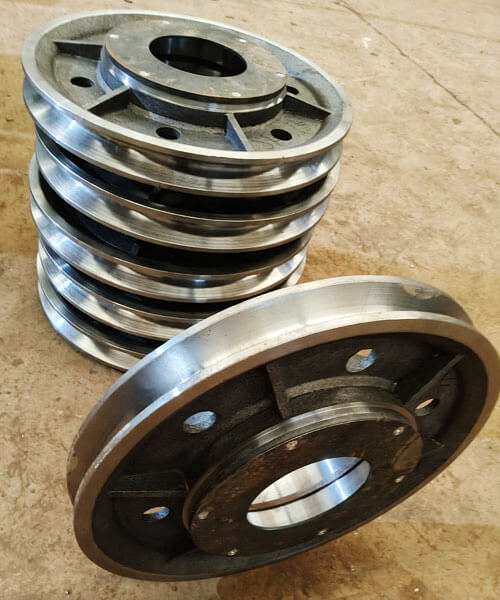
Cranes and Lifting Equipment
Cranes are one of the most important applications for cast steel pulleys.
Sheaves in hoisting systems repeatedly transfer loads from the wire rope to the shaft or bearing assembly and may experience shock loading during lifting, lowering, acceleration, and stopping.
Custom cast steel pulleys are used in:
- Overhead cranes
- Gantry cranes
- Mobile cranes
- Tower cranes
- Port cranes
- Crane blocks and hook assemblies
- Winch and reeving systems
For crane applications, the groove profile, sheave diameter-to-rope diameter relationship, bore, and structural integrity must be matched to the lifting system.
Kagamitan sa Pagmimina
Mining machinery imposes particularly severe conditions on mechanical components because of high loads, abrasive dust, epekto nito, continuous operation, and difficult maintenance environments.
Cast steel pulleys and sheaves can be used in hoisting equipment, rope-handling systems, mga conveyor, and other heavy-duty machinery.
In applications involving severe impact and abrasion, material selection and surface hardness may become particularly important.
Construction and Material-Handling Equipment
Construction machinery often incorporates pulley systems for lifting, Pagpoposisyon, tensioning, or redirecting wire rope.
Kabilang sa mga karaniwang aplikasyon ang:
- Construction hoists
- Material-handling systems
- Winches
- Lifting attachments
- Cable-guiding systems
- Specialized handling machinery
Custom casting is particularly useful when a standard pulley cannot meet the required dimensional or mounting configuration.
Marine and Offshore Equipment
Marine and offshore environments combine mechanical loading with humidity, pagkakalantad ng tubig asin, kaagnasan, and limited access for maintenance.
Custom cast steel pulleys can be incorporated into:
- Marine cranes
- Offshore lifting equipment
- Shipboard winches
- Mooring systems
- Deck machinery
- Cable and rope-handling equipment
For these applications, the material and corrosion-protection system should be selected according to the actual marine environment.
Stainless cast steel may be considered when corrosion resistance is a primary requirement.
Oil and Gas Equipment
Oil and gas equipment may expose pulleys and sheaves to high loads, panginginig ng boses, corrosive atmospheres, and continuous operating cycles.
Custom cast steel components can be used in lifting, hoisting, and specialized material-handling equipment.
Where the application is safety-critical, the material specification, NDT requirements, paggamot ng init, and traceability should be defined in advance.
Mga Makinarya sa Industriya
Custom pulleys are also used in industrial equipment for:
- Cable routing
- Tensioning systems
- Hoists
- Conveyor systems
- Specialized transmission equipment
- Automated handling machinery
The major advantage of a custom design is that the pulley can be developed around the complete equipment interface rather than forcing the equipment to accommodate a standard pulley.
8. Core Advantages of Precision Cast Steel Pulleys
Precision cast steel pulleys offer several advantages over alternatives.
- Mataas na lakas at katigasan: Cast steel can withstand heavy loads, epekto nito, and fatigue better than cast iron or aluminum.
- Design flexibility: Casting allows complex shapes, integrated features, and optimized material distribution.
- Near-net shape: Casting reduces machining time and material waste compared with fabrication from plate or bar.
- Weldability: Steel castings can be welded and repaired, unlike cast iron.
- Scalability: Casting is economical for both small and large production runs, and for very large pulleys that would be difficult to fabricate.
- Consistent quality: A controlled foundry process produces repeatable properties and dimensions.
- Pagpapasadya: Mga haluang metal, Mga Paggamot sa Init, and machining can be tailored to the application.
- Epektibo ang gastos: Para sa maraming mga application, cast steel pulleys offer the best combination of performance and total cost.
9. Cast Steel Pulley vs Cast Iron Pulleys
Cast steel and cast iron pulleys can both be produced by casting, but their mechanical behavior, epekto ng paglaban, load capacity, and typical service conditions are significantly different.
| Core Characteristic | Cast Steel Pulley | Cast Iron Pulley |
| Lakas ng loob | Mataas na makunat at lakas ng ani; suitable for heavily loaded components | Generally lower, especially for gray cast iron |
| Tigas na tigas | High toughness and better resistance to shock loading | Lower toughness; gray iron is relatively brittle |
| Epekto ng Paglaban | Excellent for repeated or sudden loading | Limited under severe impact conditions |
| Ductility | Significant plastic deformation capacity before fracture | Low for gray cast iron; highly grade-dependent |
| Pagganap ng Pagkapagod | Generally better for cyclic and dynamic loading | More limited, particularly where stress concentrations exist |
| Magsuot ng Paglaban | Can be improved through alloy selection and heat treatment | Good in some cast iron grades, especially under stable sliding or abrasive conditions |
Machinability |
Mabuti na lang, but harder alloys may require controlled CNC machining | Generally excellent, particularly for gray cast iron |
| Casting Capability | Angkop para sa kumplikadong, integrated load-bearing geometries | Excellent castability and suitable for complex shapes |
| Paggamot ng Heat | Can be normalized, annealed na nga ba, pinawi at pinahina, or surface hardened depending on grade | Heat-treatment options depend strongly on iron grade and are generally more limited for gray iron |
| Heavy-Duty Service | Well suited to cranes, pagmimina, hoists, and severe-duty machinery | Better suited to lighter or more stable loading conditions |
| Fracture Behavior | More tolerant of overload and impact before fracture | More susceptible to brittle fracture under excessive shock |
| Gastos sa Materyal | Generally higher | Generally lower |
| Best Core Advantage | Lakas ng loob, tigas na tigas, and reliability under demanding loads | Cost efficiency, katatagan, at machinability |
10. Why Choose DEZE as Your Custom Cast Steel Pulley Manufacturer?
Teknolohiya ng DEZE nagbibigay ng custom cast steel pulley manufacturing from precision casting through CNC machining and final inspection, allowing the complete component to be developed and produced within an integrated manufacturing workflow.
Our manufacturing approach begins with engineering review and material selection, followed by pattern development, paggawa ng amag, controlled steel melting and pouring, pagpapatibay, paggamot ng init, katumpakan machining, and quality inspection.
Different cast steel material systems can be selected according to working load, impact conditions, temperatura, magsuot ng, and corrosion exposure.
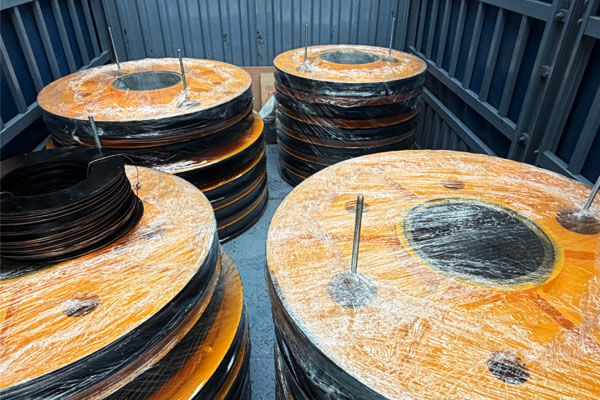
Where required, the manufacturing process can incorporate hardness verification and appropriate NDT, including PT, MT, UT, or RT, according to the component specification.
The objective is not simply to supply a raw casting. It is to provide a finished custom pulley with controlled material properties, accurate functional geometry, consistent machining, and traceable quality documentation.
11. Pangwakas na Salita
Custom cast steel pulleys are engineered components for applications where load capacity, epekto ng paglaban, Magsuot ng pagganap, katumpakan ng sukat, and long-term reliability are important.
Their performance depends on the combined quality of the material, paghahagis ng mga, paggamot ng init, machining, at inspeksyon.
Precision casting provides an efficient route for producing complex pulley geometry with an integrated sheave and hub structure while reducing unnecessary machining.
Subsequent CNC machining establishes the critical dimensions of the rope groove, bore, keyway, hub, and mounting surfaces.
Heat treatment can then provide the required balance of strength, tigas na tigas, at tigas na tigas, while inspection confirms casting integrity and dimensional accuracy.
For crane, pagmimina, konstruksiyon, marine, sa malayo sa pampang, langis at gas, and industrial machinery applications, the correct pulley should be selected according to the rope specification, loading condition, operating environment, and applicable technical requirements.
A properly engineered cast steel pulley is not simply a wheel with a groove; it is a load-bearing component whose geometry and material condition directly influence the reliability of the complete rope-handling system.
Mga FAQ
What is the difference between cast steel and cast iron pulleys?
Cast steel has higher strength and toughness and is weldable.
Cast iron is cheaper and easier to machine but is more brittle and not easily welded.
What is the groove profile of a pulley?
The groove profile is the shape of the channel that seats the rope or cable.
It must match the rope diameter and construction to ensure proper seating, i-minimize ang wear, and prevent derailment.
Why is heat treatment important for cast steel pulleys?
Heat treatment controls strength, tigas na tigas, tigas na tigas, and residual stresses. It ensures the pulley can withstand its service loads without premature failure.
How is pulley quality verified?
Quality is verified through material certification, dimensional inspection, Pagsubok na hindi mapanirang (dye penetrant, magnetic particle, ultrasonic na, radyograpiko), Pagsubok sa Katigasan, and load testing where required.
Can cast steel pulleys be repaired?
Oo nga. Steel castings can be welded and repaired, unlike cast iron. Repairs should be performed by qualified welders using approved procedures.
What surface finish is required for a pulley groove?
The required finish depends on the rope type, mga kondisyon ng pagpapatakbo, and design specification.
A machined groove around Ra 1.6–3.2 μm may be appropriate for some applications, but there is no universal roughness value for every pulley.
Why is concentricity important for a pulley?
The bore and rope groove must maintain an appropriate positional relationship. Excessive eccentricity or runout can cause uneven rotation, unstable rope movement, panginginig ng boses, and nonuniform loading.