
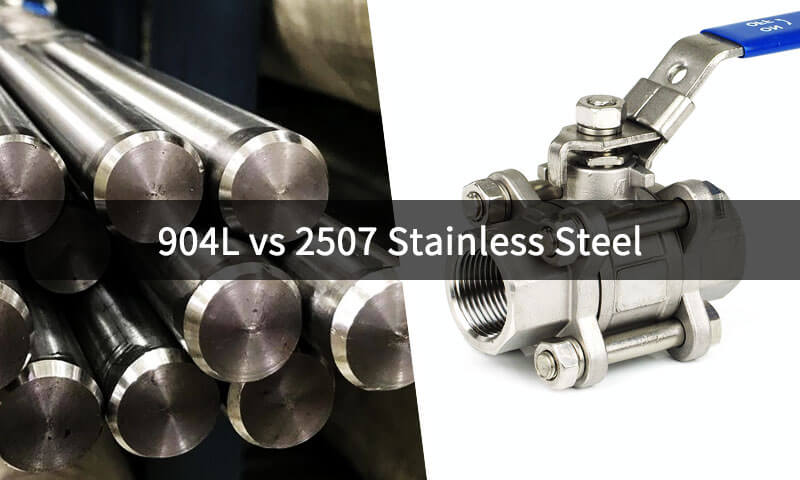
904L is a super austenitic stainless steel developed to withstand highly acidic environments, particularly sulfuric acid and phosphoric acid applications.
Ang mataas na nikel nito, kromo, molibdenum, and copper content provides outstanding resistance to general corrosion, pitting, and crevice corrosion while maintaining excellent formability and weldability.
2507, sa kabilang banda, ay isang super duplex stainless steel that combines approximately equal proportions of austenite and ferrite.
This unique dual-phase microstructure delivers nearly twice the mechanical strength of conventional austenitic stainless steels while providing exceptional resistance to chloride-induced pitting, bitak na kaagnasan, at pag-crack ng kaagnasan ng stress.
Bilang isang resulta, 2507 has become the material of choice for offshore platforms, seawater desalination plants, subsea pipelines, and other harsh chloride-rich environments.
Choosing between 904L and 2507 is not a matter of “better” or “worse”. It is a strategic decision that must weigh corrosion resistance against mechanical strength, weldability against cost, and availability against performance.
1. Understanding 904L and 2507 Hindi kinakalawang na asero
Although both 904L and 2507 are classified as high-performance hindi kinakalawang na aseros, they belong to different metallurgical families and were developed to solve distinct engineering challenges.
Understanding their composition, mikroistruktura, and design philosophy is the foundation for selecting the appropriate material for corrosive or high-strength applications.
What Is 904L Stainless Steel?
904L is a low-carbon, high-alloy austenitic stainless steel specifically developed for applications requiring exceptional corrosion resistance in aggressive chemical environments.
Compared with standard austenitic grades such as 304L and 316L, 904L contains significantly higher levels of nikel (Ni), kromo (Cr), molibdenum (Mo), at tanso (Cu), giving it outstanding resistance to reducing acids, chloride-induced pitting, and crevice corrosion.
Originally introduced for handling sulfuric acid in chemical processing plants, 904L is now widely used in industries where long-term durability under highly corrosive conditions is essential,
including chemical processing, langis at gas, marine engineering, pharmaceutical production, pulp and paper, and flue gas desulfurization systems.

Austenitic Stainless Steel Classification
904L belongs to the super austenitic stainless steel Pamilya. Its fully austenitic microstructure offers several advantages:
- Excellent corrosion resistance across a wide range of chemical environments
- Superior ductility and toughness, Kahit na sa cryogenic temperatura
- Non-magnetic characteristics in the annealed condition
- Excellent formability and weldability
- High resistance to intergranular corrosion due to its low carbon content
Unlike duplex stainless steels, 904L does not rely on a mixed ferritic-austenitic structure for strength.
Sa halip, its performance is achieved through high alloying levels that enhance both corrosion resistance and metallurgical stability.
Development History
904L stainless steel was initially developed during the 1960s to address corrosion challenges in sulfuric acid production and fertilizer manufacturing, where conventional stainless steels exhibited inadequate resistance.
Engineers sought an alloy capable of maintaining structural integrity in reducing acid environments without sacrificing weldability or fabrication performance.
Sa paglipas ng panahon, advances in metallurgy and manufacturing technology expanded the use of 904L into offshore engineering, mga heat exchanger, presyon vessels, and high-purity process equipment.
Ngayon, it remains one of the most widely recognized super austenitic stainless steels for corrosive industrial applications.
Mga Pangunahing Katangian
904L stainless steel offers an excellent balance of corrosion resistance, fabrication performance, at tigas na tigas. Its defining characteristics include:
- Outstanding resistance to sulfuric, posporiko, and organic acids
- High resistance to pitting and crevice corrosion in chloride-containing environments
- Excellent weldability without the need for post-weld heat treatment in many applications
- Superior toughness at both ambient and cryogenic temperatures
- Low susceptibility to sensitization due to its low carbon content
- Good formability for complex fabricated components
These properties make 904L particularly suitable for pressure vessels, mga tangke ng imbakan, mga sistema ng piping, and heat exchangers exposed to aggressive chemical media.
Mga Internasyonal na Pamantayan
904L stainless steel is standardized under multiple international specifications, ensuring global material consistency and interchangeability.
| Pamantayan | Pagtatalaga |
| UNS | N08904 |
| ASTM | ASTM A240, ASTM A182, ASTM A312, ASTM A276 |
| EN | EN 1.4539 |
| DIN | X1NiCrMoCu25-20-5 |
| ISO | ISO 15510 |
| JIS | SUS 904L |
Ano ang 2507 Hindi kinakalawang na asero?
2507 ay isang super duplex stainless steel engineered to combine the excellent corrosion resistance of austenitic stainless steel with the high strength of ferritic stainless steel.
Its balanced microstructure consists of approximately 50% austenite and 50% ferrite
Due to its superior strength and durability, 2507 is widely used in offshore oil and gas production, subsea equipment, seawater desalination, marine engineering, pagproseso ng kemikal, and other applications exposed to highly corrosive chloride environments.

Super Duplex Stainless Steel Classification
2507 belongs to the super duplex stainless steel Pamilya, which is characterized by:
- Dual-phase ferrite-austenite microstructure
- High chromium and molybdenum content
- Nitrogen alloying for enhanced strength and corrosion resistance
- Excellent resistance to stress corrosion cracking
- High yield strength—approximately twice that of conventional austenitic stainless steels
The balanced microstructure enables 2507 to deliver a unique combination of mechanical performance and corrosion resistance that cannot be achieved with fully austenitic alloys alone.
Development History
Duplex stainless steels were originally developed to overcome the limitations of traditional austenitic stainless steels in chloride-rich environments.
As offshore oil production, seawater desalination, and deep-water engineering expanded during the late twentieth century, engineers required materials capable of resisting localized corrosion while maintaining high mechanical strength.
2507 stainless steel emerged as a premium super duplex grade with enhanced chromium, molibdenum, and nitrogen contents, significantly improving resistance to pitting, bitak na kaagnasan, at pag-crack ng kaagnasan ng stress.
Ngayon, it is considered one of the most reliable stainless steels for harsh marine and offshore service.
Dual-Phase Microstructure
The defining feature of 2507 is its carefully controlled dual-phase structure, typically comprising:
- Tinatayang 50% ferrite
- Tinatayang 50% austenite
This balanced microstructure provides several engineering benefits:
- High yield and tensile strength
- Napakahusay na katigasan
- Superior resistance to chloride stress corrosion cracking
- Enhanced fatigue performance
- Improved resistance to localized corrosion
- Better dimensional stability under mechanical loading
Gayunpaman, maintaining this microstructural balance requires strict control during heat treatment and welding to avoid the formation of detrimental intermetallic phases.
Mga Pangunahing Katangian
2507 stainless steel is recognized for its outstanding combination of mechanical and corrosion-resistant properties, kasama na ang:
- Exceptional resistance to pitting and crevice corrosion
- Excellent chloride stress corrosion cracking resistance
- Nearly double the yield strength of 904L
- High fatigue strength for cyclic loading applications
- Good impact toughness
- Excellent seawater corrosion resistance
- Reduced wall thickness requirements due to higher strength
These characteristics make 2507 stainless steel an ideal material for structural components operating under high pressure and severe corrosion conditions.
Mga Internasyonal na Pamantayan
2507 stainless steel is covered by several globally recognized material standards.
| Pamantayan | Pagtatalaga |
| UNS | S32750 |
| ASTM | ASTM A240, ASTM A182, ASTM A276, ASTM A789, ASTM A790 |
| EN | EN 1.4410 |
| DIN | X2CrNiMoN25-7-4 |
| ISO | ISO 15156 (Langis & Gas Service) |
2. Paghahambing ng Komposisyon ng Kemikal: 904L vs 2507 Hindi kinakalawang na asero
The chemical composition of stainless steel fundamentally determines its microstructure, paglaban sa kaagnasan, mekanikal na mga katangian, weldability, and service performance.
904L relies on high nickel, molibdenum, at tanso contents to enhance resistance to reducing acids and general corrosion,
habang ang 2507 achieves superior mechanical strength and chloride resistance through a carefully balanced combination of kromo, molibdenum, nitrogen, and a duplex (austenite-ferrite) mikroistruktura.
| Elemento (wt%) | 904L (UNS N08904) | 2507 (UNS S32750) | Pangunahing Tungkulin |
| Chromium (Cr) | 19.0–23.0 | 24.0–26.0 | Improves oxidation resistance, passivation na lang, and pitting corrosion resistance |
| Nikel (Ni) | 23.0–28.0 | 6.0–8.0 | Nagpapatatag ng austenite, enhances toughness and corrosion resistance |
| Molibdenum (Mo) | 4.0–5.0 | 3.0–5.0 | Improves pitting, bitak na kaagnasan, at paglaban sa acid |
| Nitrogen (N) | ≤0.10 | 0.24–0.32 | Increases strength and pitting resistance, stabilizes austenite |
| Tanso (Cu) | 1.0–2.0 | ≤0.50 | Enhances resistance to sulfuric and phosphoric acids |
Carbon (C) |
≤0.020 | ≤0.030 | Low carbon minimizes carbide precipitation and intergranular corrosion |
| Mga mangganeso (Mn) | ≤2.0 | ≤1.2 | Improves hot workability and deoxidation |
| Silicon (Si Si) | ≤1.0 | ≤0.8 | Improves oxidation resistance and casting fluidity |
| Posporus (P) | ≤0.045 | ≤0.035 | Controlled to maintain toughness |
| Sulfur (S) | ≤0.035 | ≤0.020 | Low sulfur improves weldability and corrosion resistance |
| Bakal na Bakal (Fe) | Balanse | Balanse | Matrix material |
3. Paghahambing ng Mga Katangian ng Mekanikal: 904L vs 2507 Hindi kinakalawang na asero
The mechanical properties of 904L and 2507 reflect their fundamentally different microstructures: austenitic vs. duplex.
| Mechanical property | 904L (annealed na nga ba) | 2507 (solution annealed) | Pagkakaiba |
| Lakas ng paghatak (MPa) | 520‑680 | 700‑850 | 2507 is 20‑30% stronger. |
| Magbunga ng lakas (0.2%, MPa) | 220 | 550 | 2507 is 2.5× stronger. |
| Pagpapahaba (%) | ≥35 | ≥25 | 904L is more ductile. |
| Ang katigasan ng ulo (HB) | 150‑180 | 250‑300 | 2507 is significantly harder. |
Impact toughness (Charpy, J) |
>100 (at room temp) | 70‑100 (at room temp) | Both are tough; 904L retains toughness at cryogenic temperatures. |
| Modulus of elasticity (GPa) | 195 | 200 | Similar. |
| Lakas ng pagkapagod (10⁷ Mga siklo, MPa) | 250‑300 | 400‑450 | 2507 has superior fatigue resistance. |
| Creep resistance | Mabuti na lang | Katamtaman (limited to ≤300°C) | 904L is better at elevated temperatures. |
| Ductile-to-brittle transition | Wala (austenitic) | −50°C (duplex) | 904L is suitable for cryogenic applications; 2507 is limited. |
4. Paghahambing ng Paglaban sa Kaagnasan: 904L vs 2507 Hindi kinakalawang na asero
Corrosion resistance is the primary reason engineers select high-alloy stainless steels. While both 904L and 2507 significantly outperform standard grades such as 304 and 316L,
they excel in different corrosive environments because of their distinct alloy compositions and microstructures.
Sa pangkalahatan, 904L performs exceptionally well in reducing acids, samantalang ang 2507 provides superior resistance to chloride-induced localized corrosion and stress corrosion cracking.

Pangkalahatang Paglaban sa Kaagnasan
Both alloys develop a stable chromium-rich passive oxide layer that protects the underlying metal from uniform corrosion.
Compared with conventional stainless steels, both materials offer:
- Excellent atmospheric corrosion resistance
- Mataas na paglaban sa oksihenasyon
- Superior industrial corrosion performance
- Long service life
Gayunpaman, their optimal service environments differ significantly.
Pitting Corrosion Resistance
Pitting corrosion is a localized form of attack that occurs when the passive film breaks down, particularly in chloride-containing solutions.
Dahil 2507 ay naglalaman ng:
- Higher chromium
- Similar molybdenum
- Much higher nitrogen
it exhibits considerably higher resistance to pitting.
| Materyal | Typical PREN | Paglaban sa Pagpipigil |
| 316L | 24–27 | Mabuti na lang |
| 904L | 35–38 | Napakahusay |
| 2507 | 42–45 | Natitirang mga |
2507 is therefore the preferred choice for seawater pipelines, mga platform sa malayo sa pampang, mga halaman ng desalination, at mga kagamitang pandagat.
Crevice Corrosion Resistance
Crevice corrosion often develops beneath gaskets, mga flanges, mga bolts, deposits, or stagnant water where oxygen is depleted.
Although both alloys perform well, 2507’s higher PREN and duplex structure provide greater resistance, particularly in warm chloride-rich environments.
Stress kaagnasan pagbasag (SCC)
Stress corrosion cracking results from the combined effects of tensile stress and corrosive media, especially chlorides.
This is one of the most significant differences between the two materials.
- 904L offers improved SCC resistance compared with standard austenitic grades but may still be susceptible under severe chloride conditions.
- 2507, with its duplex microstructure, provides outstanding resistance to chloride-induced SCC and is widely used in offshore oil and gas systems where such failures are a major concern.
Sulfuric Acid Resistance
| Kapaligiran | 904L | 2507 |
| 10‑40% H₂SO₄ at 20‑80°C | Napakahusay | Katamtaman |
| Dilute H₂SO₄ (<10%) | Napakahusay | Mabuti na lang |
| Hot concentrated H₂SO₄ (>70%) | Mabuti na lang | Mga Maralita |
904L is the superior alloy for sulfuric acid handling because of its copper content. 2507’s copper is limited to ≤0.5%, giving it much lower resistance to reducing acids.
5. Heat Resistance and Weldability
Paglaban sa Init
| Parameter | 904L | 2507 |
| Maximum continuous service temperature | 300‑400°C | ≤300°C |
| Short‑term peak temperature | 450°C | 350°C |
| Oxidation resistance | Mabuti na lang (up to 600°C) | Mabuti na lang (up to 500°C) |
| Creep resistance | Mabuti na lang | Limitado (duplex phase unstable >300°C) |
| Sensitisation risk | Mababa ang (mababa ang carbon) | Mababa ang (mababa ang carbon + nitrogen) |
Critical note: 2507 should hindi naman be used above 300°C for extended periods.
Above this temperature, the duplex microstructure can decompose—forming harmful sigma phase, which embrittles the material and reduces corrosion resistance.
904L can be used up to 400°C (and for short periods up to 450°C) without significant phase degradation.
Weldability
| Weldability factor | 904L | 2507 |
| Weldability rating | Napakahusay | Mabuti na lang (requires skilled welders) |
| Preheat required | Hindi | Hindi |
| Filler metal | Matching 904L (ER385) | Matching 2507 (hal., ER2594) |
| Heat input control | Not critical | Critical (keep interpass <150°C) |
| Post‑weld heat treatment | Hindi kinakailangan | Hindi kinakailangan |
| Risk of hot cracking | Mababa ang | Mababa ang |
| Risk of sigma phase | Wala | Mataas na (slow cooling or high heat input) |
| Back‑purge required | Hindi (for air applications) | Oo nga (for high‑quality welds) |
Key insight: 904L is easier to weld than 2507. Its fully austenitic structure is forgiving, with no risk of sigma phase formation.
2507’s duplex structure requires strict control of heat input, interpass temperature (<150°C), and cooling rate to prevent precipitation of sigma phase or excessive ferrite/austenite imbalance.
6. Machinability and Fabrication
The substantial differences in alloy composition and microstructure between 904L and 2507 stainless steel have a direct impact on machining behavior, Mga Pamamaraan ng Paggawa, tooling requirements, and manufacturing costs.
Machinability Comparison
| Pag-aari | 904L Hindi kinakalawang na Asero | 2507 Hindi kinakalawang na asero |
| Relative Machinability (AISI 1212 = 100%) | 35–40% | 20–30% |
| Mga Puwersa ng Pagputol | Katamtaman | Mataas na |
| Tool Wear | Katamtaman hanggang sa Mataas | Mataas na |
| Work Hardening Tendency | Napakataas na | Katamtaman |
| Chip Formation | Long and Stringy | Shorter but Hard |
| Recommended Tooling | Mga Tool sa Carbide | Premium Carbide or Ceramic |
| Surface Finish Potential | Napakahusay | Mabuti na lang |
Machining Characteristics of 904L
904L contains exceptionally high levels of nickel and molybdenum, which provide outstanding corrosion resistance but also increase ductility and toughness.
Bilang isang resulta, the material exhibits severe work hardening during machining operations.
Typical challenges include:
- Rapid hardening of the machined surface.
- Increased heat generation in the cutting zone.
- Difficulty in chip breaking.
- Higher tool wear compared with standard austenitic grades.
Recommended machining practices include:
- Using sharp positive-rake carbide inserts.
- Maintaining continuous cuts whenever possible.
- Applying generous coolant flow to dissipate heat.
- Selecting moderate cutting speeds and higher feed rates.
- Avoiding repeated shallow cuts that promote work hardening.
Typical machining processes include:
- CNC pagliko
- CNC paggiling
- Pagbutas ng butas
- Thread machining
- Precision finishing operations
Machining Characteristics of 2507
The machining difficulties associated with 2507 arise primarily from its high strength and hardness rather than excessive work hardening.
Compared with 904L, 2507 typically results in:
- Higher cutting loads.
- Greater tool edge wear.
- Increased vibration risk.
- Reduced allowable cutting speeds.
Successful machining of 2507 generally requires:
- High-rigidity machine tools.
- Premium coated carbide inserts.
- Mga sistema ng coolant na may mataas na presyon.
- Optimized tool geometry.
- Lower spindle speeds with adequate feed rates.
Although machining costs are generally higher, the superior mechanical strength of 2507 often allows designers to reduce section thickness, partially compensating for the increased manufacturing expense.
Formability Comparison
| Forming Property | 904L | 2507 |
| Cold Formability | Napakahusay | Mabuti na lang |
| Malalim na Pagguhit | Napakahusay | Katamtaman |
| Bending Capability | Napakahusay | Mabuti na lang |
| Stretch Forming | Napakahusay | Katamtaman |
| Springback Tendency | Katamtaman | Mataas na |
904L Advantages
The fully austenitic structure provides excellent ductility and toughness, making 904L highly suitable for:
- Deep-drawn vessels
- Complex piping systems
- Chemical storage tanks
- Pharmaceutical processing equipment
The material performs particularly well in applications involving severe deformation or tight bending radii.
2507 Mga kalamangan
Although less formable than 904L, 2507 mga alok:
- Higher structural stiffness.
- Better load-bearing capability.
- Reduced wall thickness requirements.
Gayunpaman, manufacturers must account for increased springback during bending operations, often requiring over-bending compensation.
7. Investment Casting Performance Comparison: 904L vs 2507 Hindi kinakalawang na asero
Pamumuhunan sa paghahagis, kilala rin bilang lost wax casting, is a precision manufacturing process widely used to produce complex stainless steel components with excellent dimensional accuracy, masalimuot na geometries, makinis na ibabaw ay nagtatapos, and reduced machining requirements.
Compared with conventional casting methods, investment casting provides superior control over component shape and surface quality, making it ideal for demanding applications in chemical processing, langis at gas, marine engineering, energy systems, at mga kagamitang pang industriya.
| Investment casting factor | 904L | 2507 |
| Pagkatubig | Mabuti na lang (high nickel) | Katamtaman (duplex has lower fluidity) |
| Solidification shrinkage | Katamtaman (~ 2%) | Moderate‑high (~2‑3%) |
| Hot tearing tendency | Mababa ang | Katamtaman (duplex) |
| Shell interaction | Mababa ang (silica‑sol shells) | Mababa ang |
| Pouring temperature (°C) | 1550‑1650 | 1550‑1650 |
| Heat treatment required | Solution anneal (1040‑1100°C) + pawiin | Solution anneal (1020‑1100°C) + pawiin |
| NDT / inspeksyon | Radiography, dye penetrant | Radiography, dye penetrant, ferrite measurement |
| Castability rating | Napakahusay | Mabuti na lang |
Key considerations:
- 904L casts well due to its high nickel content (good fluidity, low oxidation).
- 2507 casts well but requires careful control of cooling rate to achieve the correct austenite‑ferrite balance (50/50). Rapid cooling from solution annealing is essential.
- Ferrite measurement: Para sa 2507 Mga Casting ng Pamumuhunan, the ferrite content must be measured (typically 35‑65%) to ensure phase balance and corrosion resistance.
8. Mga Pang industriya na Aplikasyon
904L hindi kinakalawang na asero is primarily selected for environments involving aggressive acids, especially sulfuric acid and phosphoric acid, where its high nickel and copper content provides exceptional corrosion resistance.
2507 hindi kinakalawang na asero, as a super duplex stainless steel, is preferred for applications requiring a combination of high mechanical strength, excellent chloride resistance, and superior resistance to stress corrosion cracking, particularly in offshore and marine environments.

Chemical Processing Industry
904L Stainless Steel Applications
The chemical processing industry is one of the most important application areas for 904L stainless steel.
Due to its high nickel content (approximately 23–28%) and copper addition, 904L provides outstanding resistance to reducing acids, especially sulfuric acid.
Kabilang sa mga karaniwang aplikasyon ang:
- Sulfuric acid storage tanks.
- Acid transfer pipelines.
- Reactors and mixing vessels.
- Mga heat exchanger.
- Evaporators.
- Bomba bodies.
- Valve mga bahagi.
- Chemical processing fittings.
2507 Hindi kinakalawang na asero Mga Application
Kahit na 2507 is not typically selected for strongly reducing acid environments, it performs exceptionally well in chloride-containing chemical processes.
Kabilang sa mga karaniwang aplikasyon ang:
- Chloride processing equipment.
- Chemical storage systems.
- Heat exchangers exposed to saline solutions.
- Process piping systems.
Industriya ng Langis at Gas
The oil and gas industry demands materials capable of surviving high pressure, Mataas na temperatura, and highly corrosive environments containing chlorides, hydrogen sulfide, at tubig dagat.
2507 Hindi kinakalawang na asero Mga Application
2507 is widely used in offshore oil and gas operations due to its excellent strength and corrosion resistance.
Typical components include:
- Subsea valves.
- Offshore platform piping.
- Flowlines.
- Umbilical tubing.
- Pressure control equipment.
- Pump components.
- Manifold systems.
904L Stainless Steel Applications
904L can also be used in oil and gas facilities, particularly where chemical corrosion resistance is more important than high mechanical strength.
Kasama sa mga aplikasyon ang:
- Chemical injection systems.
- Acid handling equipment.
- Processing units.
- Specialized piping systems.
Marine Engineering Applications
Marine environments are among the most challenging conditions for metallic materials because seawater contains high concentrations of chloride ions.
2507 Hindi kinakalawang na asero Mga Application
2507 is one of the preferred stainless steels for marine applications.
Typical uses include:
- Seawater cooling systems.
- Shipboard piping.
- Marine pumps.
- Mga istruktura sa malayo sa pampang.
- Heat exchanger components.
- Desalination equipment.
904L Stainless Steel Applications
904L also performs well in marine environments but is generally selected for specialized applications requiring excellent surface finish and corrosion resistance.
Kabilang sa mga halimbawa ang:
- Marine decorative components.
- Precision fittings.
- Luxury equipment components.
- Corrosion-resistant fasteners.
Desalination Industry
Desalination plants expose materials to concentrated seawater containing extremely high chloride levels.
2507 Hindi kinakalawang na asero Mga Application
2507 has become a major material choice for modern desalination systems.
Kabilang sa mga karaniwang aplikasyon ang:
- High-pressure pump components.
- Reverse osmosis piping.
- Brine circulation systems.
- Pressure vessels.
- Mga heat exchanger.
904L Stainless Steel Applications
904L may be used in desalination equipment where excellent corrosion resistance is needed but mechanical loading is moderate.
Kasama sa mga aplikasyon ang:
- Low-pressure piping.
- Chemical dosing systems.
- Auxiliary equipment.
Pharmaceutical and Food Processing Industry
904L Stainless Steel Applications
- Sterile processing vessels.
- Purified water systems.
- Storage tanks.
- Laboratory equipment.
- High-purity piping.
2507 Hindi kinakalawang na asero Mga Application
2507 is less common in pharmaceutical applications but may be selected where high strength and chloride resistance are required.
Kabilang sa mga halimbawa ang:
- High-pressure process systems.
- Chloride-containing pharmaceutical processes.
- Industrial-scale fluid handling equipment.
Power Generation Industry
2507 Hindi kinakalawang na asero Mga Application
Power plants often require materials resistant to cooling water corrosion and high mechanical loads.
Typical applications:
- Condenser systems.
- Cooling water piping.
- Mga heat exchanger.
- Boiler auxiliary systems.
- Flue gas treatment equipment.
904L Stainless Steel Applications
904L is commonly used in:
- Flue gas desulfurization systems.
- Acid handling systems.
- Chemical treatment equipment.
Its excellent resistance to sulfur-containing compounds makes it valuable in pollution control systems.
Pulp and Paper Industry
The pulp and paper industry involves exposure to chemicals such as chlorides, sulfur compounds, and bleaching agents.
904L Stainless Steel Applications
Ginagamit para sa:
- Bleaching equipment.
- Mga tangke ng kemikal.
- Acid-resistant piping.
2507 Hindi kinakalawang na asero Mga Application
Ginagamit para sa:
- Bleaching towers.
- Mga Digester.
- Recovery systems.
- Chloride-containing process equipment.
9. Comprehensive Comparison: 904L vs 2507 Hindi kinakalawang na asero
The following table provides a comprehensive engineering comparison between 904L super austenitic stainless steel at 2507 super duplex stainless steel from multiple perspectives.
| Comparison Category | 904L Hindi kinakalawang na Asero (UNS N08904) | 2507 Super Duplex hindi kinakalawang na asero (UNS S32750) |
| Material Classification | Super austenitic stainless steel | Super duplex stainless steel |
| Metallurgical Structure | Fully austenitic single-phase structure | Dual-phase structure: humigit-kumulang 50% ferrite + 50% austenite |
| Primary Design Objective | Maximum corrosion resistance in aggressive chemical environments | High strength combined with superior chloride corrosion resistance |
| Mga Internasyonal na Pamantayan | ASTM A240 / A182 / A312, EN 1.4539, UNS N08904 | ASTM A240 / A182 / A790, EN 1.4410, UNS S32750 |
| Chromium (Cr) | 19–23% | 24–26% |
| Nikel (Ni) | 23–28% | 6–8% |
| Typical PREN Value | Approximately 35–38 | Approximately 42–45 |
| Densidad ng katawan | Tinatayang 8.0 g/cm³ | Tinatayang 7.8 g/cm³ |
| Yield Lakas | ≥220 MPa | ≥550 MPa |
| Lakas ng Paghatak | ≥490 MPa | ≥800 MPa |
| Pangkalahatang Paglaban sa Kaagnasan | Napakahusay | Napakahusay |
| Pitting Corrosion Resistance | Napakahusay | Natitirang mga |
| Crevice Corrosion Resistance | Napakahusay | Natitirang mga |
| Chloride Stress Corrosion Cracking Resistance | Mabuti na lang | Napakahusay |
| Seawater Resistance | Napakahusay | Natitirang mga |
| Sulfuric Acid Resistance | Natitirang mga | Moderate to Good |
| Phosphoric Acid Resistance | Natitirang mga | Mabuti na lang |
| Organic Acid Resistance | Napakahusay | Napakahusay |
Mataas na Temperatura ng Pagganap |
Better long-term temperature capability (~400–450°C) | Limited by phase stability (~ 300-350 ° C) |
| Low-Temperature Toughness | Napakahusay | Napakahusay |
| Mga Katangian ng Magnetic | Non-magnetic in annealed condition | Slightly magnetic due to ferrite phase |
| Work Hardening Tendency | Malakas na | Very Strong |
| Machinability | Mahirap | More difficult |
| Cutting Tool Requirement | Carbide tools recommended | Advanced coated carbide tools recommended |
| Formability | Napakahusay | Katamtaman |
| Cold Working Capability | Napakahusay | Limitado |
| Weldability | Napakahusay | Good but requires strict control |
| Pagiging kumplikado ng hinang | Relatively easy | Higher due to phase balance requirements |
| Post Weld Heat Treatment | Usually unnecessary | Usually unnecessary but process control is critical |
| Heat Treatment Requirement | Solusyon pagsusubo | Solution annealing with strict phase control |
| Microstructure Control Difficulty | Katamtaman | Mataas na |
| Investment Casting Difficulty | Mataas na | Napakataas na |
| Casting Process Control Requirement | Alloy chemistry and surface quality control | Kimika, pagpapatibay, and phase balance control |
| Hot Cracking Risk During Casting | Mababa ang | Katamtaman |
| Segregation Sensitivity | Katamtaman | Mas Mataas |
| Typical Investment Casting Components | Chemical valves, acid-resistant pumps, pharmaceutical parts | Mga balbula sa malayo sa pampang, marine pumps, mga bahagi ng subsea |
Best Application Environment |
Aggressive chemical and acidic environments | Chloride-rich, mataas na presyon, mga kapaligiran sa dagat |
| Typical Industries | Pagproseso ng kemikal, mga parmasyutiko, Pulp & papel na papel, mga pataba | Langis & gas, offshore engineering, desalination, marine |
| Pressure-Bearing Capability | Katamtaman | Napakahusay |
| Wall Thickness Reduction Potential | Limitado | High due to superior strength |
| Maintenance Requirement | Low in chemical environments | Very low in marine environments |
| Lifecycle Cost Advantage | Lower maintenance in acidic service | Lower maintenance in seawater and high-pressure service |
Gastos sa Materyal |
Very High due to high nickel content | High due to alloying and processing requirements |
| Main Advantages | Exceptional acid resistance, mahusay na weldability, superior ductility | Natitirang lakas, chloride resistance, SCC resistance |
| Main Limitations | Lower strength, mas mataas na gastos sa materyal | More difficult fabrication and temperature limitations |
| Recommended Selection | Choose when chemical corrosion resistance and fabrication flexibility are priorities | Choose when mechanical strength and chloride resistance are critical |
10. Pangwakas na Salita
904L and 2507 are two top-tier corrosion-resistant stainless steel grades with different technical routes and complementary advantages.
904L, as a super austenitic stainless steel, excels in highly corrosive chemical environments where resistance to reducing acids is essential.
Its high nickel and copper content provides outstanding protection against sulfuric acid, posporiko acid, and organic acids while maintaining excellent weldability, tigas na tigas, and fabrication capability.
2507, as a super duplex stainless steel, represents a different design philosophy.
Through its balanced ferrite-austenite structure and high chromium-molybdenum-nitrogen alloying system, it delivers exceptional mechanical strength and outstanding resistance to chloride-induced corrosion.
These characteristics make it the preferred material for offshore platforms, seawater systems, mga halaman ng desalination, and high-pressure industrial equipment.
There is no universal winner between these two materials. The optimal choice depends entirely on the service environment, mechanical loading conditions, fabrication requirements, and lifecycle cost considerations.
Mga FAQ
Which is better for seawater, 904L or 2507 Hindi kinakalawang na asero?
2507 is clearly superior for seawater service.
Its significantly higher PREN value gives it much higher critical pitting and crevice corrosion temperatures, and its dual-phase structure provides far better chloride stress corrosion resistance.
904L is not recommended for long-term immersion in seawater, especially in warm or stagnant seawater with crevices.
Can 904L and 2507 Stainless Steel be used interchangeably?
Hindi. They serve different applications. Using 904L in hot seawater will likely result in pitting or SCC. Using 2507 in sulfuric acid will result in rapid corrosion. The selection must be environment‑specific.

