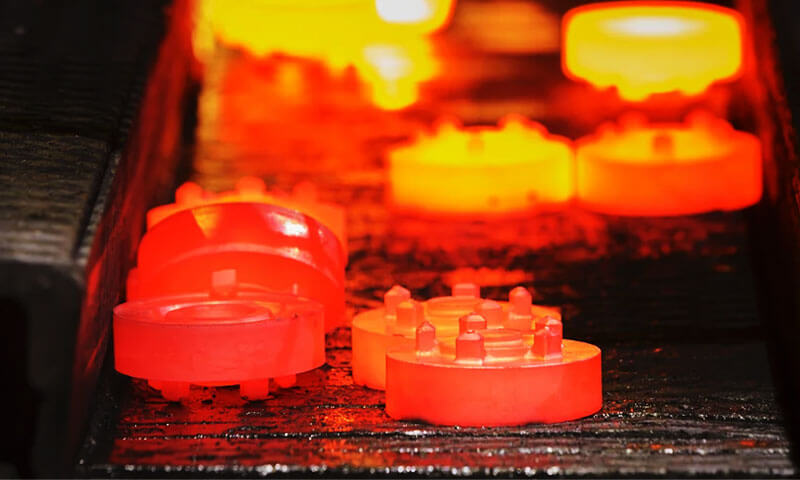
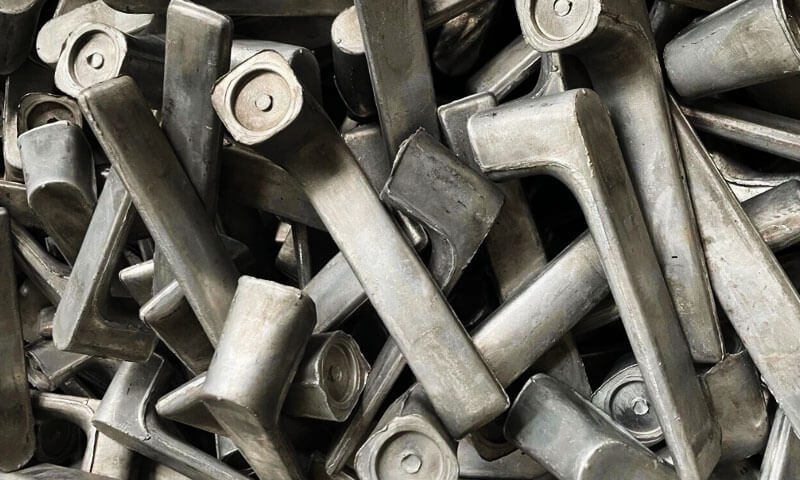
If you have spent any time around aluminum forging, you know the name 6061. It is not the hardest alloy; it is not the strongest, and it is not the most corrosion-resistant.
But year after year, it remains the alloy that quietly does the job in bicycle frames, robot joints, mga kagamitang medikal, EV brackets, power tool housings, and countless other load-bearing parts.
In my years on the forge floor, I have seen engineers over-specify 7075 when 6061-T6 would have been perfectly adequate.
I have seen purchasing teams chase the lowest price and end up with recycled 6061 that would not anodize properly. I have also seen beautifully forged 6061-T6 parts last for decades in the field.
This article is a detailed, practical look at 6061-T6 aluminum alloy forging—what it is, how it behaves, how to forge it, how to heat treat it, and where it makes sense.
If you are searching for reliable information on 6061-T6 forging properties, forging temperature, T6 init paggamot, o 6061 mga bes 6063, this guide is written for you.
1. Ano ang 6061 aluminyo haluang metal?
6061 belongs to the 6000 series of aluminum alloys, which use magnesium and silicon as their primary alloying elements.
It is a heat-treatable alloy whose mechanical properties can be improved through controlled solution heat treatment and artificial aging.
Its main strengthening mechanism involves the precipitation of fine Mg-Si-based strengthening phases, commonly described in engineering practice through the Mg₂Si system.
Copper and other minor alloying elements also influence its precipitation response and overall properties.
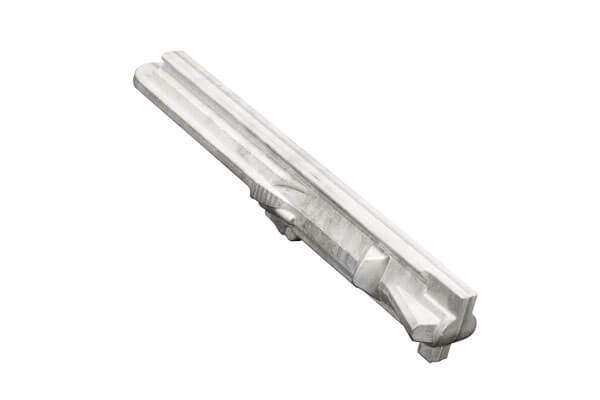
Typical Chemical Composition of 6061 Aluminyo
| Elemento | Typical Specification Range (wt.%) |
| Aluminyo (Al) | Balanse |
| Magnesium (Mg) | 0.80–1.20 |
| Silicon (Si Si) | 0.40–0.80 |
| Tanso (Cu) | 0.15–0.40 |
| Chromium (Cr) | 0.04–0.35 |
| Bakal na Bakal (Fe) | 0.70 max na max. |
| Mga mangganeso (Mn) | 0.15 max na max. |
| Sink (Zn) | 0.25 max na max. |
| Titanium (Ti) | 0.15 max na max. |
The composition ranges are representative of the standard 6061 alloy specification. The governing material standard and purchase specification determine the acceptance limits for a particular production batch.
2. Understanding the Mechanical Properties of 6061-T6
The T6 designation indicates that the material has undergone solution heat treatment followed by artificial aging to develop its specified properties.
It is not simply a description of the alloy composition; it represents a particular metallurgical condition.
The following table provides representative room-temperature properties for common 6061-T6 wrought products.
Actual values for forgings depend on the applicable specification, kapal ng seksyon, product geometry, and testing direction.
Typical Mechanical and Physical Properties
| Pag-aari | Representative Value |
| Ultimate tensile strength | Approximately 290–310 MPa |
| Magbunga ng lakas | Approximately 240–276 MPa |
| Pagpapahaba | Approximately 8–17%, depending on product form |
| Elastic modulus | Tinatayang 68.9 GPa |
| Densidad ng katawan | Tinatayang 2.70 g/cm³ |
| Brinell hardness | Tinatayang 95 HB |
| Thermal expansion coefficient | Approximately 23–24 × 10⁻⁶/K near room temperature |
| Melting range | Approximately 580–650°C |
These values are indicative, not universal design allowables. Qualified forging properties should be taken from the applicable material specification and verified for the actual component.
Strength and Structural Reliability
For most general industrial components, 6061-T6 provides a useful combination of tensile strength and yield strength without the material cost and processing demands associated with higher-strength aluminum alloys.
It is suitable for components subjected to moderate-to-high mechanical loads, provided the design accounts for section thickness, mga konsentrasyon ng stress, fatigue requirements, and the actual properties of the finished forging.
A point worth remembering from the shop floor: a nominal tensile-strength value does not tell the whole story about a forged component.
Grain flow, local geometry, Mga depekto, paggamot ng init, and machining-induced stresses also influence service performance.
Paglaban sa kaagnasan
6061 generally offers good resistance to atmospheric corrosion and many freshwater environments.
It is frequently selected for outdoor machinery, transportation equipment, and components exposed to ordinary industrial conditions.
For marine, coastal, or chemically aggressive environments, additional protection may be necessary.
Pagpapahid ng langis, suitable conversion coatings, or paint systems can improve surface durability, depende sa application.
The contact between aluminum and dissimilar metals should also be considered. Under unfavorable moisture and electrical-contact conditions, galvanic corrosion can damage the aluminum surface.
Machinability
6061-T6 is well suited to CNC milling, pagliko, pagbabarena, boring nga, at pagtapik.
Its combination of strength and machinability makes it attractive for parts requiring accurate bores, mounting faces, mga thread, and complex pockets.
Gayunpaman, a forged blank is not automatically easy to machine. Natitirang stress, local hardness variation, insufficient machining allowance, and poor workholding can all produce dimensional problems.
Weldability
6061 can be welded using common aluminum welding processes, but welding a T6 component changes the local metallurgical condition.
The heat-affected zone generally loses some of its precipitation-hardening strength unless a suitable post-weld treatment restores the required properties.
For highly loaded components, the joint design and reduced local strength must be considered during engineering.
Kung saan posible, a forged component designed to minimize welded joints can simplify quality control and load transfer.
Pagtatapos ng Ibabaw
6061 generally responds well to anodizing and other common aluminum finishing processes.
Anodizing can improve corrosion resistance and surface wear performance, although the result depends on the alloy, pretreatment, anodizing method, and coating thickness.
For visible components, such as bicycle parts, equipment housings, and consumer-product structures, surface preparation and material consistency are particularly important for achieving uniform appearance.
3. What Does the T6 Temper Mean?
The T6 temper is achieved through a controlled heat-treatment sequence.
For forged 6061 mga bahagi, this process must be designed around the alloy, forging geometry, kapal ng seksyon, and applicable specification.
It is also important to distinguish the forging temperature from the solution heat-treatment temperature.
They serve different metallurgical purposes and must not be treated as interchangeable.
Solusyon Heat Paggamot
During solution heat treatment, the forging is heated to a specified temperature so that soluble alloying elements enter the aluminum matrix.
Para sa 6061, a solution-treatment temperature around 530–550°C is commonly referenced, although the exact approved cycle depends on the material specification and component requirements.
The objective is to create a suitable solid solution before quenching.
Temperature uniformity is critical. Underheating can result in an inadequate solution-treatment response, while excessive temperature can cause localized incipient melting or other metallurgical damage.
For thick or complex forgings, the holding period must be established with reference to section thickness, furnace uniformity, and the qualified heat-treatment procedure.
Pagpapawi
After solution treatment, the component is rapidly cooled, typically by water quenching when required by the approved process.
Quenching retains the supersaturated solid solution needed for subsequent artificial aging.
Gayunpaman, rapid cooling can also introduce thermal gradients and residual stresses.
Manipis na mga seksyon, thick hubs, mga tadyang, and complex transitions may cool at different rates, increasing the risk of distortion.
Dahil dito, an experienced heat-treatment engineer considers not only the quench medium but also the component geometry, transfer time, fixture arrangement, and cooling uniformity.
Artificial Aging
Following quenching, the material is artificially aged to develop its required strength.
A typical reference for 6061 forgings is aging near 160–180°C for approximately eight hours, although approved cycles vary according to product form and specification.
The actual treatment must be confirmed against the governing requirements rather than copied indiscriminately from a general reference.
Sa panahon ng pag-iipon, fine strengthening precipitates form within the aluminum matrix. Their size, pamamahagi ng, and coherency affect the movement of dislocations and therefore the alloy’s strength.
Underaging may leave the material below its intended strength. Excessive aging temperature or time can lead to overaging and a reduction in strength.
The purpose of T6 treatment is not simply to make the aluminum harder. It is to achieve a controlled balance of strength, ductility, and metallurgical stability.
4. Bakit nga ba 6061 Is Well Suited to Forging
6061 is widely used for aluminum forgings because its hot-workability and heat-treatable properties make it suitable for many industrial component geometries.
Forging is especially advantageous when the part requires integrated geometry, good structural integrity, and reliable mechanical performance.

A Practical Forging Temperature Range
Para sa 6061 aluminyo, the metal temperature during forging is generally controlled within an approximate working range of 430–480°C, subject to the alloy condition, billet size, die design, and qualified process.
The upper end of this range should not be treated as a target for every component. Technical references identify approximately 480°C as the upper end of the recommended forging range.
From a production engineer’s perspective, the important point is that billet temperature and actual metal temperature during deformation are not necessarily the same.
A billet may cool while being transferred from the furnace, during preforming, or during contact with the die.
Excessive cooling increases deformation resistance and can lead to incomplete filling, high press loads, o pag crack.
Sa kabilang banda, excessive heating can damage the material and reduce process reliability.
Temperature should therefore be controlled as part of the complete forging sequence rather than by relying solely on the furnace display.
Moderate Deformation Resistance
Compared with more difficult-to-forge high-strength alloys, 6061 can be formed efficiently under properly controlled hot-forging conditions.
Its deformation resistance still changes with temperature, Rate ng pilay, billet geometry, and deformation amount.
Die filling and press-load requirements must therefore be evaluated against the actual part design.
Good Suitability for Closed-Die Forging
Closed-die forging is particularly useful for producing repeatable three-dimensional components with bosses, mga tadyang, Mga Paglipat, and integrated mounting features.
A typical manufacturing route includes:
- Billet inspection and cutting.
- Controlled billet heating.
- Preforming or blocker forging where required.
- Finish forging in the final die.
- Flash trimming and preliminary inspection.
- Solution heat treatment and quenching.
- Artipisyal na pagtanda.
- CNC machining and finishing.
- Final dimensional and material inspection.
Not every component requires a separate preform or identical process stages. The route should be developed around geometry, material flow, die filling, at dami ng produksyon.
Grain Flow and Structural Integrity
One of the major advantages of forging is the deformation of the metal into the required shape.
Under suitable conditions, this can refine the worked microstructure and establish directional grain flow that follows the component’s geometry.
This can be beneficial for fatigue performance and load-bearing capability, particularly when the part design and die layout align the material flow with major service loads.
Gayunpaman, grain flow is not automatically favorable merely because a part has been forged.
Poor preform design, pagtitiklop, laps, hindi kumpletong pagpuno, or inappropriate material flow can introduce defects. Forging design and process control remain essential.
5. Key Process Controls for 6061-T6 Aluminum Forging
Sa produksyon, good 6061 aluminum forgings come from a repeatable process rather than a single optimal parameter.
The following controls have the greatest practical importance.
| Yugto ng Proseso | Critical Control | Potential Problem if Poorly Controlled |
| Billet preparation | Alloy identity, material condition, billet dimensions | Chemistry variation, inconsistent deformation |
| Pag init ng katawan | Billet temperature and uniformity | Incomplete filling, pag crack na, sobrang init |
| Die design | Preform geometry, radii, flash allowance, die alignment | Laps, underfill, excessive flash |
| Pagbubuo ng mga | Press load, deformation sequence, transfer time | Flow defects, dimensional variation |
| Lunas sa init | Solution temperature, pagbabad, pagpapawi ng, pag-iipon | Incorrect strength, pagbaluktot, inconsistent properties |
| Machining | Datum strategy, clamping, allowance, tool path | Dimensional drift, residual-stress distortion |
| Inspeksyon | Kimika, tigas na tigas, mga sukat, relevant NDT | Undetected material or process defects |
What I Pay Particular Attention to During Production
Una, the material entering the press must be traceable and appropriate for the specified alloy.
A supplier’s certificate is useful, but material identification and incoming inspection must be part of the quality system.
Second, die filling must be evaluated before production is released. If a component repeatedly produces laps, malamig na mga shut, or underfilled areas, increasing press force is not necessarily the right solution.
The underlying issue may be preform shape, billet volume, temperatura, die geometry, or material flow.
Third, heat treatment must be validated for the actual forging. A cycle that works well for a small bracket may not provide equivalent temperature uniformity or dimensional stability in a large component with thick hubs and thin ribs.
Sa wakas, the finished forging must be inspected against the drawing and material specification.
Hardness alone cannot confirm that all required tensile properties, mga sukat, and structural conditions have been achieved.
6. Why 6061-T6 Aluminum Forging is Often Better Than Cast Aluminum Parts
Forging and casting are complementary processes, and neither is automatically superior for every component.
The choice depends on geometry, structural requirements, dami ng produksyon, at gastos.
For load-bearing components, gayunpaman, forging can offer meaningful advantages over conventional cast aluminum parts.
| Comparison Factor | 6061-T6 Aluminum Forging | aluminyo paghahagis |
| Manufacturing principle | Solid billet is plastically deformed into shape | Molten metal solidifies in a mold |
| Microstructure | Worked and deformed structure | Solidification structure |
| Grain flow | Can be aligned with component geometry | Does not provide forging-type directional grain flow |
| Internal defect risks | Forging-related defects remain possible; sound starting material is essential | Porosity, pag urong, and inclusions may occur depending on the process |
| Mechanical performance | Often advantageous for demanding load-bearing applications | Depends on alloy, casting process, casting soundness, at paggamot sa init |
Geometric flexibility |
Limited by forging and die-design requirements | Strong advantage for complex cavities and intricate geometry |
| Machining allowance | Can be controlled through near-net-shape forging | Depends on casting method and dimensional requirements |
| Tooling considerations | Forging dies and press capacity can be significant investments | Varies widely by process; sand casting can be economical for low quantities |
| Typical selection | Structural parts requiring strength and fatigue performance | Complex shapes, integrated cavities, and designs favoring casting economics |
The important distinction is that forging changes the material through deformation, while casting forms the component through solidification.
When the component’s geometry and production volume are suitable, forging can provide a favorable combination of structural performance and repeatability.
Gayunpaman, the final decision should be supported by the required mechanical properties, design loads, geometry, and manufacturing economics.
7. 6061 mga bes. 6063 mga bes. 7075: Which Alloy Should You Choose for Forging?
Choosing between 6061, 6063, at 7075 aluminum depends on the component’s strength requirements, forging feasibility, corrosion environment, machining needs, and production cost.
Although all three are heat-treatable aluminum alloys, they serve different manufacturing purposes.
| Comparison Factor | 6061 Aluminyo haluang metal | 6063 Aluminyo haluang metal | 7075 Aluminyo haluang metal |
| haluang metal serye ng mga | Al-Mg-Si | Al-Mg-Si | Al-Zn-Mg-Cu |
| Kamag-anak lakas ng loob | Katamtaman hanggang mataas | Mababa hanggang katamtaman | Napakataas |
| Representative Paghatak ng balat lakas ng loob sa T6 condition* | Approximately 290–310 MPa | Approximately 205–240 MPa | Approximately 530–570 MPa |
| Representative ani lakas ng loob sa T6 condition* | Approximately 240–276 MPa | Approximately 170–215 MPa | Approximately 470–505 MPa |
| Pagbubuo ng mga mga katangian | Good hot forgeability; suitable for a wide range of industrial components | Primarily used for extrusion; forging suitability should be evaluated for the specific component | High-strength alloy requiring careful control of forging temperature, pagpapapangit, at paggamot sa init |
| Kaagnasan paglaban | Good for general industrial environments | Good to very good in many atmospheric environments | Generally less resistant to corrosion than 6061 and requires greater attention to the service environment |
| Weldability | Sa pangkalahatan ay mabuti, although welding reduces local T6 strength | Sa pangkalahatan ay mabuti, subject to the application and temper | Generally poor for conventional fusion welding |
CNC machinability |
Mabuti na lang; suitable for precision machining | Mabuti na lang | Mabuti na lang, but machining strategy depends on the component and material condition |
| Pagpapahid ng langis at surface pagtatapos ng | Mabuti na lang, with widely used decorative and protective finishes | Excellent choice for many uniform architectural and decorative finishes | Anodizing is possible, but cosmetic appearance and corrosion protection depend on alloy condition and process |
| Kamag-anak materyal na bagay gastos | Katamtaman | Katamtaman | Generally higher |
| Tipikal mga aplikasyon | Forged brackets, mga bahagi ng makinarya, hydraulic parts, structural connectors, robotic components | Extruded profiles, nalulubog ang init, architectural sections, selected lightweight components | High-strength structural fittings, specialized aerospace components, high-load mechanical parts |
| Best suited for | Balanced strength, paglaban sa kaagnasan, machinability, at gastos | Applications prioritizing extrusion performance, complex profiles, at anyo ng ibabaw | Applications where high strength is the principal design requirement |
Mechanical properties are representative reference ranges for common wrought products in T6 condition, not guaranteed values for every forging.
Actual properties depend on product form, kapal ng seksyon, specification, paggamot ng init, and testing requirements.
8. Typical Applications of 6061-T6 Aluminum Forgings
The alloy is suitable for a broad range of lightweight structural and mechanical components.
In each application, the final design and applicable specifications determine whether a forged 6061-T6 aluminum component is appropriate.

Bicycle and Sports Equipment
Applications include crank components, handlebar stems, seat clamps, connection fittings, and other structural accessories.
The principal advantages are low density, useful strength, machinability, and the ability to create complex geometry while retaining a relatively low component mass.
Robotics at Automation
Robotic joints, mounting brackets, actuator supports, and structural connectors often require a combination of stiffness, katumpakan ng sukat, and low mass.
6061-T6 forgings provide a practical starting material for components that subsequently require CNC machining of bores, bearing seats, and mounting interfaces.
Automotive and Electric Vehicles
Possible applications include selected brackets, mounting components, structural connectors, and auxiliary mechanical parts.
For safety-critical chassis or suspension components, the alloy condition, forging specification, fatigue performance, and validation requirements must be established before production.
Hydraulic and Industrial Machinery
Hydraulic components, equipment brackets, valve-related parts, mga kabit kabit, and machine supports can benefit from the combination of strength, paglaban sa kaagnasan, at machinability.
For pressure-containing components, the design must separately address pressure integrity, pagbubuklod, and applicable qualification requirements. The alloy designation alone does not establish suitability.
Medical Equipment and Industrial Instruments
Equipment structures, adjustment mechanisms, mounting plates, and support components can use 6061-T6 where weight and precision are important.
Power Tools and Mechanical Assemblies
Selected housings, gearbox supports, structural connectors, and other machined components may benefit from forged 6061 blanks.
9. Practical Warnings from the Forge Floor
I have learned a few lessons the hard way. Here are my warnings for anyone specifying 6061-T6 forgings.
Do Not Default to 7075
7075 is stronger, but it is also more expensive, harder to forge, harder to weld, and less corrosion-resistant. For most parts, 6061-T6 is enough. Using 7075 when it is not needed is simply burning money.
Anodize for Outdoor and Coastal Service
6061 has moderate corrosion resistance. In a benign indoor environment, it is fine.
For long-term outdoor or coastal exposure, anodize it. The oxide layer will protect the surface and extend service life.
Confirm T6 Heat Treatment
I cannot say this enough. A 6061 forging without T6 is not a structural part. Ask for hardness reports and tensile data. If the supplier cannot provide them, find another supplier.
Use Native Aluminum, Not Recycled
Recycled 6061 can have inconsistent chemistry. It may not anodize uniformly, and its strength can vary. For critical forgings, insist on virgin aluminum ingot and request a spectrometry report for each batch.
Consider Welding Carefully
6061 is weldable, but the heat-affected zone loses strength. If you weld a 6061-T6 part, you may need to accept a lower strength in the weld area, or plan for post-weld heat treatment if possible.
Machine After T6
If you machine before T6, the part may distort during quenching. For tight-tolerance parts, rough machine, T6 treat, then finish machine.
10. Mga Huling Kaisipan
6061-T6 is not the flashiest aluminum alloy. It will not win a strength competition against 7075.
It will not win a corrosion competition against 5052. But it is the alloy that gets the job done—day after day, part after part.
In my decades on the forge floor, I have learned that the best material is not always the strongest or the cheapest.
It is the one that matches the application. For the vast majority of structural aluminum forgings, that material is 6061-T6.
If you are designing a forged component, start with 6061-T6. If it meets your strength, kaagnasan, and weight requirements, you have found your answer. And if it does not, then consider moving up to a more specialized alloy.
But do not skip the workhorse just because it is familiar. Familiarity, in this case, is a sign of proven performance.
FAQ
What is 6061-T6 aluminum forging?
It is a forging made from 6061 aluminum alloy and subsequently processed to the T6 temper through solution heat treatment and artificial aging, according to the applicable specification.
The forging process forms the component, while heat treatment establishes its required final properties.
What is the difference between 6061-T6 and 6061-T651 aluminum?
T6 is solution heat treated and artificially aged. T651 is T6 plus a controlled stretch to relieve internal stress. T651 is often used for machined parts where dimensional stability is critical.
Is 6061-T6 stronger than 6063-T6 aluminum?
Oo nga. 6061-T6 has higher tensile and yield strength than 6063-T6. 6063 is chosen more for extrudability and surface finish than for strength.
How hard is 6061-T6 aluminum?
Typical hardness is around 95 HB (Brinell). This is moderate—hard enough for structural use, soft enough to machine easily.
Why does 6061-T6 aluminum need heat treatment?
Without T6, 6061 has only about half its potential strength. The T6 treatment precipitates Mg₂Si particles that strengthen the alloy.
Is 6061-T6 aluminum good for anodizing?
Oo nga. 6061 anodizes evenly and takes dye well. It is a common choice for visible, cosmetic, and architectural parts.