In the precise realm of fluid handling systems—where a deviation of mere milliliters per minute can alter process stability—the needle valve occupies a unique position as an instrument of exacting control.
While globe valves and ball valves are optimized for high-capacity flow or rapid shutoff, the needle valve is engineered for micro-flow regulation, capable of adjusting minute volumes of liquids or gases with exceptional repeatability.
Its role extends from calibrating analytical instruments in laboratories to maintaining stable pressures in offshore wellheads—environments where “close enough” is not an acceptable engineering standard.
This article examines the design, meganika, prestasie maatstawwe, and application spectrum of needle valves, revealing why their precision engineering and durability make them indispensable in high-stakes fluid control.
1. What Is a Needle Valve?
A needle valve is a linear-motion control device designed for fine regulation of flow, typically in low- to moderate-capacity systems. Its signature feature is a slender, tapered stem—often with a cone angle between 10° and 30°—that mates with a correspondingly conical seat.
By rotating the stem, the operator creates a variable orifice, adjusting flow in highly controlled increments.
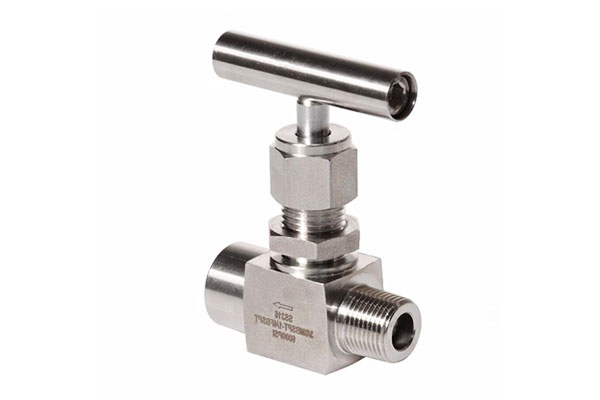
Precision is further enhanced by fine-pitch threads- tipies 10 na 20 threads per inch (TPI)—that convert rotational motion into micrometer-scale linear displacement.
This allows for stable, repeatable adjustments, often enabling changes as small as 0.01 liter per minuut (gpm).
Unlike isolation valves designed for binary open/close operation, the needle valve can maintain a steady-state flow across its full range of stem positions, making it ideal for metering, versmoor, and balancing duties.
2. Needle Valve Key Components
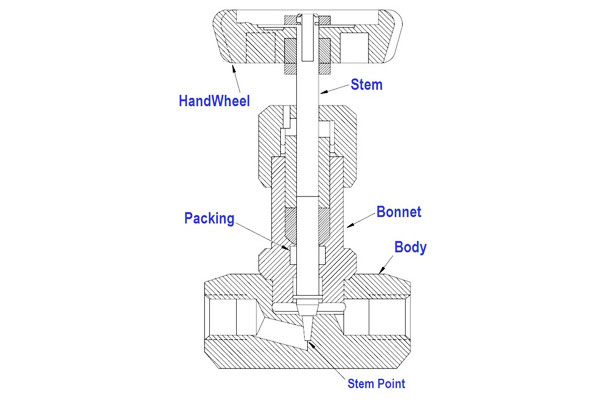
The precision and reliability of a needle valve result from the interaction of its core components, each manufactured to stringent dimensional tolerances and surface finish requirements.
Klep liggaam
The valve body forms the primary pressure boundary and houses the internal flow path. It must provide mechanical strength, chemiese verenigbaarheid, and dimensional stability over the full operating range.
- Materiaal: Algemene keuses sluit in brons, 304/316 vlekvrye staal, Inklok, en titaan.
- Material Selection Criteria:
-
- 316 vlekvrye staal — resists chloride-induced pitting and crevice corrosion in seawater and chemical process streams.
- Inklok — maintains mechanical integrity at temperatures exceeding 1000° C, suitable for hydrocarbon processing and aerospace applications.
- Titaan — exceptional strength-to-weight ratio and resistance to strong oxidizers.
- Configurations: Reguit deur, hoek, or block-and-bleed bodies are selected based on installation geometry and maintenance requirements.
Needle Stem
The stem is the key metering element, converting rotational input into controlled linear displacement.
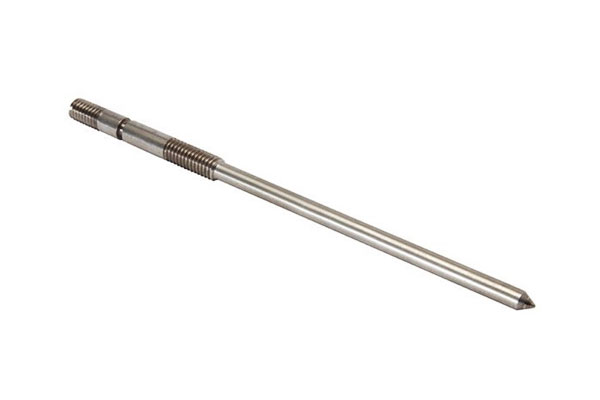
- Meetkunde: Lank, slender profile with a precision-ground tapered tip (cone angle 10°–30°) to mate exactly with the seat.
- Oppervlakafwerking: Laboratory-grade stems are often lapped to RA ≤ 0.025 μm, minimizing turbulence and enabling near-hermetic sealing.
- Drade: Fine-pitch threads (10–20 threads per inch) allow micrometer-scale movement per handwheel rotation, supporting adjustments as small as 0.01 gpm.
- Materiaal: Hardened stainless steel or alloy steel for wear resistance; bedekkings (Bv., Ptfe) may be applied to reduce friction and prevent galling in aggressive media.
Klepstoeltjie
The seat provides the sealing interface for the needle tip, directly influencing leakage class and durability.
- Materiaal: Verhard 316 vlekvrye staal, brons, of keramiek for exceptional wear resistance and chemical stability.
- Machining Precision: Taper angles are matched to the stem within ±0,001 mm, ensuring uniform contact pressure and minimizing leak paths.
- Ontwerpvariante: Replaceable seat inserts are used in high-cycle or abrasive service to extend operational life.
Packing Gland
The packing gland prevents process fluid from escaping along the stem while allowing smooth adjustment.
- Packing Materials:
-
- Ptfe — low friction, excellent chemical resistance, service temperatures up to 232° C.
- Grafiet — high-temperature resistance (op na 450° C), suitable for steam service.
- Braided stainless steel — extreme pressure sealing (>10,000 psi) in high-vibration environments.
- Live-Loaded Designs: Incorporate spring elements to maintain sealing force, compensating for packing wear and thermal expansion over time.
Handwheel or Actuator
The actuation method governs precision, herhaalbaarheid, and suitability for manual or automated systems.
- Handleiding: Ergonomic handwheels allow fine tactile feedback for field or laboratory adjustments.
- Automated: Pneumaties, elektries, or hydraulic actuators with position feedback can achieve control accuracy within ±0.5% of full scale.
- Locking Devices: Prevent unintentional adjustments in critical or vibration-prone installations.
Beëindig verbindings
Draaded draad (Npt, BSP), geflens, of gesweis (sok sweislas, stuiksweislas) to match system requirements. Instrument needle valves often use compression fittings (Bv., Swagelok) for leak-tight connections in high-purity applications.
3. How Needle Valves Work?
The needle valve operates on the principle of variable orifice control: rotating the handwheel advances or retracts the needle into the seat, altering the size of the gap between them.
This gap determines the flow rate, with smaller gaps restricting flow and larger gaps allowing more fluid to pass.
- Vloei -eienskappe: Needle valves exhibit linear flow behavior—flow rate increases proportionally with stem lift—making them predictable and easy to calibrate.
Byvoorbeeld, n 10% turn of the handwheel (which lifts the needle by 10% of its total travel) results in a roughly 10% increase in flow, a trait critical for applications like chemical dosing. - Drukval: Due to their restrictive design, needle valves create higher pressure drops than globe or ball valves, even when fully open.
A 1/4-inch needle valve, byvoorbeeld, has a pressure drop of 5 psi by 1 gpm of water, in vergelyking met 1 psi for a 1/4-inch ball valve. This intentional restriction is what enables fine control at low flows. - Shutoff Mechanism: When fully closed, the needle’s taper presses tightly against the seat, bereik Bubble-Tight Shutoff (leakage rates <0.1 cc/min for liquid service, <0.1 standard cubic centimeters per minute (sccm) for gases).
Soft-seated versions (with PTFE or Viton inserts in the seat) achieve even lower leakage (<0.01 cc/min), critical for high-purity systems.
4. Types of Needle Valves
Needle valves are produced in multiple configurations to address the diverse demands of process control, instrumentasie, and high-pressure fluid handling.
Their classification is commonly based on flow path geometry, stem tip design, aandryfmetode, pressure/temperature rating, en specialized functional adaptations.
By Flow Path Geometry
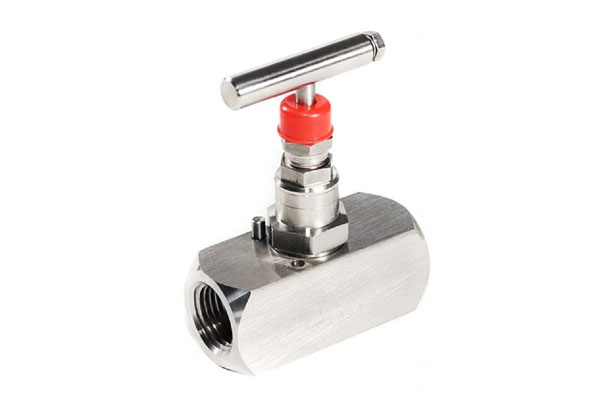
Straight-Through Needle Valves
- Opset: The inlet and outlet ports are in-line, creating a direct path for fluid when the valve is open.

Straight-Through Needle Valve - Voordele:
-
- Minimal turbulence and pressure drop due to absence of directional changes.
- Lower erosion risk in applications involving fine particulates.
- Tipiese toepassings:
-
- Fuel metering in aerospace systems.
- Laboratory test benches requiring stable baseline flow.
- Example Data: A stainless steel straight-through needle valve may achieve a Cv of 0.25 teen 5 turns open, supporting micro-flow control without significant head loss.
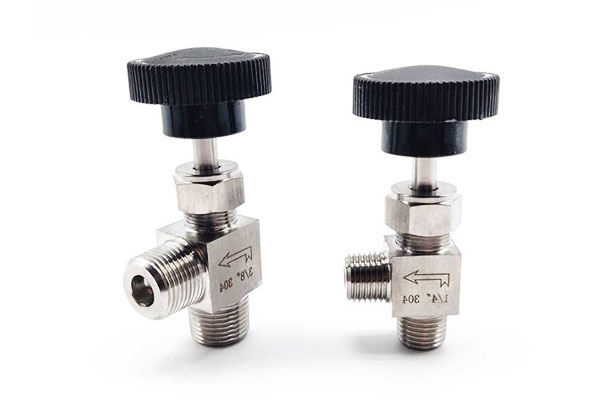
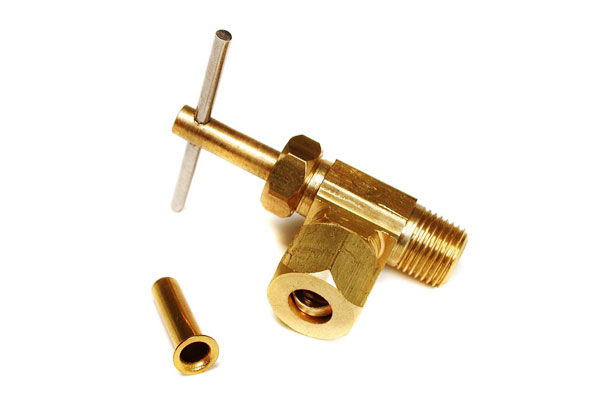
Angle Needle Valves
- Opset: Inlet and outlet ports are positioned at 90°, enabling both throttling and directional change.
Angle Needle Valve - Voordele:

-
- Eliminates the need for a separate elbow fitting, reducing leak points and installation space.
- Facilitates condensate drainage or sample extraction from vertical lines.
- Tipiese toepassings:
-
- Steam sampling lines in power plants.
- Draining and venting systems in chemical processing.
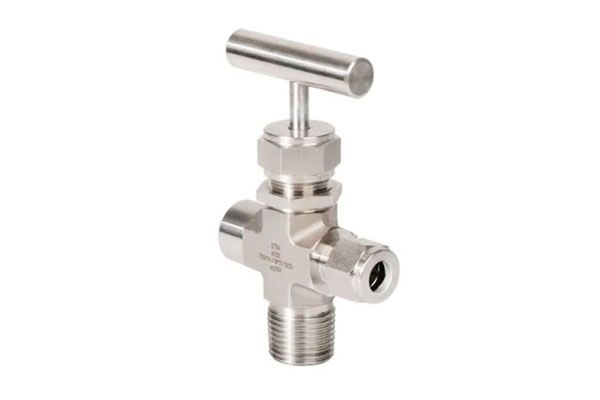
Cross-Pattern Needle Valves
- Opset: Four-port body that allows integration of multiple fluid paths.
Cross-Pattern Needle Valve Components - Voordele:
-
- Compact manifolding without external piping tees.
- Can function as a bypass or calibration connection point.
- Tipiese toepassings:
-
- High-precision calibration stations in metrology labs.
- Multi-stream analysis systems.
By Stem Tip Design
Conical Tip
- Beskrywing: The industry standard for precision throttling; the sharp taper provides progressive flow area change.
- Verrigting:
-
- Enables repeatable settings within ±1% of Cv.
- Ideal for both liquid and gas service in clean systems.
- Aansoeke:
-
- Instrumentation isolation and calibration.
- Dosing of specialty chemicals in research laboratories.
Ball Tip
- Beskrywing: A rounded tip contacts a matching seat, reducing seat wear over repeated cycles.
- Voordele:
-
- Better suited for frequent open/close operations.
- Less sensitive to minor seat misalignments.
- Aansoeke:
-
- Portable instrumentation kits.
- Field service sampling where rapid adjustments are required.
Soft-Seated Needle and Seat
- Beskrywing: Incorporates a PTFE, Pek, or elastomeric insert into the seat to achieve bubble-tight sealing.
- Verrigting:
-
- Leakage rate can meet ANSI/FCI 70-2 Klas VI (no visible leakage).
- Suitable for low-pressure gas service or high-purity chemical systems.
- Aansoeke:
-
- Oxygen and specialty gas distribution panels.
- Semiconductor process fluid lines.
By Actuation Method
Manual Needle Valves
- Operasie: Handwheel-driven, providing tactile feedback for incremental adjustments.
- Voordele:
-
- Eenvoudig, Koste-effektief, and maintenance-friendly.
- No external power source required.
- Aansoeke:
-
- Laboratory research rigs.
- Field calibration of pressure gauges.
Pneumatically Actuated Needle Valves
- Operasie: Air pressure drives stem movement; ideal for rapid, Afgeleë bediening.
- Verrigting:
-
- Typical actuation time <1 tweede.
- Repeatability within ±0.5% of full travel when used with a positioner.
- Aansoeke:
-
- Automated flow control in pilot plants.
- Remote hazardous-area adjustments without human exposure.
Electrically Actuated Needle Valves
- Operasie: Powered by stepper motors or servo actuators, often with closed-loop feedback.
- Verrigting:
-
- Positioning accuracy to ±0.25% of travel.
- Integration with PLC/DCS for process automation.
- Aansoeke:
-
- Semiconductor manufacturing requiring precise flow ramping.
- Fine control in pharmaceutical blending.
By Pressure and Service Rating
Standard Service Needle Valves
- Rating: Typically 3,000–6,000 psi (20–41 MPa).
- Aansoeke: General process control in oil & gas, waterbehandeling, en kragopwekking.
High-Pressure Needle Valves
- Rating: Op na 15,000 psi (103 MPA) of meer, depending on material and design.
- Kenmerke:
-
- Heavy-wall body construction.
- Dual ferrule connections for high-integrity sealing.
- Aansoeke:
-
- Hydraulic test rigs.
- Subsea oilfield equipment.
Cryogenic Needle Valves
- Temperatuurreeks: Down to −196°C for liquid nitrogen service.
- Ontwerpkenmerke:
-
- Extended bonnet to keep packing above frost line.
- Low-temperature-compatible materials such as austenitic stainless steel.
- Aansoeke:
-
- LNG transfer systems.
- Aerospace propellant handling.
High-Temperature Needle Valves
- Temperatuurreeks: Up to 650°C with graphite packing and metal-to-metal seating.
- Aansoeke:
-
- Steam superheater lines.
- Furnace atmosphere control.
Specialty Variants
- Manifold Needle Valves — Integrated into 2-, 3-, or 5-valve manifolds for pressure transmitters.
- Block-and-Bleed Needle Valves — Allow isolation and safe venting in instrumentation systems.
- Metering Needle Valves — Optimized for extremely fine flow adjustments, with Cv values as low as 0.0005.
5. Typical Applications of Needle Valve
Needle valves occupy a specialized niche in fluid control: situations where presiesheid, stabiliteit, en herhaalbaarheid matter more than maximum flow capacity.
Their fine-threaded stem and tapered tip allow operators to adjust flow rates in increments often too small to measure with conventional valves.
Instrumentation and Analytical Systems
- Rol: Regulate fluid supply to sensors, transmitters, and laboratory instruments.
- Voorbeelde: Calibrating pressure gauges, controlling carrier gas in gas chromatography (GC), stabilizing flow in mass spectrometers.
- Prestasie data: A 1/8-inch needle valve with Cv = 0.05 can maintain helium flow at 5–10 standard cubic centimeters per minute (sccm) in GC systems, ensuring stable baselines and reproducible results.
Sampling and Process Verification
- Rol: Extract representative process samples without contaminating or disturbing system conditions.
- Voorbeelde: Crude oil sampling from pipelines, batch verification in chemical plants.
- Sleutel kenmerk: Block-and-bleed needle valve assemblies isolate the sampling point and vent trapped fluid, preventing cross-contamination and ensuring operator safety.
Pressure Isolation and Surge Protection
- Rol: Protect sensitive instrumentation from sudden pressure spikes or enable safe maintenance isolation.
- Voorbeelde: Isolating differential pressure transmitters in refineries, shielding analyzers during high-pressure well testing.
- Prestasie data: In upstream oil operations, needle valves are routinely specified to handle surges exceeding 10,000 psi without deformation or leakage.
Precision Metering and Additive Injection
- Rol: Deliver exact volumes of fluids or gases into a process stream.
- Voorbeelde: Injecting corrosion inhibitors into offshore pipelines, dosing reagents in water treatment plants.
- Akkuraatheid: Manual or automated needle valves can maintain dosing accuracy within ±0.5% of setpoint, even under fluctuating upstream pressures.
High-Pressure and Harsh Environment Service
- Rol: Control flows under extreme pressure, temperatuur, or corrosive conditions.
- Voorbeelde: Hydraulic systems operating at 5,000–15,000 psi, subsea manifolds, wellhead choke systems.
- Material Advantage: 316 stainless steel offers superior corrosion resistance in seawater, while Inconel is preferred for hot, sour hydrocarbon service.
6. Prestasie-eienskappe & Limits
The performance of a needle valve is defined by its ability to deliver presies, stal, and repeatable flow control while withstanding the mechanical, termiese, and chemical stresses of its service environment. Key performance parameters include:
Controllability and Resolution
- Fine Adjustment Capability: The combination of a tapered stem and fine-pitch threads (typically 10–28 TPI) enables small changes in orifice area.
- Resolution: High-precision designs can adjust flow in increments as low as 0.01 liter per minuut (gpm) of 5 standard cubic centimeters per minute (sccm) for gases.
- Turn-to-Flow Ratio: A typical 3–5 turns from fully closed to fully open allows smooth modulation, avoiding sudden surges.
Lekprestasie
- Metal-to-Metal Seat: Suitable for high temperature and pressure, leakage typically meets Api 598 of ISO 5208 Rate E standaarde (bubble-tight is not always guaranteed).
- Soft Seat Designs: Using PTFE, Pek, or elastomers can achieve Bubble-Tight Shutoff for critical isolation, meeting ANSI/FCI 70-2 Klas VI lekkasie kriteria.
- Packing Integrity: With properly adjusted packing, stem leakage rates are often below 1×10⁻⁶ atm·cc/sec helium in instrumentation service.
Drukval en vloeikoëffisiënt (CV)
- Cv Range: Needle valves typically have Cv values from 0.0005 na 2.0, depending on size and port design.
- Drukval: The long, narrow flow path produces a relatively high pressure drop; teen 1.0 CV, water flowing at 10 gpm experiences an approximate drop of 1 psi under standard conditions.
- Flow Stability: Even at 90% oopmaak, the valve maintains laminar-like flow characteristics in micro-flow ranges.
Response Speed and Hysteresis
- Handmatige werking: Operator input results in proportional flow change without overshoot, provided rotation is deliberate.
- Outomatiese stelsels: Pneumatic/electric actuators with positioners can achieve ±0.5% repeatability with minimal hysteresis, critical in closed-loop control.
Pressure and Temperature Limits
- Drukgradering:
-
- Standard stainless steel needle valves: op na 6,000 psi (414 verbod)
- High-pressure designs: op na 20,000 psi (1,379 verbod)
- Temperatuurreeks:
-
- Metaal sitplek: −196°C to +565°C
- Soft seat: −40°C to +232°C (Ptfe) or up to +315°C (Pek)
Duursaamheid en slytasieweerstand
- Stem and Seat Hardness: Oppervlakverharding (Bv., nitriding) reduces wear from repeated adjustments.
- Korrosieweerstand: 316 stainless steel provides excellent chloride resistance, while Inconel or Hastelloy extend service in acidic or high-temperature conditions.
- Siklus lewe: High-quality needle valves often exceed 100,000 adjustment cycles without measurable leakage increase.
Application-Specific Constraints
- Not Ideal for High Flow Demand: Limited Cv makes them unsuitable for main process isolation or large flow transfer.
- Viscous Fluids: Thick liquids can impair fine control and cause clogging in small orifices.
- Particulate Contamination: In micro-orifice designs, upstream filtration (Bv., 5 μm) is recommended to prevent seat damage.
7. Voordele en beperkings
Advantages of Needle Valve
- Presisiebeheer: Unmatched ability to regulate micro-flows (0.001–5 gpm) with linear, predictable behavior.
- Stywe afsluiting: Leakage rates 10–100× lower than globe valves, critical for hazardous or high-purity fluids.
- Kompakte ontwerp: Smaller footprint than globe valves, ideal for crowded instrument panels or skids.
- Materiële veelsydigheid: Available in alloys resistant to corrosion, hoë temperature, en skuur.
Limitations of Needle Valve
- Low Flow Capacity: Cv values <2.0 make them unsuitable for high-flow systems (Bv., water verspreiding).
- High Pressure Drop: Even when fully open, pressure loss is 5–10× higher than ball or gate valves.
- Slow Actuation: Fine threading requires multiple handwheel turns to open/close, unsuitable for rapid cycling.
- Abrasion Sensitivity: Tapered needle and seat wear quickly in slurries or fluids with particulates >50 μm.
8. Toets, Inspeksie & Relevant Standards
- Hydrostatic Testing: Valves are pressure-tested at 1.5× their rated working pressure (Bv., 3,000 psi for a 2,000 psi valve) vir 60 seconds with no visible leakage.
- Lektoetsing: Conducted with air (for gases) or water (for liquids) to verify compliance with ANSI/FCI 70-2 lekkasieklasse.
- Dimensionele inspeksie: Critical features (needle taper, seat angle) are verified using coordinate measuring machines (CMM) to ensure ±0.001 mm tolerances.
- Relevant Standards:
-
- ASME B16.34: Governs pressure-temperature ratings for valve materials.
- API 6A: Specifies requirements for high-pressure valves in oil & gas applications.
- ISO 9001: Ensures quality management in manufacturing, critical for medical and aerospace use.
9. Vergelyking met ander kleppe
Needle valves are a specialized subset within the broader family of industrial valves.
Understanding how they compare with other valve types clarifies their unique role in fluid control systems and guides proper selection.
| Kenmerkend | Needle Valve | Globe klep | Balklep | Diafragma klep | Pinch Valve | Kontroleer klep |
| Flow Control Precision | Baie hoog (micro-flow control) | Gematig | Laag | Gematig | Laag | Geen |
| Tipiese toepassings | Instrumentasie, monsterneming, meting | Process throttling, general control | Aan/af-isolasie, quick shutoff | Sanitêre, korrosiewe vloeistowwe | Abrasive, mis hantering | Preventing backflow |
| Operasie spoed | Stadig (meervoudige draai) | Gematig (meervoudige draai) | Vas (kwarte draai) | Gematig | Gematig | Outomatiese (flow-driven) |
| Drukval | Hoog | Gematig | Laag | Gematig | Laag tot matig | Laag |
| Afsluitvermoë | Goed (metaal of sagte sitplek) | Goed | Uitmuntend (Bubble-Tight) | Uitmuntend (soft seal) | Goed (sleeve pinch seal) | N/A |
| Beste geskik vir | Precise flow modulation at low rates | Moderate flow control with throttling | Rapid open/close, full flow or isolation | Clean/contaminant-sensitive fluids | Druppels, abrasive or corrosive fluids | Flow direction assurance |
10. Konklusie
The needle valve may lack the brute strength of a gate valve or the speed of a ball valve, but its mastery of precision makes it irreplaceable in systems where micro-flow control dictates success.
From calibrating a lab instrument to stabilizing pressure in a deep-sea oil rig, its ability to balance tight shutoff, linear flow, and material versatility ensures it remains a cornerstone of fluid control engineering.
Hierdie: Precision Valve Casting Solutions for High-Demand Industries
Hierdie specializes in delivering high-precision valve casting solutions tailored to meet the stringent requirements of critical industrial applications.
Renowned for its commitment to reliability, Dimensionele akkuraatheid, and pressure integrity, Hierdie offers comprehensive services that span the entire manufacturing process—from raw castings to fully machined valve components and complete assemblies.
Our Valve Casting Expertise Servcies
Leveraging advanced casting technologies such as Beleggingsgooi with lost wax processes, Hierdie produces complex valve bodies and trims featuring intricate internal geometries and exceptional surface finishes.
For larger valve components like bodies, flense, en bonnets, Hierdie employs cost-efficient sand and shell mold casting methods, ideal for heavy-duty sectors including oil & gas- en kragopwekking.
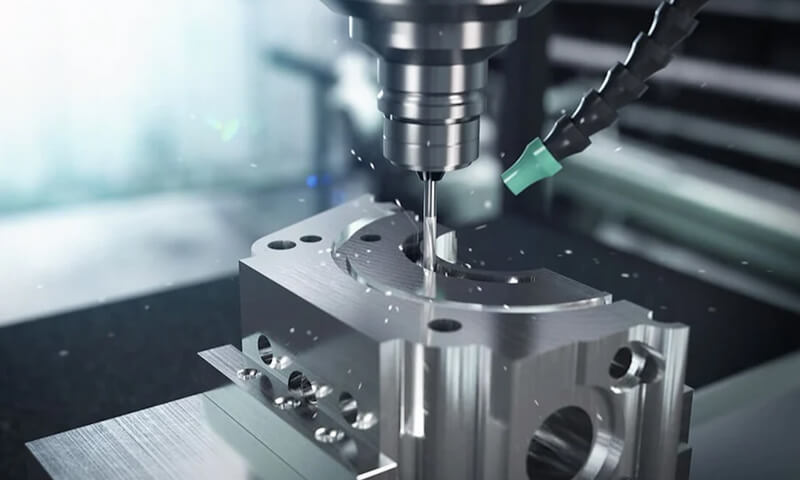
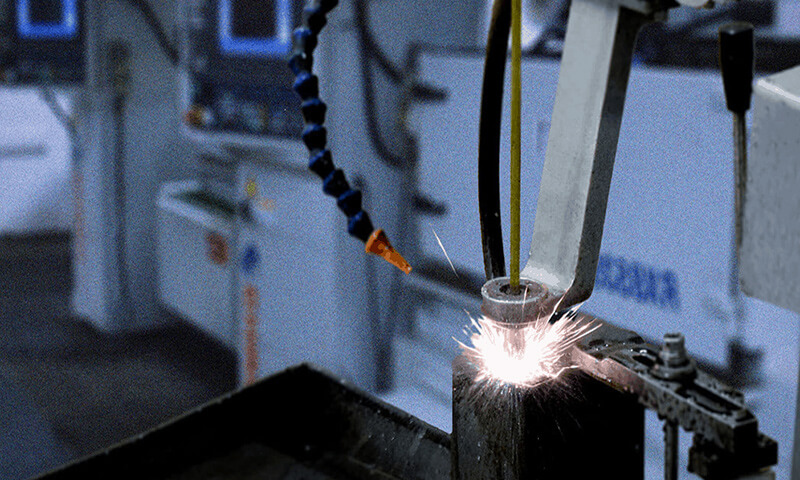
Presiesheid CNC -bewerking further enhances each casting by delivering tight tolerances on sealing surfaces, drade, and seats, ensuring optimal valve performance and leak-tight integrity.
Hierdie’s extensive material portfolio covers stainless steels (CF8, CF8M, CF3, CF3M), brons, smeebare yster, dupleks, and specialty high-alloy metals, enabling solutions that endure corrosive environments, extreme pressures, en verhoogde temperature.
From custom butterfly valves to globe, hek, needle, and check valves—whether prototypes or high-volume production—Hierdie is a trusted partner dedicated to precision engineering, duursaamheid, and uncompromising quality assurance.
Kontak ons nou!
Vrae
Can needle valves be used for throttling high-viscosity fluids (Bv., heavy oil)?
Ja, but select metal-seated valves with larger Cv values (0.5–2.0) to reduce clogging. Vermy sagte sitplekke, which can deform under viscous drag.
What is the difference between a needle valve and a globe valve?
Needle valves have a tapered needle and fine threads for micro-flow control; globe valves use a flat or curved disc and coarser threads, prioritizing higher flow rates over precision.
Are needle valves suitable for vacuum systems?
Ja, with metal-to-metal seats and PTFE packing, they maintain vacuum tightness (≤1×10⁻⁶ torr) for applications like semiconductor manufacturing.
What is the typical service life of a needle valve?
In skoon diens (Bv., laboratory water), 5– 10 jaar; in harsh service (Bv., suur gas), 1–3 years with quarterly maintenance.