

1. Bekendstelling
Modern manufacturing increasingly demands components with ingewikkelde meetkunde, stywe toleransies, liggewig strukture, and integrated functionality.
Nywerhede soos motor, lugvaart, elektronika, and telecommunications are shifting toward highly integrated parts that reduce assembly complexity and improve performance.
Among various manufacturing processes, aluminum die casting has emerged as one of the most efficient and reliable methods for producing such components.
Aluminium die casting involves injecting molten aluminum alloy into precision steel molds under high pressure, allowing manufacturers to produce parts with excellent dimensional accuracy, Gladde oppervlakafwerkings, and complex internal features.
The process is particularly suitable for high-volume production of geometrically complex components, including thin walls, ribbes, base, holtes, and intricate contours.
2. Fundamentals of Aluminum Die Casting for Complex Geometries
A clear understanding of the fundamental principles of aluminum Die rolverdeling is essential when producing components with complex geometries.
In the die casting process, molten aluminum alloy is injected into a precisely machined steel die at high pressure—typically ranging from 10 na 150 MPA—and at high filling velocities of 1–50 m/s.
The molten metal rapidly fills the cavity and solidifies under controlled cooling conditions to form the final part.
When manufacturing geometrically complex components, the process becomes significantly more demanding.
Factors such as mold configuration, metal flow behavior, termiese bestuur, and solidification dynamics must be carefully optimized.
Any imbalance in filling speed, pressure distribution, or cooling rate can lead to defects such as incomplete filling, air entrapment, krimp porositeit, or dimensional distortion.
Dus, successful die casting of complex parts requires precise integration of vormontwerp, alloy selection, and process parameter control.
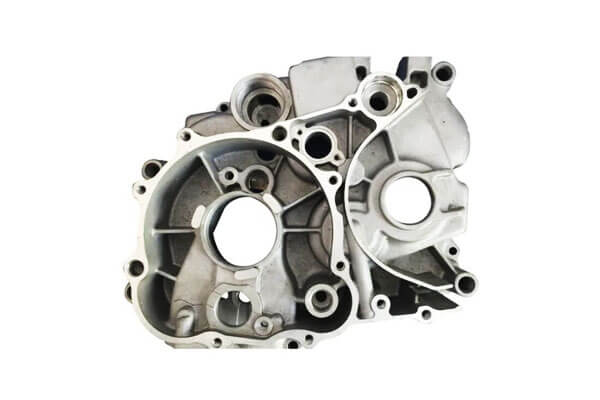
Defining Characteristics of Complex Aluminum Die-Cast Components
In aluminum die casting, a component is generally considered geometrically complex when its design incorporates structural features that challenge metal flow, solidification uniformity, or mold release.
These features typically include the following:
Dunwandige strukture
Many advanced die-cast components require wall thicknesses in the range of 0.5–1,5 mm.
Such thin sections demand extremely stable filling conditions. Insufficient filling velocity or pressure can cause defects such as misruns or cold shuts, while excessive turbulence may introduce porosity.
Deep Cavities and Narrow Channels
Components with high aspect ratios (depth-to-width ratios exceeding approximately 4:1) present additional challenges.
Molten metal must travel longer distances through confined passages, increasing the likelihood of air entrapment, onvolledige vulling, and localized thermal gradients. These features also accelerate wear in narrow mold areas.
Ondersny, Protrusions, and Internal Features
Designs containing undercuts or internal structures cannot be released from a conventional two-plate die.
They require additional mechanisms such as sliding cores, side actions, or lifters to allow proper part ejection while protecting delicate features.
Integrated Functional Elements
Modern die-cast components often incorporate multiple functions within a single part, insluitende base, ribbes, skroefdraadgate, verkoelingskanale, and mounting structures.
While this integration reduces secondary machining and assembly operations, it increases the complexity of the mold cavity and gating system.
Asymmetric or Irregular Geometry
Parts with non-uniform wall thicknesses or asymmetric cross-sections tend to solidify unevenly.
Differential cooling can lead to shrinkage defects, interne spanning, or dimensional distortion, requiring careful thermal management within the die.
Because these structural characteristics interact with metal flow and solidification behavior, manufacturing complex die-cast parts requires a comprehensive design strategy in which die layout, hekontwerp, alloy selection, and process parameters are optimized together.
Advantages of Aluminum Alloys in Complex Die Casting
Aluminum alloys are particularly well suited for producing complex die-cast components because their intrinsic physical and metallurgical properties align closely with the demands of high-speed, high-precision casting processes.
Relatively Low Melting Temperature
Most aluminum casting alloys melt between 580°C and 660°C, which is significantly lower than the melting temperatures of ferrous metals.
This lower processing temperature reduces thermal stress on molds, prolongs die life, and minimizes the risk of damage to delicate mold features such as thin cores or sliding inserts.
Uitstekende vloeibaarheid
Molten aluminum exhibits high fluidity, enabling it to flow rapidly into Dun dele, narrow channels, and detailed cavities before solidification occurs.
This property is essential for achieving full mold filling and accurate reproduction of complex geometrical features.
Hoë sterkte-tot-gewig-verhouding
Aluminum components are typically 30–50% lighter than comparable steel parts while still providing adequate mechanical strength for structural applications.
This makes aluminum die casting particularly valuable in industries where weight reduction improves efficiency, soos motor, lugvaart, en elektronika.
Good Surface Finish and Machinability
Die-cast aluminum parts generally achieve surface roughness values in the range of Ra 1,6–6,3 μm, which allows many components to be used with minimal post-processing.
When additional machining is required, aluminum alloys are relatively easy to machine, enabling tight dimensional tolerances.
Natuurlike korrosieweerstand
Aluminum naturally forms a stable oxide layer on its surface, providing inherent resistance to corrosion in many environments.
Legeringselemente soos magnesium (Mg) en sink (Zn) can further enhance corrosion performance and mechanical properties.
For complex die-cast applications, several aluminum alloys are widely used, insluitende ADC12, A380, en A360.
These alloys belong primarily to the Al-Si-Cu of Al–Si–Mg systems and are selected according to performance requirements such as strength, selfpiriteit, gietbaarheid, en korrosieweerstand.
3. Key Challenges in Aluminum Die Casting for Complex Geometries
Although aluminum alloys offer excellent properties for high-precision die casting, the production of components with complex geometries introduces a series of technical challenges.
These challenges arise from the interaction of mold design, process dynamics, and material behavior.
Addressing them systematically is essential to maintain product quality, produktiwiteit, en koste-effektiwiteit.

Mold Design and Tooling Challenges
The die is the central element of the casting process, and its design largely dictates the manufacturability of complex aluminum parts. Key challenges include:
Undercuts and Core Mechanisms
Complex features such as undercuts, internal threads, and cavities often cannot be ejected with a standard two-plate die.
This necessitates specialized mechanisms such as skyfies, lifters, collapsible cores, or rotating inserts.
These additions increase mold complexity, koste bereken, and potential failure points.
Precise synchronization of these moving elements is critical to prevent damage to delicate features during ejection.
Filling Uniformity and Venting
Parts with narrow channels, diep holtes, or asymmetrical shapes are prone to uneven filling and air entrapment.
Poor venting can result in porosity, krimpholtes, of koue sluitings.
Designing vents that effectively release trapped air—often in hard-to-reach areas—is particularly challenging for intricate geometries.
Cooling and Thermal Management
Non-uniform cross-sections create uneven cooling rates, where thick regions solidify more slowly than thin sections.
Uneven thermal dissipation can lead to shrinkage, dimensionele vervorming, or extended cycle times.
Routing cooling channels to achieve uniform heat extraction across complex features—without interfering with slides, kerne, or inserts—requires careful engineering.
Mold Wear and Longevity
Intricate molds with thin cores, Skerp rande, or moving elements are highly susceptible to wear and thermal stress from repeated high-pressure injection of molten aluminum.
Wear in critical areas can cause dimensional deviations, oppervlak defekte, and premature mold failure, increasing both downtime and production costs.
Process Control Challenges
Even with an optimized mold, the die casting process for complex geometries demands precise control. Minor deviations in process parameters can generate significant defects.
Filling Velocity and Pressure Control
Maintaining the correct metal flow rate and pressure is essential to ensure complete filling of thin walls, narrow channels, and intricate cavities.
Insufficient velocity can cause underfills or cold shuts, while excessive velocity increases turbulence, air entrapment, and mold erosion.
Advanced process control, insluitende variable-speed pumps, may be required to dynamically adjust filling for regions with varying wall thickness.
Solidification Management
Uniform solidification is critical to prevent shrinkage, porositeit, and distortion.
Uneven wall thickness complicates this, as thick sections cool slowly, leading to shrinkage cavities, while thin sections may solidify too quickly, risking cracks or brittleness.
Achieving consistent cooling requires careful management of mold temperature, coolant flow, en siklus tyd, tailored to part geometry.
Porosity and Defect Formation
Complex geometries are more susceptible to porositeit, caused by trapped air, incomplete venting, or non-uniform solidification.
Both macro- and micro-porosity reduce mechanical strength, moegheid lewe, en korrosieweerstand, particularly in critical aerospace or automotive applications.
Detecting defects in deep cavities or fine features is inherently difficult.
Material-Related Challenges
The properties of the selected aluminum alloy play a decisive role in the castability of complex parts. Key considerations include:
Fluidity vs. Strength Trade-Off
High-fluidity alloys (Bv., ADC12) can fill intricate features effectively but may have lower mechanical strength.
High-strength alloys (Bv., A356) provide superior structural performance but have reduced flowability, making them difficult to cast into thin walls or narrow channels.
Selecting an alloy that balances fluidity with required mechanical properties is essential for success.
Oxide Inclusion Control
Aluminum forms oksied films (Al₂o₃) rapidly during melting and handling.
These inclusions can become trapped in narrow cavities or intricate sections, causing surface defects and compromising part performance.
Effective melt handling, insluitende ontgassing, filtrasie, and careful pouring, is critical to minimize oxide-related defects.
Alloy Segregation
Non-uniform cooling can cause segregation of alloying elements (Bv., CU, En) in different regions of the casting.
This leads to variations in local mechanical properties, increasing the risk of defects such as hot tears, krake, or brittleness, particularly in thin-walled or highly intricate features.
4. Advanced Solutions for Overcoming Challenges in Aluminum Die Casting of Complex Geometries
Addressing the technical challenges inherent to aluminum die casting of complex geometries requires a multi-faceted approach that integrates innovative mold design, precise process control, material optimization, and rigorous post-casting quality assurance.
These advanced solutions enable manufacturers to produce intricate aluminum components at scale while maintaining high quality, doeltreffendheid, en koste-effektiwiteit.
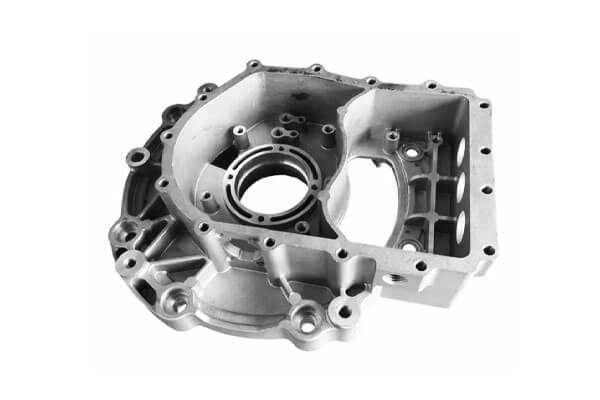
Innovative Mold Design and Tooling
Recent advances in mold design and tooling have significantly expanded the manufacturability of complex aluminum geometries:
3D-Printed Mold Inserts
Bykomende vervaardiging (Is) tegnieke, soos Selektiewe lasersmelting (SLM), allow production of mold inserts with intricate internal features, insluitende conformal cooling channels that closely follow part geometry.
These channels ensure uniform heat extraction, reducing cooling times by 20–40% and minimizing dimensional distortion.
Byvoorbeeld, a thin-walled automotive component with complex cavities can see cooling time reduced from 15 seconds to 8 sekondes, while dimensional accuracy improves by 15–20%.
Multi-Axis Slides and Collapsible Cores
Gevorderd multi-axis slide mechanisms en collapsible cores facilitate the ejection of parts with deep undercuts or internal features.
Segmented or shape-memory alloy cores can retract from internal cavities after solidification, eliminating the need for overly complex slide systems.
This allows production of parts with curved or recessed channels that would be impossible using conventional tooling.
High-Precision Mold Machining
CNC machining and Electrical Discharge Machining (EDM) enable the creation of molds with sub-micron precision, accurately reproducing fine ribs, narrow channels, and delicate details.
EDM is particularly effective for hard steel molds with complex shapes, producing sharp features without tool wear.
Advanced Mold Coatings
Coatings such as Titanium nitride (Tin) of Diamantagtige koolstof (DLC) Verminder wrywing, improve filling efficiency, enhance heat transfer, and prolong mold life.
DLC-bedekkings, byvoorbeeld, can decrease mold wear by 30–50% for parts with intricate undercuts, reducing maintenance costs and increasing productivity.
Advanced Process Control and Simulation
Optimizing process parameters is essential for ensuring defect-free production of complex geometries:
Die Casting Simulation Software
Tools like Prostekort, MAGMAsoft, and Flow-3D gebruik CFD and FEA to simulate metal flow, stoling, en verkoeling.
These simulations allow engineers to identify potential defects (Bv., porositeit, koue sluitings, krimping) before mold fabrication.
For complex components, simulations help optimize gate and vent placement, ensuring uniform filling and minimizing air entrapment.
Real-Time Process Monitoring
Sensors integrated into molds and die casting machines provide continuous data on temperature, druk, and flow velocity.
This enables dynamic adjustments to maintain consistent filling and cooling. Real-time monitoring can reduce defect rates for complex parts by 25–30%.
Automated Process Control Systems
Outomatisasie, insluitende robotiese giet, inline inspection, and automated mold cleaning, minimizes human error and ensures consistent process control.
Robotic pouring systems, byvoorbeeld, precisely regulate flow rates to fill thin-walled or intricate features uniformly.
Material Innovations and Melt Quality Control
Optimizing alloy composition and melt quality enhances castability for complex parts:
High-Fluidity, High-Strength Alloys
Allooie soos A383 and ADC14 balance fluidity and strength, making them ideal for intricate geometries.
Silikon, koper, and magnesium contents are optimized to improve flowability while maintaining tensile strength.
A383, byvoorbeeld, bied 15% higher fluidity than ADC12 while sustaining tensile strength of 240 MPA.
Melt Degassing and Filtering
Rotary degassing with inert gases (argon of stikstof) removes dissolved hydrogen, reducing porosity.
Keramiek skuimfilters (CFF) with high filtration efficiency (≥95%) remove oxide inclusions, ensuring clean molten metal reaches all cavities.
A 30-pore CFF, byvoorbeeld, can reduce oxide inclusions by 80%, improving surface finish and mechanical properties.
Graanverfyning
Adding grain refiners such as titanium-boron (Ti-B) reduces grain size, improving flow, Meganiese eienskappe, and resistance to shrinkage defects.
Grain refinement is especially beneficial for thin-walled sections, promoting uniform solidification and reducing the risk of cracks.
Post-Casting Processing and Quality Assurance
Ensuring the integrity of complex die-cast components requires advanced inspection and finishing methods:
Nie-vernietigende toetsing (Ndt)
Tegnieke soos X-ray CT scanning, Ultrasoniese toetsing (UT), en magnetiese deeltjietoetsing (MT) detect internal and surface defects.
CT scanning provides 3D imaging of complex parts, revealing hidden porosity, insluitings, or dimensional deviations.
Selfs a 0.1 mm pore in an internal cavity can be identified before the part proceeds to finishing.
Precision Machining and Surface Finishing
5-axis CNC machining corrects minor dimensional variations in complex features, such as threads or holes, en verbeter oppervlakafwerking.
Post-casting treatments like anodizing or powder coating enhance corrosion resistance and aesthetic quality, ensuring suitability for high-end applications.
Defect Repair Technologies
High-precision repair techniques, insluitende laser sweiswerk en wrywing roer sweiswerk, address minor defects without compromising part integrity.
Laser welding is particularly effective for thin-walled parts, providing localized heat input and minimal distortion.
5. Industrial Applications of Aluminum Die Casting for Complex Geometries
The capability to produce complex aluminum die-cast components has significantly broadened the scope of applications across industries where liggewig, hoë-presisie, and cost-effective parts is noodsaaklik.
By enabling intricate internal features, Dun mure, and integrated assemblies, complex die casting drives innovation, prestasie optimalisering, en vervaardigingsdoeltreffendheid.
Motorbedryf
The automotive sector is the largest consumer of aluminum die-cast components, leveraging complex geometries to reduce weight and enhance performance:
Enjinkomponente
Advanced engine blocks, silinderkoppe, and intake manifolds incorporate integrated coolant channels, oil passages, and mounting points.
These intricate internal features optimize fluid flow and heat transfer while maintaining structural integrity.
Modern die-cast engine blocks can include oor 50 geïntegreerde kenmerke, produced in a single casting operation, minimizing post-processing and assembly complexity.
Transmission and Chassis Components
Components such as transmission cases, differential housings, and suspension parts utilize Dun mure, ondersny, and integrated brackets.
These designs reduce weight to improve fuel efficiency without compromising strength or vibration resistance.
Byvoorbeeld, a die-cast aluminum suspension knuckle with a complex, asymmetric design can achieve a 30% gewigsvermindering compared to a steel counterpart, while retaining necessary durability.
Electric Vehicle Components
Battery -omhulsels, motorhuise, and inverter casings are increasingly produced using aluminum die casting, incorporating multi-cavity structures and integrated cooling channels to manage thermal loads and maintain structural integrity.
Complex designs allow precise accommodation of battery cells and wiring, verbeter energy efficiency and system compactness.
Lugvaartbedryf
In lugvaart, aluminum die casting enables liggewig, high-strength components with intricate geometries, meeting rigorous safety and performance standards:
Aerostructures
Hakies, toebehore, and housings for wings, rompe, and landing gear feature Dun mure, diep holtes, and undercuts, with tolerances often as tight as ±0.005 inches.
Byvoorbeeld, a die-cast aluminum wing bracket with a complex curved geometry can reduce weight by 25% compared to a machined steel equivalent, enhancing fuel efficiency and payload capacity.
Enjinkomponente
Critical parts such as compressor housings, turbine casings, and fuel system components integrate internal cooling channels and complex internal features.
High-strength aluminum alloys combined with precise die casting ensure these components withstand elevated temperatures and pressures.
A multi-stage die-cast compressor housing, byvoorbeeld, can improve airflow efficiency while reducing both weight and production costs.
Verbruikerselektronika
The consumer electronics industry benefits from die-cast aluminum components for liggewig, duursaam, and aesthetically refined products:
Device Enclosures
Skootrekenaar, tablet, and smartphone enclosures often require Dun mure, integrated ports, and heat management features.
Complex die casting ensures dimensional precision and smooth surfaces, enabling sleek designs.
Byvoorbeeld, a laptop chassis produced with die casting achieves seamless integration, gewigsvermindering, and improved thermal performance.
Hittebakke
Advanced electronics heat sinks utilize intricate fin geometries achievable only through precision die casting.
Dun, closely spaced fins (0.5–1,0 mm) maximize heat dissipation, improving component longevity.
Die-cast heat sinks can achieve 30% higher thermal efficiency than traditional extruded designs.
Mediese toestelle
Medical applications leverage aluminum die casting for Biocompatibele, hoë-presisie-komponente:
Chirurgiese instrumente
Forceps, retractors, and other surgical tools require intricate jaws, skarniere, and ergonomic handles.
Aluminum alloys like A360 provide korrosieweerstand, light weight, en strukturele betroubaarheid, improving surgeon comfort and instrument performance.
Medical Equipment Housings
Diagnostic equipment such as ultrasound machines and MRI scanners benefit from complex housings with integrated cable channels, mounting points, en verkoelingstelsels.
Precision die casting ensures tight tolerances and clean surface finishes, facilitating portability and durability.
Byvoorbeeld, a die-cast ultrasound housing with multi-cavity design reduces weight while maintaining mechanical integrity and thermal management.
7. Konklusie
Aluminum die casting for complex geometries represents a highly sophisticated manufacturing process that demands the integration of advanced mold design, precise process control, innovative material selection, en streng kwaliteitsversekering.
The production of intricate components poses inherent challenges, including mold design complexity, process variability, uneven solidification, and metallurgical inconsistencies.
Nietemin, modern technological advancements—such as 3D-printed mold inserts, conformal cooling channels, die casting simulation software, and intelligent process monitoring systems—have significantly mitigated these obstacles, enabling the reliable production of high-quality complex parts.
Vrae
What is the maximum complexity achievable in aluminum die-cast parts?
Complexity is governed by mold design, alloy fluidity, en prosesbeheer, but modern techniques enable the production of components with thin walls (0.5–1,5 mm), diep holtes (aspect ratios up to 6:1), intricate undercuts, and integrated features such as threads, ribbes, en gate.
Aerospace internal cooling channels and automotive multi-cavity battery enclosures are examples of routinely produced high-complexity parts.
Can complex aluminum die-cast parts be heat-treated?
Ja. Allooie soos ADC12 and A380 can undergo T6 or similar heat treatments, which homogenize the microstructure, enhance mechanical properties, and mitigate variations caused by uneven cooling in complex geometries.
What is the cost impact of producing complex die-cast parts?
Wyle initial costs for molds—particularly with slides or 3D-printed inserts—are higher, per-part production costs decrease in high-volume runs, as integrated features reduce post-casting machining and assembly.
Low-volume production remains relatively costly, but advanced technologies are steadily reducing this barrier.

