
Case Analysis
| Project | 310S Stainless Steel Investment Casting Burner Cap |
| Reference project | High-temperature industrial burner component |
| Project scope | Precision investment casting of a complex 310S stainless steel burner cap, including wax pattern development, ceramic shell casting, 310S melting and pouring, tepelné spracovanie, povrchová úprava, rozmerová kontrola, and optional NDT. |
| Materiál | AISI 310S / V 1.4845 austenitická nehrdzavejúca oceľ — selected for its excellent oxidation resistance, tepelná stabilita, and suitability for prolonged high-temperature service. |
| Manufacturing process | Wax injection + silica-sol investment casting + budova z keramického plášťa + odparafínovanie + 310S precision melting + controlled pouring + knockout + cut-off/grinding + heat treatment where specified + povrchová úprava + rozmerová kontrola + NDT where required. |
| Operating environment | High-temperature oxidizing atmosphere, with service temperatures potentially approaching 1,050° C, subject to the actual burner design and operating conditions. |
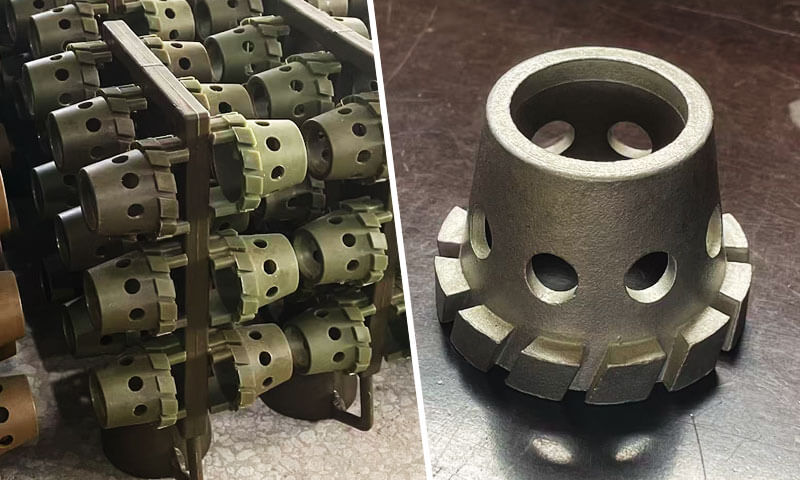
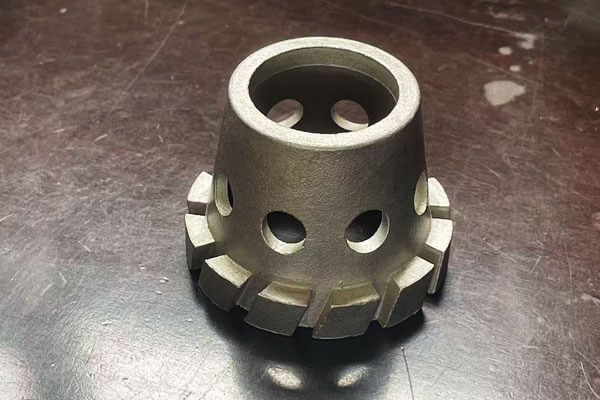
| Key casting features | Tapered hollow body, internal cavity, multiple gas/air holes, upper annular rim, and circumferential serrated flame-stabilizing teeth. |
| Primary engineering challenge | Achieving reliable filling, controlled solidification, accurate hole geometry, stable circularity, and internal soundness while preserving the high-temperature properties of 310S. |
1. Project Overview
This case study documents a real‑world custom silica‑sol odlievanie investícií project for a 310S stainless steel burner cap, a core consumable component for industrial gas combustion equipment.
The workpiece features a tapered hollow main body, multiple uniformly distributed premix air holes around the cylinder wall, and circumferential serrated flame‑stabilizing teeth at the bottom.
Manufactured by lost‑wax investment casting and followed by CNC finishing, the part is designed for continuous service under high‑temperature oxidation environment up to 1050 ° C.
Faced with metallurgical drawbacks of 310S heat‑resistant stainless steel and complex part geometry, our foundry overcame multiple trial‑production obstacles and delivered stable mass‑production components that fully satisfied end‑use combustion performance.
This article summarizes project background, technical difficulties, customized countermeasures, quality control workflow and final project outcomes.
2. Project Background
Industrial burner caps are critical hardware determining combustion stability, thermal efficiency and service lifespan of furnaces, heat‑treatment lines and commercial heating systems.
Household burner caps are mostly manufactured by sheet‑metal stamping, yet heavy‑duty industrial operating conditions demand cast structures with higher wall strength and superior high‑temperature durability.
The end‑user’s original imported burner cap suffered frequent premature failure: thermal cracking and surface spalling occurred after short‑cycle high‑temperature operation.
The customer decided to localize the spare‑part supply chain and selected 310S (V 1.4845 / AISI 310S) austenitic heat‑resistant stainless steel for its excellent high‑temperature oxidation resistance and creep resistance.
Napriek tomu, 310S is notoriously difficult for precision investment casting. It has a broad solidification temperature range, high melt viscosity, and high susceptibility to hot tearing, micro‑shrinkage porosity and oxide slag inclusions.
Combined with abrupt wall‑thickness transitions, small‑diameter premix holes and thin serrated teeth of the burner cap, conventional casting parameters cannot achieve qualified mass output, which created urgent technical demands for our professional investment‑casting engineering team.
3. Client Requirements
The industrial equipment customer put forward multi‑dimensional technical, dimensional and performance requirements for this custom burner cap:
- Material Specification: Strict chemical composition for 310S stainless steel; Cr 24.0‑26.0 %, Ni 19.0‑22.0 %, with limited trace impurity elements.
Metallographic structure shall be homogeneous austenite after solution annealing heat treatment. - Rozmerový & Geometric Tolerance: Casting dimensional tolerance complies with ISO 8062 CT‑5 standard. Inner premix hole positions, aperture sizes and bottom serrated‑tooth profiles must maintain consistency, to guarantee predictable fuel‑air premixing effect.
Key mounting interfaces reserve allowance for subsequent CNC machining. - Internal Quality: Zero hot cracks and penetrating micro‑cracks; shrinkage porosity and micro‑voids shall not affect mechanical strength and high‑temperature performance.
Acceptance standard passes magnetic particle testing (MT) and ultrasonic testing (Ut). No harmful slag inclusions inside casting sections. - Kvalita povrchu: Smooth as‑cast surface, no sticky sand, pitting or cold laps. Surface roughness Ra ≤ 6.3 μm before shot blasting.
- Service Performance: Long‑term stable operation under cyclic temperature up to 1050 ° C; no thermal cracking, deformation or severe oxidation spalling during normal working cycles.
- Commercial Target: Achieve stable mass production with competitive yield, to support continuous spare‑part supply for customer’s combustion‑equipment after‑sales system.
4. Výziev
During prototype trial production, our engineering team identified interlocked material‑related and geometry‑driven challenges:
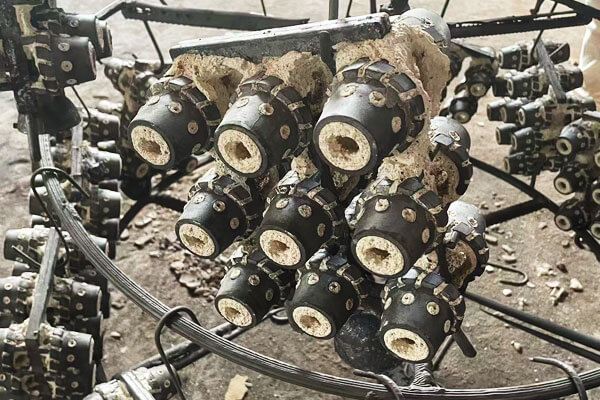
High Hot-Tearing Risk at Thick-to-Thin Wall Transitions
The most critical metallurgical challenge was the risk of hot tearing during the final stage of solidification.
The burner cap contains a relatively heavy mounting section that connects to a much thinner tapered body, followed by delicate serrated flame-stabilizing teeth.
This abrupt variation in section thickness produces substantial differences in local cooling rate and solidification time.
310S stainless steel further increases the risk because of its relatively broad solidification range. Thin sections can become rigid while adjacent heavy sections remain partially liquid or semi-solid.
As the remaining liquid metal contracts and the surrounding material continues to shrink, localized tensile stress can develop in regions where the partially solidified structure has limited ability to deform or receive additional liquid metal.
The most dangerous cracks are not necessarily large visible defects.
Micro hot tears can form along interdendritic regions or at geometric transition zones and remain difficult to identify through conventional visual inspection.
Under repeated heating and cooling, these discontinuities can act as stress concentrators and gradually propagate.
Difficult Feeding and Gas Management Around Small Premix-Air Holes
The array of premix-air holes introduced a second major challenge.
These holes are functional combustion features rather than decorative geometry.
Their diameter, pozíciu, kruhovitosť, and consistency directly influence the distribution of combustion air around the burner cap.
From a casting perspective, však, small holes create restricted flow paths and localized thermal gradients.
During filling, the molten 310S must reproduce relatively fine ceramic features while maintaining sufficient fluidity.
Počas tuhnutia, these areas have limited access to feeding metal and can become vulnerable to localized shrinkage.
V rovnakom čase, any residual gas or turbulent flow generated during mold filling can become trapped around internal hole surfaces.
Thin Serrated Teeth and Premature Solidification
The circumferential serrated teeth at the bottom of the burner cap presented another geometry-specific challenge.
These thin projections must be completely filled and maintain a consistent profile while remaining mechanically robust during high-temperature service.
Because their thermal mass is considerably lower than that of the main body, they cool and solidify rapidly.
This creates two competing requirements.
Na jednej strane, the molten metal must retain adequate fluidity long enough to reproduce the thin tooth geometry.
Na druhej strane, excessive superheat or prolonged exposure to high-temperature molten metal can increase oxidation and ceramic-shell interaction.
The teeth also experience a different contraction history from the surrounding body.
If the solidified teeth become mechanically constrained by still-solidifying sections, residual stresses can accumulate around the tooth roots.
Oxide Inclusions and Metal–Shell Reactions
The quality of the ceramic shell becomes especially important when casting heat-resistant stainless steels such as 310S.
At elevated melting and pouring temperatures, molten stainless steel can interact with refractory materials and atmospheric oxygen.
Poorly controlled shell chemistry, inadequate firing, nadmerná teplota nalievania, or turbulent metal flow may increase the risk of surface reactions and non-metallic inclusions.
Typical concerns included:
- Oxidové inklúzie
- Refractory contamination
- Ceramic reaction products
- Sticky sand
- Povrchové jamky
- Hrubá alebo nepravidelná odlievacia koža
- Entrapped oxide films
These defects have a dual impact.
Z výrobného hľadiska, they reduce casting yield and increase finishing requirements.
From a service perspective, surface discontinuities can become preferential sites for oxidation and crack initiation during repeated exposure to high temperature.
For a component operating near 1050 ° C, a seemingly minor surface defect can become significantly more important after prolonged thermal exposure.
The challenge was therefore to maintain metal cleanliness and ceramic-shell stability simultaneously, rather than treating surface quality as a purely cosmetic requirement.
Dimensional Stability of a Complex Investment Casting
The burner cap requires a high degree of dimensional consistency despite its relatively complex geometry.
Investment casting can reproduce fine details very effectively, but the final metal component is influenced by dimensional changes at multiple stages:
wax injection → wax cooling → shell building → shell firing → metal solidification → heat treatment → machining.
A small deviation in the wax pattern can be transferred into the ceramic shell.
Shell deformation during drying or firing can further amplify the deviation, while non-uniform metal shrinkage can introduce another layer of dimensional change.
The challenge was therefore not simply to achieve dimensional accuracy on one prototype.
The real objective was to establish a repeatable dimensional-control system capable of maintaining consistency throughout serial production.
Ceramic Shell Cracking and Gas Permeability Balance
The shell itself presented a delicate engineering compromise.
The ceramic mold had to be strong enough to withstand:
- Wax removal
- Vysokoteplotné vypaľovanie
- Manipulácia
- Molten-metal impact
- Metallostatic pressure
V rovnakom čase, it needed sufficient permeability to allow gases to escape during pouring.
An excessively dense shell may provide good surface reproduction but restrict gas evacuation.
A shell with insufficient strength or poor interlayer bonding can crack during firing or pouring, resulting in metal penetration, rozmerové chyby, or catastrophic casting failure.
The complex burner-cap geometry made this balance more demanding because narrow features and internal contours create areas where drying, firing and metal filling conditions may differ from those of the main body.
Molten-Metal Cleanliness and Pouring Stability
Another challenge was maintaining stable molten-metal quality from furnace to mold.
For precision 310S investment casting, chemical composition alone does not guarantee casting quality. The molten steel must also have appropriate:
- Teplota
- Tekutosť
- Gas content
- Inclusion level
- Deoxidation condition
- Pouring stability
Insufficient deoxidation can increase oxide formation, while excessive or poorly controlled deoxidation may introduce undesirable reaction products.
Podobne, an excessively high pouring temperature may improve filling but increase metal-shell reaction and oxidation.
The process therefore required a controlled operating window in which plynulosť, cleanliness and ceramic-shell compatibility were balanced simultaneously.
This was especially important for the thin premix holes and serrated teeth, where unstable metal flow could immediately translate into incomplete filling or entrapped inclusions.
5. Our Solution
Ako a professional silica sol investment casting foundry, we did not attempt to solve the burner-cap defects through a single adjustment to pouring temperature or alloy chemistry.
The key was to establish a geometry-specific and metallurgy-driven process window for 310S stainless steel.
For this project, we treated the burner cap as a complete casting system: wax pattern → ceramic shell → gating and feeding → melting → pouring → solidification → heat treatment → CNC finishing → inspection.
Each stage was optimized against a specific failure mode identified during prototype trials.
The following measures were implemented during process development.
Gating and Feeding Redesign to Eliminate Hot Tearing
The first major improvement was a complete redesign of the gating and feeding system.
The initial trial used a relatively conventional feeding arrangement.
CT/section analysis of rejected samples showed that the highest defect concentration occurred around the thick-to-thin transition between the mounting boss and tapered body, with additional risk around the roots of the serrated teeth.
We therefore redesigned the casting to establish a more predictable directional solidification sequence.
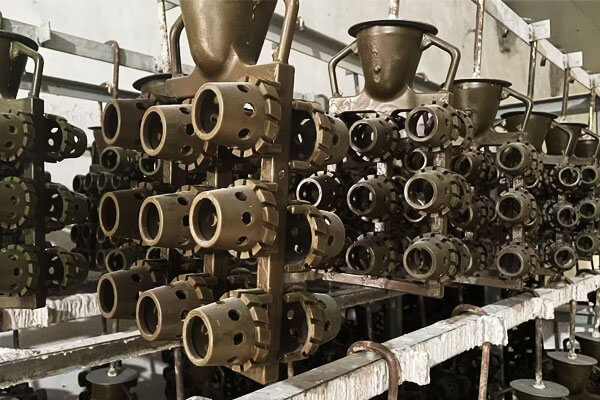
The basic strategy was:
Thin functional sections → main tapered body → thick mounting boss → feeding source
The heavy mounting boss was deliberately maintained as one of the last-solidifying regions so that it could continue to supply liquid metal to adjacent sections during volumetric contraction.
We also introduced localized feeding at critical thermal nodes rather than simply increasing the total riser volume.
During process trials, we compared several gating configurations and monitored the defect distribution after sectioning.
The optimized design significantly reduced isolated shrinkage indications and eliminated the recurring hot-tear pattern observed in the early trials.
For this specific component, the important lesson was that more riser metal was not the solution; the solidification sequence had to be redesigned first.
Controlling the Serrated Teeth Through Filling and Thermal Balance
The thin serrated teeth were treated as a separate casting problem.
Because these features have a much higher surface-area-to-volume ratio than the main body, they lose heat rapidly and can freeze before the rest of the casting has completed filling.
Our solution combined three controls:
- Short and stable metal-flow paths
- Optimized shell preheating
- Controlled pouring superheat
Instead of simply increasing the pouring temperature to force metal into the teeth, we optimized the relationship between metal temperature and shell temperature.
The working pouring range was controlled at approximately 1580–1620 °C, while shell preheating and firing conditions were stabilized before pouring.
This provided sufficient fluidity for the thin teeth without unnecessarily increasing metal temperature and ceramic-shell reaction.
We also modified the local gating direction so that the metal reached the thin features with less turbulence and less opportunity for premature freezing.
The result was a substantial improvement in complete filling of the serrated profile while avoiding the common trade-off between thin-section filling and excessive oxidation.
Dedicated Control of Premix-Air Holes
The premix holes were one of the most important functional features of the burner cap.
We therefore established a dedicated control route rather than treating the holes as ordinary investment-cast geometry.
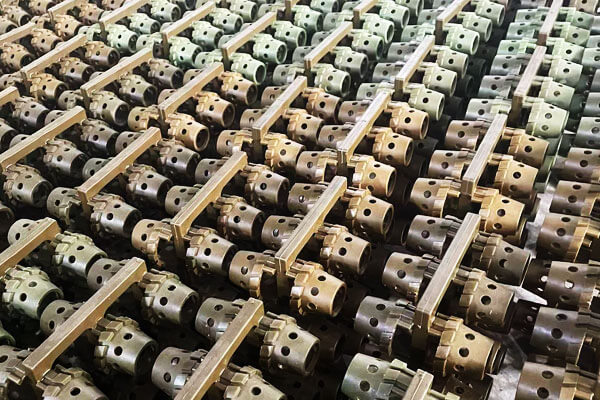
The process focused on four parameters:
- Priemer otvoru
- Hole position
- Circumferential spacing
- Internal surface integrity
At the wax stage, 100% inspection was performed on the hole-forming features. Any wax pattern with damaged cores, deformation or blocked passages was rejected before assembly.
At the casting stage, filling behavior was improved through controlled metal flow and vacuum assistance.
The objective was to minimize turbulence and trapped gas around the small-diameter passages.
For critical hole dimensions, a cast-to-machine strategy was adopted: investment casting provided the near-net geometry, while CNC machining was used to establish the final functional dimensions where tighter tolerances were required.
This approach avoided excessive machining while providing much better consistency than relying exclusively on as-cast hole dimensions.
Silica Sol Shell Optimization for 310S
For this project, ceramic-shell quality was directly connected to casting quality.
We developed a high-purity silica sol shell system with a fine zircon-based face coat specifically suited to the surface requirements of the 310S burner cap.
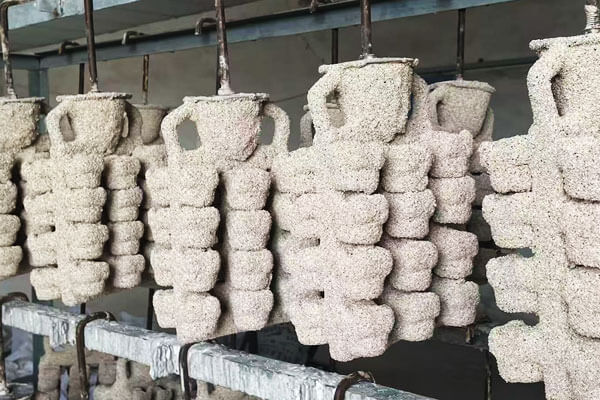
The shell process was optimized in three areas:
Face Coat
A high-purity refractory face coat was used to minimize direct chemical interaction between molten 310S and the ceramic mold.
This helped reduce:
- Sticky sand
- Ceramic reaction
- Povrchové jamky
- Refractory inclusions
- Loss of fine tooth geometry
Backup Layers
The backup layers were adjusted to balance shell strength and gas permeability.
This was particularly important because a shell that is too dense may restrict gas evacuation, while insufficient permeability can increase gas-related defects around the premix holes.
Drying and Firing
Each shell layer was dried under controlled temperature and humidity conditions.
Completed shells were then fired at approximately 1180–1220 °C to remove residual wax, moisture and organic materials and to stabilize the refractory structure.
Rejected shells were not allowed to proceed to pouring if inspection identified cracking, incomplete drying, weak interlayer bonding, or abnormal surface conditions.
Molten 310S Cleanliness Control
For 310S, we recognized that chemical composition is only one part of molten-metal quality.
The actual casting performance also depends on oxide level, rozpustené plyny, temperature stability and inclusion control.
Our melting procedure therefore included:
- Controlled charge-material selection
- Medium-frequency induction melting
- Heat-by-heat spectrometer analysis
- Controlled deoxidation
- Argon-assisted degassing
- Temperature verification immediately before pouring
Argon treatment was typically maintained for approximately 3– 5 minút under controlled conditions.
The purpose was to reduce dissolved gas and promote the separation of non-metallic inclusions before the metal entered the ceramic shell.
The chemical composition was verified before pouring to ensure that the melt remained within the specified 310S chemistry, including the customer’s required chromium and nickel ranges.
This combination of kontrola chémie + kontrola inklúzie + regulácia teploty was essential for improving internal casting integrity.
Vacuum-Assisted Pouring for Better Internal Soundness
The burner cap’s small holes and thin sections made turbulence and gas entrapment particularly undesirable.
We therefore introduced vacuum-assisted investment casting to improve mold filling and reduce the amount of air remaining in the cavity during pouring.
The process was optimized around a controlled sequence:
shell preparation → vacuum establishment → stable metal introduction → controlled filling → solidification under stable conditions
Pouring speed was deliberately controlled rather than maximized.
Excessive turbulence can create oxide films that become trapped inside the casting, while an excessively slow filling rate can cause premature freezing in thin features.
The objective was therefore to maintain a stable metal front with sufficient filling velocity.
This approach was particularly effective for the premix-hole region and thin serrated teeth, where filling quality has a direct relationship with the functional performance of the burner cap.
Controlling Dimensional Variation from Wax to Finished Casting
The dimensional problem was addressed as a process-chain issue rather than a final-inspection issue.
We established control points at every major dimensional transformation:
Wax pattern → shell → fired mold → casting → heat treatment → CNC component
For the wax pattern, critical dimensions were checked before tree assembly.
For the ceramic shell, drying and firing conditions were stabilized to minimize deformation.
On the metal casting, shrinkage allowances and machining stock were incorporated into the tooling and casting design.
Po tepelnom spracovaní, critical mounting dimensions and functional surfaces were CNC machined and inspected.
For the production burner cap, applicable casting dimensions were controlled toward the customer’s ISO 8062 CT5 requirement, while tighter functional dimensions were established through CNC machining where necessary.
This approach significantly reduced batch-to-batch dimensional variation.
6. Technical Highlights
| Technical Focus | Our Technical Solution | Key Process Data / Vyplývať |
| 310S Metallurgy Control | Developed the casting process around the specific solidification and metallurgical behavior of 310S rather than applying a generic stainless-steel casting recipe. | Controlled chemistry for each melt; argon degassing for approximately 3– 5 min; pouring window controlled at 1580–1620 °C. |
| Geometry-Specific Gating & Kŕmenie | Redesigned gating and risering around the thermal mass distribution; positioned feeding capacity at critical thick-to-thin transitions and promoted directional solidification. | Solidification sequence optimized from thin sections toward the heavier feeding region. |
| Thin Serrated Teeth Filling | Vyvážený metal temperature + shell temperature + gating geometry + filling speed to maintain sufficient fluidity without excessive superheat. | Pouring controlled within approximately 1580–1620 °C. |
| Premix-Air Hole Quality | Controlled hole-forming features at the wax stage, optimized metal flow, applied vacuum-assisted filling, and used CNC calibration for critical dimensions. | 100% wax-pattern inspection; critical hole geometry verified after casting/CNC. |
| Silica Sol Ceramic Shell | Used a high-purity silica sol shell with zircon-based face coat and optimized backup-layer permeability and strength. | Shell firing approximately 1180–1220 °C. |
Shell Gas Permeability |
Adjusted refractory particle distribution and layer structure to balance permeability with mechanical strength. | Controlled slurry, layer thickness, sušiace prostredie, and firing conditions. |
| Molten-Metal Cleanliness | Combined controlled deoxidation, argon-assisted degassing, verified charge materials, and heat-by-heat chemical analysis. | Argon treatment approximately 3– 5 min; spectrometer verification for each melt. |
| Vacuum-Assisted Pouring | Applied vacuum-assisted filling with controlled pouring speed to maintain a stable metal front. | Filling parameters optimized for thin-wall and miniature features. |
| Smerová tuhosť | Coordinated riser location, gate design, hrúbka sekcie, and thermal conditions to control the solidification path. | Feeding concentrated at selected thermal nodes. |
| Žíhanie riešenia | Developed an application-specific solution-annealing process for the investment-cast microstructure. | Metallographic verification of the post-treatment structure. |
Near-Net-Shape Manufacturing |
Used investment casting for complex profiles and CNC machining only for functional interfaces. | CNC applied to threads, páriace sa tváre, reference surfaces, and selected critical holes. |
| Rozmerová stabilita | Established dimensional control from wax tooling through casting, tepelné spracovanie, and CNC finishing. | Applicable casting dimensions controlled to ISO 8062 CT5; wax-pattern shrinkage targeted within approximately ±0.3%. |
| Nedeštruktívne testovanie | Implemented MT for surface/near-surface cracks and UT for internal discontinuities, supported by metallographic sampling. | No detectable hot-tearing defects under the specified MT/UT inspection regime. |
| Process-Based Quality Control | Established quality gates from wax pattern, škrupina, melting and pouring through heat treatment, Ndt, and CNC inspection. | 100% wax-pattern inspection plus batch and heat-level process verification. |
| Production Stability | Integrated metallurgy, hradlovanie, shell technology, taviace sa, nalievanie, tepelné spracovanie, obrábanie, and inspection into one standardized process. | Casting yield improved from approximately 87% do 99.2%. |
| High-Temperature Service Performance | Combined sound casting structure, optimalizované tepelné spracovanie, controlled geometry, and high-quality surface condition. | Stable cyclic testing up to approximately 1050 ° C without unacceptable cracking, deformácia, or severe oxidation spalling. |
7. Production and Quality Control
Strict multi‑stage quality‑control gates run through the whole production flow:
- Wax Pattern QC: 100 % visual inspection for surface flaws; key dimension measurement with coordinate‑measuring calipers. Non‑conforming wax patterns are scrapped directly.
- Shell‑Making QC: Monitor workshop temperature and humidity for every shell batch; inspect shell thickness, surface integrity and firing effect before pouring. Cracked or incompletely fired shells are rejected.
- Melting Raw‑Material & Composition QC: Incoming raw material inspection; spectrometer composition test for every molten‑steel batch to guarantee 310S chemical‑composition compliance.
- Post‑Pouring In‑Process QC: After shake‑out and shot blasting, visual screening for surface defects is performed.
Representative samples from each batch are selected for section inspection to check internal shrinkage or porosity. - Nedeštruktívne testovanie: Batch‑wise magnetic particle testing (MT) detects surface and near‑surface micro‑cracks; ultrazvukové testovanie (Ut) checks internal volume for harmful shrinkage cavities and inclusions.
- Heat‑Treatment Verification: Random sampling for metallographic analysis confirms homogeneous austenitic microstructure after solution annealing.
- Final Dimensional Inspection: CNC‑finished parts are measured for critical assembly dimensions and premix‑hole geometry to match customer drawing requirements. Only castings passing all QC items are released for delivery.
8. Project Results
After multiple rounds of prototype validation and process optimization, the 310S stainless steel burner cap project was successfully transferred from trial production to stable serial manufacturing.
The final results demonstrated that the optimized silica sol investment casting process could simultaneously satisfy the component’s demanding requirements for casting integrity, rozmerová konzistencia, kvalita povrchu, metallurgical stability, and high-temperature combustion performance.
Ešte dôležitejšie, the project results were measured not only by inspection data, but also by the component’s performance in its actual industrial application.
Significant Improvement in Casting Yield
The initial prototype stage achieved a casting yield of approximately 87%. The main losses were associated with hot-tearing indications, localized shrinkage, thin-feature filling, and surface-related defects.
Following optimization of the gating and feeding system, ceramic shell process, molten-metal treatment, podmienky nalievania, and wax-pattern control, the production yield increased to approximately 99.2%.
This improvement demonstrated that the process had moved beyond prototype-level feasibility and achieved the stability required for serial production.
| Production Indicator | Initial Trial | Optimized Production |
| Casting Yield | ~87% | 99.2% |
| Applicable Casting Tolerance | Unstable | ISO 8062 CT5 |
| Drsnosť povrchu | Variabilné | RA ≤ 6.3 μm before final finishing |
| Hot-Tearing Risk | Recurrent | No detectable cracks under specified MT/UT inspection |
| Mikroštruktúra | Variabilné | Homogeneous austenitic structure verified |
Successful Replacement of the Imported Component
From the customer’s perspective, one of the most important results was successful localization of the previously imported burner cap.
The finished 310S investment castings provided comparable functional performance while offering significant supply-chain advantages:
- Shorter procurement lead time
- More responsive spare-part production
- Reduced dependence on overseas suppliers
- Lower procurement and logistics costs
- Improved production planning
- Stable repeat-order capability
The project therefore delivered value beyond casting quality. It helped the customer establish a more reliable local supply chain for critical combustion-system spare parts.
Overall Project Outcome
The project successfully transformed a difficult 310S stainless steel investment casting from an unstable prototype into a high-yield industrial component.
The key achievements can be summarized as follows:
The broader significance of the project lies in demonstrating that 310S heat-resistant stainless steel can be reliably investment cast into complex, thin-wall burner components when the entire process is engineered around the alloy’s solidification behavior and the component’s actual service conditions.
For this burner cap, casting quality was ultimately inseparable from combustion performance.
The improvement in solidification control protected structural integrity; improved shell quality protected surface condition; cleaner molten metal improved internal soundness; precise geometry supported air-fuel distribution; and controlled heat treatment improved thermal-cycle resistance.
Inými slovami, the project succeeded because the manufacturing process was designed not merely to produce a qualified casting, but to produce a reliable high-temperature combustion component.
9. Why This Solution Worked
The success of this burner‑cap casting project originates from combining deep understanding of 310S metallurgical properties, full consideration of part geometric weaknesses, and systematic process iteration rather than single‑parameter adjustment.
Po prvé, we did not simply copy general‑purpose investment‑casting parameters.
We fully recognized 310S’s wide solidification range, high‑melt‑viscosity and hot‑crack tendency, and targeted these material‑inherent risks at gating‑riser design, melting and pouring phases.
Po druhé, we treated the burner cap’s structural features — uneven wall thickness, small premix holes and delicate serrated teeth — as core input for process design.
Every optimization step responds to specific geometry‑caused failure modes, instead of applying one‑size‑fits‑all casting recipes.
Po tretie, quality control is implemented across the whole manufacturing chain, starting from wax‑pattern upstream procedures. Potential defects are intercepted early, instead of only inspecting finished castings.
Fourth, post‑casting heat‑treatment and CNC finishing are regarded as indispensable links for final component performance.
Proper solution annealing unlocks 310S heat‑resistant potential, while precision machining guarantees assembly and combustion‑function requirements.
This project proves that for complex heat‑resistant stainless‑steel custom castings, qualified deliverables rely on integrated thinking of material metallurgy, casting‑process design, geometry‑adapted gating layout and full‑link quality assurance, rather than isolated parameter tweaks.

